Level:
Correct: 0
Incorrect: 0
Marks: 0/0
Exam Practice
Subject:
Topics:
AQA GCSE History (Conflict and tension in Asia 1950-1975) Smart practice A mixed round aimed at your weak spots
Unit 1
Part one: Conflict in Korea
Unit 2
Part two: Escalation of conflict in Vietnam
Unit 3
Part three: The ending of conflict in Vietnam
Avg
score:
–
Topics
done:
0/9

Johnson's War

Practise 44 exam-style questions on Johnson's War for AQA GCSE History (Conflict and tension in Asia 1950-1975). Write your answer as you would in the exam and get it marked in seconds against the mark scheme, point by point, with an AI tutor on hand if you get stuck.

  • 44 questions
  • 1–20 marks each
  • Instant marking
  • No sign-up needed
20 questions, marked as you go

Sample questions with model answers

Here are 4 of the questions in this topic, each with a model answer, an explanation of why it earns the marks and the mark scheme an examiner would use.

Question 1

2 marks

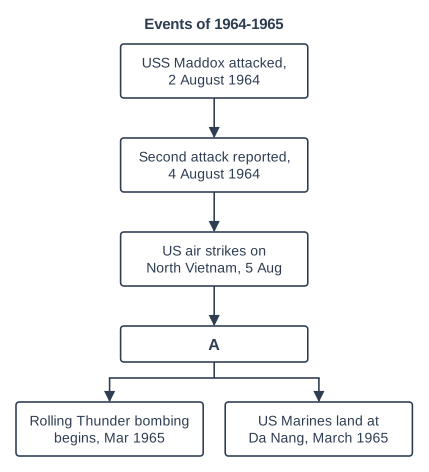
Figure 1 is a flow chart of events in 1964 and 1965.

Name the event that should replace A, and give one power that it gave President Johnson.

Events of 1964-1965. Flow chart of 6 boxes joined by arrows, read from top to bottom. The first box is "USS Maddox attacked, 2 August 1964", which leads to "Second attack reported, 4 August 1964", which leads to "US air strikes on North Vietnam, 5 Aug", which leads to box A. From box A, 2 arrows branch out side by side: the left arrow leads to "Rolling Thunder bombing begins, Mar 1965"; the right arrow leads to "US Marines land at Da Nang, March 1965".

Model answer

A is the Gulf of Tonkin Resolution, passed by Congress on 7 August 1964. It gave Johnson the power to take 'all necessary measures' to repel attacks on US forces and to prevent further aggression, without Congress having to declare war.

Explanation

The resolution passed by 416 votes to 0 in the House of Representatives and 88 to 2 in the Senate. It was so broadly worded that Johnson used it to start Operation Rolling Thunder and to send combat troops in March 1965 without ever asking Congress for a declaration of war.

Mark scheme
  1. 1 mark

    The Gulf of Tonkin Resolution (passed by Congress on 7 August 1964).

    Accept 'Tonkin Gulf Resolution' or 'Congress passed a resolution giving Johnson war powers'. Do not accept 'Congress declared war' - there was never a declaration of war.

  2. 1 mark

    One power: to take 'all necessary measures' to repel any armed attack against US forces / to prevent further aggression / to use armed force to help South Vietnam (or any member of the South East Asia Treaty Organisation) that asked for help / to fight a war or send combat troops without a declaration of war by Congress.

    Any one of these (max 1).

Question 2

4 marks

Source A: from a report by Walter Cronkite, the presenter of the CBS Evening News, broadcast on 27 February 1968 after he had visited Vietnam during the Tet Offensive.
'To say that we are closer to victory today is to believe, in the face of the evidence, the optimists who have been wrong in the past. To suggest we are on the edge of defeat is to yield to unreasonable pessimism. To say that we are mired in stalemate seems the only realistic, yet unsatisfactory, conclusion.'

Source A criticises the claims the US government was making about the progress of the war. How do you know?

Explain your answer by referring to Source A and your contextual knowledge.

Model answer

Source A criticises the government's claims because Cronkite says that to believe the USA is 'closer to victory' is to believe 'the optimists who have been wrong in the past'. This is aimed at the government and military leaders: in November 1967 General Westmoreland had told Americans that the end of the war was coming into view, and the daily briefings in Saigon kept announcing high enemy body counts as proof of progress. Cronkite concludes instead that the war is 'mired in stalemate'. This reflects the shock of the Tet Offensive, which began on 30-31 January 1968, when the communists attacked more than 100 towns and cities, got inside the grounds of the US Embassy in Saigon and held Hue for almost a month. Although Tet was a military defeat for the communists, it showed that the enemy was far from beaten, exposing the credibility gap. The provenance makes the criticism even stronger: Cronkite was the most trusted newsreader in America, he had visited Vietnam himself during Tet, and he was speaking to millions of viewers. Johnson reportedly said that if he had lost Cronkite, he had lost middle America.

Explanation

Level 2 needs you to explain Cronkite's words using knowledge of what the government had claimed (Westmoreland in November 1967, body counts) and why Tet undermined those claims, and/or to explain why it mattered that America's most trusted newsreader said this after visiting Vietnam.

Mark scheme
  1. 4 marks

    Levels of response (4 marks).
    Level 2 (3-4 marks): Developed analysis of Source A: explains how the content (e.g. rejecting the view that the USA was 'closer to victory', calling those who said so 'optimists who have been wrong in the past', and concluding that the war was 'mired in stalemate') and/or the provenance (America's most trusted newsreader, speaking on national television after visiting Vietnam during Tet) criticise official claims, supported by relevant contextual knowledge (e.g. Westmoreland's claims of progress in November 1967, the body count, the shock of the Tet Offensive, the credibility gap).
    Level 1 (1-2 marks): Simple analysis of Source A: identifies a relevant feature, e.g. 'he says the war is a stalemate', with little or no supporting knowledge.
    0 marks: nothing worthy of credit.

    Indicative content (not a checklist; credit other valid points): Cronkite rejects the claim that the USA was 'closer to victory' - in November 1967 General Westmoreland had told Americans that the end was coming into view; 'optimists who have been wrong in the past' refers to official claims of progress, such as body counts announced at the daily Saigon briefings (the 'Five O'Clock Follies') - the credibility gap; 'mired in stalemate' contradicts the government's message - the Tet Offensive (from 30-31 January 1968), with attacks on more than 100 towns and cities, the US Embassy in Saigon and the month-long battle for Hue, showed the enemy was far from beaten, even though it was a military defeat for the communists; provenance - Cronkite was the most trusted newsreader in America and had been seen as neutral, so his judgement carried great weight; he spoke after visiting Vietnam himself during Tet, so he could claim first-hand knowledge; broadcast to millions of viewers on national television; Johnson reportedly said that if he had lost Cronkite he had lost middle America; a month later (31 March 1968) Johnson announced a partial bombing halt and that he would not seek re-election.

Question 3

12 marks

Source B: from a television address to the American people by President Johnson, late on the night of 4 August 1964.
'As President and Commander in Chief, it is my duty to the American people to report that renewed hostile actions against United States ships on the high seas in the Gulf of Tonkin have today required me to order the military forces of the United States to take action in reply... We still seek no wider war.'

Source C: from a message sent to his superiors by Captain John Herrick, the commander of the US destroyers in the Gulf of Tonkin, a few hours after the second attack was reported on 4 August 1964. It was not made public at the time.
'Review of action makes many reported contacts and torpedoes fired appear doubtful. Freak weather effects on radar and overeager sonarmen may have accounted for much... Suggest complete evaluation before any further action taken.'

How useful are Sources B and C to an historian studying the Gulf of Tonkin incident?

Explain your answer using Sources B and C and your contextual knowledge.

Model answer

Source B is useful for showing how President Johnson presented the Gulf of Tonkin incident to the American people. He describes 'renewed hostile actions' against US ships 'on the high seas', making North Vietnam look like the aggressor and the USA the innocent victim, and announces that he has ordered retaliation. The provenance explains why: this was a public television address given within hours of the reported attack, and Johnson wanted to win support for the air strikes and for the resolution he was about to send to Congress. It was also three months before the 1964 presidential election, so the phrase 'We still seek no wider war' was meant to make him look firm but not reckless compared with his opponent, Barry Goldwater. However, Source B is less useful for what actually happened, because it leaves out important context. The Maddox was on an intelligence-gathering patrol close to the coast, where US-backed South Vietnamese commandos had recently raided North Vietnamese targets, so North Vietnam saw the destroyers as part of an attack on it.

Source C is useful in a different way, because it shows the doubts that existed at the time. Captain Herrick, the commander on the spot, says that many of the reported contacts and torpedoes 'appear doubtful' and blames 'freak weather effects' and 'overeager sonarmen'. Its provenance makes it valuable: it was a private military message, written within hours by an eyewitness who had no reason to play down an attack on his own ships, and it was not intended for the public. It shows that the government had reason to doubt the second attack when Johnson spoke. However, it was written in confusion after a night action and does not prove there was no attack; Herrick's later messages still suggested that an ambush had probably taken place at the start of the action.

Together the sources are very useful because they contrast public certainty with private doubt. Within three days Congress passed the Gulf of Tonkin Resolution by 416 votes to 0 and 88 to 2, giving Johnson the power to take 'all necessary measures'. The doubts in Source C only became public in Senate hearings in 1968, and a National Security Agency study released in 2005 concluded that no attack happened on 4 August. So, used together, B and C show an historian not just what happened but how an uncertain incident was used to give the President wide powers to escalate the war.

Explanation

Source B shows how Johnson presented the incident in public; Source C shows the private doubts at the time. Level 4 needs a judgement on both sources that uses content AND provenance (who wrote it, when, why and for whom), tested against knowledge such as the Maddox's mission, the resolution and the later evidence that the 4 August attack did not happen.

Mark scheme
  1. 12 marks

    Levels of response (12 marks).
    Level 4 (10-12 marks): Complex evaluation of both sources with sustained judgement based on content and provenance: explains how useful each source is for studying the Gulf of Tonkin incident (e.g. Source B for how Johnson presented the incident in public to justify retaliation and win support; Source C for the private doubts about whether the second attack happened), uses accurate contextual knowledge to test them (e.g. the Maddox's intelligence mission and the South Vietnamese raids, the Gulf of Tonkin Resolution, later evidence that the 4 August attack did not happen), and reaches a substantiated judgement about their usefulness, possibly showing that they are most useful when used together.
    Level 3 (7-9 marks): Developed evaluation of both sources based on content and/or provenance, supported by relevant contextual knowledge.
    Level 2 (4-6 marks): Simple evaluation of one or both sources based on content and/or provenance, e.g. Source B is useful because it is by the President; Source C is useful because the captain was there.
    Level 1 (1-3 marks): Basic analysis of one or both sources: describes or paraphrases the content, or makes general comments about bias or reliability, with little or no knowledge.
    0 marks: nothing worthy of credit.

    Indicative content (not a checklist; credit other valid points): Source B content - presents the incident as 'renewed hostile actions' on the 'high seas', i.e. unprovoked North Vietnamese aggression, and announces US retaliation (air strikes on North Vietnamese naval bases on 5 August) while claiming to 'seek no wider war'; Source B provenance - a public television address by the President, meant to reassure Americans and win support for retaliation and for the resolution he sent to Congress; given three months before the November 1964 election, when Johnson wanted to look firm but moderate compared with Barry Goldwater; useful for how the government presented and used the incident, less useful for what actually happened; Source B leaves out that the Maddox was on an intelligence-gathering patrol close to where US-backed South Vietnamese commando raids had just attacked the North Vietnamese coast; Source C content - the commander on the spot doubted the second attack, blaming weather effects on radar and 'overeager sonarmen', and urged evaluation 'before any further action' - yet Johnson ordered retaliation the same day; Source C provenance - a private, immediate military message from an eyewitness with no reason to play down an attack on his own ships; not meant for the public, so good evidence of doubts the government knew about; limitation - written in confusion hours after a night action, it does not prove there was no attack, and Herrick's later messages suggested that an ambush had probably taken place at the start of the action; context - Congress passed the Gulf of Tonkin Resolution on 7 August (416-0 and 88-2), allowing 'all necessary measures'; the doubts became public in Senate Foreign Relations Committee hearings in 1968, and a National Security Agency study released in 2005 concluded that no attack took place on 4 August; judgement - together very useful: B shows the public certainty used to justify escalation and C the private doubt, revealing how an uncertain incident was used to win wide war powers.

Question 4

20 marks

'Operation Rolling Thunder was a failure.'

How far do you agree with this statement?

Explain your answer.

[16 marks] [SPaG 4 marks]

Model answer

Operation Rolling Thunder was the sustained bombing of North Vietnam from 2 March 1965 to 1 November 1968. Its aims were to destroy North Vietnam's industry and transport, cut the flow of supplies to the Vietcong, raise South Vietnamese morale and force Hanoi to negotiate. Judged against these aims, I largely agree that it was a failure, although it did cause great damage and some argue it could have worked without Johnson's restrictions.

Rolling Thunder did achieve some things. More than 600,000 tons of bombs were dropped, destroying bridges, railways, power stations, factories and much of North Vietnam's fuel storage. North Vietnam had to divert hundreds of thousands of people to repairing roads and manning air defences, which may have slowed the movement of supplies. The bombing also gave a short boost to South Vietnamese morale in 1965, when the South seemed close to collapse. Some American commanders argued that the bombing only failed because it was too restricted: Johnson kept away from central Hanoi, the port of Haiphong and the Chinese border, and paused the bombing several times, for example for 37 days over Christmas 1965.

However, the bombing failed to achieve its main aims. North Vietnam was mainly an agricultural country with little industry, and it moved what it had into the countryside. Roads and bridges were repaired almost overnight, and men and supplies kept flowing down the Ho Chi Minh Trail through Laos and Cambodia; the number of North Vietnamese troops going south actually increased. The USSR and China replaced what was destroyed, sending surface-to-air missiles, MiG fighters, weapons and food, and Chinese troops helped with repairs and air defence. So the bombing did not stop the Vietcong being supplied.

The bombing also failed to break North Vietnam's will or force it to negotiate. Instead, it united the population against a foreign attacker and gave Hanoi a propaganda weapon, especially when US pilots were shot down and captured. Hanoi refused to talk while the bombing continued. The Tet Offensive of January 1968 proved that, after three years of bombing, the North and the Vietcong could still launch attacks on more than 100 towns and cities at once.

Rolling Thunder also had costly side effects for the USA. Hundreds of aircraft were lost, and tens of thousands of North Vietnamese civilians were killed, which brought international criticism and fuelled protest at home. By 1967 Robert McNamara, the Secretary of Defense who had planned the escalation, privately told Johnson that the bombing was not working. In the end, Johnson had to limit the bombing on 31 March 1968 and stop it completely on 1 November 1968 in order to get peace talks started - the opposite of the plan, which was to bomb Hanoi into negotiating.

In conclusion, Rolling Thunder was largely a failure. It did serious damage, and it is possible that heavier bombing might have achieved more, but the campaign failed in every one of its main aims: supplies kept flowing, morale in the North held, and Hanoi only agreed to talk once the bombing stopped. It also cost the USA aircraft, prisoners and public support, which makes it a failure not just militarily but politically.

Explanation

Judge Rolling Thunder against its aims: destroying industry and transport, cutting supplies, raising Southern morale and forcing talks. A strong answer weighs the damage done (and the argument that restrictions caused failure) against the evidence of failure - dispersal and rebuilding, Soviet and Chinese aid, continued supplies, stronger resolve, Tet, and the 1968 halt. Level 4 needs a sustained judgement.

Mark scheme
  1. 16 marks

    Levels of response (16 marks).
    Level 4 (13-16 marks): Complex explanation of the ways in which Rolling Thunder failed and the ways in which it achieved something, judged against its aims (destroying North Vietnam's industry and transport, cutting supplies to the South, raising South Vietnamese morale, forcing Hanoi to negotiate), supported by extended, accurate knowledge, leading to a sustained judgement about how far it was a failure.
    Level 3 (9-12 marks): Developed explanation of failure and of at least one way in which it succeeded or other relevant considerations, supported by relevant, accurate knowledge; a judgement may be given but is not fully sustained.
    Level 2 (5-8 marks): Simple explanation of the failure or success of the bombing, with some relevant knowledge.
    Level 1 (1-4 marks): Basic explanation: general statements about the bombing, with limited knowledge.
    0 marks: nothing worthy of credit.

    Indicative content (not a checklist; credit other valid points): aims - Rolling Thunder (2 March 1965 to 1 November 1968) aimed to destroy North Vietnam's industry, transport and military bases, stop the flow of supplies and men to the South, boost South Vietnamese morale and force Hanoi to stop supporting the Vietcong and negotiate; failure - North Vietnam was mainly agricultural and dispersed its small industry; roads and bridges were repaired quickly by hundreds of thousands of workers; supplies and infiltration down the Ho Chi Minh Trail continued and grew; the USSR and China increased aid, including surface-to-air missiles, MiG fighters, weapons, food and Chinese engineering and anti-aircraft troops; the bombing strengthened North Vietnamese resolve and was useful propaganda; Hanoi refused to negotiate while the bombing went on; hundreds of US aircraft were lost and captured pilots became prisoners of war; tens of thousands of civilian deaths brought international criticism and fuelled protest in the USA; McNamara privately concluded by 1967 that it was failing; the Tet Offensive (1968) showed the North could still mount a huge attack; Johnson had to limit (31 March 1968) and then end the bombing (1 November 1968) to start talks; success or partial success - more than 600,000 tons of bombs destroyed bridges, railways, power stations, factories and much fuel storage; it forced the North to divert huge resources and manpower to repair and air defence, and may have slowed supplies; it gave South Vietnam a short boost in morale; some argue it failed only because of Johnson's restrictions and pauses (e.g. 37 days at Christmas 1965-66) rather than because bombing could not work; the halt in November 1968 did help bring Hanoi to serious talks in Paris; possible judgements - a failure against its main aims; or a partial success that was undermined by restrictions; or a failure that also damaged the USA politically.

  2. 4 marks

    SPaG. High performance (4 marks): spells and punctuates with consistent accuracy; uses rules of grammar with effective control of meaning overall; uses a wide range of specialist terms as appropriate.
    Intermediate performance (2-3 marks): spells and punctuates with considerable accuracy; uses rules of grammar with general control of meaning overall; uses a good range of specialist terms as appropriate.
    Threshold performance (1 mark): spells and punctuates with reasonable accuracy; uses rules of grammar with some control of meaning and any errors do not significantly hinder meaning overall; uses a limited range of specialist terms as appropriate.
    0 marks: the student writes nothing, or the response does not relate to the question, or errors severely hinder meaning.

    SPaG marks are awarded only if the answer relates to the question.

Ready to try the rest? Every answer you write is marked against the mark scheme, so you can see exactly where the marks are.

AI Tutor Hints first, answers after you try

Hi! Stuck? Ask me for a hint and I’ll help you work it out. Once you’ve checked your answer I can explain exactly where the marks are.