Level:
Correct: 0
Incorrect: 0
Marks: 0/0
Exam Practice
Subject:
Topics:
AQA GCSE History (Conflict and tension 1945-1972) Smart practice A mixed round aimed at your weak spots
Unit 1
Part one: The origins of the Cold War
Unit 2
Part two: The development of the Cold War
Unit 3
Part three: Transformation of the Cold War
Avg
score:
–
Topics
done:
0/9

The 'Thaw'

Practise 46 exam-style questions on The 'Thaw' for AQA GCSE History (Conflict and tension 1945-1972). Write your answer as you would in the exam and get it marked in seconds against the mark scheme, point by point, with an AI tutor on hand if you get stuck.

  • 46 questions
  • 1–20 marks each
  • Instant marking
  • No sign-up needed
20 questions, marked as you go

Sample questions with model answers

Here are 4 of the questions in this topic, each with a model answer, an explanation of why it earns the marks and the mark scheme an examiner would use.

Question 1

2 marks

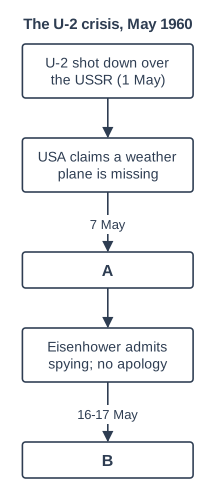
Figure 1 is a flow chart of the U-2 crisis in May 1960.

What should replace A and B?

The U-2 crisis, May 1960. Flow chart of 5 boxes joined by arrows, read from top to bottom. The first box is "U-2 shot down over the USSR (1 May)", which leads to "USA claims a weather plane is missing", which leads (along an arrow labelled "7 May") to box A, which leads to "Eisenhower admits spying; no apology", which leads (along an arrow labelled "16-17 May") to box B.

Model answer

A: Khrushchev revealed that the pilot, Gary Powers, was alive and in Soviet hands, along with the plane's spy camera and film, exposing the American cover story. B: the Paris Summit collapsed when Khrushchev walked out after Eisenhower refused to apologise.

Explanation

Khrushchev set a trap: on 5 May he announced only that a spy plane had been shot down, and after the USA repeated its weather-plane story he revealed on 7 May that Powers was alive. Eisenhower then admitted the flights but would not apologise, and the Paris Summit broke up on its first days, 16-17 May.

Mark scheme
  1. 1 mark

    A (7 May): Khrushchev revealed that the pilot, Gary Powers, had been captured alive, with the plane's camera and film, proving it was a spy plane.

    Accept: the Soviets showed the pilot was alive / the USA was caught lying / Khrushchev showed the wreckage and spy equipment.

  2. 1 mark

    B (16-17 May): the Paris Summit collapsed when Khrushchev walked out after Eisenhower refused to apologise.

    Accept: Khrushchev demanded an apology and left the summit / the summit failed / the invitation for Eisenhower to visit the USSR was withdrawn.

Question 2

4 marks

Source A: a summary of a statement issued by NASA, the American space agency, on 3 May 1960.
The statement said that a U-2 research aircraft, flying on a weather research mission, had apparently gone down in the Lake Van area of Turkey on 1 May. It said that the pilot had reported over the emergency radio frequency that he was having difficulties with his oxygen supply.

Source A shows that the US government tried to cover up the real purpose of the U-2 flight. How do you know?

Explain your answer by referring to Source A and your contextual knowledge.

Model answer

Source A shows a cover-up because NASA describes the U-2 as a 'research aircraft' on a 'weather research mission', when it was really a spy plane. It says the plane went down near Lake Van in Turkey, far from where it was actually lost, and it claims that the pilot reported problems with his oxygen supply. This story suggested that the pilot might have lost consciousness and drifted into Soviet airspace by accident, so that any flight over the USSR would look like an innocent mistake.

My knowledge shows that this was untrue. The U-2 was a CIA spy plane that had been photographing the USSR from about 70,000 feet since 1956. On 1 May 1960 Francis Gary Powers took off from Peshawar in Pakistan to fly right across the USSR to Norway, and he was shot down near Sverdlovsk. The provenance helps to explain the story: a civilian agency, NASA, was used to make it believable, and the statement was issued before the government knew that the Soviets had captured Powers alive. Khrushchev set a trap: on 5 May he announced only that a plane had been shot down, and on 7 May he revealed that the pilot was alive and showed the camera and film. The USA had been caught lying, and Eisenhower had to admit the truth.

Explanation

Level 2 answers explain the deliberate features of the cover story (weather research, Turkey, the oxygen problem) and use context - a CIA flight from Peshawar shot down near Sverdlovsk, Khrushchev's trap of 5-7 May - or the provenance of a civilian agency speaking before the pilot's capture was known.

Mark scheme
  1. 4 marks

    Levels of response (4 marks).
    Level 2 (3-4 marks): Developed analysis of Source A, explaining how its content and/or provenance shows a cover-up (e.g. the claim of 'weather research', the location in Turkey far from the real flight path, the oxygen story suggesting an accidental straying; a civilian agency used as cover before the government knew the pilot was alive), supported by relevant contextual knowledge such as the CIA spy flight from Peshawar, the shoot-down near Sverdlovsk and Khrushchev's revelations of 5 and 7 May.
    Level 1 (1-2 marks): Simple analysis of Source A, identifying basic features (e.g. 'it says it was a weather plane'), with little or no contextual knowledge.
    0 marks: nothing worthy of credit.

    Indicative content (not a checklist; credit other valid points): content - describes the U-2 as a 'research aircraft' on a 'weather research mission', hiding its spying role; places the loss near Lake Van in Turkey, nowhere near the real route across the USSR; the oxygen problem suggested that an unconscious pilot might have drifted off course accidentally. Provenance - NASA, a civilian space agency, was used to give the story credibility; issued on 3 May, before the US government knew that the USSR had captured the pilot and the wreckage. Context - the U-2 was a CIA spy plane flying at about 70,000 feet that had photographed the USSR since 1956; Francis Gary Powers took off from Peshawar in Pakistan on 1 May 1960 to fly across the USSR to Bodø in Norway and was shot down by a missile near Sverdlovsk; on 5 May Khrushchev announced that a spy plane had been shot down, and the USA repeated the weather story; on 7 May Khrushchev revealed that Powers was alive and had confessed, and showed the camera and film; the USA was caught lying; on 11 May Eisenhower admitted the flights but refused to apologise; the Paris Summit collapsed on 16-17 May.

Question 3

12 marks

Study Sources B and C.

Source B: from the memoirs of a Hungarian who was a student in Budapest in 1956, published in Britain in 1986. (Written for practice.)
'It was not only politics. My father, an engineer, earned barely enough for meat on Sundays, while the AVH men lived in the best flats, and every month someone we knew disappeared. When we heard that Khrushchev himself had called Stalin a criminal, we asked why Stalin's little copy still ruled us. And when the Poles stood up to Moscow and won, we thought: why not us? Nobody planned a revolution. We marched to show solidarity, and the shooting at the radio station made us revolutionaries.'

Source C: from a report sent to Moscow by a senior Soviet official in Budapest on 24 October 1956. (Written for practice.)
'The disorders were organised by hostile elements who have long prepared for this moment, helped by the propaganda of Western radio stations. The Hungarian party leadership has made serious mistakes. It failed to control the press and allowed the writers' clubs to spread anti-Soviet ideas for months. Comrade Gerő has lost all authority. Without the immediate help of our troops the situation could not have been held.'

How useful are Sources B and C to an historian studying the causes of the Hungarian Uprising?

Explain your answer using Sources B and C and your contextual knowledge.

Model answer

Source B is useful because it shows why ordinary Hungarians rose up. The writer describes economic hardship - his engineer father 'earned barely enough for meat on Sundays' - while 'the AVH men lived in the best flats', and he mentions fear of the secret police, as 'every month someone we knew disappeared'. This matches my knowledge of Rákosi's Stalinist rule, with low living standards, show trials and the AVH. He also identifies the triggers of 1956: Khrushchev's Secret Speech, which made Hungarians ask 'why Stalin's little copy still ruled us', and the Polish example, when Gomułka came to power with Soviet acceptance in October. His point that 'the shooting at the radio station made us revolutionaries' fits what happened on 23 October, when the AVH fired on the crowd. As a participant, he has first-hand knowledge of how students felt. However, he wrote in 1986, thirty years later, while living in Britain, so his memory may be shaped by hindsight and by sympathy for the cause, and it is only one person's experience.

Source C is useful in a different way. Written on 24 October, the second day of the uprising, it shows how the Soviet authorities understood the causes. The official blames 'hostile elements' and 'the propaganda of Western radio stations', which reflects the Soviet belief that the uprising was a counter-revolution encouraged by the West; Radio Free Europe did broadcast to Hungary. However, he also admits that the Hungarian party 'made serious mistakes', allowing the press and 'writers' clubs' to spread criticism, which is supported by the open debates of the Petőfi Circle in 1956, and he says Gerő had 'lost all authority'. Because it is a confidential report rather than propaganda, it is a frank account of the regime's collapse. But it is limited by its Soviet viewpoint: it says nothing about the economic hardship and hatred of Soviet control described in Source B, and blaming outsiders and local leaders protected Soviet policy.

Overall, Source B is more useful for the causes of the uprising, because it explains both the long-term grievances and the triggers of 1956, and it is supported by what we know. Source C is still valuable, because it reveals the collapse of the Hungarian regime's authority and how the Soviet leaders interpreted events, which helps to explain why they sent in troops. Used together, they show that the uprising came from deep popular grievances, released by de-Stalinisation and the Polish example, at a time when the regime had lost control.

Explanation

Level 4 answers judge B as a participant's account (rich on grievances and triggers, but written with hindsight in exile) and C as a confidential Soviet report from the crisis (revealing Soviet perceptions and the regime's collapse, but blaming outsiders), with context such as Rákosi's rule, the Secret Speech, Poland and 23 October.

Mark scheme
  1. 12 marks

    Levels of response (12 marks).
    Level 4 (10-12 marks): Complex evaluation of both sources, reaching a sustained judgement about their usefulness for studying the causes of the uprising, based on their content AND provenance (e.g. B as a participant's account of grievances and triggers, valuable but written by an exile with hindsight; C as a confidential Soviet report written during the crisis, revealing how the USSR understood it but blaming outsiders), supported by relevant contextual knowledge.
    Level 3 (7-9 marks): Developed evaluation of both sources based on their content and/or provenance, supported by relevant contextual knowledge.
    Level 2 (4-6 marks): Simple evaluation of one or both sources based on content and/or provenance, with some contextual knowledge.
    Level 1 (1-3 marks): Basic analysis of one or both sources, mainly describing what they say, with limited knowledge.
    0 marks: nothing worthy of credit.

    Indicative content (not a checklist; credit other valid points): Source B content - economic hardship and privilege for the AVH; fear of the secret police; the Secret Speech discrediting Stalin and his Hungarian copy (Rákosi/Gerő); the Polish example; the uprising was unplanned and the shooting at the radio station turned protest into revolt. Source B provenance - a participant, so first-hand knowledge of feelings in 1956; but written thirty years later by someone living in the West, with hindsight and possible sympathy for the cause; one person's experience. Source C content - blames 'hostile elements' and Western radio propaganda; admits the Hungarian party's mistakes, its loss of control of the press and writers' clubs; Gerő has lost authority; Soviet troops were needed. Source C provenance - a confidential report written on the second day of the uprising, so it shows what Soviet leaders were told at the time and was not written for propaganda; but it fits events into a Soviet view of counter-revolution and may protect Soviet policy by blaming outsiders and the local leaders. Context - Rákosi's Stalinist rule, the AVH, show trials and Mindszenty; low living standards and Soviet exploitation; Nagy's New Course (1953-55) and his removal; the Secret Speech (February 1956); the Petőfi Circle debates; Rákosi replaced by Gerő (July 1956); Rajk's reburial (6 October); Poznań riots and Gomułka's success in Poland (October 1956); the Sixteen Points (22 October); the demonstration of 23 October, the Stalin statue, the shooting at the radio station; Gerő's hostile broadcast; Radio Free Europe; Soviet tanks entered Budapest on 24 October. Judgement - B is more useful for the real causes (long-term grievances and triggers), C for Soviet perceptions and for the weakness of the Hungarian regime; together they cover popular grievances and the collapse of the regime's authority.

Question 4

20 marks

'The Soviet Union gained more than it lost from crushing the Hungarian Uprising.'

How far do you agree with this statement?

Explain your answer.

[16 marks] [SPaG 4 marks]

Model answer

In terms of power, the Soviet Union gained a great deal from crushing the Hungarian Uprising. Most importantly, it restored communist control of Hungary. János Kádár, installed on 4 November 1956, kept Hungary loyal to the USSR until 1988, and Hungary remained in the Warsaw Pact, so the Soviet buffer zone in Eastern Europe was preserved. The crushing of the uprising also stopped a possible domino effect: no other satellite seriously challenged Soviet rule again until Czechoslovakia in 1968, when the USSR used the same method.

The USSR also learned that the West would not intervene in its sphere. Despite years of American talk about 'liberating' Eastern Europe, Eisenhower sent no help, and the UN's calls for Soviet withdrawal were simply ignored after the USSR vetoed action in the Security Council. The Suez Crisis, happening at the same time, divided the West and allowed the USSR to point to Western imperialism. At home, Khrushchev showed the hardliners and the Chinese leaders that de-Stalinisation did not mean weakness, which strengthened his position against rivals who tried, and failed, to remove him in 1957.

However, the USSR also suffered serious losses. Its international reputation was badly damaged. Western opinion was outraged; Time magazine named the 'Hungarian Freedom Fighter' its Man of the Year, the UN General Assembly condemned the invasion, and several countries withdrew from the Melbourne Olympics in protest. The flight of about 200,000 refugees showed the world how many people wanted to escape communism, and the execution of Nagy in 1958 caused fresh outrage.

The damage to communism's appeal was also important. Thousands of communists in Western Europe left their parties in disgust, including many intellectuals who had previously defended the USSR. Khrushchev's policy of peaceful coexistence, announced earlier that year, now looked hypocritical, and the Thaw was badly damaged. In Hungary itself, the invasion left lasting hatred of Soviet rule, which resurfaced when communism collapsed in 1989.

In conclusion, I largely agree with the statement, but it depends on how gains and losses are measured. In terms of power and security, which the Soviet leaders valued most, the USSR gained more: it kept control of Hungary, preserved the Warsaw Pact and learned that the West would not intervene. In terms of reputation and the appeal of communism, it lost a great deal, and these losses had long-term effects. But in 1956 the Soviet leaders were prepared to pay that price, and from their point of view crushing the uprising achieved what mattered most to them.

Explanation

Level 4 answers weigh Soviet gains (control restored, the Warsaw Pact preserved, the domino effect stopped, Western non-intervention revealed) against losses (world opinion, Western communists, peaceful coexistence, lasting resentment), reaching a sustained judgement that may depend on how 'gain' is measured.

Mark scheme
  1. 16 marks

    Levels of response (16 marks).
    Level 4 (13-16 marks): Complex explanation of Soviet gains (e.g. control of Hungary and the buffer zone restored, the Warsaw Pact preserved, a warning to other satellites, proof that the West would not intervene, Khrushchev's position secured) and Soviet losses (e.g. damage to its international image, loss of support among Western communists, damage to peaceful coexistence, lasting resentment in Hungary), leading to a sustained judgement, supported by extended, accurate and relevant knowledge.
    Level 3 (9-12 marks): Developed explanation of gains and losses, supported by a range of accurate knowledge.
    Level 2 (5-8 marks): Simple explanation of gains or losses, supported by some relevant knowledge.
    Level 1 (1-4 marks): Basic explanation, with limited knowledge and little or no analysis.
    0 marks: nothing worthy of credit.

    Indicative content (not a checklist; credit other valid points): gains - communist rule restored under Kádár, who ruled until 1988 and kept Hungary loyal; Hungary stayed in the Warsaw Pact and the buffer zone was preserved; the domino effect was stopped - no satellite seriously challenged Soviet rule again until 1968, when the same method was used; the West's failure to act showed it would not intervene in the Soviet sphere, ending the threat of 'liberation'; the UN was shown to be powerless; Khrushchev showed hardliners and China he was not weak, which strengthened him against rivals who tried and failed to remove him in 1957; Suez allowed the USSR to point to Western imperialism; Kádár's later reforms ('goulash communism') brought some stability. Losses - world opinion turned against the USSR; Time named the Hungarian Freedom Fighter its Man of the Year; the UN General Assembly condemned the invasion; several countries withdrew from the Melbourne Olympics; thousands of Western communists left their parties, weakening communism in the West; peaceful coexistence looked hypocritical and the Thaw was damaged; the loss of Soviet soldiers (about 700) and the cost; about 200,000 Hungarians fled, a propaganda disaster; lasting hatred in Hungary; the execution of Nagy (1958) caused further outrage; newly independent countries saw Soviet imperialism. Possible judgements - in terms of power and security the USSR gained more; in terms of reputation and the appeal of communism it lost more; the Soviet leaders themselves valued control over image, so from their perspective they gained more.

  2. 4 marks

    SPaG. High performance (4 marks): spells and punctuates with consistent accuracy; uses rules of grammar with effective control of meaning overall; uses a wide range of specialist terms as appropriate.
    Intermediate performance (2-3 marks): spells and punctuates with considerable accuracy; uses rules of grammar with general control of meaning overall; uses a good range of specialist terms as appropriate.
    Threshold performance (1 mark): spells and punctuates with reasonable accuracy; uses rules of grammar with some control of meaning and any errors do not significantly hinder meaning overall; uses a limited range of specialist terms as appropriate.
    0 marks: the student writes nothing, or the response does not relate to the question, or errors severely hinder meaning.

    SPaG marks are awarded only if the answer relates to the question.

Ready to try the rest? Every answer you write is marked against the mark scheme, so you can see exactly where the marks are.

AI Tutor Hints first, answers after you try

Hi! Stuck? Ask me for a hint and I’ll help you work it out. Once you’ve checked your answer I can explain exactly where the marks are.