Level:
Correct: 0
Incorrect: 0
Marks: 0/0
Exam Practice
Subject:
Topics:
AQA GCSE History (Conflict and tension 1945-1972) Smart practice A mixed round aimed at your weak spots
Unit 1
Part one: The origins of the Cold War
Unit 2
Part two: The development of the Cold War
Unit 3
Part three: Transformation of the Cold War
Avg
score:
–
Topics
done:
0/9

Easing of tension

Practise 44 exam-style questions on Easing of tension for AQA GCSE History (Conflict and tension 1945-1972). Write your answer as you would in the exam and get it marked in seconds against the mark scheme, point by point, with an AI tutor on hand if you get stuck.

  • 44 questions
  • 1–20 marks each
  • Instant marking
  • No sign-up needed
20 questions, marked as you go

Sample questions with model answers

Here are 4 of the questions in this topic, each with a model answer, an explanation of why it earns the marks and the mark scheme an examiner would use.

Question 1

2 marks

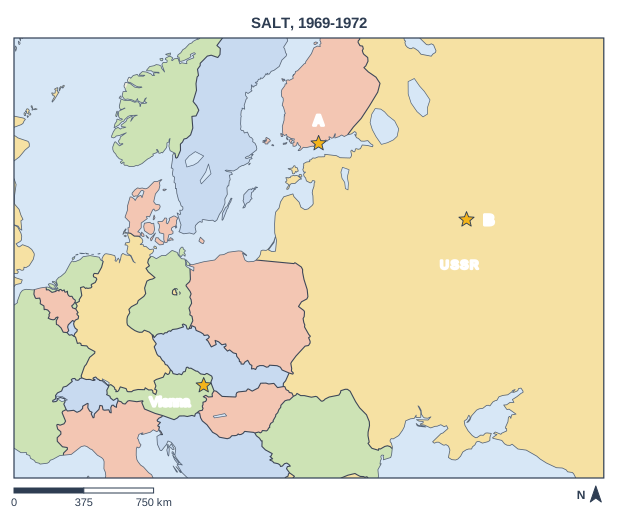
Figure 1 is a map showing cities connected with the SALT talks between 1969 and 1972. The talks were held in turn in Vienna and in the city labelled A, where they first opened. The agreements were signed in the city labelled B.

Name the cities labelled A and B.

Map of part of Europe (4°E to 44°E, 44°N to 64°N) in 1949, at the start of the Cold War, titled "SALT, 1969-1972". It is drawn with real coastlines (land pale buff, sea pale blue) and the borders of the time as simplified lines; a north arrow shows north at the top; the scale bar is 750 km long. Each state is shaded a pale colour, with neighbouring states in different colours. State names printed on the map: "USSR". Points: a yellow star labelled A on the coast, towards the top of the map; a yellow star labelled "Vienna" (inland); a yellow star labelled B inland, in the country labelled "USSR", towards the right of the map.

Model answer

A is Helsinki and B is Moscow.

Explanation

The SALT talks opened in Helsinki, the capital of neutral Finland, on 17 November 1969, and then moved between Helsinki and Vienna. The SALT 1 agreements were signed by Nixon and Brezhnev in Moscow on 26 May 1972, during the first visit to Moscow by a serving US President.

Mark scheme
  1. 1 mark

    A: Helsinki.

  2. 1 mark

    B: Moscow.

    Do not accept Leningrad or Washington.

Question 2

4 marks

Source A: a cartoon published in an American newspaper in 1972. (Written for practice.)
Leonid Brezhnev sits at a desk, smiling, signing a document labelled 'Détente' with his right hand. With his left hand, behind his back, he is turning a key in a heavy prison door. Behind the bars, people hold up signs reading 'Let my people go' and 'Freedom to write'. On the floor beside the desk lie books stamped 'Banned'. The caption reads: 'Friendly relations.'

Source A suggests that détente ignored the Soviet Union's record on human rights. How do you know?

Explain your answer by referring to Source A and your contextual knowledge.

Model answer

Source A suggests that détente ignored human rights because Brezhnev signs a document labelled 'Détente' with one hand while locking a prison door with the other. This suggests that agreements with the West did nothing to stop repression inside the USSR. SALT 1 and the other agreements signed at the Moscow summit in May 1972 dealt with arms and trade, not with human rights. The sign 'Let my people go' refers to Soviet Jews who were refused permission to emigrate, known as refuseniks; in August 1972 the USSR even introduced a heavy tax on emigrants to repay the cost of their education. 'Freedom to write' and the books stamped 'Banned' refer to censorship and the persecution of writers such as Solzhenitsyn, who had been expelled from the Writers' Union in 1969. The caption 'Friendly relations' is ironic, suggesting the West was being friendly to an oppressive government. The provenance supports this: it comes from an American newspaper in 1972, when many Americans were criticising Nixon and Kissinger for ignoring human rights, and Senator Henry Jackson proposed linking trade with the USSR to freedom of emigration.

Explanation

Level 2 explains what the locked prison, the signs and the banned books represent, using knowledge of refuseniks, the education tax, censorship and dissident writers, and/or explains why an American newspaper in 1972 was critical of détente's silence on human rights.

Mark scheme
  1. 4 marks

    Levels of response (4 marks).
    Level 2 (3-4 marks): Developed analysis of Source A: explains how details of the cartoon (e.g. Brezhnev signing 'Détente' while locking a prison door, the signs 'Let my people go' and 'Freedom to write', the banned books, the ironic caption) and/or its provenance (an American newspaper in 1972) suggest that détente ignored Soviet human rights abuses, supported by relevant contextual knowledge (e.g. refuseniks, the emigration tax, dissident writers, censorship, the Jackson amendment).
    Level 1 (1-2 marks): Simple analysis of Source A: identifies a relevant feature, e.g. 'Brezhnev is locking people up', with little or no supporting knowledge.
    0 marks: nothing worthy of credit.

    Indicative content (not a checklist; credit other valid points): Brezhnev signing with one hand while locking the prison with the other suggests that agreements with the West did nothing to stop repression at home - SALT 1 and the Moscow summit (May 1972) dealt with arms and trade, not human rights; 'Let my people go' refers to Soviet Jews refused permission to emigrate ('refuseniks'); in August 1972 the USSR introduced a heavy 'education tax' on emigrants; the Leningrad trial of 1970 had caused international protests; 'Freedom to write' and the banned books refer to censorship and the persecution of writers such as Solzhenitsyn (expelled from the Writers' Union in 1969) and Sinyavsky and Daniel (labour camps, 1966); the ironic caption 'Friendly relations' suggests the West was being friendly to an oppressive regime; provenance - an American newspaper in 1972 reflects growing criticism in the USA, among both liberals and conservatives, of Nixon and Kissinger's realpolitik, which avoided raising human rights; Senator Henry Jackson proposed in October 1972 to link trade with the USSR to freedom of emigration.

Question 3

12 marks

Source B: from the memoirs of a former member of President Nixon's National Security Council staff, published in 1983. (Written for practice.)
'By 1969 the old policy no longer worked. We had half a million men in Vietnam, the dollar was under pressure and the universities were in revolt. Congress would not pay for an endless arms race, and the Russians now had as many missiles as we did. The President's view was simple: if we could not win the arms race, we had to manage it - and if the Russians and the Chinese hated each other, we should talk to both.'

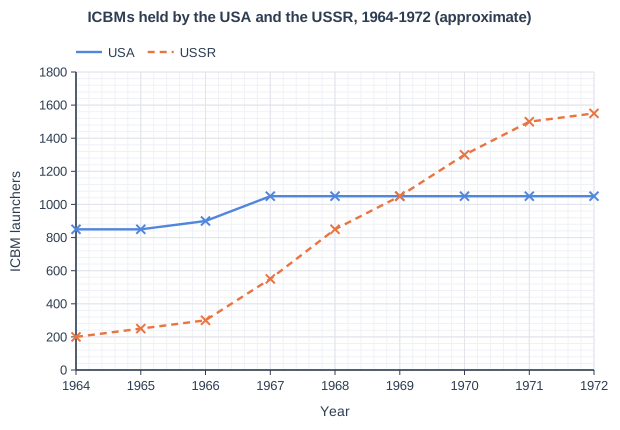
Source C is Figure 1: a graph showing the approximate number of intercontinental ballistic missile (ICBM) launchers held by the USA and the USSR from 1964 to 1972, based on Western estimates.

How useful are Sources B and C to an historian studying why the USA wanted détente?

Explain your answer using Sources B and C and your contextual knowledge.

ICBMs held by the USA and the USSR, 1964-1972 (approximate). Line graph of ICBM launchers (y-axis, 0 to 1800) against year (x-axis, 1964 to 1972). "USA" joins the points (1964, 850), (1965, 850), (1966, 900), (1967, 1050), (1968, 1050), (1969, 1050), (1970, 1050), (1971, 1050), (1972, 1050). "USSR" (dashed) joins the points (1964, 200), (1965, 250), (1966, 300), (1967, 550), (1968, 850), (1969, 1050), (1970, 1300), (1971, 1500), (1972, 1550).

Model answer

Source B is useful because it gives a wide range of reasons why the USA wanted détente. The author mentions half a million men in Vietnam, pressure on the dollar, universities in revolt, a Congress unwilling to pay for an endless arms race and Soviet nuclear parity. This fits my knowledge: the USA had over 500,000 troops in Vietnam in 1968-69, inflation and a weak dollar led Nixon to end the dollar's link with gold in 1971, and the anti-war movement was at its height, with four students shot dead at Kent State University in 1970. The idea of 'managing' the arms race explains why Nixon agreed to the SALT talks in 1969, and 'talk to both' describes triangular diplomacy, which exploited the split between the USSR and China after their border clashes of 1969. The provenance adds to its value, because a member of the National Security Council staff worked closely with Nixon and Kissinger and would have known their thinking. However, the memoirs were written in 1983, with hindsight, and may make the policy sound more carefully planned than it really was. Memoirs can also be written to defend the author's own reputation.

Source C is useful because it gives precise evidence for one of the most important reasons for détente: Soviet nuclear parity. It shows the USSR's ICBMs rising from about 200 in 1964 to about 1,050 in 1969, equal to the USA's, and to about 1,550 by 1972, while American numbers stayed at about 1,050 from 1967. This confirms Source B's claim that 'the Russians now had as many missiles as we did'. Parity meant that mutually assured destruction was now a reality and that the USA could no longer hope to stay ahead, so limiting the arms race made sense. As Western estimates based on intelligence, the figures are approximate but broadly reliable. However, the graph shows only ICBM launchers. It does not show warheads, where the USA was still ahead because it was fitting missiles with multiple warheads (MIRVs), or submarines and bombers, so it exaggerates Soviet strength. It also shows only one reason for détente.

Overall, Source B is more useful because it explains several reasons why the USA wanted détente, and Source C supports one of them with hard evidence. Together they are very useful, but neither mentions some important motives, such as Nixon's hope that the USSR would help to end the Vietnam War (linkage) or his wish for foreign-policy successes before the 1972 election.

Explanation

Source B gives many US motives (Vietnam, the economy, protest, cost, parity, the Sino-Soviet split) from an insider but with hindsight; Source C precisely shows Soviet ICBM parity by 1969 but counts only launchers. Level 4 evaluates content and provenance for both and judges their combined value.

Mark scheme
  1. 12 marks

    Levels of response (12 marks).
    Level 4 (10-12 marks): Complex evaluation of both sources with sustained judgement based on content and provenance: explains how useful Source B is for the range of US motives (an insider's later account covering Vietnam, the economy, protest, cost, parity and the Sino-Soviet split) and how useful Source C is as statistical evidence of Soviet nuclear parity (Western estimates of ICBM numbers), tests both against accurate contextual knowledge (e.g. the cost of Vietnam, the dollar crisis, MAD, MIRVs and ABMs, triangular diplomacy, SALT), and reaches a substantiated judgement, e.g. that B is more useful for the range of reasons while C confirms one of them precisely but has limits.
    Level 3 (7-9 marks): Developed evaluation of both sources based on content and/or provenance, supported by relevant contextual knowledge.
    Level 2 (4-6 marks): Simple evaluation of one or both sources based on content and/or provenance.
    Level 1 (1-3 marks): Basic analysis of one or both sources: describes the content or makes general comments, with little or no knowledge.
    0 marks: nothing worthy of credit.

    Indicative content (not a checklist; credit other valid points): Source B content - gives several US motives: the Vietnam War (over 500,000 US troops in 1968-69), economic problems (inflation; the dollar crisis led Nixon to end the dollar's link with gold in 1971), protest at home (the anti-war movement, Kent State, 1970), the cost of the arms race, Soviet nuclear parity, and the Sino-Soviet split (border clashes, 1969) - 'talk to both' describes triangular diplomacy; 'manage it' explains SALT; Source B provenance - a member of the National Security Council staff was an insider close to Nixon and Kissinger, so well placed to know their thinking; but writing in 1983 with hindsight, after Watergate and the decline of détente, he may present policy as more planned and logical than it was; memoirs can be self-justifying; only one view; Source C content - shows the USSR's ICBMs rising from about 200 (1964) to about 1,050 (1969), equal to the USA, and about 1,550 (1972), while US numbers stayed at about 1,050 from 1967 - confirming parity, which made MAD real and meant the USA could no longer stay ahead; Source C provenance - Western estimates, approximate but based on intelligence (e.g. satellite photographs); it shows only ICBM launchers - not warheads (the USA led because of MIRVs), submarines or bombers - so it overstates Soviet advantage; it shows one reason only; context - the USA's own build-up had stopped in 1967 by choice; new ABMs and MIRVs threatened a costly new race; judgement - B more useful for the range of motives, C precise evidence for one key motive; together they explain why negotiation made sense, though neither mentions Nixon's political aims (the 1972 election) or the hope of Soviet help in Vietnam (linkage).

Question 4

20 marks

'Nixon was more important than Brezhnev in bringing about détente.'

How far do you agree with this statement?

Explain your answer.

[16 marks] [SPaG 4 marks]

Model answer

Richard Nixon, President of the USA from 1969, and Leonid Brezhnev, leader of the Soviet Union from 1964, signed SALT 1 together at the Moscow summit in May 1972, the high point of early détente. Both played essential parts. I think Nixon was slightly more important, because his opening to China set the pace and timing of détente, but Nixon could have achieved nothing without Brezhnev's willingness to negotiate, so the difference between them was small.

Nixon's contribution was very significant. In his inaugural address in January 1969 he announced 'an era of negotiation'. With his National Security Adviser, Henry Kissinger, he followed a policy of realpolitik, dealing with the communist powers according to America's national interests rather than ideology. He agreed to the SALT talks, which began in November 1969, and used linkage to try to win Soviet help over Vietnam. His anti-communist record, going back to his 'Kitchen Debate' with Khrushchev in 1959, meant that critics could not accuse him of being soft, which made détente politically possible in the USA.

Nixon's most important move was his opening to China. Seeing the split between China and the USSR after their border clashes of 1969, he and Kissinger began contacts with Beijing. After Kissinger's secret visit in July 1971, Nixon visited China in February 1972. This triangular diplomacy alarmed the Soviet leaders, and only three months later Nixon became the first serving US President to visit Moscow, where SALT 1 and the Basic Principles were signed. In this sense Nixon was the driving force behind the timing of détente. However, much of the detailed work was done by Kissinger, Nixon was partly motivated by the 1972 election, and he continued to use force in Vietnam, invading Cambodia in 1970 and mining Haiphong in 1972.

Brezhnev's contribution was also essential. Under his leadership the USSR built up its nuclear forces until it had caught up with the USA by about 1969-70. This parity was what made détente possible, because the USSR could negotiate as an equal. Brezhnev agreed to the SALT talks and responded positively to West Germany's Ostpolitik: the Moscow Treaty of August 1970 accepted Europe's post-war borders, and in 1971 the USSR signed the Four-Power Agreement on Berlin. In March 1971 his Peace Programme called for an end to the arms race and a European security conference. Most importantly, when Nixon mined North Vietnam's ports in May 1972, some Soviet leaders wanted to cancel the summit, but Brezhnev insisted it should go ahead. Without that decision, SALT 1 would not have been signed in 1972.

It is also important to remember that neither leader acted alone. Brandt's Ostpolitik eased tension in Europe, and powerful pressures pushed both superpowers towards détente: the cost of the arms race, nuclear parity, the Vietnam War and the Sino-Soviet split. Talks on limiting strategic arms had already been planned under President Johnson in 1968, which suggests that détente did not depend only on Nixon and Brezhnev.

In conclusion, both leaders were necessary. Brezhnev made détente possible by reaching parity and choosing to negotiate, and his decision to go ahead with the Moscow summit was crucial. But Nixon's bold opening to China changed the balance of the Cold War and created the urgency that brought the USSR to the table in 1972. I therefore agree with the statement to some extent: Nixon was slightly more important in shaping when and how détente happened, but Brezhnev was almost equally important in making it possible.

Explanation

Nixon offered 'an era of negotiation', used realpolitik and linkage, and his opening to China set the timing; Brezhnev's nuclear parity, Peace Programme, support for Ostpolitik and decision to go ahead with the summit after Haiphong made agreement possible. Level 4 compares the two, considers other factors, and sustains a judgement.

Mark scheme
  1. 16 marks

    Levels of response (16 marks).
    Level 4 (13-16 marks): Complex explanation of Nixon's contribution (e.g. 'era of negotiation', realpolitik with Kissinger, linkage, the opening to China and triangular diplomacy, the Moscow summit, his anti-communist credentials) and Brezhnev's contribution (e.g. nuclear parity making equal negotiation possible, agreeing to SALT, the Peace Programme, support for Ostpolitik and the Berlin agreement, insisting the summit go ahead after Haiphong, SALT 1), possibly with other factors (e.g. Kissinger, Brandt, circumstances), supported by extended, accurate knowledge, leading to a sustained judgement comparing the two.
    Level 3 (9-12 marks): Developed explanation of the roles of Nixon and Brezhnev, supported by relevant, accurate knowledge; a judgement may be given but is not fully sustained.
    Level 2 (5-8 marks): Simple explanation of the role of Nixon or Brezhnev, with some relevant knowledge.
    Level 1 (1-4 marks): Basic explanation: general statements, with limited knowledge.
    0 marks: nothing worthy of credit.

    Indicative content (not a checklist; credit other valid points): Nixon - inaugural address (January 1969) promised 'an era of negotiation'; with Kissinger followed realpolitik, dealing with communist states on national interest; linkage; agreed to SALT talks (November 1969); the Nixon Doctrine and Vietnamisation reduced US commitments; the opening to China - ping-pong diplomacy (1971), Kissinger's secret visit (July 1971), Nixon in Beijing (February 1972) - pushed the USSR towards agreement; first serving US President to visit Moscow (May 1972); his anti-communist past (e.g. the Kitchen Debate, 1959) protected him from charges of weakness; motives included the 1972 election; but much was done by Kissinger, and Nixon also escalated force (Cambodia 1970, Linebacker 1972); Brezhnev - led the USSR from 1964; built nuclear forces to parity by about 1969-70, which made equal negotiation possible; agreed to the SALT talks; supported Brandt's Ostpolitik (Moscow Treaty, August 1970) and the Four-Power Agreement on Berlin (1971); the Peace Programme (March 1971); responded to the China opening by agreeing to a summit; insisted the Moscow summit go ahead despite the mining of Haiphong (May 1972); signed SALT 1 and the Basic Principles; his motives - economic needs, grain, technology, recognition, fear of China; collective leadership with Kosygin and Gromyko; other factors - Brandt's Ostpolitik, Kissinger and Dobrynin, impersonal pressures (parity, cost, Vietnam, the Sino-Soviet split); possible judgements - Nixon was more important as the initiator of the China move that set the timing; or Brezhnev was as important because without his willingness and parity nothing could be agreed; or both were necessary and circumstances mattered most.

  2. 4 marks

    SPaG. High performance (4 marks): spells and punctuates with consistent accuracy; uses rules of grammar with effective control of meaning overall; uses a wide range of specialist terms as appropriate.
    Intermediate performance (2-3 marks): spells and punctuates with considerable accuracy; uses rules of grammar with general control of meaning overall; uses a good range of specialist terms as appropriate.
    Threshold performance (1 mark): spells and punctuates with reasonable accuracy; uses rules of grammar with some control of meaning and any errors do not significantly hinder meaning overall; uses a limited range of specialist terms as appropriate.
    0 marks: the student writes nothing, or the response does not relate to the question, or errors severely hinder meaning.

    SPaG marks are awarded only if the answer relates to the question.

Ready to try the rest? Every answer you write is marked against the mark scheme, so you can see exactly where the marks are.

AI Tutor Hints first, answers after you try

Hi! Stuck? Ask me for a hint and I’ll help you work it out. Once you’ve checked your answer I can explain exactly where the marks are.