Level:
Correct: 0
Incorrect: 0
Marks: 0/0
Exam Practice
Subject:
Topics:
AQA GCSE History (Conflict and tension 1945-1972) Smart practice A mixed round aimed at your weak spots
Unit 1
Part one: The origins of the Cold War
Unit 2
Part two: The development of the Cold War
Unit 3
Part three: Transformation of the Cold War
Avg
score:
–
Topics
done:
0/9

Czechoslovakia

Practise 44 exam-style questions on Czechoslovakia for AQA GCSE History (Conflict and tension 1945-1972). Write your answer as you would in the exam and get it marked in seconds against the mark scheme, point by point, with an AI tutor on hand if you get stuck.

  • 44 questions
  • 1–20 marks each
  • Instant marking
  • No sign-up needed
20 questions, marked as you go

Sample questions with model answers

Here are 4 of the questions in this topic, each with a model answer, an explanation of why it earns the marks and the mark scheme an examiner would use.

Question 1

2 marks

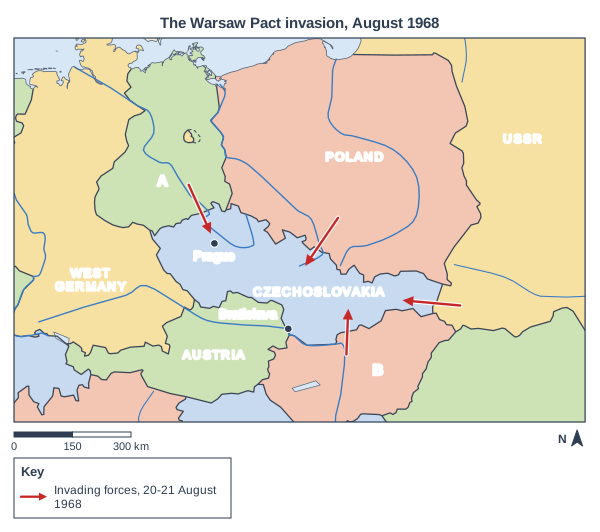
Figure 1 is a map showing the routes taken by the Warsaw Pact forces that invaded Czechoslovakia on the night of 20-21 August 1968.

Name the countries labelled A and B.

Map of part of Europe (8°E to 27°E, 46°N to 54.5°N) in 1949, at the start of the Cold War, titled "The Warsaw Pact invasion, August 1968". It is drawn with real coastlines (land pale buff, sea pale blue) and the borders of the time as simplified lines; a north arrow shows north at the top; the scale bar is 300 km long. Each state is shaded a pale colour, with neighbouring states in different colours. State names printed on the map: "USSR", "WEST GERMANY", "POLAND", "CZECHOSLOVAKIA" and "AUSTRIA". The letter A is printed on a state towards the left of the map, which borders the country labelled "WEST GERMANY", the country labelled "CZECHOSLOVAKIA" and the country labelled "POLAND". The letter B is printed on a state towards the bottom of the map, which borders the country labelled "USSR", the country labelled "CZECHOSLOVAKIA" and the country labelled "AUSTRIA". Dashed lines mark a territory inside a larger state. Blue lines show rivers, not named. Points: a dot labelled "Prague" (inland); a dot labelled "Bratislava" (inland). Arrows: a red arrow (key: "Invading forces, 20-21 August 1968") from the left of the map to the point labelled "Prague"; a red arrow from the centre of the map to the centre of the map; a red arrow from the bottom right of the map to the bottom right of the map; a red arrow from the bottom of the map to the bottom of the map. The key (below the map) shows: "Invading forces, 20-21 August 1968".

Model answer

A is East Germany and B is Hungary.

Explanation

Warsaw Pact forces entered Czechoslovakia from East Germany, Poland, the USSR and Hungary. Most of the troops were Soviet, joined by Polish, Hungarian and Bulgarian units; East Germany helped to plan the invasion, though its own troops played only a very small part. About 250,000 troops crossed the border on the first night, and the total later rose to about half a million.

Mark scheme
  1. 1 mark

    A: East Germany.

    Accept 'the GDR' or 'the German Democratic Republic'. Do not accept 'Germany' or 'West Germany'.

  2. 1 mark

    B: Hungary.

Question 2

4 marks

Source A: a summary of a speech made by Nicolae Ceaușescu, the leader of communist Romania, to a huge crowd in Bucharest on 21 August 1968.
Ceaușescu said that the entry of the troops of five socialist countries into Czechoslovakia was a great mistake and a serious danger to peace in Europe and to the future of socialism in the world. He said that nothing could justify interfering in the internal affairs of another socialist state. He announced that Romania would form armed Patriotic Guards of workers, peasants and intellectuals to defend the country's independence.

Source A opposes the invasion of Czechoslovakia. How do you know?

Explain your answer by referring to Source A and your contextual knowledge.

Model answer

Source A opposes the invasion because Ceaușescu calls it 'a great mistake' and 'a serious danger to peace in Europe and to the future of socialism', which directly rejects the Soviet claim that the invasion was defending socialism. He also says that nothing could justify interfering in the internal affairs of another socialist state, rejecting the idea that the communist states had a shared right to intervene, which Brezhnev later set out as the Brezhnev Doctrine. His announcement of armed Patriotic Guards shows that Romania feared it might be invaded next and was ready to defend itself. The provenance makes the opposition even clearer. Ceaușescu was the leader of a Warsaw Pact member, and Romania was the only member that refused to send troops. He had visited Prague only days earlier and signed a friendship treaty with Czechoslovakia. By speaking to a huge crowd on the day of the invasion, he was openly defying the USSR. He was not a reformer like Dubček, but he wanted to defend Romania's independence, which made him popular at home.

Explanation

Level 2 explains Ceaușescu's words (a 'great mistake', no right to interfere, the Patriotic Guards) and uses knowledge of Romania's refusal to join the invasion and its independent foreign policy, or explains the significance of a Warsaw Pact leader condemning the invasion in public on the day it happened.

Mark scheme
  1. 4 marks

    Levels of response (4 marks).
    Level 2 (3-4 marks): Developed analysis of Source A: explains how its content (e.g. 'a great mistake', 'a serious danger to peace', no justification for interfering, the Patriotic Guards) and/or its provenance (the leader of a Warsaw Pact state, speaking publicly on the day of the invasion) show opposition, supported by relevant contextual knowledge (e.g. Romania's refusal to take part, its independent foreign policy, fear that it could be next, divisions in the Warsaw Pact).
    Level 1 (1-2 marks): Simple analysis of Source A: identifies a relevant feature, e.g. 'he says it was a great mistake', with little or no supporting knowledge.
    0 marks: nothing worthy of credit.

    Indicative content (not a checklist; credit other valid points): calling the invasion 'a great mistake' and 'a serious danger to peace' condemns it directly, rejecting the Soviet claim that it protected socialism; 'nothing could justify interfering in the internal affairs of another socialist state' rejects the idea, later called the Brezhnev Doctrine, that the socialist states could intervene in each other's affairs; the Patriotic Guards show that Romania feared it might be invaded next and was prepared to defend itself; context - Romania was the only Warsaw Pact member that refused to take part in the invasion (the USSR, Poland, Hungary, Bulgaria and East Germany backed it); Ceaușescu had visited Prague only days before (15-17 August) and signed a friendship treaty with Czechoslovakia; Romania had followed an independent foreign policy in the 1960s; provenance - the speech was made by the leader of a Warsaw Pact state, in public, on the very day of the invasion, so it was a deliberate show of defiance towards the USSR; Ceaușescu was not a reformer like Dubček - he was defending national independence, which also made him popular at home and in the West.

Question 3

12 marks

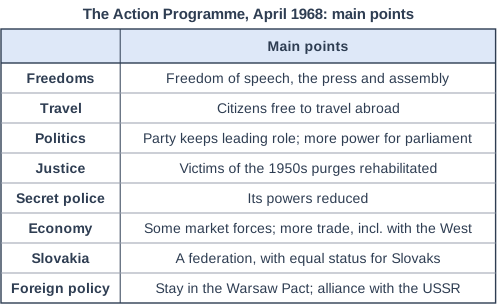
Source B is Figure 1: a summary of the main points of the Action Programme, published by the Czechoslovak Communist Party in April 1968.

Source C: from a letter written by a university student in Prague to a pen-friend in Britain, May 1968. (Written for practice.)
'For the first time in my life I can buy a newspaper and believe what it says. Every evening my whole family watches television, where people argue openly about the trials of the 1950s and about what has gone wrong with our economy. Dubček says the Party will keep its leading role, but that it must earn our trust instead of demanding it. Many of my friends want to go further and have real opposition parties. My father, who remembers 1948, worries that the Russians will never allow it.'

How useful are Sources B and C to an historian studying the Prague Spring reforms of 1968?

Explain your answer using Sources B and C and your contextual knowledge.

The Action Programme, April 1968: main points. Table with columns (row headings), "Main points". Freedoms; Main points: Freedom of speech, the press and assembly | Travel; Main points: Citizens free to travel abroad | Politics; Main points: Party keeps leading role; more power for parliament | Justice; Main points: Victims of the 1950s purges rehabilitated | Secret police; Main points: Its powers reduced | Economy; Main points: Some market forces; more trade, incl. with the West | Slovakia; Main points: A federation, with equal status for Slovaks | Foreign policy; Main points: Stay in the Warsaw Pact; alliance with the USSR.

Model answer

Source B is useful because it sets out exactly what the Prague Spring reforms were meant to be. The Action Programme promised freedom of speech, the press and assembly, freedom to travel abroad, more power for parliament, the rehabilitation of the victims of the purges of the 1950s and limits on the secret police. It also promised economic reform with some market forces and a federation that would give Slovaks equal status. This was Dubček's 'socialism with a human face'. Importantly, Source B also shows the limits of the reforms: the party would keep its leading role and Czechoslovakia would stay in the Warsaw Pact and loyal to the USSR. The provenance makes it very reliable as evidence of the leaders' aims, because it is the Communist Party's own official programme, adopted in April 1968. However, it only shows intentions, not what actually happened, and it was written partly to reassure the Soviet Union, so it may play down how far reform might go.

Source C is useful because it shows how the reforms were experienced by ordinary people. The student says that for the first time he can believe the newspapers and that people argue openly on television about the trials of the 1950s. This fits my knowledge that censorship was relaxed from March 1968 and that the press exposed the crimes of the Stalinist years, such as the Slánský trial. Source C supports Source B that the party would keep its leading role, but it also shows that many people wanted to go further and have opposition parties. This matches my knowledge of new clubs such as KAN and K231, and of the 'Two Thousand Words' manifesto of June 1968, which urged people to push reform from below. The father's fear that 'the Russians will never allow it' shows that people knew of the Soviet hostility already shown at the Dresden meeting in March. The provenance adds to its value: it is a private letter written in May 1968, at the height of the Prague Spring, so the student had no reason to hide his feelings. However, it is the view of one young, educated person in Prague, and may not reflect the views of workers, Slovaks or conservative communists.

Overall, both sources are useful, and they are most useful together. Source B shows what the party leaders officially intended, while Source C shows the excitement that free speech released and the pressure to go further than Dubček wanted. This gap between Dubček's limited aims and the people's growing demands helps to explain why the USSR became so alarmed and invaded in August 1968, although neither source shows the Soviet response directly.

Explanation

Source B gives the official aims and limits of the reforms (useful but a statement of intent, partly written to reassure Moscow); Source C shows how free speech was experienced and the pressure to go further (honest and first-hand, but one student's view). Level 4 evaluates content and provenance for both and judges what they show together, e.g. the gap between Dubček's aims and popular demands.

Mark scheme
  1. 12 marks

    Levels of response (12 marks).
    Level 4 (10-12 marks): Complex evaluation of both sources with sustained judgement based on content and provenance: explains how useful Source B is for the official aims of the reforms (the party's own programme, setting out freedoms, economic reform and federation while keeping the party's leading role and the Warsaw Pact) and how useful Source C is for how the reforms were experienced and the pressure to go further (a young Praguer writing privately in May 1968), tests both against accurate contextual knowledge (e.g. the end of censorship, KAN and K231, the 'Two Thousand Words', Soviet fears), and reaches a substantiated judgement about their combined value, e.g. that B shows what the leaders intended and C shows why the movement worried Moscow.
    Level 3 (7-9 marks): Developed evaluation of both sources based on content and/or provenance, supported by relevant contextual knowledge.
    Level 2 (4-6 marks): Simple evaluation of one or both sources based on content and/or provenance.
    Level 1 (1-3 marks): Basic analysis of one or both sources: describes the content or makes general comments, with little or no knowledge.
    0 marks: nothing worthy of credit.

    Indicative content (not a checklist; credit other valid points): Source B content - sets out the main reforms: freedom of speech, the press and assembly, freedom to travel, more power for parliament, rehabilitation of purge victims, curbs on the secret police, economic reform with some market forces and more trade with the West, and a federation for Slovakia; it also shows the limits - the party's leading role and loyalty to the Warsaw Pact and the USSR - which Dubček stressed to reassure Moscow; Source B provenance - the Communist Party's official programme, adopted on 5 April 1968, so it is reliable evidence of the leaders' stated aims ('socialism with a human face'); but it is a statement of intentions, not of what happened, and it was written partly to reassure the USSR, so it may play down how far reform might go; as a summary it cannot show the reaction to it; Source C content - shows the effects of the relaxation of censorship (from March 1968): trust in newspapers, open debate on television about the show trials of the 1950s and the economy; supports B on the party's leading role; shows that some people wanted to go further (opposition parties) - fits knowledge of KAN, K231 and attempts to revive the Social Democrats, and the 'Two Thousand Words' (June 1968); the father's fear shows awareness of Soviet opposition (the Dresden meeting, March 1968); Source C provenance - a private letter by a student in Prague in May 1968, at the height of the Prague Spring, so it gives an honest, first-hand view of the mood; but it is one young, educated city-dweller's view and may not reflect workers, Slovaks or conservatives; the student may exaggerate the enthusiasm; judgement - together they are very useful: B shows the official aims and limits of the reforms, C shows how they were experienced and why the movement seemed to be slipping out of the party's control, which explains Soviet alarm; neither shows the Soviet response directly.

Question 4

20 marks

'The Soviet response to the Prague Spring was a success for the USSR.'

How far do you agree with this statement?

Explain your answer.

[16 marks] [SPaG 4 marks]

Model answer

The Soviet Union responded to the Prague Spring first with pressure and then, on 20-21 August 1968, with a Warsaw Pact invasion of Czechoslovakia. Its aim was to end Dubček's reforms and keep Czechoslovakia firmly under communist control and inside the Soviet bloc. In the short term the response was clearly a success, but it came at a high price, and in the long term it weakened the USSR and communism itself. Overall, I agree with the statement only for the short term.

The response succeeded in its main aim. The invasion ended the Prague Spring within days. The Czechoslovak army was ordered not to resist, and about 100 Czechoslovaks were killed - far fewer than the thousands who died in Hungary in 1956. Under the Moscow Protocol of 26 August, Dubček and the other leaders agreed to restore censorship and abandon most of their reforms. In October 1968 a treaty allowed about 75,000 Soviet troops to stay in the country, and in April 1969 Dubček was replaced by Gustáv Husák. Husák's 'normalisation' purged reformers from the party and from their jobs, and kept Czechoslovakia a loyal Soviet ally for twenty years.

The response also strengthened Soviet control over the rest of Eastern Europe. The Brezhnev Doctrine, announced in November 1968, made clear that no socialist country would be allowed to abandon communism. For more than a decade no satellite state attempted anything like the Prague Spring. The West protested but did nothing, accepting that Czechoslovakia lay within the Soviet sphere. Relations with the West recovered quickly: talks on limiting strategic arms began in November 1969, West Germany's Ostpolitik accepted Europe's post-war borders, and Brezhnev and Nixon signed SALT 1 in May 1972. In terms of security and power, the USSR lost very little.

However, the response did serious damage to the Soviet Union's reputation. It was condemned around the world, and the USSR had to veto a UN Security Council resolution. Even communists turned against Moscow. The Italian and French Communist Parties criticised the invasion, and Western communism began to drift away from Soviet control. Within the Warsaw Pact, Romania refused to take part and condemned the invasion, and Albania formally left the alliance. Most seriously, China denounced the invasion and feared that the Brezhnev Doctrine might be used against it. The Sino-Soviet split deepened into armed clashes on the border in 1969, and China then moved closer to the USA, leading to Nixon's visit to Beijing in 1972. This was a major setback for the USSR in the Cold War.

The response also failed to win the support of the Czechoslovak people. They resisted the invasion, refused to form a puppet government and continued to protest: in January 1969 the student Jan Palach set himself on fire in protest, and in March 1969 the ice hockey victories over the USSR led to anti-Soviet riots. Normalisation kept order through fear, but communism lost any real popular support, and the economy stagnated. The invasion also destroyed the hope that communism could be reformed from within. When Gorbachev abandoned the Brezhnev Doctrine in 1989, the regime collapsed in the Velvet Revolution, and Dubček returned to public life.

In conclusion, the Soviet response was a success in its immediate aim of keeping Czechoslovakia communist and inside the Warsaw Pact, and it did not stop détente with the West. However, it damaged the USSR's reputation, split the communist world and left a people who resented Soviet rule. It was a short-term success that stored up long-term problems, so I only partly agree with the statement.

Explanation

The response kept Czechoslovakia communist and loyal (normalisation, Soviet troops, the Brezhnev Doctrine) without stopping détente, but it damaged the USSR's reputation, split the communist world (Romania, Albania, China, Western communist parties) and alienated the Czechoslovak people. Level 4 weighs these and sustains a judgement, often distinguishing short- and long-term effects.

Mark scheme
  1. 16 marks

    Levels of response (16 marks).
    Level 4 (13-16 marks): Complex explanation of the ways in which the Soviet response succeeded (e.g. reforms reversed with few deaths, Husák's 'normalisation', Soviet troops stationed in Czechoslovakia, the Brezhnev Doctrine deterring other satellites, no Western intervention, détente soon afterwards) and the ways in which it failed or had costs (e.g. damage to the USSR's reputation, condemnation by Western communist parties, Romania and Albania, the deepening Sino-Soviet split, the alienation of the Czechoslovak people and the loss of belief in reform communism), supported by extended, accurate knowledge, leading to a sustained judgement (e.g. distinguishing short-term and long-term effects).
    Level 3 (9-12 marks): Developed explanation of success and failure, or a well-developed explanation of one side with some reference to the other, supported by relevant, accurate knowledge; a judgement may be given but is not fully sustained.
    Level 2 (5-8 marks): Simple explanation of the success or failure of the Soviet response, with some relevant knowledge.
    Level 1 (1-4 marks): Basic explanation: general statements, with limited knowledge.
    0 marks: nothing worthy of credit.

    Indicative content (not a checklist; credit other valid points): success - the invasion (20-21 August 1968) ended the reforms quickly; the army did not resist and about 100 Czechoslovaks were killed, far fewer than in Hungary in 1956; the Moscow Protocol (26 August) restored censorship; a treaty (October 1968) kept about 75,000 Soviet troops in the country; Dubček was replaced by Husák (April 1969), whose 'normalisation' purged reformers and kept Czechoslovakia loyal for twenty years; the Brezhnev Doctrine warned all the satellites, and none tried a similar reform movement for over a decade; the West protested but did nothing; East-West relations soon improved - SALT talks began in November 1969, SALT 1 was signed in May 1972, and Brandt's Ostpolitik accepted the post-war borders; failure/costs - the invasion was condemned worldwide and the USSR vetoed a UN resolution; the Italian and French Communist Parties criticised it, and Western communism drifted away from Moscow; Romania refused to take part and Albania left the Warsaw Pact; China condemned it, the Sino-Soviet split deepened into border clashes in 1969, and China moved towards the USA (Nixon's visit, 1972); the Czechoslovak people were alienated - resistance in 1968, Jan Palach's protest (January 1969), the ice hockey riots (March 1969); communism lost its legitimacy and Czechoslovakia stagnated; reform communism was discredited, and when Gorbachev abandoned the Brezhnev Doctrine in 1989 the regime collapsed (the Velvet Revolution); possible judgements - a short-term success but a long-term failure; or a success in its main aim (keeping control) at a high price in reputation.

  2. 4 marks

    SPaG. High performance (4 marks): spells and punctuates with consistent accuracy; uses rules of grammar with effective control of meaning overall; uses a wide range of specialist terms as appropriate.
    Intermediate performance (2-3 marks): spells and punctuates with considerable accuracy; uses rules of grammar with general control of meaning overall; uses a good range of specialist terms as appropriate.
    Threshold performance (1 mark): spells and punctuates with reasonable accuracy; uses rules of grammar with some control of meaning and any errors do not significantly hinder meaning overall; uses a limited range of specialist terms as appropriate.
    0 marks: the student writes nothing, or the response does not relate to the question, or errors severely hinder meaning.

    SPaG marks are awarded only if the answer relates to the question.

Ready to try the rest? Every answer you write is marked against the mark scheme, so you can see exactly where the marks are.

AI Tutor Hints first, answers after you try

Hi! Stuck? Ask me for a hint and I’ll help you work it out. Once you’ve checked your answer I can explain exactly where the marks are.