Level:
Correct: 0
Incorrect: 0
Marks: 0/0
Exam Practice
Subject:
Topics:
AQA GCSE History (Conflict and tension 1945-1972) Smart practice A mixed round aimed at your weak spots
Unit 1
Part one: The origins of the Cold War
Unit 2
Part two: The development of the Cold War
Unit 3
Part three: Transformation of the Cold War
Avg
score:
–
Topics
done:
0/9

The Iron Curtain and the evolution of East-West rivalry

Practise 44 exam-style questions on The Iron Curtain and the evolution of East-West rivalry for AQA GCSE History (Conflict and tension 1945-1972). Write your answer as you would in the exam and get it marked in seconds against the mark scheme, point by point, with an AI tutor on hand if you get stuck.

  • 44 questions
  • 1–20 marks each
  • Instant marking
  • No sign-up needed
20 questions, marked as you go

Sample questions with model answers

Here are 4 of the questions in this topic, each with a model answer, an explanation of why it earns the marks and the mark scheme an examiner would use.

Question 1

2 marks

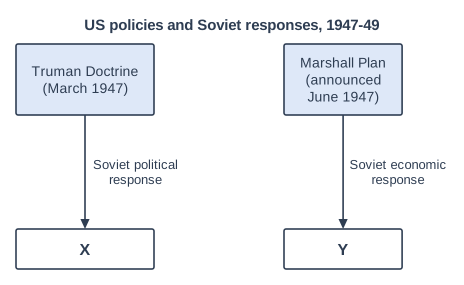
Figure 1 shows two US policies of 1947 and the Soviet responses to them.

Name the organisations that should replace X and Y.

US policies and Soviet responses, 1947-49. Block diagram with four parts in three rows. Top row, left to right: a box "Truman Doctrine (March 1947)" (shaded) and a box "Marshall Plan (announced June 1947)" (shaded). Bottom row, left to right: a box labelled X and a box labelled Y. Connections: an arrow from "Truman Doctrine (March 1947)" to box X, labelled "Soviet political response"; an arrow from "Marshall Plan (announced June 1947)" to box Y, labelled "Soviet economic response".

Model answer

X is Cominform, set up in September 1947, and Y is Comecon, set up in January 1949.

Explanation

Stalin set up Cominform in September 1947 to coordinate the communist parties of Europe and keep them loyal to Moscow, and Comecon in January 1949 as the Soviet bloc's economic alternative to the Marshall Plan. Both were part of his reaction to US containment.

Mark scheme
  1. 1 mark

    X: Cominform (the Communist Information Bureau).

    Accept Cominform alone.

  2. 1 mark

    Y: Comecon (the Council for Mutual Economic Assistance).

    Accept Comecon alone or CMEA. Do not accept the Warsaw Pact.

Question 2

4 marks

Source A: a summary of the resolution of the Cominform (the Communist Information Bureau) about Yugoslavia, published on 28 June 1948.

The resolution said that the leaders of the Communist Party of Yugoslavia had followed an unfriendly policy towards the Soviet Union and had insulted Soviet military and civilian advisers. It accused them of putting nationalism before loyalty to the international communist movement and of abandoning the teachings of Marx and Lenin. It called on the 'healthy elements' in the Yugoslav party to make their leaders admit their mistakes or replace them, and declared that the Yugoslav party had placed itself outside the Cominform.

Source A is critical of Tito's leadership of Yugoslavia. How do you know?

Explain your answer by referring to Source A and your contextual knowledge.

Model answer

Source A is critical of Tito's leadership because it accuses the Yugoslav leaders of being unfriendly to the Soviet Union, insulting Soviet advisers and putting nationalism before communism. Saying they had abandoned the teachings of Marx and Lenin was the worst accusation one communist could make against another. The call on 'healthy elements' to replace the leaders was really an appeal for the Yugoslav communists to overthrow Tito. I know the quarrel had grown because Tito refused to let Soviet advisers control the Yugoslav army and economy and made his own plans, such as a Balkan federation with Bulgaria.

The provenance also shows this. Cominform had been set up by Stalin in 1947 to keep communist parties loyal to Moscow, so this resolution expressed Stalin's anger. He wanted to make an example of Tito so that no other Eastern European leader would dare to follow an independent path.

Explanation

The Cominform resolution expelled Yugoslavia and called for Tito's removal because he would not obey Stalin. Level 2 needs developed explanation of the content or provenance supported by knowledge of the causes of the split or Stalin's control of Cominform.

Mark scheme
  1. 4 marks

    Levels of response (4 marks).
    Level 2 (3-4 marks): Developed analysis of Source A, explaining how its content and/or provenance show criticism of Tito's leadership, supported by relevant contextual knowledge, e.g. calling on 'healthy elements' to replace the leaders was an open call for Tito's overthrow, after Tito had refused to accept Soviet advisers and control of the Yugoslav economy and army; or Cominform was controlled by Stalin, who was determined to make an example of Tito so that other satellite states would not follow his independent line.
    Level 1 (1-2 marks): Simple analysis of Source A based on content and/or provenance, e.g. 'it says Yugoslavia was unfriendly to the USSR' or 'it was written by Tito's enemies', or general knowledge not linked to the source.
    0 marks: nothing worthy of credit.

    Indicative content (not a checklist; credit other valid points): content - accuses Yugoslav leaders of hostility to the USSR, of insulting Soviet advisers and of nationalism, all serious charges for communists; 'abandoning Marx and Lenin' calls them traitors to communism; urging 'healthy elements' to replace the leaders invites a revolt against Tito; Yugoslavia is put 'outside' the Cominform, i.e. expelled. Provenance - Cominform, set up by Stalin in 1947 to coordinate communist parties and keep them loyal to Moscow; its headquarters had been in Belgrade, which shows how serious the split was; a public resolution meant to isolate Tito and warn other parties. Context - Tito's partisans had freed Yugoslavia largely without the Red Army, so he had his own power base; disputes over Soviet advisers (withdrawn in March 1948) and joint companies; Tito's plans for a Balkan federation with Bulgaria and his support for the Greek communists angered Stalin; Stalin expected Tito to fall ('I will shake my little finger and there will be no more Tito', as Khrushchev later reported); purges of 'Titoists' followed in Hungary, Bulgaria, Poland and Czechoslovakia; Tito survived and accepted Western aid.

Question 3

12 marks

Source B: a summary of the 'Long Telegram' sent to the US government by George Kennan, a senior American diplomat in Moscow, in February 1946.

Kennan argued that the Soviet leaders had a traditional Russian sense of insecurity and used Marxist ideas to justify their harsh rule. They believed the USSR could never live peacefully alongside capitalist countries and would try to extend Soviet influence wherever it could. However, Soviet power was 'impervious to logic of reason' but 'highly sensitive to logic of force': it would usually back down when it met strong resistance.

Source C: a summary of a report sent to the Soviet government by Nikolai Novikov, the Soviet ambassador in Washington, in September 1946.

Novikov reported that American foreign policy reflected the greed of American big business and was aimed at world supremacy. The USA was greatly increasing its military spending and building bases all over the world, far from its own borders. Since Roosevelt's death, anti-Soviet forces had grown stronger in Washington, and the USA was preparing for a future war against the Soviet Union, which it saw as the main obstacle to its domination.

How useful are Sources B and C to an historian studying why relations between the USA and the USSR broke down in 1946?

Explain your answer using Sources B and C and your contextual knowledge.

Model answer

Source B is useful because it shows how the American government came to see the Soviet Union in 1946. Kennan argues that the Soviet leaders were insecure, used Marxism to justify their rule and believed they could never live peacefully alongside capitalism, so they would expand wherever they could. His conclusion that Soviet power was 'highly sensitive to logic of force' is important, because it became the basis of containment. The provenance makes it very valuable: Kennan was a Russia expert at the US embassy in Moscow, writing secretly to his own government, so he could be frank. His telegram was read widely in Washington and helped shape Truman's tougher policy, which led to the Truman Doctrine in 1947. However, it is one diplomat's interpretation of Soviet motives, not proof of Stalin's intentions; Stalin's actions in Poland and Romania could also be explained by a desire for security after the German invasion.

Source C is useful because it shows the other side of the breakdown. Novikov claims the USA was aiming at world supremacy, building bases around the world and preparing for war against the USSR. This reflects real Soviet fears: the USA had the atomic bomb, which it had used on Japan in 1945, it had ended Lend-Lease, and in 1946 Truman had sat beside Churchill during the 'Iron Curtain' speech. Novikov was well placed, as ambassador in Washington, but he wrote the report at the request of Molotov, the Soviet Foreign Minister, so he probably told the Soviet leaders what they already believed. That is a limitation as evidence of American aims, but it makes the source very useful for understanding Soviet thinking.

Overall, the two sources are most useful together. They are almost mirror images: each side's diplomat portrays the other as aggressive and expansionist. They show that the breakdown in 1946 was caused by mutual suspicion and ideology as much as by particular events, although an historian would need other evidence, such as what actually happened in Iran, Turkey and Eastern Europe, to judge how accurate each side's fears were.

Explanation

The Long Telegram and the Novikov Telegram show how each superpower had come to see the other as a threat by 1946. Level 4 needs evaluation of both sources using content and provenance, with a sustained judgement; noticing that they show perceptions on both sides, and that each was shaped by its government's views, is the key to a top answer.

Mark scheme
  1. 12 marks

    Levels of response (12 marks).
    Level 4 (10-12 marks): Complex evaluation of both sources with a sustained judgement about their usefulness, based on content AND provenance and supported by contextual knowledge, e.g. explains that the two reports are mirror images, written by diplomats for their own governments, which show how each superpower had come to see the other as expansionist and so explain the move to containment and the hardening of Soviet policy, while recognising that each reflects what its government wanted to hear.
    Level 3 (7-9 marks): Developed evaluation of both sources based on content and/or provenance, supported by relevant contextual knowledge, e.g. explains that Source B helped shape US containment policy and that Source C shows Soviet fears of US bases and the atomic monopoly.
    Level 2 (4-6 marks): Simple evaluation of one or both sources based on content and/or provenance, e.g. 'Source B is useful because Kennan lived in Moscow and knew the USSR'.
    Level 1 (1-3 marks): Basic analysis of one or both sources: describes what they say or who produced them, with no real evaluation of their usefulness.
    0 marks: nothing worthy of credit.

    Indicative content (not a checklist; credit other valid points): Source B content - Soviet insecurity, ideology, belief that capitalism and communism could not coexist, expansion wherever possible, but backing down when faced with force; this became the basis of containment. Source B provenance - Kennan was an expert on Russia at the US embassy in Moscow; a secret report to his own government, so frank; about 8,000 words long, it was widely read in Washington and influenced Truman, so it explains US policy (the Truman Doctrine of March 1947 and Kennan's 'X' article of 1947); limitation - it is one American's view of Soviet motives, not evidence of what Stalin actually intended. Source C content - the USA aims at world supremacy, increases military spending, builds bases, prepares for war; Roosevelt's death led to a tougher policy. Source C provenance - Soviet ambassador in Washington, so close to US politics; a secret report, written in Paris at the request of the Foreign Minister Molotov, who marked it up, so it probably tells Soviet leaders what they wanted to hear; it shows Soviet perceptions, which matter as much as facts in explaining the breakdown. Context - US atomic monopoly after Hiroshima (August 1945); end of Lend-Lease; Churchill's Iron Curtain speech (March 1946) with Truman present; Soviet control of Poland and Romania; the Iran crisis (Soviet troops stayed until May 1946); Soviet pressure on Turkey over the Straits; Byrnes' Stuttgart speech (September 1946); US bases in Europe and Asia. Judgement - very useful together, because they show the mutual suspicion and misperception behind the breakdown; both are limited because they are views of the other side's intentions, coloured by ideology and by what their governments expected.

Question 4

20 marks

'The USA was more to blame than the USSR for the growing rivalry between East and West in the years 1945-49.'

How far do you agree with this statement?

Explain your answer.

[16 marks] [SPaG 4 marks]

Model answer

There is a case that the USA was more to blame. When Truman became President in April 1945 he took a much harder line than Roosevelt, and the atomic bombs dropped on Japan in August 1945 gave the USA a monopoly of nuclear weapons, which Stalin saw as a threat and a form of pressure. Lend-Lease was ended abruptly, and the Americans would not agree to large reparations from the western zones of Germany. In 1946 Truman sat beside Churchill during the 'Iron Curtain' speech, and Kennan's Long Telegram led to the policy of containment. From the Soviet point of view, the USA was building bases around the world, as the Soviet ambassador Novikov reported in 1946. In 1947 the Truman Doctrine declared that the world must choose between two ways of life, and the Marshall Plan seemed to Stalin to be 'dollar imperialism' designed to buy influence in Europe. In 1948 the Western powers moved to create a separate West German state and introduced a new currency, and in 1949 they formed NATO. Seen from Moscow, the USA was the aggressor, and it was far more powerful than the war-shattered USSR.

However, there is a strong case that the USSR was more to blame. At Yalta Stalin had promised free elections in Eastern Europe, but he broke this promise. Communists backed by the Red Army took over the police, removed their rivals through 'salami tactics' and rigged elections, as in Poland in January 1947. Soviet troops stayed in northern Iran into 1946, and the USSR pressed Turkey for control of the Straits. Many American actions were responses to these events: the Truman Doctrine came after Britain could no longer support Greece and Turkey, and Congress passed the Marshall Plan only after the communist coup in Czechoslovakia in February 1948. Most seriously, in June 1948 Stalin blockaded West Berlin, trying to force the Western powers out by cutting more than two million people off from food and fuel. NATO was a direct response to that.

It can also be argued that neither side was wholly to blame, because the rivalry came from mutual suspicion. Each side believed it was acting defensively. Stalin, whose country had lost an estimated 20 million or more people, wanted security and believed capitalism was bound to be hostile. The Americans, remembering the appeasement of the 1930s, believed that if communism was not contained it would spread, as Kennan argued. Each defensive step looked aggressive to the other, creating a cycle of action and reaction.

Overall, I disagree with the statement. The USA did make the rivalry worse, especially with the Marshall Plan and its policy in Germany, and its greater power made Stalin feel threatened. But the Soviet Union was more to blame, because its actions in Eastern Europe came first, broke the agreements made at Yalta and were carried out by force, and the Berlin Blockade was the most aggressive act of the period. Most American policies were reactions to Soviet expansion, even if they were sometimes presented in ways that deepened Soviet suspicions.

Explanation

Responsibility for the Cold War is debated: some historians blame Soviet expansion, others American power and containment, and others mutual misunderstanding. Level 4 needs explanation of the actions of both sides with specific evidence and a sustained judgement; showing how each side's actions provoked the other strengthens the answer.

Mark scheme
  1. 16 marks

    Levels of response (16 marks).
    Level 4 (13-16 marks): Complex explanation of US actions and of Soviet actions (and possibly of mutual misunderstanding), showing how each side's actions provoked the other, with a range of accurate, detailed knowledge, leading to a sustained judgement about responsibility.
    Level 3 (9-12 marks): Developed explanation of US actions and of Soviet actions, with accurate, relevant knowledge.
    Level 2 (5-8 marks): Simple explanation of US actions or of Soviet actions, e.g. 'the Marshall Plan made Stalin feel threatened'.
    Level 1 (1-4 marks): Basic explanation of one or more factors: general statements with little specific knowledge.
    0 marks: nothing worthy of credit.

    Indicative content (not a checklist; credit other valid points): For the statement (US to blame): Truman was more hostile than Roosevelt (criticised Molotov in April 1945); the atomic bombs (August 1945) and the US nuclear monopoly; the abrupt end of Lend-Lease; refusal of reparations from the western zones; Churchill's Iron Curtain speech with Truman present (March 1946); the Long Telegram led to containment; US bases around the world (Novikov's report); the Truman Doctrine (March 1947) divided the world into two ways of life; the Marshall Plan seen as 'dollar imperialism'; Bizonia, the London Conference and the Deutschmark (1948) divided Germany and provoked the Blockade; NATO (1949) was a military alliance on the USSR's doorstep. Against (USSR to blame): Stalin broke the Yalta promise of free elections; Soviet takeover of Eastern Europe through 'salami tactics' and rigged elections (Poland, January 1947); Soviet troops stayed in northern Iran in 1946; pressure on Turkey over the Straits; the Czech coup (February 1948); the Berlin Blockade (June 1948) tried to starve West Berlin; Cominform and Comecon; Stalin's ideology and paranoia. Mutual misunderstanding: each side saw its own actions as defensive (Soviet security after 20+ million deaths; American fear of communism spreading through poverty); a cycle of action and reaction. Historians' views: 'orthodox' writers blamed Stalin's expansion; 'revisionists' blamed American economic and atomic power; 'post-revisionists' stressed mutual misperception. Possible judgements: the USSR more to blame because Soviet actions came first and broke agreements; the USA more to blame because it had more power and pushed containment; or both shared blame.

  2. 4 marks

    SPaG. High performance (4 marks): spells and punctuates with consistent accuracy; uses rules of grammar with effective control of meaning overall; uses a wide range of specialist terms as appropriate.
    Intermediate performance (2-3 marks): spells and punctuates with considerable accuracy; uses rules of grammar with general control of meaning overall; uses a good range of specialist terms as appropriate.
    Threshold performance (1 mark): spells and punctuates with reasonable accuracy; uses rules of grammar with some control of meaning and any errors do not significantly hinder meaning overall; uses a limited range of specialist terms as appropriate.
    0 marks: the student writes nothing, or the response does not relate to the question, or errors severely hinder meaning.

    SPaG marks are awarded only if the answer relates to the question.

Ready to try the rest? Every answer you write is marked against the mark scheme, so you can see exactly where the marks are.

AI Tutor Hints first, answers after you try

Hi! Stuck? Ask me for a hint and I’ll help you work it out. Once you’ve checked your answer I can explain exactly where the marks are.