Level:
Correct: 0
Incorrect: 0
Marks: 0/0
Exam Practice
Subject:
Topics:
AQA GCSE History (Conflict and tension 1945-1972) Smart practice A mixed round aimed at your weak spots
Unit 1
Part one: The origins of the Cold War
Unit 2
Part two: The development of the Cold War
Unit 3
Part three: Transformation of the Cold War
Avg
score:
–
Topics
done:
0/9

Tensions over Cuba

Practise 46 exam-style questions on Tensions over Cuba for AQA GCSE History (Conflict and tension 1945-1972). Write your answer as you would in the exam and get it marked in seconds against the mark scheme, point by point, with an AI tutor on hand if you get stuck.

  • 46 questions
  • 1–20 marks each
  • Instant marking
  • No sign-up needed
20 questions, marked as you go

Sample questions with model answers

Here are 4 of the questions in this topic, each with a model answer, an explanation of why it earns the marks and the mark scheme an examiner would use.

Question 1

2 marks

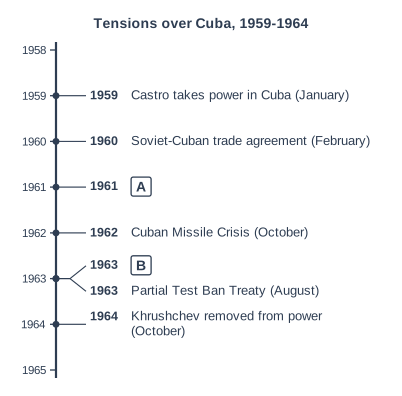
Figure 1 is a timeline of events involving Cuba from 1959 to 1964.

Identify the events labelled A and B on Figure 1.

Vertical timeline titled "Tensions over Cuba, 1959-1964", running from 1958 at the top to 1965 at the bottom, with the years marked every year (1958 to 1965). Events marked by dots on the line, in date order: 1959: Castro takes power in Cuba (January); 1960: Soviet-Cuban trade agreement (February); 1961: label A; 1962: Cuban Missile Crisis (October); 1963: label B; 1963: Partial Test Ban Treaty (August); 1964: Khrushchev removed from power (October).

Model answer

A is the Bay of Pigs invasion of April 1961. B is the setting up of the hotline between Washington and Moscow in 1963.

Explanation

The Bay of Pigs (April 1961) pushed Castro closer to the USSR and helped lead to the missile crisis. After the crisis, the hotline (agreed in June 1963) and the Partial Test Ban Treaty (August 1963) were the first steps towards easing tension.

Mark scheme
  1. 1 mark

    A (1961): the Bay of Pigs invasion.

    Accept 'CIA-backed Cuban exiles invade Cuba' or 'the USA breaks off relations with Cuba' (January 1961).

  2. 1 mark

    B (1963): the hotline between Washington and Moscow is set up.

    Accept 'the hotline' or 'a direct telephone / teleprinter link between the White House and the Kremlin'. Do not accept 'the Test Ban Treaty', which is already shown.

Question 2

4 marks

Source A: a cartoon published in an American newspaper in April 1961. (Written for practice.)
The cartoon shows President Kennedy hopping on one foot, holding a smoking pistol labelled 'CIA plan'. He has just shot himself in the other foot, which is bandaged and labelled 'Bay of Pigs'. In the background Fidel Castro, cigar in mouth, is laughing and waving a Cuban flag.

Source A criticises Kennedy's handling of the Bay of Pigs invasion. How do you know?

Explain your answer by referring to Source A and your contextual knowledge.

Model answer

Source A criticises Kennedy because it shows him shooting himself in the foot, which means harming himself through his own mistake. The pistol is labelled 'CIA plan', showing that Kennedy had approved a plan drawn up by the CIA, and the injured foot is labelled 'Bay of Pigs'. This fits what happened: in April 1961 about 1,400 CIA-trained Cuban exiles landed at the Bay of Pigs, but Kennedy refused to give them American air cover, the expected uprising never happened, and they were defeated within three days, with about 1,100 captured. Because American involvement was obvious, the USA was humiliated. Castro laughing in the background shows that he was the real winner: the failure made him more popular and pushed him closer to the Soviet Union, and he declared Cuba a socialist state. The provenance supports this: it was published in an American newspaper in April 1961, just after the failure, which shows that Kennedy faced criticism at home only three months into his presidency.

Explanation

Level 2 explains the 'shot himself in the foot' image and Castro's laughter, supported by knowledge of why the invasion failed and its consequences. Noting that an American newspaper criticised a new President develops the provenance.

Mark scheme
  1. 4 marks

    Levels of response (4 marks).
    Level 2 (3-4 marks): Developed analysis of Source A: explains how the content (e.g. Kennedy shooting himself in the foot with the 'CIA plan', Castro laughing) and/or the provenance (an American newspaper in April 1961, straight after the failure) show criticism of Kennedy, supported by relevant contextual knowledge (e.g. the plan inherited from Eisenhower, the refusal of air cover, the defeat within three days, about 1,100 exiles captured, Castro strengthened).
    Level 1 (1-2 marks): Simple analysis of Source A: identifies a relevant feature, e.g. 'Kennedy has shot himself in the foot', with little or no supporting knowledge.
    0 marks: nothing worthy of credit.

    Indicative content (not a checklist; credit other valid points): 'shooting yourself in the foot' means harming yourself through your own mistake - Kennedy damaged the USA and himself; the pistol labelled 'CIA plan' shows the invasion was planned by the CIA and approved by Kennedy; Castro laughing shows he was the winner, strengthened by the failure; context - the plan was drawn up under Eisenhower (1960) and approved by Kennedy; about 1,400 CIA-trained exiles landed on 17 April 1961; Kennedy cancelled a second air strike and refused US air cover; the expected uprising did not happen; about 20,000 Cuban troops defeated the exiles within three days; over 100 were killed and about 1,100 captured; US involvement was obvious, so the USA was humiliated; Castro declared Cuba socialist and moved closer to the USSR; Khrushchev saw Kennedy as weak; Kennedy publicly took responsibility; provenance - an American newspaper in April 1961, showing that Kennedy faced criticism at home, not only abroad, just three months into his presidency.

Question 3

8 marks

Write an account of how the USA reacted to the discovery of Soviet missiles on Cuba between 14 and 24 October 1962.

Model answer

On 14 October 1962 an American U-2 spy plane flew over Cuba and photographed Soviet missile sites under construction. On 16 October President Kennedy was shown the photographs. He set up a special group of advisers, known as ExComm, including his brother Robert Kennedy, Defense Secretary Robert McNamara and Secretary of State Dean Rusk, as well as military chiefs. To keep the discovery secret, Kennedy carried on with his normal public schedule while ExComm met.

ExComm discussed several options. Doing nothing would make Kennedy look weak and leave the missiles in place. The military chiefs, such as General Curtis LeMay, wanted air strikes followed by an invasion. However, an air strike could not be certain of destroying all the missiles, and both an air strike and an invasion would kill Soviet troops on Cuba, which could lead to nuclear war or a Soviet move against West Berlin. Gradually ExComm came to favour a naval blockade. Because a blockade was an act of war under international law, Kennedy called it a 'quarantine'. It would stop more missiles reaching Cuba, show American determination and give Khrushchev time to back down, while stronger options remained available.

On 22 October Kennedy went on television to tell the American people about the missiles. He announced the quarantine and warned that any nuclear missile launched from Cuba would be treated as an attack by the Soviet Union on the United States, requiring a full retaliatory response. America's allies were informed, and on 23 October the Organisation of American States voted to support the quarantine, giving it legal backing. Meanwhile US forces gathered in Florida in case an invasion was needed.

The quarantine came into force on 24 October, about 500 nautical miles from Cuba, and American nuclear forces were put on DEFCON 2, their highest state of alert ever. As Soviet ships approached the line, the world held its breath, but they stopped or turned back. Dean Rusk remarked, 'We're eyeball to eyeball, and I think the other fellow just blinked.' The quarantine had worked, but the missiles already on Cuba remained, so the crisis was not yet over.

Explanation

A strong account explains the discovery, the options considered by ExComm and why the quarantine was preferred to an air strike or invasion, then the 22 October broadcast and the quarantine taking effect on 24 October. Level 4 explains the reasoning behind Kennedy's choices.

Mark scheme
  1. 8 marks

    Levels of response (8 marks).
    Level 4 (7-8 marks): Complex analysis: a coherent, well-structured account that explains how the missiles were discovered, how Kennedy and ExComm weighed the options, why the quarantine was chosen, how it was announced and supported, and how it took effect on 24 October, explaining the reasons for each decision, supported by extended, accurate knowledge.
    Level 3 (5-6 marks): Developed analysis in a well-ordered account: explains several stages of the US reaction with accurate knowledge, though some links are less developed.
    Level 2 (3-4 marks): Simple analysis: a basic account, e.g. that Kennedy set up a blockade.
    Level 1 (1-2 marks): Basic analysis: general statements, with limited knowledge.
    0 marks: nothing worthy of credit.

    Indicative content (not a checklist; credit other valid points): 14 October - a U-2 piloted by Major Richard Heyser photographed missile sites; 16 October - Kennedy was shown the photographs; ExComm formed (Robert Kennedy, McNamara, Rusk, Bundy, military chiefs); it met in secret for several days; options - do nothing, diplomacy, an air strike ('surgical strike'), invasion, blockade; the military chiefs (e.g. General Curtis LeMay) favoured air strikes and invasion; but an air strike could not be sure of destroying all the missiles and would kill Soviet troops; an invasion risked war and a Soviet move against Berlin; a blockade was called a 'quarantine' because a blockade was an act of war under international law; it would stop more missiles arriving and give Khrushchev time to back down; Kennedy kept up his normal schedule to keep the discovery secret; 22 October - Kennedy's television address: the missiles, the quarantine, a warning that any missile launched from Cuba would bring a full retaliatory response; allies were informed (e.g. Britain's Macmillan, France's de Gaulle); 23 October - the Organisation of American States backed the quarantine; US forces prepared for invasion; 24 October - the quarantine came into force about 500 nautical miles from Cuba; SAC went to DEFCON 2; Soviet ships stopped or turned back - Rusk: 'eyeball to eyeball'.

Question 4

20 marks

'The Bay of Pigs invasion was the main reason for the Cuban Missile Crisis.'

How far do you agree with this statement?

Explain your answer.

[16 marks] [SPaG 4 marks]

Model answer

The Cuban Missile Crisis began in October 1962, eighteen months after the failed Bay of Pigs invasion of April 1961. The invasion was an important cause of the crisis, because it pushed Castro towards the Soviet Union, convinced both Castro and Khrushchev that Cuba needed protection, and made Khrushchev think Kennedy was weak. However, I think the main reason for the crisis was the nuclear rivalry between the superpowers, which made Khrushchev willing to take such a risk.

The Bay of Pigs was clearly important. About 1,400 CIA-trained Cuban exiles landed on 17 April 1961 and were defeated within three days. The invasion convinced Castro that the USA would try again, this time with American troops. On the eve of the landing he declared his revolution socialist, and by December 1961 he called himself a Marxist-Leninist, moving Cuba firmly into the Soviet camp. The invasion was followed by further American pressure, including Operation Mongoose, a CIA campaign of sabotage and plots against Castro, and Cuba's suspension from the Organisation of American States in January 1962. All this explains why Castro was willing to accept Soviet missiles, and why Khrushchev could present them as defensive.

The Bay of Pigs also shaped Khrushchev's view of Kennedy. He concluded that the young President was weak and indecisive, because Kennedy had approved the invasion but would not use American forces to make it succeed. This view was strengthened at the Vienna Summit in June 1961 and when Kennedy accepted the Berlin Wall in August. Khrushchev therefore believed he could place missiles on Cuba and Kennedy would accept them.

However, other factors were also important. Relations between the USA and Cuba had already collapsed before the invasion. Castro's land reform and nationalisation of American businesses, his trade deal with the Soviet Union in 1960, and the American sugar cut and trade embargo had already turned Cuba towards the USSR. The Bay of Pigs made this worse but did not start it.

The most important factor was the nuclear balance. Although Khrushchev boasted about Soviet rockets, the USA had far more long-range missiles than the USSR, and it had placed Jupiter missiles in Turkey, on the Soviet border. Missiles on Cuba were a cheap way to close this gap and to give the Americans what Khrushchev called 'a little of their own medicine'. He may also have hoped to use them to win concessions over Berlin. This explains why Khrushchev sent nuclear missiles, including intermediate-range missiles that could reach almost the whole USA, rather than simply sending troops to defend Cuba.

Finally, the crisis was also caused by the American reaction. Kennedy decided that the missiles were unacceptable because they had been placed in secret, because they challenged American power in its own hemisphere and because he could not afford to look weak, especially before the November elections. A crisis happened because both leaders were determined not to back down.

In conclusion, the Bay of Pigs was an important cause of the Cuban Missile Crisis, because it drove Castro into the arms of the Soviet Union and convinced Khrushchev that Kennedy was weak. But it was not the main reason. Relations had already broken down before 1961, and the decision to send nuclear missiles is best explained by the superpowers' nuclear rivalry and Khrushchev's wish to close the missile gap. The Bay of Pigs helped make the crisis possible, but superpower rivalry made it happen.

Explanation

Explain how the Bay of Pigs pushed Castro towards the USSR, created fear of invasion and shaped Khrushchev's view of Kennedy, then weigh it against the earlier breakdown of relations, the missile gap and Turkey, Berlin and Kennedy's reaction. Level 4 sustains a judgement about which mattered most.

Mark scheme
  1. 16 marks

    Levels of response (16 marks).
    Level 4 (13-16 marks): Complex explanation of the Bay of Pigs as a cause (Castro's move to the USSR, the fear of invasion, Khrushchev's view of Kennedy) and of other causes (the breakdown of US-Cuban relations from 1959, the missile gap and the Jupiters in Turkey, Khrushchev's ambitions and gamble, Berlin, Kennedy's response to the missiles), weighing them against each other, supported by extended, accurate knowledge, leading to a sustained judgement.
    Level 3 (9-12 marks): Developed explanation of the stated factor and other factors, or a well-developed explanation of one with some reference to the other, supported by relevant, accurate knowledge; a judgement may be given but is not fully sustained.
    Level 2 (5-8 marks): Simple explanation of the stated factor or other factors, with some relevant knowledge.
    Level 1 (1-4 marks): Basic explanation: general statements, with limited knowledge.
    0 marks: nothing worthy of credit.

    Indicative content (not a checklist; credit other valid points): the Bay of Pigs (April 1961) - about 1,400 CIA-trained exiles defeated; Castro declared the revolution socialist and moved into the Soviet camp; Castro and Khrushchev expected a new, stronger invasion - a key reason for the missiles; Khrushchev concluded Kennedy was weak; it led to Operation Mongoose and further US pressure; other causes - the earlier breakdown of US-Cuban relations (1959-61): land reform, nationalisation, the Soviet trade deal (1960), the sugar cut and embargo; Castro was already turning to the USSR before the invasion; the missile gap - the USA had far more long-range missiles; the Jupiter missiles in Turkey; Khrushchev's personal gamble and his belief that Kennedy would accept the missiles (also shaped by Vienna, June 1961, and the Berlin Wall, August 1961); Berlin - a possible bargaining chip; Operation Mongoose (from November 1961), US exercises and the OAS suspension (January 1962) kept the fear of invasion alive; the crisis itself was caused by Kennedy's decision that the missiles were unacceptable (secrecy, credibility, elections) rather than by the missiles alone; possible judgements - the Bay of Pigs was an important trigger that linked Cuba to the USSR and shaped Khrushchev's view of Kennedy, but the main reason was the superpower rivalry and the missile gap; or it was the main reason, as without it neither Castro nor Khrushchev would have seen the need for missiles on Cuba.

  2. 4 marks

    SPaG. High performance (4 marks): spells and punctuates with consistent accuracy; uses rules of grammar with effective control of meaning overall; uses a wide range of specialist terms as appropriate.
    Intermediate performance (2-3 marks): spells and punctuates with considerable accuracy; uses rules of grammar with general control of meaning overall; uses a good range of specialist terms as appropriate.
    Threshold performance (1 mark): spells and punctuates with reasonable accuracy; uses rules of grammar with some control of meaning and any errors do not significantly hinder meaning overall; uses a limited range of specialist terms as appropriate.
    0 marks: the student writes nothing, or the response does not relate to the question, or errors severely hinder meaning.

    SPaG marks are awarded only if the answer relates to the question.

Ready to try the rest? Every answer you write is marked against the mark scheme, so you can see exactly where the marks are.

AI Tutor Hints first, answers after you try

Hi! Stuck? Ask me for a hint and I’ll help you work it out. Once you’ve checked your answer I can explain exactly where the marks are.