Level:
Correct: 0
Incorrect: 0
Marks: 0/0
Exam Practice
Subject:
Topics:
Avg
score:
–
Topics
done:
0/8

The Gulf War,1990

Practise 48 exam-style questions on The Gulf War,1990 for AQA GCSE History (Gulf and Afghanistan 1990-2009). Write your answer as you would in the exam and get it marked in seconds against the mark scheme, point by point, with an AI tutor on hand if you get stuck.

  • 48 questions
  • 1–20 marks each
  • Instant marking
  • No sign-up needed
20 questions, marked as you go

Sample questions with model answers

Here are 4 of the questions in this topic, each with a model answer, an explanation of why it earns the marks and the mark scheme an examiner would use.

Question 1

2 marks

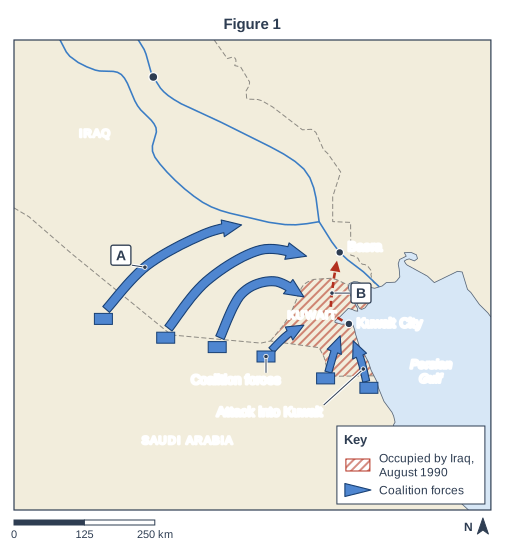
Figure 1 is a map of the coalition's ground offensive against Iraqi forces in February 1991.

What do the arrows labelled A and the dashed arrow labelled B show?

Map of a region of countries around the head of a gulf. The heading reads "Figure 1". Map (north at the top) with borders, a scale bar and north arrow, showing the head of a gulf: two rivers flow south-east and join just above it; a small country sits at the head of the gulf with a dot on its coast, a large country lies to the south and another to the east. A larger dot is near the top on the eastern river and a dot on the waterway just above the gulf. Blue blocks stand in a line along the northern border of the large southern country; blue arrows sweep north from them into the country with two rivers, west of the small country at the head of the gulf, and curve east; short blue arrows point north into the small country, which is hatched red; a dashed red arrow runs from the dot on its coast north towards the dot on the waterway. The scale bar shows 250 km. A key shows red hatching: "Occupied by Iraq, August 1990"; a blue block arrow: "Coalition forces". Label A points to the blue arrows sweeping north from the large southern country into the country with two rivers, west of the small country, and curving east; label B points to the dashed red arrow from the dot on the coast of the small country north towards the dot on the waterway; the label "Coalition forces" points to the blue blocks in a line along the northern border of the large southern country; the label "Attack into Kuwait" points to the short blue arrows pointing north into the small country at the head of the gulf; the label "Kuwait City" points to the dot on the coast of the small country at the head of the gulf; the label "Basra" points to the dot on the waterway just above the head of the gulf; the label "IRAQ" is written on the country with two long rivers flowing south-east to the head of the gulf; the label "KUWAIT" is written on the small country at the head of the gulf; the label "SAUDI ARABIA" is written on the large country in the south; the label "Persian Gulf" is written on the gulf in the south-east.

Model answer

A shows the 'left hook', in which coalition armoured forces swept through the desert west of Kuwait into southern Iraq to cut off the Iraqi army. B shows the Iraqi retreat from Kuwait towards Basra, along the road that became known as the 'Highway of Death'.

Explanation

General Schwarzkopf's plan made the Iraqis expect a landing from the sea while US and British armoured divisions outflanked them through the desert. The Iraqi army collapsed within about 100 hours (24-28 February 1991), and its retreating columns were attacked from the air on the road to Basra.

Mark scheme
  1. 1 mark

    A: the 'left hook' - coalition armoured forces sweeping through the desert west of Kuwait into southern Iraq and turning east to cut off the Iraqi army.

    Accept: the left hook / coalition (US and British) forces outflanking the Iraqi army / attack into Iraq west of Kuwait. Do not accept: the Iraqi invasion / Desert Shield / the attack into Kuwait (shown separately).

  2. 1 mark

    B: the Iraqi retreat from Kuwait towards Basra (along the road known as the 'Highway of Death').

    Accept: Iraqi forces fleeing Kuwait / the retreat to Basra / the Highway of Death. Do not accept: the Iraqi invasion of Kuwait / a coalition attack.

Question 2

4 marks

Source A: a cartoon published in a Jordanian newspaper in September 1990. (Written for practice.)
It shows a huge American soldier in a cowboy hat sitting on the dome of a mosque in the Arabian desert, his boots resting on barrels labelled 'Arab oil'. A small Gulf ruler in robes kneels to serve him coffee. In the background, an Israeli tank rolls through a Palestinian village while the soldier looks the other way. The caption reads: 'The new guardians of the Gulf'.

Source A opposes the presence of US forces in the Gulf. How do you know?

Explain your answer by referring to Source A and your contextual knowledge.

Model answer

Source A opposes the US presence because it shows a huge American soldier sitting on the dome of a mosque, which suggests that US forces were showing contempt for Islam by being based in Saudi Arabia, the land of Mecca and Medina. His boots rest on barrels of 'Arab oil', suggesting that oil, not justice, was the real reason the Americans had come. The Gulf ruler kneeling to serve him coffee suggests that Arab rulers had become servants of the USA. Most pointedly, the soldier looks the other way while an Israeli tank rolls through a Palestinian village, accusing the USA of double standards: it acted against Iraq's occupation of Kuwait but not against Israel's occupation of Palestinian land. I know that King Fahd invited US forces into Saudi Arabia in August 1990 and that hundreds of thousands arrived. Saddam exploited Arab anger over Israel with his 'linkage' proposal, and in Jordan, where many people were Palestinians, there was strong sympathy for Iraq. King Hussein refused to join the coalition. The cartoon comes from a Jordanian newspaper, so it reflects this popular opposition.

Explanation

Level 2 answers explain how the cartoon's details (the mosque, the oil, the kneeling ruler, the ignored Israeli tank) attack the US presence, and support this with context such as King Fahd's invitation, linkage and Jordanian opinion, or with the provenance. Describing the cartoon without context is Level 1.

Mark scheme
  1. 4 marks

    Levels of response (4 marks).
    Level 2 (3-4 marks): Developed analysis of Source A supported by relevant contextual knowledge: explains how details (the soldier on the mosque, the oil barrels, the kneeling ruler, the ignored Israeli tank, the ironic caption) present US forces as occupiers interested in oil who humiliate Arab rulers and ignore Palestinian suffering, and supports this with specific context (e.g. King Fahd's invitation to US forces, Jordan's refusal to join the coalition, Saddam's 'linkage', criticism by Saudi clerics) and/or the provenance (a Jordanian newspaper, reflecting Jordanian and Palestinian opinion).
    Level 1 (1-2 marks): Simple analysis of Source A: identifies a critical feature (e.g. the Americans want the oil) with little or no contextual knowledge.
    0 marks: nothing worthy of credit.

    Indicative content (not a checklist; credit other valid points): The soldier sitting on a mosque suggests US forces disrespect Islam and its holy places (US troops were based in Saudi Arabia, home of Mecca and Medina); his boots on 'Arab oil' barrels suggest the real motive is oil; the kneeling Gulf ruler suggests Arab rulers had become servants of the USA; the Israeli tank the soldier ignores suggests double standards - the USA acts against Iraq's occupation of Kuwait but not Israel's occupation of Palestinian land; the caption 'new guardians' is ironic, implying a new foreign occupation. Context: King Fahd invited US forces on 6 August 1990 (Desert Shield); hundreds of thousands of foreign troops arrived; Saddam's 'linkage' proposal (12 August) drew on Arab anger over Israel; Jordan's King Hussein refused to join the coalition and tried to mediate; many Jordanians, including a large Palestinian population, sympathised with Iraq; some Saudi clerics and Osama bin Laden condemned the presence of non-Muslim troops. Provenance: a Jordanian newspaper in 1990 reflected strong popular opposition in Jordan; Jordan depended on trade with Iraq.

Question 3

12 marks

Source B: a summary of a passage from Margaret Thatcher's memoirs, The Downing Street Years, published in 1993. She describes meeting President Bush at Aspen, Colorado, on 2 August 1990 and urging him to stand firm. She also recalls that in late August, when Bush decided to let an Iraqi oil tanker pass rather than stop it before the UN had authorised a blockade, she agreed but told him that this was 'no time to go wobbly'.

Source C: from a report by an American journalist in Washington, August 1990. (Written for practice.)
'Some in London claim that Mrs Thatcher stiffened the President's spine at Aspen. White House officials tell a different story. They say the President had already decided that the invasion could not be allowed to stand, and that the key decisions - sending troops to Saudi Arabia and taking the crisis to the United Nations - were his own.'

How useful are Sources B and C to an historian studying the roles of Bush and Thatcher in the Gulf crisis of 1990?

Explain your answer using Sources B and C and your contextual knowledge.

Model answer

Source B is useful because it shows how Thatcher saw her own role. She describes urging Bush to stand firm when they met at Aspen on 2 August 1990, the day of the invasion, and later telling him that it was 'no time to go wobbly' when he decided to let an Iraqi tanker pass. This fits what I know: Thatcher was determined from the start, shaped by her experience of the Falklands War, and Britain quickly sent aircraft, warships and an armoured brigade to the Gulf. However, the provenance means it must be treated with care. These are her memoirs, written in 1993 after she had been forced out of office, so she had a strong motive to emphasise her influence and her decisiveness, and she was writing with hindsight. The source also shows that she accepted Bush's decision over the tanker, which suggests he was the one in charge.

Source C presents the opposite view, that the key decisions were Bush's. My knowledge supports this to a large extent. On 5 August Bush declared that the invasion 'will not stand'; he persuaded King Fahd to accept US troops and announced Operation Desert Shield on 8 August; he insisted on working through the UN, which Thatcher thought unnecessary; and the USA provided over half a million troops. However, C is also one-sided. It is based on unnamed White House officials, who wanted Bush to receive the credit, and an American journalist might naturally play down a British role.

Overall, the sources are most useful together, because each reflects the interests of its author and together they reveal the debate about who led the response. Source C is probably closer to the truth about who took the decisions, since the USA had the power and Bush made the key moves, but Source B shows that Thatcher encouraged firmness in the crucial early weeks. Neither source covers the war itself, as Thatcher resigned in November 1990 and John Major led Britain during Desert Storm.

Explanation

Level 4 answers recognise that both sources have a motive - Thatcher's memoirs written after her fall; a report based on White House officials - and test their claims against context such as Aspen, 'This will not stand', Desert Shield and the UN strategy. A sustained judgement might be that Bush made the decisions while Thatcher stiffened resolve early on.

Mark scheme
  1. 12 marks

    Levels of response (12 marks).
    Level 4 (10-12 marks): Complex evaluation of both sources with sustained judgement based on content and provenance: evaluates what each source claims about the relative roles of Bush and Thatcher, weighs their provenance (Thatcher's own memoirs, written after her fall with a motive to emphasise her role; a contemporary journalist relying on White House officials who wanted credit for Bush), and uses contextual knowledge (e.g. Aspen, 'This will not stand', Desert Shield, the UN resolutions, Thatcher's resignation) to reach a sustained judgement.
    Level 3 (7-9 marks): Developed evaluation of both sources based on content and/or provenance, supported by relevant contextual knowledge.
    Level 2 (4-6 marks): Simple evaluation of one or both sources based on content and/or provenance, with some contextual knowledge.
    Level 1 (1-3 marks): Basic analysis of one or both sources: describes or paraphrases them with little or no evaluation.
    0 marks: nothing worthy of credit.

    Indicative content (not a checklist; credit other valid points): Source B content: Thatcher urged Bush to stand firm at Aspen on 2 August and pressed him again in late August ('no time to go wobbly') - suggesting she strengthened his resolve. Context: Thatcher was at Aspen for a conference; her Falklands experience; British forces sent in August and September 1990; Bush was working to get UN Resolution 665 (25 August) authorising naval enforcement of sanctions. Source B provenance: Thatcher's own account, written in 1993 after her fall from power, so she had every reason to stress her influence and her decisiveness; written with hindsight, though she had access to her papers and was present at the events; it also shows she accepted Bush's decision, which limits her claim. Source C content: claims Bush had already decided and that the key decisions were his. Context: Bush said 'This will not stand' on 5 August; he persuaded King Fahd to accept US troops (6 August) and announced Desert Shield (8 August); he insisted on working through the UN and built the coalition; the USA provided over half a million troops. Source C provenance: a contemporary report, but based on unnamed White House officials who wanted Bush to get the credit; American journalists might also play down a British role. Judgement: each source reflects its author's interest; together they show the debate about influence; most historians accept that Bush made the decisions while Thatcher encouraged firmness early on; both are more useful for the first weeks of the crisis than for the war itself (Thatcher resigned in November 1990).

Question 4

20 marks

'The UN campaign against Saddam Hussein in 1990-1991 was a success.'

How far do you agree with this statement?

Explain your answer.
[16 marks] [SPaG 4 marks]

Model answer

The UN campaign against Saddam Hussein was a success in achieving its main aim, the liberation of Kuwait, and it showed that the Security Council could work as its founders intended. However, it was a limited success: sanctions alone failed, the war was really fought by a US-led coalition, and Saddam was left in power, creating problems that lasted for over a decade.

The campaign's achievements were considerable. On the day of the invasion the Security Council passed Resolution 660 demanding Iraq's withdrawal, followed by sanctions (Resolution 661), the declaration that the annexation was void (662) and a naval blockade (665). On 29 November 1990, Resolution 678 authorised 'all necessary means' to free Kuwait if Iraq had not left by 15 January 1991. This unity was possible because the Cold War was ending: the Soviet Union voted with the USA, and China abstained rather than using its veto. UN authority gave the coalition of more than 30 countries, including Egypt, Syria and Saudi Arabia, a legitimacy that a purely American war would have lacked. By 28 February 1991 Kuwait had been liberated and its government restored, so aggression had been reversed.

The UN also tried to make the victory last. Resolution 687 in April 1991 required Iraq to destroy its chemical and biological weapons and long-range missiles under UN inspection, and in the following years UNSCOM inspectors destroyed large quantities of weapons. Resolution 688 condemned Saddam's repression of the Kurds.

However, the campaign had serious limitations. Sanctions, which were meant to force Iraq out peacefully, did not work, and in the end it took a war. The war was fought not by UN forces but by a coalition led and dominated by the USA, which provided over half a million troops, and critics saw the UN as a tool of American policy; Yemen lost US aid after voting against Resolution 678. Most importantly, Saddam remained in power. The Shia and Kurdish uprisings of March 1991 were crushed, more than a million Kurds fled, and the no-fly zones that followed were set up by the USA, Britain and France rather than by a specific UN resolution. Sanctions remained for years, causing great suffering for ordinary Iraqis, and by 1998 Iraq had forced the inspectors out and the Security Council was divided.

Overall, I largely agree with the statement. Judged by its stated aim, to reverse the invasion of Kuwait, the UN campaign was a clear success and a rare example of collective security working. But it solved the immediate crisis rather than the problem of Saddam Hussein, and the limitations of the post-war settlement meant that the Gulf remained unstable throughout the 1990s.

Explanation

Level 4 answers explain the campaign's successes (the resolutions, unity after the Cold War, legitimacy, the liberation of Kuwait, Resolution 687) and its limitations (sanctions failed, US domination, Saddam's survival, the crushed uprisings, the long-term cost of sanctions), reaching a sustained judgement about what 'success' means here.

Mark scheme
  1. 16 marks

    Levels of response (16 marks).
    Level 4 (13-16 marks): Complex explanation of the ways the UN campaign succeeded (e.g. Kuwait liberated, international law upheld, unprecedented unity in the Security Council, the legitimacy it gave the coalition, disarmament under Resolution 687) and the ways it failed or was limited (e.g. sanctions did not force withdrawal, the war was fought by a US-led coalition rather than the UN, Saddam stayed in power, the uprisings were crushed, the humanitarian cost of sanctions, later divisions), with a range of accurate, specific knowledge, leading to a sustained judgement.
    Level 3 (9-12 marks): Developed explanation of both successes and limitations, with accurate supporting knowledge.
    Level 2 (5-8 marks): Simple explanation of successes or limitations.
    Level 1 (1-4 marks): Basic explanation, with little specific knowledge.
    0 marks: nothing worthy of credit.

    Indicative content (not a checklist; credit other valid points): Successes: Resolution 660 demanded withdrawal on the day of the invasion; 661 imposed sanctions; 662 declared the annexation void; 665 enforced a blockade; 678 (29 November 1990, 12-2, China abstaining) authorised force - the Security Council worked as intended because the Cold War was ending (the Soviet Union voted with the USA); the coalition of more than 30 countries, including Arab states, had legitimacy; Kuwait was liberated by 28 February 1991 and its government restored; aggression was reversed. Resolution 687 (April 1991) required Iraq to destroy its chemical and biological weapons and long-range missiles under UN inspection (UNSCOM), accept the border and pay compensation; UNSCOM destroyed large quantities of weapons in the 1990s. Resolution 688 condemned the repression of the Kurds. Limitations: sanctions did not make Saddam withdraw; the war was fought by a US-led coalition, not a UN force, and some saw the UN as a tool of the USA (Yemen lost US aid after voting against 678); Saddam remained in power; the Shia and Kurdish uprisings of March 1991 were crushed and over a million Kurds fled; the no-fly zones were set up by the USA, Britain and France rather than by a specific UN resolution; long-term sanctions caused great suffering for ordinary Iraqis; Iraq obstructed inspectors and UNSCOM left in 1998; the Security Council divided in the late 1990s (Russia, France and China against the USA and Britain). Possible judgements: a success in its stated aim (liberating Kuwait) and as a model of collective security; or a limited success because it left Saddam in power and created long-term problems.

  2. 4 marks

    SPaG. High performance (4 marks): spells and punctuates with consistent accuracy; uses rules of grammar with effective control of meaning overall; uses a wide range of specialist terms as appropriate.
    Intermediate performance (2-3 marks): spells and punctuates with considerable accuracy; uses rules of grammar with general control of meaning overall; uses a good range of specialist terms as appropriate.
    Threshold performance (1 mark): spells and punctuates with reasonable accuracy; uses rules of grammar with some control of meaning and any errors do not significantly hinder meaning overall; uses a limited range of specialist terms as appropriate.
    0 marks: the student writes nothing, or the response does not relate to the question, or errors severely hinder meaning.

    SPaG marks are awarded only if the answer relates to the question.

Ready to try the rest? Every answer you write is marked against the mark scheme, so you can see exactly where the marks are.

AI Tutor Hints first, answers after you try

Hi! Stuck? Ask me for a hint and I’ll help you work it out. Once you’ve checked your answer I can explain exactly where the marks are.