Level:
Correct: 0
Incorrect: 0
Marks: 0/0
Exam Practice
Subject:
Topics:
Avg
score:
–
Topics
done:
0/8

Regional instability

Practise 48 exam-style questions on Regional instability for AQA GCSE History (Gulf and Afghanistan 1990-2009). Write your answer as you would in the exam and get it marked in seconds against the mark scheme, point by point, with an AI tutor on hand if you get stuck.

  • 48 questions
  • 1–20 marks each
  • Instant marking
  • No sign-up needed
20 questions, marked as you go

Sample questions with model answers

Here are 4 of the questions in this topic, each with a model answer, an explanation of why it earns the marks and the mark scheme an examiner would use.

Question 1

2 marks

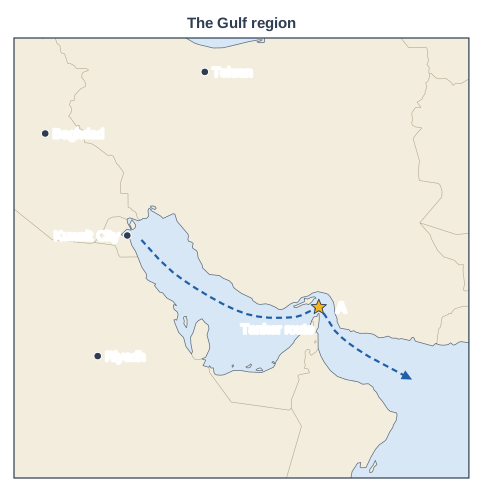
Figure 1 is a map of the Gulf region.

Name the narrow sea passage labelled A, and explain why Western governments were worried about it during the Iran-Iraq War.

Map of the area from 43°E to 63°E and from 20°N to 37°N, titled "The Gulf region". Points: a yellow star labelled A near the centre of the map (about 65% of the way across from the left and 60% of the way down); a dot labelled "Baghdad" in Iraq; a dot labelled "Tehran" in Iran; a dot labelled "Kuwait City" in Kuwait; a dot labelled "Riyadh" in Saudi Arabia. Lines drawn: a dashed line with an arrowhead at its end labelled "Tanker route" from the Persian Gulf (part of the Indian Ocean), about 30 km off the coast of Kuwait to the Arabian Sea (part of the Indian Ocean), heading generally south-east.

Model answer

A is the Strait of Hormuz. Western governments were worried because most of the Gulf's oil exports pass through this narrow strait by tanker, and Iran, which lies on its northern side, could attack tankers or try to close it, cutting oil supplies to the West.

Explanation

The Strait of Hormuz is the only sea route out of the Persian Gulf. During the Tanker War (1984-88) Iran attacked shipping and laid mines, so the USA, Britain and other countries sent warships to keep the oil flowing.

Mark scheme
  1. 1 mark

    A: the Strait of Hormuz.

    Accept: Straits of Hormuz / Hormuz Strait / Hormuz. Do not accept: Shatt al-Arab / Persian Gulf / Gulf of Oman / Suez Canal.

  2. 1 mark

    A valid explanation: most of the oil exported from the Gulf by tanker passes through it, and Iran (which borders it) could attack shipping or threaten to close it, cutting off oil supplies to the West and pushing up prices.

    Accept any one developed point linking the strait to oil supplies and a threat to them, e.g. the Tanker War of 1984-88, Iranian mines and gunboats near the strait, Iran's threats to close it. A bare 'oil goes through it' without a threat earns the mark only if it explains why that mattered to the West (e.g. dependence on Gulf oil).

Question 2

4 marks

Source A: a cartoon published in a British newspaper in August 1990. (Written for practice.)
It shows Saddam Hussein in military uniform standing on a map of Kuwait, with a large sack labelled 'Kuwait's oil' slung over his shoulder. With his other hand he waves a banner reading 'Justice for Palestine!' at a cheering crowd. Under his boot lies a small, flattened figure labelled 'Kuwait'.

Source A criticises the way Saddam Hussein used the Palestinian issue in 1990. How do you know?

Explain your answer by referring to Source A and your contextual knowledge.

Model answer

Source A criticises Saddam because it shows him holding up a banner for 'Justice for Palestine' while carrying a sack of Kuwait's oil and standing on a crushed Kuwait. The cartoonist is saying that his concern for the Palestinians is a trick to distract attention from his real aim, which was to grab Kuwait's oil, and that he is a hypocrite, because he complains about Israel's occupation while occupying Kuwait himself. I know that after invading Kuwait on 2 August 1990, Saddam announced on 12 August that Iraq would discuss leaving Kuwait only if Israel withdrew from the occupied Palestinian territories. This 'linkage' was meant to win Arab support and divide the coalition forming against him, and the cheering crowd shows it had some success: the PLO and many Jordanians and Palestinians backed Saddam. But his real motives were economic, such as Iraq's war debts and his anger at Kuwait's overproduction of oil. The cartoon was published in Britain in August 1990, when Britain was sending forces to the Gulf, so it reflects British hostility to Saddam.

Explanation

Level 2 answers explain the contrast in the cartoon (the Palestine banner versus the oil and the crushed Kuwait) and support it with knowledge of the 12 August 1990 'linkage' proposal or Saddam's real motives. Describing the drawing without context is Level 1.

Mark scheme
  1. 4 marks

    Levels of response (4 marks).
    Level 2 (3-4 marks): Developed analysis of Source A supported by relevant contextual knowledge: explains how the cartoon contrasts Saddam's banner for Palestine with his real aims (the sack of oil, Kuwait crushed underfoot) to show he used the Palestinian cause as a cover, and supports this with specific context (e.g. his 'linkage' proposal of 12 August 1990, PLO and popular Arab support, his economic motives for invading Kuwait) and/or the provenance.
    Level 1 (1-2 marks): Simple analysis of Source A: identifies a critical feature (e.g. Saddam is stealing Kuwait's oil) with little or no contextual knowledge.
    0 marks: nothing worthy of credit.

    Indicative content (not a checklist; credit other valid points): The banner 'Justice for Palestine!' is held up to distract the crowd while the sack labelled 'Kuwait's oil' shows his real motive; Kuwait crushed under his boot shows that he is himself an occupier - so his claim to oppose occupation is hypocritical. The cheering crowd suggests the tactic was winning popular Arab support. Context: Iraq invaded Kuwait on 2 August 1990; on 12 August Saddam proposed that all occupations in the region be dealt with together - Israel should withdraw from the occupied Palestinian territories (and Syria from Lebanon) before Iraq's position in Kuwait was discussed ('linkage'); the USA rejected this. His real motives included Iraq's war debts, Kuwait's overproduction of oil and the dispute over the Rumaila oil field. Arafat and the PLO backed Saddam, and many people in Jordan and the occupied territories supported him. Provenance: a British cartoon from August 1990, when Britain, under Thatcher, was sending forces to the Gulf, so it reflects British hostility to Saddam.

Question 3

12 marks

Source B: a description of photographs taken in Halabja, a Kurdish town in northern Iraq, a few days after the chemical attack of 16 March 1988. Iranian forces, who held the town, brought foreign journalists to see it. The photographs show the bodies of men, women and children lying in streets, courtyards and doorways, with no visible wounds; one shows a man who died holding a baby. They were published in newspapers around the world.

Source C: from a statement broadcast by Iraqi state radio in March 1988. (Written for practice.)
'The Zionist and imperialist press is spreading lies about Halabja. Iraq's heroic forces have done nothing but defend our homeland against the Iranian invaders and the traitors who have sold themselves to Khomeini. If civilians have died, the blame lies with the Iranian regime, which brought war into our towns.'

How useful are Sources B and C to an historian studying the effects of the Iran-Iraq War on the Kurds of Iraq?

Explain your answer using Sources B and C and your contextual knowledge.

Model answer

Source B is very useful for showing the human effects of the war on the Kurds. The photographs show the bodies of men, women and even babies lying in the streets of Halabja, so they prove that the victims were mainly civilians, not fighters. The fact that the bodies have no visible wounds suggests chemical weapons, and I know that on 16 March 1988 Iraqi aircraft attacked Halabja with mustard gas and nerve agents, killing about 5,000 people. As photographs taken within days of the attack they are powerful, direct evidence that is hard to deny. However, their provenance limits them a little: Iran held the town and brought foreign journalists there because it wanted the world to condemn Iraq, so the scenes photographed were chosen to shock. The photographs also show the result of the attack but not who carried it out or why.

Source C helps to answer the question of why. Broadcast by Iraqi state radio, it calls the Kurds 'traitors who have sold themselves to Khomeini'. This reflects the fact that the main Kurdish parties, the KDP and the PUK, had co-operated with Iran during the war, and it explains why Saddam's regime treated the Kurds as enemies. As evidence of what happened it is unreliable: it was propaganda from a government controlled by Saddam, trying to deny responsibility and blame Iran. But that makes it useful in another way, because it reveals the regime's attitude and the way it tried to cover up its crimes.

Neither source shows the full scale of what happened to the Kurds. Halabja was part of the wider Anfal campaign led by Ali Hassan al-Majid in 1987-89, in which thousands of villages were destroyed and tens of thousands of Kurds were killed, while Western governments that backed Iraq said little. Overall, Source B is the more useful for showing the effects of the war on Kurdish civilians, but used together the sources are more valuable still: B shows the suffering, and C, despite its bias, shows the thinking that lay behind it.

Explanation

Usefulness depends on the historian's purpose: B is strong on the human effects but was taken where Iran wanted journalists to see; C is unreliable on facts but revealing about the regime's view of the Kurds as traitors. Level 4 needs evaluation of both content and provenance of both sources, supported by context such as the Anfal campaign, and a sustained judgement.

Mark scheme
  1. 12 marks

    Levels of response (12 marks).
    Level 4 (10-12 marks): Complex evaluation of both sources with sustained judgement based on content and provenance: evaluates what each source shows about the war's effects on the Kurds and how its origin and purpose (photographs taken where Iran brought journalists; a denial broadcast by Iraqi state radio) affect its usefulness, using contextual knowledge (e.g. the Anfal campaign, Kurdish co-operation with Iran) to reach a sustained judgement about the sources' usefulness, individually or together.
    Level 3 (7-9 marks): Developed evaluation of both sources based on content and/or provenance, supported by relevant contextual knowledge.
    Level 2 (4-6 marks): Simple evaluation of one or both sources based on content and/or provenance, with some contextual knowledge.
    Level 1 (1-3 marks): Basic analysis of one or both sources: describes or paraphrases them with little or no evaluation.
    0 marks: nothing worthy of credit.

    Indicative content (not a checklist; credit other valid points): Source B content: shows civilian victims - women, children and babies - so the war's effects fell on ordinary Kurds, not just fighters; the lack of wounds points to chemical weapons. Context: about 5,000 people died at Halabja; Iraqi aircraft used mustard gas and nerve agents after Iranian forces and PUK fighters took the town. Source B provenance: photographs are direct visual evidence taken within days, hard to dispute, and they made Halabja known worldwide. But Iran controlled the town and brought journalists to win sympathy and turn world opinion against Iraq, so what was photographed was chosen; photographs show the result, not who carried it out or why. Source C content: shows the Iraqi government's attitude - it calls the Kurds 'traitors' who sold themselves to Khomeini, which explains why Saddam targeted them (many Kurds co-operated with Iran during the war). It also shows the regime denied responsibility and blamed Iran. Source C provenance: state radio under Saddam's control, broadcast to defend the regime at home and abroad, so it is unreliable on what happened but very useful for the regime's propaganda and mindset. Context beyond Halabja: the Anfal campaign under Ali Hassan al-Majid, 1987-89 - thousands of villages destroyed and tens of thousands killed; Western governments backing Iraq said little at the time. Judgement: B is more useful for the human effects; C for the motives and attitudes behind the attacks; together they show both the suffering and the regime's justification, but neither shows the full scale of the Anfal campaign.

Question 4

20 marks

'Outside powers were mainly responsible for the instability in the Gulf in the 1980s.'

How far do you agree with this statement?

Explain your answer.
[16 marks] [SPaG 4 marks]

Model answer

Outside powers did a great deal to make the Gulf unstable in the 1980s, but the main responsibility lay with the region's own leaders, Saddam Hussein and Ayatollah Khomeini, whose decisions started and prolonged the decade's central conflict, the Iran-Iraq War.

There is a strong case against the outside powers. Western interference had helped create the anger behind Iran's revolution: in 1953 the CIA and MI6 helped overthrow Iran's elected prime minister, Mossadegh, and the USA then backed the Shah's harsh rule for more than 25 years. In 1979 the Soviet invasion of Afghanistan brought the Cold War closer to the Gulf, and in 1980 the Carter Doctrine committed the USA to defending the region with force. During the war, outside powers armed both sides: the Soviet Union and France supplied Iraq, the USA gave it intelligence, and Israel and, secretly, the USA sold weapons to Iran. This helped keep the war going for eight years. Western silence over Iraq's use of chemical weapons encouraged Saddam, and the US Navy's role in the Tanker War led to clashes, including the shooting down of Iran Air Flight 655 in July 1988.

However, the war itself was begun by Saddam Hussein. In September 1980 he invaded Iran because he wanted control of the Shatt al-Arab and perhaps the oil-rich province of Khuzestan, and he hoped to become the leading power in the Arab world. No outside power ordered him to do so. It was also Iraq that began attacking tankers in 1984 and that used chemical weapons against Iranian soldiers and Kurdish civilians, killing about 5,000 at Halabja in 1988.

Khomeini was just as responsible for the length of the war. By 1982 Iran had driven Iraqi forces out, but instead of making peace Khomeini invaded Iraq and demanded Saddam's overthrow, prolonging the war for six more years. His aim of exporting the revolution also alarmed the Gulf monarchies, who formed the Gulf Cooperation Council in 1981, and Iranian-backed militants bombed the US and French embassies in Kuwait in 1983. Deep regional divisions, between Sunni and Shia, Arabs and Persians, and the Kurdish struggle against Baghdad, also fuelled the instability.

Overall, I disagree with the statement. Outside powers created some of the conditions for instability and made the war longer and more deadly by selling weapons and protecting their oil interests. But the key decisions - to start the war, to continue it, and to use chemical weapons - were taken in Baghdad and Tehran. Outside powers made the instability worse; they did not create it.

Explanation

Level 4 answers explain specific actions by outside powers (the 1953 coup, superpower rivalry, arms sales, Iran-Contra, the Tanker War) and by regional actors (Saddam's invasion, Khomeini's refusal to make peace, chemical weapons), then reach a sustained judgement about where the main responsibility lay. A balanced list without a reasoned conclusion stays in Level 3.

Mark scheme
  1. 16 marks

    Levels of response (16 marks).
    Level 4 (13-16 marks): Complex explanation of the role of outside powers (e.g. the USA, the Soviet Union, European arms sellers, Israel) and of regional causes (e.g. Saddam Hussein's ambitions, the Iranian Revolution and Khomeini's refusal to make peace, Sunni-Shia and Arab-Persian rivalry, the Kurdish question), with a range of accurate, specific knowledge, leading to a sustained judgement about responsibility.
    Level 3 (9-12 marks): Developed explanation of the role of outside powers and of regional causes, with accurate supporting knowledge.
    Level 2 (5-8 marks): Simple explanation of the role of outside powers or of regional causes.
    Level 1 (1-4 marks): Basic explanation of one or more causes, with little specific knowledge.
    0 marks: nothing worthy of credit.

    Indicative content (not a checklist; credit other valid points): For the statement: long-term Western interference, e.g. the CIA and MI6-backed coup in Iran in 1953 and support for the Shah, which fuelled the revolution's anti-Western anger; the Soviet invasion of Afghanistan (1979) and the Carter Doctrine (1980) brought superpower rivalry to the region; the Soviet Union and France armed Iraq; the USA's intelligence and credits for Iraq; China sold to both sides; the Iran-Contra affair - US and Israeli arms to Iran; foreign arms prolonged the war for eight years; the US Navy's role in the Tanker War - Operation Praying Mantis, the Vincennes incident (290 killed, July 1988); Western silence over Iraq's chemical weapons encouraged Saddam; Israel's bombing of Iraq's Osirak reactor (1981) and its invasion of Lebanon (1982). Against: Saddam Hussein chose to invade Iran in September 1980, for the Shatt al-Arab, Khuzestan and regional leadership; Khomeini's determination to export the revolution and his refusal to make peace from 1982 to 1988 while demanding Saddam's removal; Iraq began the Tanker War (1984) and used chemical weapons against Iran and the Kurds (Anfal, Halabja); Iranian-backed groups attacked targets in Kuwait and Bahrain; Sunni-Shia and Arab-Persian rivalry; the Kurdish struggle for self-rule; Gulf states funded Iraq's war. Possible judgements: regional leaders were mainly responsible for starting and continuing the war, while outside powers made it longer and deadlier; or outside powers bore the main responsibility because their interference created the conditions (the 1953 coup, the Shah, the arms trade) and kept the conflict going.

  2. 4 marks

    SPaG. High performance (4 marks): spells and punctuates with consistent accuracy; uses rules of grammar with effective control of meaning overall; uses a wide range of specialist terms as appropriate.
    Intermediate performance (2-3 marks): spells and punctuates with considerable accuracy; uses rules of grammar with general control of meaning overall; uses a good range of specialist terms as appropriate.
    Threshold performance (1 mark): spells and punctuates with reasonable accuracy; uses rules of grammar with some control of meaning and any errors do not significantly hinder meaning overall; uses a limited range of specialist terms as appropriate.
    0 marks: the student writes nothing, or the response does not relate to the question, or errors severely hinder meaning.

    SPaG marks are awarded only if the answer relates to the question.

Ready to try the rest? Every answer you write is marked against the mark scheme, so you can see exactly where the marks are.

AI Tutor Hints first, answers after you try

Hi! Stuck? Ask me for a hint and I’ll help you work it out. Once you’ve checked your answer I can explain exactly where the marks are.