Level:
Correct: 0
Incorrect: 0
Marks: 0/0
Exam Practice
Subject:
Topics:
Avg
score:
–
Topics
done:
0/12

The end of Empire

Practise 34 exam-style questions on The end of Empire for AQA GCSE History (Migration, empires and the people). Write your answer as you would in the exam and get it marked in seconds against the mark scheme, point by point, with an AI tutor on hand if you get stuck.

  • 34 questions
  • 1–20 marks each
  • Instant marking
  • No sign-up needed
20 questions, marked as you go

Sample questions with model answers

Here are 4 of the questions in this topic, each with a model answer, an explanation of why it earns the marks and the mark scheme an examiner would use.

Question 1

2 marks

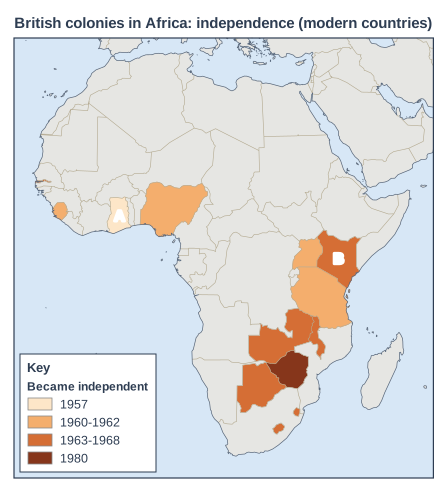
Figure 1 is a map of Africa showing when Britain's colonies became independent (shown by modern countries).

Name the countries labelled A and B.

Map of Africa, titled "British colonies in Africa: independence (modern countries)". Countries are shaded in 4 classes (key heading "Became independent"): "1957" (lightest): 1 country (1 in Africa); "1960-1962" (medium): 4 countries (4 in Africa); "1963-1968" (medium): 7 countries (7 in Africa); "1980" (darkest): 1 country (1 in Africa). Other countries are grey (not shaded). Points: the letter A printed on the map towards the left of the map (about 25% of the way across from the left and 40% of the way down); the letter B printed on the map towards the right of the map (about 80% of the way across from the left and 50% of the way down). The key (in a box on the map) shows: the heading "Became independent", "1957", "1960-1962", "1963-1968" and "1980".

Model answer

A is Ghana (the Gold Coast) and B is Kenya.

Explanation

The Gold Coast, led by Kwame Nkrumah, became the first British colony in Africa south of the Sahara to win independence, as Ghana, on 6 March 1957. Kenya became independent on 12 December 1963 under Jomo Kenyatta, after the Mau Mau emergency. Most of Britain's African colonies became independent between 1957 and 1968; Zimbabwe, where white settlers declared independence illegally in 1965, followed in 1980.

Mark scheme
  1. 1 mark

    A: Ghana (the Gold Coast), independent in 1957.

    Accept: Gold Coast. Do not accept: Nigeria, Ivory Coast, Togo.

  2. 1 mark

    B: Kenya, independent in 1963.

    Do not accept: Uganda, Tanzania, Tanganyika.

Question 2

8 marks

Source A: from a speech by Mohandas Gandhi to a meeting of the All-India Congress Committee in Bombay on 8 August 1942. The meeting had just voted for the 'Quit India' resolution, demanding that Britain end its rule in India at once. Japanese armies had conquered Burma and reached India's eastern border.
'Here is a mantra, a short one, that I give you. You may imprint it on your hearts and let every breath of yours give expression to it. The mantra is: "Do or Die". We shall either free India or die in the attempt; we shall not live to see the perpetuation of our slavery.'

How useful is Source A to an historian studying the impact of the Second World War on the Indian independence movement?

Explain your answer using Source A and your contextual knowledge.

Model answer

Source A is useful because it shows how the Second World War hardened the demands of the Indian independence movement. Gandhi, who was famous for patient non-violent protest, now called for 'Do or Die' and said 'We shall either free India or die in the attempt'. This shows a new urgency: Congress no longer wanted gradual reform but an immediate end to British rule. My knowledge explains why. In 1939 the Viceroy had declared war on India's behalf without consulting Indian leaders, and in 1942 the Cripps Mission offered only dominion status after the war. With Japan having taken Singapore and Burma, Britain looked weak, and Congress believed this was the moment to press for freedom.

The provenance adds to its usefulness. It is Gandhi's own speech to the Congress Committee on the day it passed the Quit India resolution, so it shows exactly how the leader of the movement wanted to inspire his followers. Because its purpose was to rouse people to action, its language is emotional - British rule is called 'slavery' - so it tells us more about the mood and aims of Congress than about the reality of British rule.

However, it is limited because it shows intentions, not results. The next day Gandhi and the Congress leaders were arrested and Congress was banned; protests turned violent and were crushed, with tens of thousands arrested. With Congress leaders in prison, Jinnah's Muslim League, which opposed Quit India, grew stronger, which helped lead to partition in 1947. The source also ignores Indians who responded differently, such as the 2.5 million who volunteered for the Indian Army, or Bose, who fought alongside Japan.

Overall, Source A is very useful for showing how the war made Congress demand immediate independence, but an historian would need other sources to understand the effects of the campaign.

Explanation

Quit India (August 1942) followed the failure of the Cripps Mission at the height of Japanese success. Level 4 needs a sustained judgement using content (urgency, 'Do or Die') and provenance (Gandhi's purpose in rousing Congress), with knowledge of what followed (arrests, violence, the Muslim League's rise).

Mark scheme
  1. 8 marks

    Levels of response (8 marks).
    Level 4 (7-8 marks): Complex evaluation of Source A with a sustained judgement based on content and provenance, e.g. it is useful because it shows how the war radicalised Congress - Gandhi, the leader of non-violence, now demanded immediate independence at a moment of British weakness - and its purpose (to inspire a mass movement) explains its language; but it is limited because it shows Gandhi's intentions, not what happened (arrests, violence, the strengthening of the Muslim League) or the views of other Indians; supported by accurate contextual knowledge.
    Level 3 (5-6 marks): Developed evaluation of content and/or provenance, supported by relevant knowledge of the war and the Quit India campaign.
    Level 2 (3-4 marks): Simple evaluation, e.g. it is useful because it is Gandhi's own words, or biased because he wanted independence, with little supporting knowledge.
    Level 1 (1-2 marks): Basic analysis: paraphrases the source or makes general comments about usefulness.
    0 marks: nothing worthy of credit.

    Indicative content (not a checklist; credit other valid points): Content: 'Do or Die' and 'free India or die in the attempt' show a new urgency and determination; 'slavery' shows how Congress saw British rule. Context: in 1939 the Viceroy, Lord Linlithgow, declared war on India's behalf without consulting Indian leaders, so Congress ministries resigned; the Cripps Mission (March-April 1942) offered dominion status after the war and was rejected; Japan had taken Singapore (February 1942) and Burma, so Britain looked weak and India was threatened. Provenance: Gandhi, leader of the nationalist movement, speaking to Congress at the moment of launching the campaign; his purpose was to inspire supporters, so the language is emotional and dramatic; it is unusually militant for the leader of non-violence (though he still asked for non-violent action). What it does not show: the next morning (9 August) Gandhi and the Congress leaders were arrested and Congress banned; protests turned violent (railways, telegraph lines and police stations attacked) and were crushed, with tens of thousands arrested; Congress leaders spent most of the rest of the war in prison while Jinnah's Muslim League, which opposed Quit India, grew stronger - a step towards partition; about 2.5 million Indians still volunteered for the army; Subhas Chandra Bose took a different path, leading the Indian National Army with Japan. Possible judgement: very useful for showing how the war hardened Congress's demands and Gandhi's determination, but limited for showing the outcome or the range of Indian responses.

Question 3

8 marks

Explain two ways in which the loss of the American colonies (1775-1783) and the Suez Crisis (1956) were similar.

Model answer

One similarity is that in both cases Britain was isolated and found it could not impose its will by force because powerful countries were against it. In the American War of Independence Britain faced not only the colonists but also France, which joined in 1778 after the American victory at Saratoga, followed by Spain and the Dutch Republic. At Yorktown in 1781 a French fleet prevented the Royal Navy rescuing Cornwallis, who had to surrender, and Britain recognised American independence in 1783. At Suez in 1956 Britain and France attacked Egypt after Nasser nationalised the canal, but the USA, Britain's closest ally, opposed them. Eisenhower refused financial help while the pound fell, the UN condemned the attack and the USSR made threats, so Britain had to accept a ceasefire on 6 November and withdraw. Both showed the limits of British power when it lacked allies.

A second similarity is that both divided opinion at home, brought down the Prime Minister and forced Britain to rethink its imperial role. In the 1770s Whigs such as Edmund Burke urged conciliation with the colonists, and Lord North resigned in March 1782 after the defeat at Yorktown. In 1956 the Labour Party, newspapers such as The Observer and protesters at the 'Law not War' rally opposed the attack, two ministers resigned, and Eden himself resigned in January 1957. Afterwards Britain changed direction. After 1783 it turned its attention to India, Canada and later Australia. After Suez it accepted that it could not act without American support, Macmillan rebuilt the 'special relationship', and decolonisation speeded up, with Ghana independent in 1957 and the 'Wind of Change' speech in 1960. Both crises marked a turning point in the history of the Empire.

Explanation

Both were humiliations in which Britain lacked allies against powerful opponents (France and Spain; the USA, UN and USSR), both divided opinion and toppled the Prime Minister (North 1782, Eden 1957), and both forced a rethink of empire. Level 4 needs two developed similarities with specific knowledge of both.

Mark scheme
  1. 8 marks

    Levels of response (8 marks).
    Level 4 (7-8 marks): Complex explanation of two similarities, each supported by accurate, specific knowledge of both events, e.g. both were humiliations in which Britain found itself isolated, with powerful countries against it, and could not impose its will by force; both divided opinion at home, brought down the Prime Minister and forced a rethink of Britain's imperial role.
    Level 3 (5-6 marks): Developed explanation of one or two similarities with relevant knowledge of both.
    Level 2 (3-4 marks): Simple explanation of one similarity, e.g. Britain lost in both, with some knowledge.
    Level 1 (1-2 marks): Basic explanation: identifies a similarity or describes one or both with little comparison.
    0 marks: nothing worthy of credit.

    Indicative content (not a checklist; credit other valid points): Isolation and limits of military power: in the American War Britain faced France (from 1778), Spain (1779) and the Dutch (1780) as well as the colonists; Burgoyne surrendered at Saratoga (1777) and Cornwallis at Yorktown (1781), with a French fleet blocking his escape by sea; at Suez the USA, Britain's most important ally, opposed the attack, refused financial help while the pound fell, and the UN and the USSR condemned it, forcing a ceasefire (6 November 1956) and withdrawal. Political consequences at home: both divided opinion - in the 1770s Whigs such as Edmund Burke and Charles James Fox urged conciliation; in 1956 Labour (Gaitskell), The Observer and protesters ('Law not War') opposed Eden and two ministers resigned; Lord North resigned in March 1782 after Yorktown, and Eden resigned in January 1957. Rethinking the Empire: after 1783 Britain turned its attention to India, Canada and later Australia ('swing to the east'); after Suez Britain accepted it could not act as a great power without US support, rebuilt the special relationship under Macmillan and speeded up decolonisation (Ghana 1957, 'Wind of Change' 1960). Both involved disputes over control of trade and taxation (tea, the Navigation Acts; the canal and its revenues). Differences (Suez did not directly lose a colony; the American War lasted eight years) may be noted, but the focus must be on similarity.

Question 4

20 marks

Has government been the main factor in the growth and decline of Britain's empire?

Explain your answer with reference to government and other factors. Use a range of examples from across your study of Migration, empires and the people: c790 to the present day.

[16 marks] [SPaG 4 marks]

Model answer

Government decisions have played an important part in both the growth and the decline of Britain's empire. However, for much of the period the Empire grew through private enterprise and the search for economic resources, with governments following rather than leading, and its decline was driven by war, economic weakness and nationalism as much as by government choices.

In the medieval period, government meant the decisions of kings. Henry II invaded Ireland in 1171, with papal approval, to control the Anglo-Norman lords who had gone there, and his government created an English lordship that lasted for centuries. In the sixteenth and seventeenth centuries the Crown encouraged expansion, but mostly by licensing others: Elizabeth I gave Raleigh a patent to settle America in 1584 and chartered the East India Company in 1600. The Navigation Acts from 1651 protected colonial trade, and Cromwell's 'Western Design' captured Jamaica in 1655.

Yet in this period economic resources and individuals were often more important. Sugar from Barbados and tobacco from Virginia made colonies profitable, and much of the slave trade was run by merchants. In India, the Empire was won by a private company: Robert Clive's victory at Plassey in 1757 gave the East India Company control of Bengal. Government only took over after the Indian Rebellion of 1857, with the Government of India Act of 1858.

In the nineteenth century government became more important. Disraeli bought shares in the Suez Canal in 1875 and made Victoria Empress of India in 1876; Gladstone's government occupied Egypt in 1882; and Salisbury's government took part in the Scramble for Africa after the Berlin Conference of 1884-85. Even so, individuals such as Cecil Rhodes, whose British South Africa Company took over the lands later called Rhodesia, often pushed the government into expansion, and technology such as quinine and the Maxim gun made conquest possible.

Government decisions also caused decline. Parliament's decision to tax the American colonies through the Stamp Act of 1765 provoked the Revolution and the loss of the Thirteen Colonies. In the twentieth century Attlee's Labour government decided to leave India in 1947, Eden's decision to invade Egypt in 1956 ended in humiliation, and Macmillan and Iain Macleod chose to speed up African independence after 1959. In 1968 the government announced the withdrawal from 'East of Suez'. However, these decisions were responses to other pressures: the Second World War had left Britain bankrupt, nationalist leaders such as Gandhi and Nkrumah had made colonial rule unworkable, and the USA opposed the Empire.

In conclusion, government was rarely the main driving force behind the growth of the Empire before the nineteenth century, when trade and individuals led. It became more important in the nineteenth and twentieth centuries, and after 1945 governments decided how quickly Britain withdrew. But those decisions were forced on them by economic weakness and nationalism. Overall, economic resources were a more important factor than government, which usually acted to protect trade or to adapt to changes it could not control.

Explanation

Governments chartered companies, passed laws and took over territories (1858, the Scramble) and later decided the pace of decolonisation (1947, 1959-64, 1968); but private trade and individuals led much expansion, and war, debt and nationalism forced withdrawal. Level 4 needs a sustained judgement covering both growth and decline with examples from across the period.

Mark scheme
  1. 16 marks

    Levels of response (16 marks).
    Level 4 (13-16 marks): Complex explanation of government (decisions of monarchs, Parliament and ministers, laws and policies) and other factors (economic resources, individuals, war, ideas, science and technology, religion) leading to a sustained judgement about whether government has been the main factor in the growth and decline of the Empire, supported by a range of accurate, specific examples from across the whole period, covering both growth and decline.
    Level 3 (9-12 marks): Developed explanation of government and other factor(s), with relevant specific examples from more than one period; there may be a judgement, but it is not fully sustained.
    Level 2 (5-8 marks): Simple explanation of government and/or other factor(s), with a limited range of examples or a narrow time span.
    Level 1 (1-4 marks): Basic explanation of one or more factors: general statements or narrative with little relevant knowledge.
    0 marks: nothing worthy of credit.

    Indicative content (not a checklist; credit other valid points): Government and growth: Henry II's invasion of Ireland (1171), with papal approval; Elizabeth I's grants to adventurers (Raleigh's patent, 1584) and the charter of the East India Company (1600); the Navigation Acts (from 1651) protecting colonial trade; Cromwell's 'Western Design' took Jamaica (1655); government took over India after 1857 (Government of India Act, 1858; Queen Victoria Empress of India, 1876); Disraeli bought Suez Canal shares (1875); Gladstone's occupation of Egypt (1882); Salisbury's government in the Scramble for Africa (Berlin Conference, 1884-85); the Boer War (1899-1902). Government and decline: Parliament's taxes on the American colonies (Stamp Act 1765, Townshend Duties 1767) caused the Revolution; Government of India Acts (1919, 1935) moved India towards self-rule; Attlee's Labour government decided to leave India (1947); Eden's decision to attack Egypt (1956) backfired; Macmillan and Macleod speeded up African independence (1959-64); Wilson's government withdrew from 'East of Suez' (announced 1968); Thatcher's government fought for the Falklands (1982) but agreed to return Hong Kong (1984, handed over 1997). Other factors: economic resources - private companies led much expansion (East India Company, Royal African Company, Rhodes's British South Africa Company, 1889), sugar, tobacco, cotton, gold, diamonds ('the flag followed trade'); individuals - Raleigh, Hawkins, Clive (Plassey, 1757), Rhodes, Gandhi, Nkrumah, Kenyatta; war - Seven Years' War, the world wars, Suez; ideas - civilising mission, social Darwinism, nationalism; science and technology - ships, the Maxim gun, quinine, steamships and telegraph. Possible judgements: government became more important over time - in the early modern period private companies and individuals led and governments followed, but from 1858 the state ran the Empire and from 1945 governments decided the pace of withdrawal; or economic resources were more important because governments acted mainly to protect trade and could not afford to keep the Empire after 1945.

  2. 4 marks

    SPaG. High performance (4 marks): spells and punctuates with consistent accuracy; uses rules of grammar with effective control of meaning overall; uses a wide range of specialist terms as appropriate.
    Intermediate performance (2-3 marks): spells and punctuates with considerable accuracy; uses rules of grammar with general control of meaning overall; uses a good range of specialist terms as appropriate.
    Threshold performance (1 mark): spells and punctuates with reasonable accuracy; uses rules of grammar with some control of meaning and any errors do not significantly hinder meaning overall; uses a limited range of specialist terms as appropriate.
    0 marks: the student writes nothing, or the response does not relate to the question, or errors severely hinder meaning.

    SPaG marks are awarded only if the answer relates to the question.

Ready to try the rest? Every answer you write is marked against the mark scheme, so you can see exactly where the marks are.

AI Tutor Hints first, answers after you try

Hi! Stuck? Ask me for a hint and I’ll help you work it out. Once you’ve checked your answer I can explain exactly where the marks are.