Level:
Correct: 0
Incorrect: 0
Marks: 0/0
Exam Practice
Subject:
Topics:
Avg
score:
–
Topics
done:
0/12

Invasion

Practise 35 exam-style questions on Invasion for AQA GCSE History (Migration, empires and the people). Write your answer as you would in the exam and get it marked in seconds against the mark scheme, point by point, with an AI tutor on hand if you get stuck.

  • 35 questions
  • 1–20 marks each
  • Instant marking
  • No sign-up needed
20 questions, marked as you go

Sample questions with model answers

Here are 4 of the questions in this topic, each with a model answer, an explanation of why it earns the marks and the mark scheme an examiner would use.

Question 1

2 marks

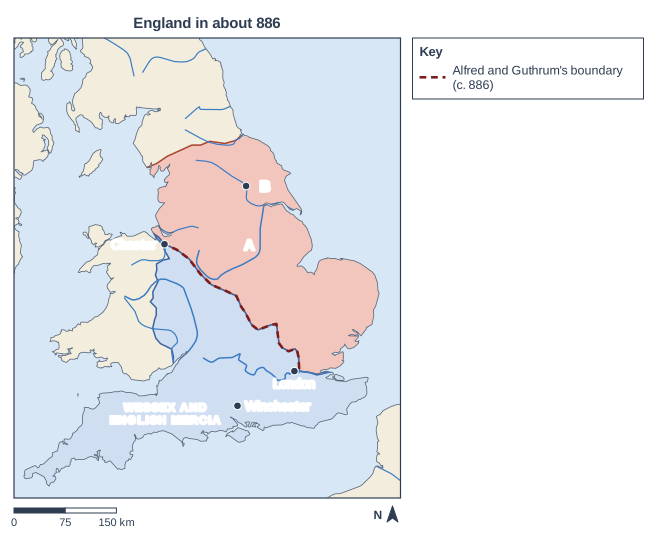
Figure 1 is a map of England in about 886.

Name the area labelled A and the Viking town labelled B.

Map of England and Wales, titled "England in about 886", drawn with real coastlines (land pale buff, sea pale blue) and no modern borders; a north arrow shows north at the top; the scale bar is 150 km long. An area covering the north and east of England, north-east of a line running from the estuary in the south-east to the north-west coast, shaded pale red and labelled A; an area covering the south and west of England, south-west of that line, shaded pale blue and labelled "Wessex and English Mercia"; a thick dashed line running north-west from near the estuary in the south-east towards the north-west coast (key: "Alfred and Guthrum's boundary (c. 886)"). Blue lines show rivers. Points: a dot labelled "London" (inland); a dot labelled B inland, towards the top of the map (about 60% of the way across and 30% of the way down), about 150 km north-east of the symbol labelled "Chester"; a dot labelled "Chester" (inland); a dot labelled "Winchester" (inland). The key (to the right of the map) shows: "Alfred and Guthrum's boundary (c. 886)".

Model answer

A is the Danelaw, the area of eastern and northern England where Danish law and customs were followed. B is York, which the Vikings called Jorvik.

Explanation

After Alfred's victory at Edington in 878, a treaty with the Viking leader Guthrum fixed a boundary running up the River Lea, to Bedford and along Watling Street. Land to the north and east became known as the Danelaw, and Jorvik (York), captured by the Great Heathen Army in 866, became a major Viking trading town.

Mark scheme
  1. 1 mark

    A: the Danelaw

    Accept Danelaw / the area under Danish law / Viking-ruled England. Do not accept Denmark or Northumbria alone.

  2. 1 mark

    B: York

    Accept Jorvik / Eoforwic.

Question 2

8 marks

Source A: a description of a drawing at the front of the Liber Vitae (Book of Life) of the New Minster, a monastery in Winchester. The book was made by the monks in about 1031. The New Minster received gifts from King Cnut and Queen Emma.

The drawing shows Cnut and Emma placing a large gold cross on the altar of the New Minster. Above them Christ sits in majesty between the Virgin Mary and St Peter. Angels above the king and queen point up to Christ, and one of them places a crown on Cnut's head. Cnut holds the cross with one hand and the hilt of his sword with the other. Emma, given her English name Aelfgifu, is drawn the same size as the king. Monks of the New Minster look up from below.

How useful is Source A to an historian studying how Cnut ruled England?

Explain your answer using Source A and your contextual knowledge.

Model answer

Source A is useful to an historian studying how Cnut ruled England because it shows how he wanted to be seen. Cnut was a Danish conqueror who had won the throne by force at the Battle of Assandun in 1016, but here he is a generous Christian king placing a gold cross on the altar, while an angel crowns him. This message, that he ruled by God's will, fits what I know about his rule: he gave gifts to churches, went on pilgrimage to Rome in 1027, and had his laws drafted by Archbishop Wulfstan of York, based on the laws of the English king Edgar.

The drawing also shows Emma, under her English name Aelfgifu, drawn the same size as the king. This is useful because Cnut married her in 1017; as Ethelred II's widow she linked him to the old English royal family and to Normandy, which helped him win acceptance. The hand on his sword is a reminder that he was still a warrior king.

The provenance limits the source as well as adding to it. It was made by the monks of the New Minster, who received gifts from Cnut and Emma, so they had every reason to flatter them. It is propaganda: it shows the image Cnut wanted, not necessarily the reality. It leaves out the harsher side of his rule, such as the execution of Eadric Streona and other nobles in 1017 and the enormous tax of 72,000 pounds plus 10,500 pounds from London in 1018. Nor does it show how he governed through powerful earls such as Godwin while he was away ruling Denmark and Norway.

Overall, Source A is very useful for showing how Cnut presented himself as a Christian king working with the Church and with Emma, which was central to how he won acceptance, but it is less useful for the practical and harsher realities of his government.

Explanation

The Liber Vitae drawing is royal propaganda made by monks who benefited from Cnut's gifts. Level 4 needs a judgement that treats it as excellent evidence of Cnut's chosen image (Christian king, partner of Emma, crowned by God) while explaining what it leaves out, using knowledge of Assandun, his laws, the 1018 tax and the earldoms.

Mark scheme
  1. 8 marks

    Levels of response (8 marks).
    Level 4 (7-8 marks): Complex evaluation of Source A that analyses both its content and its provenance (an image made by monks who received the royal couple's gifts, showing how Cnut wished to be seen) and uses contextual knowledge to reach a sustained judgement, e.g. very useful for Cnut's image as a Christian king working with the Church and with Emma, but limited for the harsher realities of his rule.
    Level 3 (5-6 marks): Developed evaluation of the content and/or provenance supported by contextual knowledge, e.g. explains that Cnut's gifts to churches, his laws drafted by Archbishop Wulfstan and his pilgrimage to Rome fit the image, or that the monks had a reason to flatter him.
    Level 2 (3-4 marks): Simple evaluation, e.g. it shows Cnut was religious, or it may be biased because the monks liked him.
    Level 1 (1-2 marks): Basic analysis, e.g. describes the picture.
    0 marks: nothing worthy of credit.

    Indicative content (not a checklist; credit other valid points): Content: Cnut giving a gold cross - generosity to the Church; the angel crowning him - the claim that he ruled by God's will, important for a conqueror who had taken the throne by force in 1016; his hand on his sword - he was still a warrior king; Emma drawn as his equal - her importance, linking him to the old royal house of Wessex and to Normandy; the English name Aelfgifu - presenting her as an English queen; monks below - the Church's support. Context: Cnut, son of Sweyn Forkbeard, won the Battle of Assandun in 1016 and became king of all England when Edmund Ironside died; he married Emma in 1017; he kept English laws and government (laws drafted by Wulfstan of York, based on King Edgar's laws, agreed at Oxford in 1018); he gave gifts to churches and went on pilgrimage to Rome in 1027; he was also ruthless - he had Eadric Streona and other nobles killed in 1017 and raised a huge tax of 72,000 pounds plus 10,500 pounds from London in 1018 to pay off his fleet; he divided England into great earldoms, raising men such as Godwin, and kept a bodyguard of housecarls; he ruled Denmark and Norway too and was often away. Provenance: made by the monks of a royal monastery that benefited from his gifts, so it is flattering and shows the image Cnut wanted; a deliberate piece of royal and religious propaganda, useful as evidence of that image; it does not show government, taxation or how ordinary people felt. Judgement: e.g. very useful for how Cnut presented his rule and his partnership with the Church and Emma, less useful for the practical and harsher side of his rule.

Question 3

8 marks

Explain the significance of Emma of Normandy for English history.

Model answer

Emma of Normandy was significant first because of her marriages, which linked England to Normandy. She was the daughter of Duke Richard I of Normandy, and in 1002 she married Ethelred II. The marriage was an alliance meant to stop the Normans sheltering Viking fleets that attacked England. It also gave the English royal family a place of refuge: when Sweyn Forkbeard conquered England in 1013, Ethelred and his family fled to Normandy.

Her second marriage, to Cnut in 1017, was significant at the time because it helped the Danish conqueror win acceptance. By marrying Ethelred's widow, Cnut linked himself to the old English royal family and gained an alliance with Normandy. Emma was a prominent queen: in the New Minster Liber Vitae of about 1031 she is drawn the same size as Cnut.

Emma was also significant as the mother of two kings, Harthacnut and Edward the Confessor. After Cnut died in 1035 she held Winchester and the royal treasury for Harthacnut against Harold Harefoot, Cnut's son by another wife. The struggle cost her dearly: her son Alfred was blinded and died in 1036, and she was exiled to Flanders in 1037. But Harthacnut became king in 1040, Edward returned in 1041, and Emma commissioned the Encomium Emmae Reginae to defend her reputation and her sons' rights.

In the long term her greatest significance was the Norman connection. Edward the Confessor spent about 25 years in exile in Normandy and favoured Normans when he became king, making Robert of Jumieges Archbishop of Canterbury. Emma was William of Normandy's great-aunt, and this family tie was part of William's claim to the throne in 1066. The Norman Conquest bound England to France for centuries. Historians today therefore see Emma as one of the most powerful and important women in early medieval England.

Explanation

Emma's marriages linked England with Normandy, legitimised Cnut and made her the mother of two kings; her family tie to William of Normandy helped lead to 1066. Level 4 explains more than one aspect, short and long term, with specific evidence such as 1002, 1017, 1035-1041 and the Encomium.

Mark scheme
  1. 8 marks

    Levels of response (8 marks).
    Level 4 (7-8 marks): Complex explanation of more than one aspect of Emma's significance, e.g. her marriages linking England to Normandy and giving Cnut legitimacy at the time, her role in the succession of her sons, and in the long term the Norman connection that led to 1066, supported by specific, accurate knowledge.
    Level 3 (5-6 marks): Developed explanation of aspects, e.g. explains how her marriage to Ethelred created a link with Normandy that helped William's claim in 1066.
    Level 2 (3-4 marks): Simple explanation of one aspect, e.g. she was important because she married two kings.
    Level 1 (1-2 marks): Basic explanation.
    0 marks: nothing worthy of credit.

    Indicative content (not a checklist; credit other valid points): Marriage to Ethelred II (1002): daughter of Duke Richard I of Normandy; an alliance meant to stop Normandy sheltering Viking fleets; children Edward, Alfred and Godgifu; in 1013 Ethelred and his family fled to Normandy when Sweyn conquered England. Marriage to Cnut (1017): linked the Danish conqueror to the old English royal family and to Normandy, helping him win acceptance; Emma was crowned and prominent at court (shown equal to Cnut in the New Minster Liber Vitae of about 1031); son Harthacnut, daughter Gunnhild. Succession: after 1035 she held Winchester and the royal treasury for Harthacnut against Harold Harefoot; her son Alfred was blinded and died in 1036 (Earl Godwin was blamed); she was exiled to Flanders in 1037; Harthacnut became king in 1040 and Edward returned in 1041; she commissioned the Encomium Emmae Reginae (c. 1041-1042); Edward seized her lands in 1043. Long term: Edward the Confessor grew up in Normandy, favoured Normans (Robert of Jumieges, Archbishop of Canterbury 1051); Emma was William of Normandy's great-aunt, so the family tie supported William's claim and the Norman Conquest of 1066, which bound England to France for centuries. Since: historians see her as one of the most powerful women of early medieval England, a skilled political player rather than just a royal wife.

Question 4

20 marks

Has religion been the main factor in causing conflict between Britain and other peoples since c790?

Explain your answer with reference to religion and other factors. Use a range of examples from across your study of Britain: Migration, empires and the people: c790 to the present day.

[16 marks] [SPaG 4 marks]

Model answer

Religion has played a part in many conflicts between Britain and other peoples, sometimes as a cause and more often as a justification or something that made conflict more bitter. However, across the whole period I think the desire for wealth and power was a more important cause, with religion the main factor in only a few cases.

At first sight, the Viking attacks look like a religious conflict. Pagan raiders attacked Christian monasteries such as Lindisfarne in 793, and churchmen such as Alcuin called them 'a pagan race'. But the Vikings attacked monasteries because they were rich and undefended, not because they were Christian. Religion actually helped to end the conflict: after Edington in 878 Guthrum was baptised with Alfred as his godfather, and the Danes in the Danelaw converted quickly, making it easier to bring them into an English kingdom. Cnut, a Danish conqueror, ruled as a Christian king.

Religion was used to justify conquest in Ireland. Henry II's involvement was supported by the papal grant known as Laudabiliter, issued by the English pope Adrian IV in 1155, which called for the reform of the Irish Church, although historians debate whether the document is genuine. Henry actually went to Ireland in 1171 because he feared that his own barons, such as Strongbow, would set up an independent kingdom there, so power was the real cause. Religion mattered more in the Ulster plantation from 1609, when Protestant settlers from England and Scotland were given land taken from Catholic Irish lords, creating divisions that lasted for centuries.

Religion was most clearly a cause in the Indian Rebellion of 1857. Sepoys believed that the cartridges for the new Enfield rifle were greased with cow and pig fat, offending both Hindus and Muslims, and many Indians feared that missionaries and British reforms threatened their religions. Yet even here, other causes mattered, such as the annexation of states under the Doctrine of Lapse and of Awadh in 1856. In Sudan, the Mahdi's religious movement led to the death of General Gordon in 1885, but Britain's reconquest at Omdurman in 1898 was mainly about controlling the Nile and protecting Egypt and the Suez Canal.

Economic resources and power caused more conflicts. The Vikings sought plunder and land. The Hundred Years' War began in 1337 because of Edward III's claim to the French throne, disputes over Gascony and its wine trade, and England's wool trade with Flanders. Elizabethan sea dogs attacked Spain for its silver as much as for its Catholicism. Britain occupied Egypt in 1882 to protect the Suez Canal, and the Boer War of 1899-1902 was fought largely over control of the gold of the Transvaal. In the twentieth century, nationalism, not religion, drove the independence movements of India and Africa and the Suez Crisis of 1956.

In conclusion, religion was the main factor in some conflicts, especially the rebellion of 1857 and the divisions created by the Ulster plantation, and it often made other conflicts more bitter. But across the whole period from c790, the search for wealth and the struggle for power caused far more conflict. Religion was more often a justification for conflict than its real cause.

Explanation

Religion was central to the 1857 rebellion and the Ulster plantation and justified the invasion of Ireland, but plunder, trade, dynastic claims and power caused most conflicts (Vikings, Hundred Years' War, privateering, Egypt, the Boer War). Level 4 needs a sustained judgement weighing religion against other factors with examples from across the period.

Mark scheme
  1. 16 marks

    Levels of response (16 marks).
    Level 4 (13-16 marks): Complex explanation of religion and of other factors (such as economic resources, war and power, government, ideas) in causing conflict between Britain and other peoples, leading to a sustained judgement about whether religion was the main factor, supported by a range of accurate, specific examples from across the whole period.
    Level 3 (9-12 marks): Developed explanation of religion and at least one other factor, supported by relevant examples from more than one period; any judgement may not be fully supported.
    Level 2 (5-8 marks): Simple explanation of religion or of other factors, e.g. explains that the Vikings were pagans who attacked monasteries, with limited examples.
    Level 1 (1-4 marks): Basic explanation; general statements with little specific knowledge.
    0 marks: nothing worthy of credit.

    Indicative content (not a checklist; credit other valid points): Religion as a cause or intensifier: pagan Vikings attacked Christian monasteries (Lindisfarne 793), though mainly for wealth; Henry II's involvement in Ireland was justified by the papal grant Laudabiliter (1155, issued by the English pope Adrian IV; its authenticity is debated), which called for reform of the Irish Church; Protestant England's rivalry with Catholic Spain encouraged privateering (Drake); the Ulster plantation (from 1609) settled Protestants from England and Scotland on land taken from Catholic Irish lords; in the Indian Rebellion of 1857 sepoys feared that cartridges greased with cow and pig fat, and the work of missionaries, threatened their religions; the Mahdi's religious movement in Sudan led to the death of Gordon (1885) and the battle of Omdurman (1898). Religion reducing conflict: Guthrum's baptism (878) and the Danes' conversion helped integration; Cnut ruled as a Christian king. Other factors: economic resources - plunder and land (Vikings), the wool trade and Gascon wine (Hundred Years' War), Spanish silver, sugar, the East India Company's profits, gold in the Boer War (1899-1902), the Suez Canal and Egypt (1882); power and dynastic claims - William's claim in 1066, Edward III's claim to the French throne (1337), the loss of Normandy (1204); land annexed under the Doctrine of Lapse and the annexation of Awadh (1856) as causes of the 1857 rebellion; ideas - imperialism, social Darwinism and nationalism (Indian and African independence movements, Suez 1956). Judgement: e.g. religion intensified and justified many conflicts and was central in 1857 and Ulster, but economic resources and power caused more of them across the whole period; religion was more often a justification than the real cause.

  2. 4 marks

    SPaG. High performance (4 marks): spells and punctuates with consistent accuracy; uses rules of grammar with effective control of meaning overall; uses a wide range of specialist terms as appropriate.
    Intermediate performance (2-3 marks): spells and punctuates with considerable accuracy; uses rules of grammar with general control of meaning overall; uses a good range of specialist terms as appropriate.
    Threshold performance (1 mark): spells and punctuates with reasonable accuracy; uses rules of grammar with some control of meaning and any errors do not significantly hinder meaning overall; uses a limited range of specialist terms as appropriate.
    0 marks: the student writes nothing, or the response does not relate to the question, or errors severely hinder meaning.

    SPaG marks are awarded only if the answer relates to the question.

Ready to try the rest? Every answer you write is marked against the mark scheme, so you can see exactly where the marks are.

AI Tutor Hints first, answers after you try

Hi! Stuck? Ask me for a hint and I’ll help you work it out. Once you’ve checked your answer I can explain exactly where the marks are.