Has war been the main factor in the rise and fall of the British Empire?
Explain your answer with reference to war and other factors. Use a range of examples from across your study of Migration, empires and the people: c790 to the present day.
[16 marks] [SPaG 4 marks]
Model answer
War was the main means by which Britain gained its empire, and it played a large part in the empire's decline. However, wars were usually fought to protect economic interests, and the end of the empire owed as much to nationalism and to Britain's economic weakness as to war itself.
War shaped England's overseas possessions from the Middle Ages. Lands in France were won and lost by war: King John lost Normandy in 1204, and in the Hundred Years' War England won Calais in 1347 but lost almost everything else by 1453. Later, war built the empire. Cromwell's Western Design captured Jamaica from Spain in 1655. The Seven Years' War (1756-63) gave Britain Canada and made it the leading European power in India, where Clive's victory at Plassey in 1757 began the Company's rule over Bengal. Further wars against Mysore, the Marathas and the Sikhs extended British rule across India, and the Napoleonic Wars gave Britain the Cape and naval supremacy. In Africa, war was the means of conquest: the Zulu were defeated in 1879, Egypt was occupied after Tel el-Kebir in 1882, Sudan was reconquered at Omdurman in 1898, and the Boer republics were defeated in 1902.
War also contributed to the empire's fall. The American War of Independence lost Britain thirteen colonies in 1783. The First World War encouraged nationalism: more than a million Indians served, and when Indians demanded more say, the Amritsar massacre of 1919 turned many against British rule. The Second World War left Britain bankrupt and showed it could not defend its empire, as the fall of Singapore in 1942 proved; India became independent in 1947. The Suez Crisis of 1956 showed that Britain could no longer act as a great power without American support, and the Mau Mau emergency showed the cost of holding on to colonies.
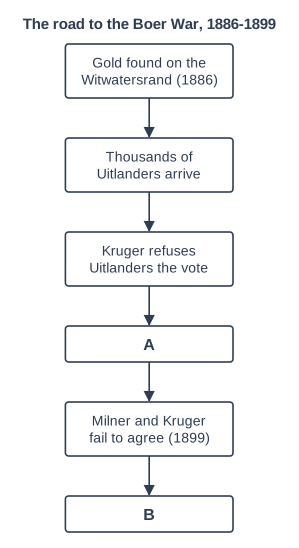
However, other factors were also important. Economic resources explain why many wars were fought: the East India Company went to India to trade, and in Africa the discovery of gold led to the Boer War. Much expansion was carried out by companies, not by armies, such as Rhodes's British South Africa Company. The fall of the empire owed much to nationalism and to individuals who led it, such as Gandhi, whose Salt March of 1930 won worldwide attention, and Nkrumah, who led Ghana to independence in 1957. Government decisions also mattered: Attlee's government chose to leave India, and Macmillan accepted the 'wind of change' in Africa in 1960.
Overall, war was the main factor in the rise of the British Empire, because almost every major addition of territory came through war, even if economic motives lay behind it. War was less clearly the main factor in its fall: the world wars weakened Britain, but nationalism, economic weakness and government decisions brought about the end of the empire. War was therefore the single most important factor across the whole story, but it worked alongside economic motives and nationalism.
Explanation
War won most of the empire (the Seven Years' War, Plassey, Omdurman, the Boer War) and contributed to its loss (America, the world wars, Suez), but economic motives, nationalism and government decisions also mattered. Level 4 needs a sustained judgement covering both rise and fall, with examples from across the period.