Has religion been the main factor in shaping England and Britain's relationship with Ireland since c790?
Explain your answer with reference to religion and other factors. Use a range of examples from across your study of Britain: Migration, empires and the people: c790 to the present day.
[16 marks] [SPaG 4 marks]
Model answer
Religion has played an important part in England and Britain's relationship with Ireland, both as a justification for intervention and, after the Reformation, as a deep source of division. However, the struggle for land and power, and English fears for their own security, were more constant factors. I will argue that religion was important but not the main factor across the whole period.
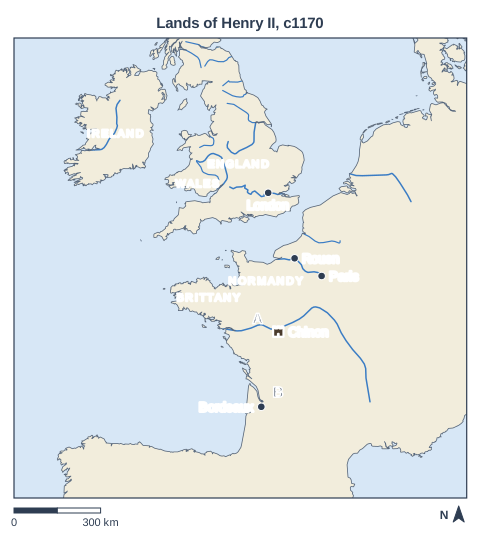
Religion was used to justify the first English intervention. The papal letter Laudabiliter, said to date from 1155, approved Henry II's entry into Ireland to reform the Irish Church, and after Henry arrived in 1171 the Synod of Cashel in 1172 reorganised the Church on English lines. However, religion was a justification rather than the real cause. The intervention began because Dermot MacMurrough, King of Leinster, appealed for help in 1166, and Henry crossed to Ireland in 1171 because he feared Strongbow would set up an independent kingdom. Power, ambition and land were the driving forces, as Anglo-Norman lords seized land and built castles.
Ideas about civilisation also mattered in the Middle Ages. Gerald of Wales described the Irish as 'a wild and inhospitable people' who lived 'like beasts', and in 1366 the Statutes of Kilkenny tried to stop English settlers adopting Irish language, dress and law. These were cultural divisions, not religious ones, as both peoples were Catholic. By about 1500 English control had shrunk to the Pale around Dublin.
Religion became far more important after the Reformation. England became Protestant while most of Ireland remained Catholic, so the English feared that Ireland could be used by Catholic enemies. These fears were realised when Spanish troops landed at Kinsale in 1601 to help the Irish rebels in the Nine Years' War. After the Flight of the Earls in 1607, the government began the plantation of Ulster in 1609, settling Protestant English and Scots on land taken from Catholic Irish lords. This created a religious divide in Ulster that has lasted to the present day. However, even the plantation was also about land and security: it was meant to make Ulster loyal and profitable.
In the nineteenth century economic factors and government policy were most important. The Great Famine of 1845-1849 killed about a million people and drove huge numbers to emigrate; by 1851 over 700,000 Irish-born people lived in Britain. Many blamed the British government for doing too little. Religion still mattered, as Irish Catholic migrants in Britain faced anti-Catholic hostility, but their poverty and competition for jobs caused as much resentment.
In conclusion, religion was a key factor in the relationship between Britain and Ireland, especially after the Reformation, when it turned conquest into a lasting division between Protestant settlers and Catholic Irish. But across the whole period, land, power and security were more constant factors: they explain the intervention of 1169-1171, the plantations and the famine. Religion deepened divisions that were rooted in conquest and the struggle for land.
Explanation
Religion justified the 12th-century intervention (Laudabiliter, Cashel) and became central after the Reformation (Kinsale, the Ulster plantation, anti-Catholic hostility), but land, power, security and economics (Dermot and Strongbow, plantations, the famine) were more constant. Level 4 needs a sustained judgement weighing religion against these factors across the period.