Level:
Correct: 0
Incorrect: 0
Marks: 0/0
Exam Practice
Subject:
Topics:
Avg
score:
–
Topics
done:
0/12

The birth of English identity

Practise 35 exam-style questions on The birth of English identity for AQA GCSE History (Migration, empires and the people). Write your answer as you would in the exam and get it marked in seconds against the mark scheme, point by point, with an AI tutor on hand if you get stuck.

  • 35 questions
  • 1–20 marks each
  • Instant marking
  • No sign-up needed
20 questions, marked as you go

Sample questions with model answers

Here are 4 of the questions in this topic, each with a model answer, an explanation of why it earns the marks and the mark scheme an examiner would use.

Question 1

2 marks

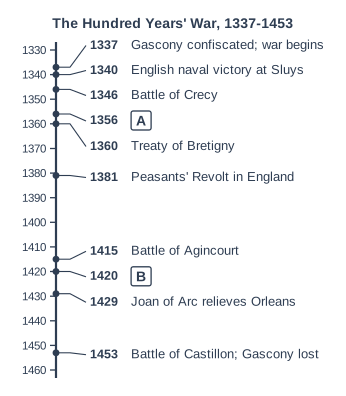
Figure 1 is a timeline of the Hundred Years' War.

Name the battle labelled A and the treaty labelled B.

Vertical timeline titled "The Hundred Years' War, 1337-1453", running from 1330 at the top to 1460 at the bottom, with the years marked every 10 years (1330 to 1460). Events marked by dots on the line, in date order: 1337: Gascony confiscated; war begins; 1340: English naval victory at Sluys; 1346: Battle of Crecy; 1356: label A; 1360: Treaty of Bretigny; 1381: Peasants' Revolt in England; 1415: Battle of Agincourt; 1420: label B; 1429: Joan of Arc relieves Orleans; 1453: Battle of Castillon; Gascony lost.

Model answer

A is the Battle of Poitiers (1356), where Edward the Black Prince defeated and captured King John II of France. B is the Treaty of Troyes (1420), which made Henry V heir to the French throne.

Explanation

Poitiers led to the Treaty of Bretigny (1360), the high point of Edward III's success. The Treaty of Troyes was the high point of Henry V's: he married Charles VI's daughter Catherine and was recognised as heir to France, but he died in 1422, two months before Charles VI.

Mark scheme
  1. 1 mark

    A: the Battle of Poitiers (1356)

    Accept Poitiers. Do not accept Crecy or Agincourt (printed on the timeline).

  2. 1 mark

    B: the Treaty of Troyes (1420)

    Accept Troyes. Do not accept Bretigny (printed on the timeline).

Question 2

8 marks

Source A: a summary of a licence granted by King Richard II in 1385 to Sir Edward Dalyngrigge, a knight who had made money fighting in France during the Hundred Years' War.

The licence gives Dalyngrigge permission to strengthen his manor house at Bodiam, near the sea in Sussex, with a stone wall, to crenellate it (add battlements) and to make it into a castle, for the defence of the surrounding country and resistance against the king's enemies.

How useful is Source A to an historian studying the impact of the Hundred Years' War on England?

Explain your answer using Source A and your contextual knowledge.

Model answer

Source A is useful to an historian studying the impact of the Hundred Years' War on England because it shows two effects of the war. First, it shows the fear of French attack on the south coast. The licence allows Dalyngrigge to fortify his house 'near the sea' for the defence of the surrounding country against the king's enemies. This fits what I know: French and Castilian raiders burned Southampton and Portsmouth in 1338, Rye in 1377 and Winchelsea in 1380, and in 1385-1386 the French gathered a large fleet to invade England. In the 1370s and 1380s the war was going badly, so the threat was real. Second, it shows that some Englishmen grew rich from the war, as Dalyngrigge had made his money fighting in France, through pay, plunder and ransoms.

The provenance gives the source value. It is an official licence granted by Richard II, so it is reliable evidence of what the king allowed and of the reason officially given. However, historians debate whether Bodiam was really built for defence. It has a wide moat and an impressive appearance, but some historians argue it was mainly a status symbol for a newly rich knight, and a licence to crenellate was itself a sign of royal favour. So the stated purpose may not tell the whole story.

The source is also limited because it shows only one building and one man in one part of England. It does not show the wider impact of the war, such as the heavy taxes that led to the poll taxes and the Peasants' Revolt of 1381, the growing power of Parliament, which had to agree to taxes for the war, or the growth of national pride and the use of English.

Overall, Source A is useful for showing the fear of French raids on the south coast and the profits some soldiers made, but an historian would need much more evidence to understand the full impact of the war on England.

Explanation

The Bodiam licence shows the fear of French raids and the wealth war brought some knights, but it covers one place and historians debate whether Bodiam was a real fortress or a status symbol. Level 4 needs a judgement combining content, provenance and wider context (raids, taxation, the Peasants' Revolt, Parliament, identity).

Mark scheme
  1. 8 marks

    Levels of response (8 marks).
    Level 4 (7-8 marks): Complex evaluation of Source A that analyses both its content and its provenance (an official royal licence of 1385, issued at a time of French raids and invasion fears, to a knight enriched by the war) and uses contextual knowledge to reach a sustained judgement, e.g. useful for showing the fear of French attack and the profits some men made from war, but limited to one building and debated as evidence of real defence.
    Level 3 (5-6 marks): Developed evaluation of the content and/or provenance supported by contextual knowledge, e.g. explains the French raids on the south coast, or the debate about whether Bodiam was built mainly for status.
    Level 2 (3-4 marks): Simple evaluation, e.g. useful because it shows people were afraid of the French.
    Level 1 (1-2 marks): Basic analysis, e.g. paraphrases the summary.
    0 marks: nothing worthy of credit.

    Indicative content (not a checklist; credit other valid points): Content: a castle 'near the sea' for defence against the king's enemies - the fear of French attack on the south coast; Dalyngrigge's wealth from fighting in France - the war brought profit (plunder, ransoms, pay) to some soldiers. Context: French and Castilian raids burned Southampton (1338), Portsmouth (1338), Rye (1377) and Winchelsea (1380); in 1385-1386 the French gathered a large fleet for a planned invasion of England; the war was going badly for England in the 1370s-1380s; other effects - heavy taxation, the poll taxes and the Peasants' Revolt (1381), national pride, the rise of English, the power of Parliament over taxation. Provenance: an official royal document, reliable as evidence of what was permitted and the reason officially given; a licence to crenellate was also a mark of royal favour and status; historians debate whether Bodiam (with its wide moat and grand appearance) was a serious fortress or mainly a status symbol built by a newly rich knight, so the stated purpose may not tell the whole story; it shows one place and one man, not England as a whole. Judgement: e.g. useful evidence of two impacts - fear of French raids on the south coast and the wealth the war brought to some - but limited, needing other evidence for the wider impact on taxation, government and identity.

Question 3

8 marks

Explain the significance of the English capture of Calais in 1347.

Model answer

The capture of Calais in 1347 was significant first because it gave England a secure military base in France. After his victory at Crecy, Edward III besieged Calais from September 1346 until it surrendered in August 1347. According to Froissart, six leading citizens offered their lives to save the town and were spared only after Queen Philippa pleaded for them. Edward expelled many of the French inhabitants and brought in English settlers. Calais was a fortified port only about 30 kilometres from Dover, so English armies could cross the Channel easily and land safely in France. In 1415 Henry V was marching to Calais when he fought the Battle of Agincourt.

A second aspect is its economic importance. From 1363 Calais was made the Staple, the town through which English wool exports had to pass. Wool was England's most valuable export, and taxing it at Calais gave the crown a large and regular income to pay for the war, while the merchants of the Staple became wealthy and influential. Calais therefore linked England's economy closely to the war and to trade with the Low Countries.

In the long term, Calais was significant because it lasted. It remained English for more than two hundred years, long after the rest of England's French lands were lost in 1453, as a reminder of England's claims in France. Its loss to France in January 1558, under Mary I, was seen as a national humiliation, and Mary is said to have declared that after her death 'Calais' would be found lying in her heart. After 1558 England held no land on the Continent and became truly an island kingdom, turning its attention to the sea and the wider world. The story of the burghers of Calais has been remembered since, most famously in Rodin's sculpture, a cast of which stands near Parliament in London.

Explanation

Calais gave England a base close to Dover, became the Staple for wool exports and royal revenue, and survived as England's last French possession until 1558, after which England became an island kingdom. Level 4 explains several aspects with specific evidence across time.

Mark scheme
  1. 8 marks

    Levels of response (8 marks).
    Level 4 (7-8 marks): Complex explanation of more than one aspect of significance, e.g. its military value as a base in France, its economic importance as the centre of the wool trade, and its long-term and symbolic importance until its loss in 1558, supported by specific, accurate knowledge.
    Level 3 (5-6 marks): Developed explanation of aspects, e.g. explains that Calais was a base for English armies and the place through which wool was exported.
    Level 2 (3-4 marks): Simple explanation of one aspect, e.g. England had a port in France.
    Level 1 (1-2 marks): Basic explanation.
    0 marks: nothing worthy of credit.

    Indicative content (not a checklist; credit other valid points): Capture: after Crecy, Edward III besieged Calais from September 1346 until it surrendered in August 1347; according to Froissart, six leading citizens (the burghers of Calais) offered their lives and were spared after Queen Philippa pleaded for them; many French inhabitants were expelled and English settlers brought in. Military: a fortified port only about 30 km from Dover, giving English armies an easy crossing and a base in France (e.g. Henry V was marching to Calais in 1415 when he fought at Agincourt); it was confirmed as English at Bretigny (1360). Economic: from 1363 Calais was the Staple - English wool exports had to pass through it, where they were taxed, giving the crown a large income and the merchants of the Staple great influence. Long term: Calais remained English for over 200 years, long after the rest of France was lost in 1453; it was finally lost to France in January 1558 under Mary I, who is said to have declared that after her death 'Calais' would be found lying in her heart; after that England had no land on the Continent and became an island kingdom. Since: the story of the burghers was made famous by Rodin's sculpture (a cast stands near Parliament in London).

Question 4

20 marks

Have economic resources been the main factor in causing England and Britain's wars since c790?

Explain your answer with reference to economic resources and other factors. Use a range of examples from across your study of Britain: Migration, empires and the people: c790 to the present day.

[16 marks] [SPaG 4 marks]

Model answer

Economic resources have been a cause of many of England and Britain's wars, from Viking raids for treasure to the Boer War over gold. However, some of the most important wars were caused mainly by dynastic claims, power and security. I will argue that economic resources were the most common cause, but not the main cause of the biggest wars.

Economic resources clearly mattered in many conflicts. The Viking raids that began with Lindisfarne in 793 were for treasure and slaves, and later invasions were for land to settle. Economic interests were one cause of the Hundred Years' War: England's wine trade with Gascony and its wool trade with Flanders were valuable, and Edward III needed to protect them. In the sixteenth century Elizabethan privateers attacked Spain for its silver. In Virginia the colonists' demand for land to grow tobacco led to war with the Powhatan people, including the attack of 1622. The Seven Years' War of 1756-1763 was fought largely over colonial trade and territory, and Robert Clive's victory at Plassey in 1757 grew out of the East India Company's trade in Bengal. In the age of empire, Britain occupied Egypt in 1882 to protect the Suez Canal and British investments, and the Boer War of 1899-1902 was fought largely over control of the gold of the Transvaal.

However, dynastic claims and the ambitions of rulers caused many medieval wars. William of Normandy invaded in 1066 to win the crown he claimed. The wars of the Angevins with the French kings were about their lands and their status as vassals, ending in the loss of Normandy in 1204. The Hundred Years' War began in 1337 mainly because Edward III claimed the French throne and Philip VI confiscated Gascony, and Henry V renewed the war in 1415 to win his inheritance.

Religion was a cause in some conflicts. Rivalry between Protestant England and Catholic Spain added to the conflict at sea, and the Indian Rebellion of 1857 was sparked by fears that cartridges greased with cow and pig fat, and the work of missionaries, threatened Hindu and Muslim beliefs. In Sudan the Mahdi's religious movement led to the death of General Gordon in 1885.

Power and security caused the greatest wars of all. Britain entered the First World War in 1914 because of the threat of German power and the invasion of Belgium, and the Second World War in 1939 to resist Hitler's aggression; neither was mainly about economic resources. In 1982 Britain fought the Falklands War to defend British sovereignty over the islands. Ideas such as imperialism and national prestige also drove rivalry with France and Germany in the Scramble for Africa.

In conclusion, economic resources were the most common cause of England and Britain's wars, especially in the age of expansion and empire, when trade, land and gold were at stake. But the biggest and most important wars, such as the Hundred Years' War and the two World Wars, were caused mainly by claims to power and by threats to Britain's security. Economic motives were usually one cause among several rather than the main factor.

Explanation

Economic motives run through many wars (Vikings, Gascony and wool, Spanish silver, Virginia, the Seven Years' War, Egypt, the Boer War), but dynastic claims (1066, 1337), religion (1857) and power and security (the World Wars, the Falklands) drove others. Level 4 needs a sustained judgement weighing economic resources against these factors across the period.

Mark scheme
  1. 16 marks

    Levels of response (16 marks).
    Level 4 (13-16 marks): Complex explanation of economic resources and of other factors (such as dynastic claims and individuals, religion, power and security, ideas such as imperialism and nationalism) in causing England and Britain's wars, leading to a sustained judgement about whether economic resources were the main factor, supported by a range of accurate, specific examples from across the whole period.
    Level 3 (9-12 marks): Developed explanation of economic resources and at least one other factor, supported by relevant examples from more than one period; any judgement may not be fully supported.
    Level 2 (5-8 marks): Simple explanation of economic resources or of other factors, e.g. explains that the Boer War was about gold, with limited examples.
    Level 1 (1-4 marks): Basic explanation; general statements with little specific knowledge.
    0 marks: nothing worthy of credit.

    Indicative content (not a checklist; credit other valid points): Economic resources: Viking raids and invasions for treasure, slaves and land; the Hundred Years' War partly over Gascony and its wine trade and the wool trade with Flanders; Elizabethan privateering against Spain for silver; conflict with the Powhatan over land in Virginia (1622); the Seven Years' War (1756-1763) over colonial trade and territory, and Plassey (1757) over the East India Company's trade in Bengal; taxation as a cause of the American War of Independence; the occupation of Egypt (1882) to protect the Suez Canal and investments; the Boer War (1899-1902) over the gold of the Transvaal; Suez (1956) over the canal. Other factors: dynastic claims and individuals - William's claim in 1066, Henry II and his sons, Edward III's claim to the French throne (1337), Henry V; religion - pagan Vikings and Christian monasteries, Protestant-Catholic rivalry with Spain, the Indian Rebellion (1857) and cartridges, the Mahdi in Sudan; power and security - the Angevin wars and the loss of Normandy (1204), French support for Scotland, the First World War (German power and the invasion of Belgium), the Second World War (Hitler's aggression); ideas - imperialism and rivalry in the Scramble for Africa, nationalism in colonial wars; sovereignty - the Falklands (1982). Judgement: e.g. economic resources were present in most wars, especially in the age of expansion, but the largest wars (the Hundred Years' War, the World Wars) were driven mainly by power, claims and security; or economic motives were usually combined with others.

  2. 4 marks

    SPaG. High performance (4 marks): spells and punctuates with consistent accuracy; uses rules of grammar with effective control of meaning overall; uses a wide range of specialist terms as appropriate.
    Intermediate performance (2-3 marks): spells and punctuates with considerable accuracy; uses rules of grammar with general control of meaning overall; uses a good range of specialist terms as appropriate.
    Threshold performance (1 mark): spells and punctuates with reasonable accuracy; uses rules of grammar with some control of meaning and any errors do not significantly hinder meaning overall; uses a limited range of specialist terms as appropriate.
    0 marks: the student writes nothing, or the response does not relate to the question, or errors severely hinder meaning.

    SPaG marks are awarded only if the answer relates to the question.

Ready to try the rest? Every answer you write is marked against the mark scheme, so you can see exactly where the marks are.

AI Tutor Hints first, answers after you try

Hi! Stuck? Ask me for a hint and I’ll help you work it out. Once you’ve checked your answer I can explain exactly where the marks are.