Practise 12 exam-style questions on Photo description: popular culture for AQA GCSE Spanish (Foundation Writing). Write your answer as you would in the exam and get it marked in seconds against the mark scheme, point by point, with the Study Helper on hand if you get stuck.
12 questions
10 marks each
Instant marking
No sign-up needed
12 questions, marked as you go
Sample questions with model answers
Here are 4 of the questions in this topic, each with a model answer, an explanation of why it earns the marks and the mark scheme an examiner would use.
Question 1
10 marks
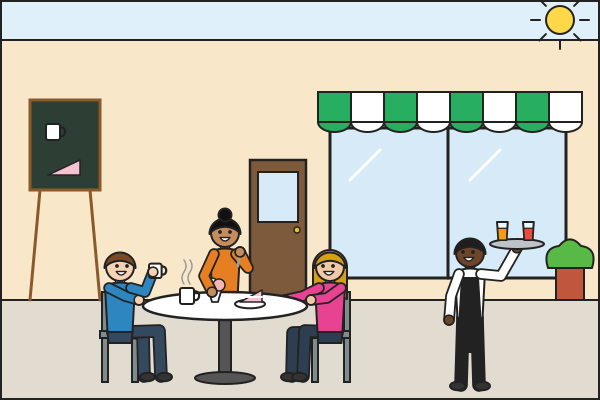
You post this picture on a blog for your school's partner school in Medellín, in Colombia.
What is in this photo? Write five sentences in Spanish.
Model answer
Hace sol y hay tres amigos en un café. El chico de la izquierda toma un café. La chica del centro come algo dulce. A la derecha, el camarero lleva dos bebidas. Me gusta mucho este café porque es bonito y tranquilo.
Explanation
Each sentence needs a conjugated verb and must describe the picture: Hay tres amigos en un café, El camarero lleva dos bebidas, Hace sol. Useful verbs are tomar and beber for drinks, comer, llevar (to carry or to wear) and estar for place (están en un café, están al aire libre). Note that café means both 'coffee' and 'café'. Words beyond the Foundation list, such as helado, taza or pastel, are credited equally, and a phrase without a verb ('dos bebidas') scores only 1 mark.
Mark scheme
2 marks
Levels of response: sentence 1 (AO2, 2 marks). Level 2 (2 marks): the relevant message is clearly communicated. Level 1 (1 mark): the message is relevant but has some ambiguity and causes a delay in communication. 0 marks: the message is irrelevant or cannot be understood.
Each of the five sentences is marked separately, as a whole, and must be about the picture. 2 marks: a sentence with an appropriate conjugated verb; the same structure may be repeated with different nouns (hay ...); any person of the verb and any tense are accepted; there may be errors as long as the message is unambiguous; a figure may be written for a number; anything that could possibly be true of the picture is accepted. 1 mark: an infinitive in an otherwise appropriate sentence (el chico jugar al fútbol); a noun phrase without a verb (una mesa; nueve personas); an error that causes ambiguity or delay (they are eating coffee); a long sentence where one part communicates and another does not. 0 marks: a single word (mesa; nueve); an inappropriate verb (quiero una casa; soy un libro); something clearly false about the picture; an opinion about the photo that says nothing about what is in it (me gusta la foto = 0; me gusta la foto porque hace sol = 2). A missing or wrong accent or ñ does not matter unless it makes the message ambiguous. Any standard variety of Spanish is accepted. Students' own ways of referring to themselves and others (pronouns, gendered language, agreements) are credited. Any combination of appropriate sentences is acceptable: the examples given under each sentence may be used for any of the five. Examples for this picture: 2 marks - Hay cuatro personas. / Veo a tres amigos y a un camarero. 1 mark - tres amigos. / un camarero con bebidas. 0 marks - camarero. / Hay seis personas (clearly false: there are four).
2 marks
Levels of response: sentence 2 (AO2, 2 marks). Level 2 (2 marks): the relevant message is clearly communicated. Level 1 (1 mark): the message is relevant but has some ambiguity and causes a delay in communication. 0 marks: the message is irrelevant or cannot be understood.
As sentence 1. Examples: 2 marks - Están en un café. / Están al aire libre. / Hace sol. 1 mark - estar en un café. / un café en la calle. 0 marks - café. / Están en el colegio (clearly false).
2 marks
Levels of response: sentence 3 (AO2, 2 marks). Level 2 (2 marks): the relevant message is clearly communicated. Level 1 (1 mark): the message is relevant but has some ambiguity and causes a delay in communication. 0 marks: the message is irrelevant or cannot be understood.
As sentence 1. Examples: 2 marks - El chico toma un café. / La chica come algo dulce. / El camarero trabaja. 1 mark - el chico beber. / el camarero llevar bebidas. 0 marks - beber. / La chica lee un libro (clearly false).
2 marks
Levels of response: sentence 4 (AO2, 2 marks). Level 2 (2 marks): the relevant message is clearly communicated. Level 1 (1 mark): the message is relevant but has some ambiguity and causes a delay in communication. 0 marks: the message is irrelevant or cannot be understood.
As sentence 1. Examples: 2 marks - Hay dos bebidas. / Hay una mesa blanca. / Hay una planta a la derecha. 1 mark - dos bebidas. / una mesa blanca. 0 marks - mesa. / Quiero un café (inappropriate verb: it says nothing about the picture). Zumo or jugo are both accepted; words beyond the Foundation list such as helado, taza or pastel are credited equally.
2 marks
Levels of response: sentence 5 (AO2, 2 marks). Level 2 (2 marks): the relevant message is clearly communicated. Level 1 (1 mark): the message is relevant but has some ambiguity and causes a delay in communication. 0 marks: the message is irrelevant or cannot be understood.
As sentence 1. Examples: 2 marks - El camarero lleva una camisa blanca. / La chica tiene el pelo rubio. / Me gusta el café porque es bonito. 1 mark - camisa blanca. / el camarero llevar una camisa. 0 marks - blanca. / Me gusta la foto (nothing about what is in it).
Question 2
10 marks
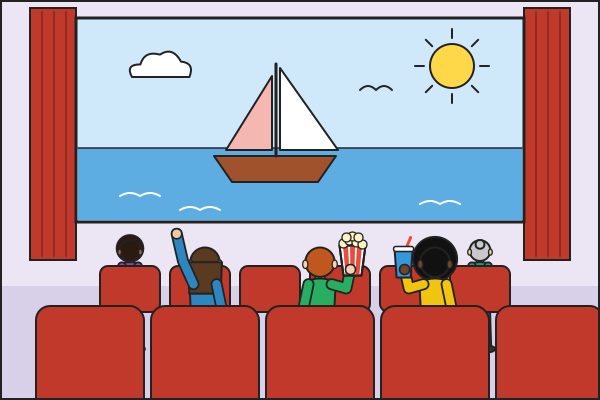
You went to the cinema with your friends. You send this picture to your friend in Tegucigalpa, in Honduras.
What is in this photo? Write five sentences in Spanish.
Model answer
Mis amigos y yo estamos en el cine. Vemos una película y en la pantalla hay un barco en el mar. Una chica levanta la mano. Mi amigo de la camiseta amarilla tiene una bebida azul. Me gusta la película porque el mar es muy bonito.
Explanation
Each sentence needs a conjugated verb and must fit the picture, for example Están en el cine or En la película hay un barco. Useful language is el cine, la película, la pantalla, ver or mirar una película, una bebida and el barco en el mar; you may write as one of the group (estamos en el cine, vemos una película). The sun and the sea are only in the film, so make that clear (en la película hace sol). Words beyond the Foundation list, such as palomitas, are credited equally, and a phrase with no verb ('una bebida azul') scores only 1 mark.
Mark scheme
2 marks
Levels of response: sentence 1 (AO2, 2 marks). Level 2 (2 marks): the relevant message is clearly communicated. Level 1 (1 mark): the message is relevant but has some ambiguity and causes a delay in communication. 0 marks: the message is irrelevant or cannot be understood.
Each of the five sentences is marked separately, as a whole, and must be about the picture. 2 marks: a sentence with an appropriate conjugated verb; the same structure may be repeated with different nouns (hay ...); any person of the verb and any tense are accepted; there may be errors as long as the message is unambiguous; a figure may be written for a number; anything that could possibly be true of the picture is accepted. 1 mark: an infinitive in an otherwise appropriate sentence (el chico jugar al fútbol); a noun phrase without a verb (una mesa; nueve personas); an error that causes ambiguity or delay (they are eating coffee); a long sentence where one part communicates and another does not. 0 marks: a single word (mesa; nueve); an inappropriate verb (quiero una casa; soy un libro); something clearly false about the picture; an opinion about the photo that says nothing about what is in it (me gusta la foto = 0; me gusta la foto porque la película es bonita = 2). A missing or wrong accent or ñ does not matter unless it makes the message ambiguous. Any standard variety of Spanish is accepted. Students' own ways of referring to themselves and others (pronouns, gendered language, agreements) are credited. Any combination of appropriate sentences is acceptable: the examples given under each sentence may be used for any of the five. Examples for this picture: 2 marks - Hay cinco personas. / Mis amigos y yo estamos en el cine. 1 mark - cinco personas en el cine. / mis amigos en el cine. 0 marks - personas. / Hay una persona (clearly false: there are five).
2 marks
Levels of response: sentence 2 (AO2, 2 marks). Level 2 (2 marks): the relevant message is clearly communicated. Level 1 (1 mark): the message is relevant but has some ambiguity and causes a delay in communication. 0 marks: the message is irrelevant or cannot be understood.
As sentence 1. Examples: 2 marks - Están en el cine. / Ven una película. / Hay muchas sillas rojas. 1 mark - estar en el cine. / una película en el cine. 0 marks - cine. / Están en un concierto (clearly false).
2 marks
Levels of response: sentence 3 (AO2, 2 marks). Level 2 (2 marks): the relevant message is clearly communicated. Level 1 (1 mark): the message is relevant but has some ambiguity and causes a delay in communication. 0 marks: the message is irrelevant or cannot be understood.
As sentence 1. Examples: 2 marks - Una persona levanta la mano. / Un chico come. / Miran la pantalla. 1 mark - levantar la mano. / mirar una película. 0 marks - mirar. / Bailan en el cine (clearly false).
2 marks
Levels of response: sentence 4 (AO2, 2 marks). Level 2 (2 marks): the relevant message is clearly communicated. Level 1 (1 mark): the message is relevant but has some ambiguity and causes a delay in communication. 0 marks: the message is irrelevant or cannot be understood.
As sentence 1. Examples: 2 marks - En la película hay un barco. / Hay un barco en el mar. / En la película hace sol. 1 mark - un barco en el mar. / una película del mar. 0 marks - barco. / En la película hay un coche (clearly false).
2 marks
Levels of response: sentence 5 (AO2, 2 marks). Level 2 (2 marks): the relevant message is clearly communicated. Level 1 (1 mark): the message is relevant but has some ambiguity and causes a delay in communication. 0 marks: the message is irrelevant or cannot be understood.
As sentence 1. Examples: 2 marks - Una chica lleva una camiseta azul. / Un chico tiene una bebida azul. / Me gusta la foto porque la película es interesante. 1 mark - una camiseta amarilla. / una bebida azul. 0 marks - azul. / Me gusta la foto (nothing about what is in it). Words beyond the Foundation list such as palomitas, butacas or cortinas are credited equally.
Question 3
10 marks
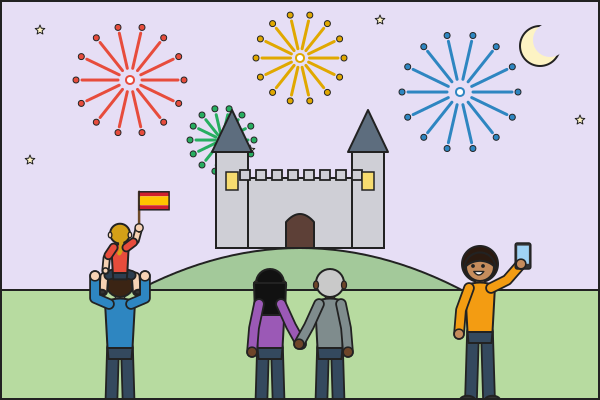
You were on holiday in Spain and send this picture to your friend in Caracas, in Venezuela.
What is in this photo? Write five sentences in Spanish.
Model answer
Es de noche y hay fuegos artificiales en el cielo. Hay un castillo gris en el centro. A la izquierda, un padre lleva a su hija. A la derecha, un chico saca una foto con su móvil. Me encantan estos fuegos artificiales porque son de muchos colores.
Explanation
Each sentence needs a conjugated verb and must fit the picture, for example Hay fuegos artificiales or Un chico saca una foto. Useful language here is es de noche, el cielo, las estrellas, el castillo, mirar los fuegos artificiales and sacar una foto con el móvil; fuegos artificiales is plural, so write son bonitos and me encantan. 'Hace sol' would be clearly false, because it is night. Words beyond the Foundation list, such as luna or bandera, are credited equally.
Mark scheme
2 marks
Levels of response: sentence 1 (AO2, 2 marks). Level 2 (2 marks): the relevant message is clearly communicated. Level 1 (1 mark): the message is relevant but has some ambiguity and causes a delay in communication. 0 marks: the message is irrelevant or cannot be understood.
Each of the five sentences is marked separately, as a whole, and must be about the picture. 2 marks: a sentence with an appropriate conjugated verb; the same structure may be repeated with different nouns (hay ...); any person of the verb and any tense are accepted; there may be errors as long as the message is unambiguous; a figure may be written for a number; anything that could possibly be true of the picture is accepted. 1 mark: an infinitive in an otherwise appropriate sentence (el chico jugar al fútbol); a noun phrase without a verb (una mesa; nueve personas); an error that causes ambiguity or delay (they are eating coffee); a long sentence where one part communicates and another does not. 0 marks: a single word (mesa; nueve); an inappropriate verb (quiero una casa; soy un libro); something clearly false about the picture; an opinion about the photo that says nothing about what is in it (me gusta la foto = 0; me gusta la foto porque hay fuegos artificiales = 2). A missing or wrong accent or ñ does not matter unless it makes the message ambiguous. Any standard variety of Spanish is accepted. Students' own ways of referring to themselves and others (pronouns, gendered language, agreements) are credited. Any combination of appropriate sentences is acceptable: the examples given under each sentence may be used for any of the five. Examples for this picture: 2 marks - Hay cinco personas. / Veo a una niña. 1 mark - cinco personas. / una familia en el campo. 0 marks - niña. / Hay diez niños (clearly false: there is one child).
2 marks
Levels of response: sentence 2 (AO2, 2 marks). Level 2 (2 marks): the relevant message is clearly communicated. Level 1 (1 mark): the message is relevant but has some ambiguity and causes a delay in communication. 0 marks: the message is irrelevant or cannot be understood.
As sentence 1. Examples: 2 marks - Es de noche. / Hay estrellas en el cielo. / Están en España. 1 mark - de noche. / estrellas en el cielo. 0 marks - noche. / Hace sol (clearly false: it is night).
2 marks
Levels of response: sentence 3 (AO2, 2 marks). Level 2 (2 marks): the relevant message is clearly communicated. Level 1 (1 mark): the message is relevant but has some ambiguity and causes a delay in communication. 0 marks: the message is irrelevant or cannot be understood.
As sentence 1. Examples: 2 marks - Miran los fuegos artificiales. / Un chico saca una foto. / La niña levanta la mano. 1 mark - mirar los fuegos artificiales. / sacar una foto. 0 marks - mirar. / Comen en un restaurante (clearly false).
2 marks
Levels of response: sentence 4 (AO2, 2 marks). Level 2 (2 marks): the relevant message is clearly communicated. Level 1 (1 mark): the message is relevant but has some ambiguity and causes a delay in communication. 0 marks: the message is irrelevant or cannot be understood.
As sentence 1. Examples: 2 marks - Hay un castillo. / Hay fuegos artificiales de muchos colores. / El castillo es gris. 1 mark - un castillo gris. / fuegos artificiales. 0 marks - castillo. / Soy un castillo (inappropriate verb). Words beyond the Foundation list such as luna or bandera (la bandera de España, una bandera española) are credited equally.
2 marks
Levels of response: sentence 5 (AO2, 2 marks). Level 2 (2 marks): the relevant message is clearly communicated. Level 1 (1 mark): the message is relevant but has some ambiguity and causes a delay in communication. 0 marks: the message is irrelevant or cannot be understood.
As sentence 1. Examples: 2 marks - El chico de la derecha lleva una camiseta naranja. / La niña es española. / Me gusta la foto porque los colores son bonitos. 1 mark - camiseta naranja. / llevar una camiseta naranja. 0 marks - naranja. / Me encanta la foto (nothing about what is in it).
Question 4
10 marks
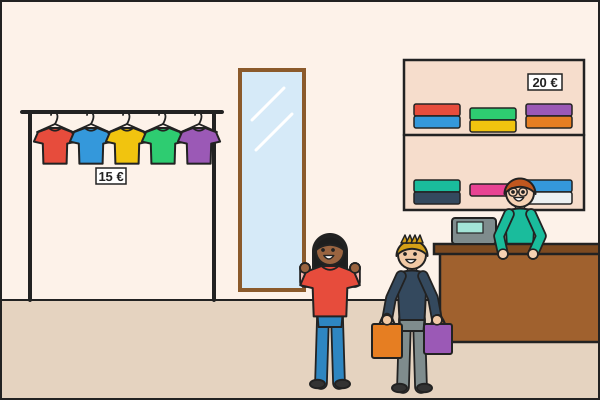
You went shopping during a holiday in Spain. You send this picture to your friend in Málaga.
What is in this photo? Write five sentences in Spanish.
Model answer
Mis amigos están en una tienda de ropa. Las camisetas cuestan quince euros. Mi amigo tiene dos bolsas y está contento. A la derecha, un hombre trabaja en la tienda. Me gusta esta tienda porque la ropa es barata.
Explanation
Each sentence needs a conjugated verb and must say something true or possible about the picture, for example Las camisetas cuestan quince euros or El chico tiene dos bolsas. Useful language is la tienda de ropa, las camisetas, la ropa, las bolsas, comprar, ir de compras and costar (cuesta for one item, cuestan for several); prices may be written as figures (15 €). A price that does not match the labels is clearly false and scores 0, and 'camisetas quince euros' has no verb and scores only 1 mark.
Mark scheme
2 marks
Levels of response: sentence 1 (AO2, 2 marks). Level 2 (2 marks): the relevant message is clearly communicated. Level 1 (1 mark): the message is relevant but has some ambiguity and causes a delay in communication. 0 marks: the message is irrelevant or cannot be understood.
Each of the five sentences is marked separately, as a whole, and must be about the picture. 2 marks: a sentence with an appropriate conjugated verb; the same structure may be repeated with different nouns (hay ...); any person of the verb and any tense are accepted; there may be errors as long as the message is unambiguous; a figure may be written for a number; anything that could possibly be true of the picture is accepted. 1 mark: an infinitive in an otherwise appropriate sentence (el chico jugar al fútbol); a noun phrase without a verb (una mesa; nueve personas); an error that causes ambiguity or delay (they are eating coffee); a long sentence where one part communicates and another does not. 0 marks: a single word (mesa; nueve); an inappropriate verb (quiero una casa; soy un libro); something clearly false about the picture; an opinion about the photo that says nothing about what is in it (me gusta la foto = 0; me gusta la foto porque la ropa es bonita = 2). A missing or wrong accent or ñ does not matter unless it makes the message ambiguous. Any standard variety of Spanish is accepted. Students' own ways of referring to themselves and others (pronouns, gendered language, agreements) are credited. Any combination of appropriate sentences is acceptable: the examples given under each sentence may be used for any of the five. Examples for this picture: 2 marks - Hay tres personas. / Veo a una chica y a un chico. 1 mark - tres personas. / una chica contenta. 0 marks - chica. / Hay seis personas (clearly false: there are three).
2 marks
Levels of response: sentence 2 (AO2, 2 marks). Level 2 (2 marks): the relevant message is clearly communicated. Level 1 (1 mark): the message is relevant but has some ambiguity and causes a delay in communication. 0 marks: the message is irrelevant or cannot be understood.
As sentence 1. Examples: 2 marks - Están en una tienda de ropa. / Es una tienda en España. 1 mark - una tienda de ropa. / estar en una tienda. 0 marks - tienda. / Están en un mercado en la calle (clearly false: they are inside a shop).
2 marks
Levels of response: sentence 3 (AO2, 2 marks). Level 2 (2 marks): the relevant message is clearly communicated. Level 1 (1 mark): the message is relevant but has some ambiguity and causes a delay in communication. 0 marks: the message is irrelevant or cannot be understood.
As sentence 1. Examples: 2 marks - Van de compras. / La chica está contenta. / Un hombre trabaja en la tienda. 1 mark - comprar ropa. / el hombre trabajar. 0 marks - comprar. / La chica come una manzana (clearly false).
2 marks
Levels of response: sentence 4 (AO2, 2 marks). Level 2 (2 marks): the relevant message is clearly communicated. Level 1 (1 mark): the message is relevant but has some ambiguity and causes a delay in communication. 0 marks: the message is irrelevant or cannot be understood.
As sentence 1. Examples: 2 marks - Las camisetas cuestan quince euros. / Hay muchas camisetas. / El chico tiene dos bolsas. 1 mark - camisetas quince euros. / dos bolsas. 0 marks - camisetas. / Las camisetas cuestan cien euros (clearly false: the label says 15 €). Words beyond the Foundation list such as espejo or dependiente are credited equally.
2 marks
Levels of response: sentence 5 (AO2, 2 marks). Level 2 (2 marks): the relevant message is clearly communicated. Level 1 (1 mark): the message is relevant but has some ambiguity and causes a delay in communication. 0 marks: the message is irrelevant or cannot be understood.
As sentence 1. Examples: 2 marks - La chica lleva una camiseta roja. / El chico tiene el pelo rubio. / Me gusta la tienda porque la ropa es barata. 1 mark - camiseta roja. / la chica llevar una camiseta roja. 0 marks - roja. / Me gusta la foto (nothing about what is in it).
Ready to try the rest? Every answer you write is marked against the mark scheme, so you can see exactly where the marks are.
Ctrl + Enter to check
Study HelperHints first, answers after you try
Stuck on this one? Ask for a hint and I’ll point you in the right direction, without giving the answer away. Once you’ve checked your answer, I’ll show you how the marks are awarded.