Level:
Correct: 0
Incorrect: 0
Marks: 0/0
Exam Practice
Course:
Topics:
Edexcel A-Level Maths (Paper 2) Smart practice A mixed round aimed at your weak spots
Unit 1
Proof
Unit 2
Algebra and functions
Unit 3
Coordinate geometry in the (x, y) plane
Unit 4
Sequences and series
Unit 5
Trigonometry
Unit 6
Exponentials and logarithms
Unit 7
Differentiation
Unit 8
Integration
Unit 9
Numerical methods
Unit 10
Vectors
Avg
score:
–
Topics
done:
0/36

The trapezium rule

Practise 16 exam-style questions on The trapezium rule for Edexcel A-Level Maths (Paper 2). Write your answer as you would in the exam and get it marked in seconds against the mark scheme, point by point, with the Study Helper on hand if you get stuck.

  • 16 questions
  • 2–10 marks each
  • Instant marking
  • No sign-up needed
16 questions, marked as you go

Sample questions with model answers

Here are 4 of the questions in this topic, each with a model answer, an explanation of why it earns the marks and the mark scheme an examiner would use.

Question 1

3 marks

Using the trapezium rule with strips of width 0.3, find an estimate for
\[\int_0^{1.2} \cos\left(x^2\right)dx\]
where \(x\) is in radians. Give your answer to 3 significant figures.

[The trapezium rule: \(\displaystyle\int_a^b y\,dx \approx \dfrac{1}{2}h\{(y_0 + y_n) + 2(y_1 + y_2 + \ldots + y_{n-1})\}\), where \(h = \dfrac{b - a}{n}\)]

Model answer

\(h = 0.3\), so the ordinates are at \(x = 0, 0.3, 0.6, 0.9, 1.2\)
y-values: 1, 0.99595, 0.93590, 0.68950, 0.13042
\(\displaystyle\int_0^{1.2} \cos(x^2)\,dx \approx \dfrac{1}{2} \times 0.3 \times \{(1 + 0.13042) + 2(0.99595 + 0.93590 + 0.68950)\}\)
\(= 0.15 \times \{1.13042 + 5.24270\} = 0.15 \times 6.37312 = 0.956\) (3 s.f.)

Explanation

With strips of width 0.3 from 0 to 1.2 there are 4 strips and 5 ordinates. Each value of \(\cos(x^2)\) must be found in radian mode, and the trapezium rule then combines them. Common errors are using degree mode and evaluating \(\cos^2 x\) instead of \(\cos(x^2)\).

Mark scheme
  1. 1 mark

    B1 The five values of \(\cos(x^2)\) at \(x = 0, 0.3, 0.6, 0.9, 1.2\): 1, 0.99595, 0.93590, 0.68950, 0.13042 (at least 3 s.f.). An answer with no working scores 0 marks.

    An answer of 0.956 with no working scores 0 marks: the working for the trapezium rule must be seen. Ordinates may be rounded or truncated to 3 s.f. or better (e.g. 0.996 for 0.99595, in [0.9955, 0.9965)). (Calculator integration gives 0.974, which is not the trapezium estimate.) Values found in degree mode (e.g. 0.99999 at x = 0.3) score B0.

  2. 1 mark

    M1 Correct structure with \(h = 0.3\): \(\dfrac{1}{2} \times 0.3 \times \{(1 + 0.13042) + 2(0.99595 + 0.93590 + 0.68950)\}\)

    Follow through their values of y; accept ordinates rounded or truncated to 3 s.f. or better, as in point 1.

  3. 1 mark

    A1 awrt 0.956, i.e. in [0.9555, 0.9565)

    0.95597...
Question 2

5 marks

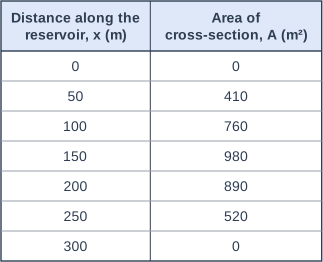
A small reservoir is 300 m long. The table shows the area, \(A\) m², of the vertical cross-section of the water at distances \(x\) metres along the reservoir.

The volume of water in the reservoir, in m³, is given by \(\displaystyle\int_0^{300} A\,dx\).

Use the trapezium rule with all the values in the table to estimate the volume of water in the reservoir.

Water is taken from the reservoir at a rate of 4.5 million litres per day, and none is added. Using your estimate, find the number of complete days for which the water would last. (1 m³ = 1000 litres)

[The trapezium rule: \(\displaystyle\int_a^b y\,dx \approx \dfrac{1}{2}h\{(y_0 + y_n) + 2(y_1 + y_2 + \ldots + y_{n-1})\}\), where \(h = \dfrac{b - a}{n}\)]

Table with columns "Distance along the reservoir, x (m)", "Area of cross-section, A (m²)". Distance along the reservoir, x (m): 0; Area of cross-section, A (m²): 0 | Distance along the reservoir, x (m): 50; Area of cross-section, A (m²): 410 | Distance along the reservoir, x (m): 100; Area of cross-section, A (m²): 760 | Distance along the reservoir, x (m): 150; Area of cross-section, A (m²): 980 | Distance along the reservoir, x (m): 200; Area of cross-section, A (m²): 890 | Distance along the reservoir, x (m): 250; Area of cross-section, A (m²): 520 | Distance along the reservoir, x (m): 300; Area of cross-section, A (m²): 0.

Model answer

\(h = 50\)
\(V \approx \dfrac{1}{2} \times 50 \times \{(0 + 0) + 2(410 + 760 + 980 + 890 + 520)\}\)
\(= 25 \times 7120 = 178\,000\) m³
\(178\,000\) m³ \(= 178\,000\,000\) litres
\(\dfrac{178\,000\,000}{4\,500\,000} = 39.6\)
So the water would last for 39 complete days.

Explanation

The volume is the area under the graph of cross-sectional area against distance, so the trapezium rule applies with h = 50. Converting to litres and dividing by the daily use gives 39.6 days, of which 39 are complete days. Common errors are forgetting the factor of 1000 between m³ and litres, and rounding 39.6 up to 40 when complete days are asked for.

Mark scheme
  1. 1 mark

    B1 \(h = 50\). An answer with no working scores 0 marks.

    An answer of 39 days with no working scores 0 marks: the trapezium rule must be seen.

  2. 1 mark

    M1 Correct structure: \(\dfrac{1}{2} \times 50 \times \{(0 + 0) + 2(410 + 760 + 980 + 890 + 520)\}\)

    Condone one copying slip.

  3. 1 mark

    A1 178 000 (m³)

    Accept \(1.78 \times 10^5\).

  4. 1 mark

    M1 Converts to litres and divides by 4.5 million: \(\dfrac{178\,000 \times 1000}{4\,500\,000}\)

    Follow through their volume. Dividing m³ by 4.5 million without converting scores M0.

  5. 1 mark

    A1 39 (complete days)

    From 39.56... Do not accept 40 or 39.6 as the final answer.

Question 3

7 marks

In this question you must show all stages of your working.
Solutions relying entirely on calculator technology are not acceptable.

The trapezium rule, with 2 strips of equal width, gives an estimate of 12.5 for
\[\int_0^2 2^{kx}\,dx\]
where \(k\) is a positive constant.

Using algebra, find the value of \(k\).

Hence find the exact value of \(\displaystyle\int_0^2 2^{kx}\,dx\), giving your answer in the form \(\dfrac{a}{\ln b}\), where \(a\) and \(b\) are integers.

[The trapezium rule: \(\displaystyle\int_a^b y\,dx \approx \dfrac{1}{2}h\{(y_0 + y_n) + 2(y_1 + y_2 + \ldots + y_{n-1})\}\), where \(h = \dfrac{b - a}{n}\)]

Model answer

h = 1, so the ordinates are at x = 0, 1, 2: \(y = 1, 2^k, 2^{2k}\)
\(\dfrac{1}{2} \times 1 \times \{(1 + 2^{2k}) + 2 \times 2^k\} = 12.5\)
Let \(u = 2^k\): \(1 + u^2 + 2u = 25\), so \(u^2 + 2u - 24 = 0\)
\((u + 6)(u - 4) = 0\), so \(u = 4\) (\(u = -6\) is impossible since \(2^k > 0\))
\(2^k = 4\), so \(k = 2\)
\(\displaystyle\int_0^2 2^{2x}\,dx = \int_0^2 4^x\,dx = \left[\dfrac{4^x}{\ln 4}\right]_0^2 = \dfrac{16 - 1}{\ln 4} = \dfrac{15}{\ln 4}\)

Explanation

With h = 1 the trapezium rule gives \(\dfrac{1}{2}(1 + 2u + u^2) = \dfrac{1}{2}(1 + u)^2\), where \(u = 2^k\), so the equation is a disguised quadratic with roots 4 and −6; only \(2^k = 4\) is possible. Then \(4^x = \mathrm{e}^{x\ln 4}\) integrates to \(\dfrac{4^x}{\ln 4}\). Common errors are not spotting the quadratic in \(2^k\) and integrating \(4^x\) as if it were a power of x.

Mark scheme
  1. 1 mark

    B1 \(h = 1\) and the ordinates \(1, 2^k, 2^{2k}\) (or \(4^k\)). An answer with no working scores 0 marks.

    An answer of k = 2 and \(\dfrac{15}{\ln 4}\) with no working scores 0 marks: the question demands working.

  2. 1 mark

    M1 Forms the equation \(\dfrac{1}{2} \times 1 \times \{(1 + 2^{2k}) + 2 \times 2^k\} = 12.5\)

  3. 1 mark

    A1 A three-term quadratic in \(u = 2^k\): \(u^2 + 2u - 24 = 0\) oe

    Accept \((1 + u)^2 = 25\).

  4. 1 mark

    M1 (dM1) Solves the quadratic (factorising, formula, completing the square or square-rooting): \((u + 6)(u - 4) = 0\)

    Depends on the M mark in point 2 (not on the A mark just before).

  5. 1 mark

    A1 \(2^k = 4\), so \(k = 2\), with \(2^k = -6\) rejected (\(2^k > 0\))

    The rejection must be stated or implied.

  6. 1 mark

    M1 Integrates \(4^x\) (or \(2^{2x}\), or \(\mathrm{e}^{x\ln 4}\)) to the form \(c \times 4^x\), where c is a constant (e.g. \(\dfrac{4^x}{\ln 4}\), \(\dfrac{\mathrm{e}^{x\ln 4}}{\ln 4}\) or \(\dfrac{2^{2x}}{2\ln 2}\)), and applies the limits 0 and 2

    Follow through their k. Writing \(4^x = \mathrm{e}^{x\ln 4}\) (the booklet result \(a^x = \mathrm{e}^{x\ln a}\)) and integrating it as \(\mathrm{e}^{cx}\) with \(c = \ln 4\) is the expected method. Integrating to \(\dfrac{4^{x+1}}{x+1}\) (treating \(4^x\) as a power of x) scores M0.

  7. 1 mark

    A1 \(\dfrac{15}{\ln 4}\)

    Accept \(\dfrac{30}{\ln 16}\) or any equivalent with integers a and b. \(\dfrac{15}{2\ln 2}\) is not in the required form: A0 unless rewritten. A decimal (10.8) scores A0.

Question 4

9 marks

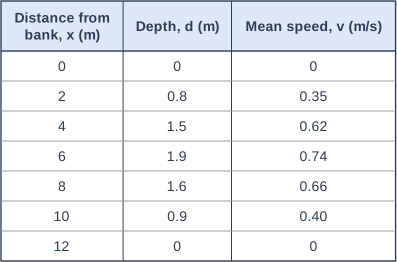
A river is 12 m wide. At points across the river, at distances \(x\) metres from one bank, a hydrologist measures the depth, \(d\) metres, and uses a flow meter to find the mean speed of the water, \(v\) metres per second, from the surface to the river bed. The table shows the results.

The discharge of the river, in m³ per second, is given by \(\displaystyle\int_0^{12} vd\,dx\), and the area of its cross-section, in m², is given by \(\displaystyle\int_0^{12} d\,dx\).

Using the trapezium rule with all the readings, estimate
• the discharge of the river
• the area of the cross-section.

Hence estimate the mean speed of the water through the cross-section, and the volume of water that flows past this point in one hour.

[The trapezium rule: \(\displaystyle\int_a^b y\,dx \approx \dfrac{1}{2}h\{(y_0 + y_n) + 2(y_1 + y_2 + \ldots + y_{n-1})\}\), where \(h = \dfrac{b - a}{n}\)]

Table with columns "Distance from bank, x (m)", "Depth, d (m)", "Mean speed, v (m/s)". Distance from bank, x (m): 0; Depth, d (m): 0; Mean speed, v (m/s): 0 | Distance from bank, x (m): 2; Depth, d (m): 0.8; Mean speed, v (m/s): 0.35 | Distance from bank, x (m): 4; Depth, d (m): 1.5; Mean speed, v (m/s): 0.62 | Distance from bank, x (m): 6; Depth, d (m): 1.9; Mean speed, v (m/s): 0.74 | Distance from bank, x (m): 8; Depth, d (m): 1.6; Mean speed, v (m/s): 0.66 | Distance from bank, x (m): 10; Depth, d (m): 0.9; Mean speed, v (m/s): 0.40 | Distance from bank, x (m): 12; Depth, d (m): 0; Mean speed, v (m/s): 0.

Model answer

Products vd: x = 0: 0; x = 2: 0.28; x = 4: 0.93; x = 6: 1.406; x = 8: 1.056; x = 10: 0.36; x = 12: 0
Discharge \(\approx \dfrac{1}{2} \times 2 \times \{(0 + 0) + 2(0.28 + 0.93 + 1.406 + 1.056 + 0.36)\} = 2 \times 4.032 = 8.064\), about 8.06 m³ per second
Area \(\approx \dfrac{1}{2} \times 2 \times \{(0 + 0) + 2(0.8 + 1.5 + 1.9 + 1.6 + 0.9)\} = 2 \times 6.7 = 13.4\) m²
Mean speed \(\approx \dfrac{8.064}{13.4} = 0.602\) m/s
Volume in one hour \(\approx 8.064 \times 3600 = 29\,030\), about 29 000 m³

Explanation

The discharge is the integral of the product vd, so the products are found first and then the trapezium rule is applied to them; the cross-sectional area uses the depths alone. The mean speed is the discharge divided by the area, and multiplying the discharge by 3600 gives the volume per hour. A common error is to multiply separate estimates (or averages) of v and d, which is not the same as integrating their product.

Mark scheme
  1. 1 mark

    B1 The products \(vd\) at x = 2, 4, 6, 8, 10: 0.28, 0.93, 1.406, 1.056, 0.36 (and 0 at both banks). An answer with no working scores 0 marks.

    Answers (discharge 8.06 m³/s, area 13.4 m², mean speed 0.602 m/s, 29 000 m³) with no working score 0 marks: the trapezium rule must be seen.

  2. 1 mark

    M1 Trapezium rule with \(h = 2\) on their products: \(\dfrac{1}{2} \times 2 \times \{(0 + 0) + 2(0.28 + 0.93 + 1.406 + 1.056 + 0.36)\}\)

    Multiplying a trapezium estimate for d by one for v scores M0: the products must be found first.

  3. 1 mark

    A1 Discharge awrt 8.06 m³/s, i.e. in [8.055, 8.065)

    8.064 exactly.

  4. 1 mark

    M1 Trapezium rule with \(h = 2\) on the depths: \(\dfrac{1}{2} \times 2 \times \{(0 + 0) + 2(0.8 + 1.5 + 1.9 + 1.6 + 0.9)\}\)

  5. 1 mark

    A1 Area 13.4 m²

    cao

  6. 1 mark

    M1 Mean speed = discharge ÷ area, with their values

  7. 1 mark

    A1 awrt 0.602 m/s, i.e. in [0.6015, 0.6025)

    \(\dfrac{8.064}{13.4} = 0.60179...\) Accept awrt 0.60, i.e. in [0.595, 0.605), if their values are rounded to 3 s.f. first (8.06 ÷ 13.4 = 0.6015).

  8. 1 mark

    M1 Volume in one hour = discharge × 3600

    Follow through their discharge.

  9. 1 mark

    A1 29 000 m³ to 3 significant figures (from 29 030), i.e. a value in [28 950, 29 050)

    Accept 29 000, 29 030, \(2.90 \times 10^4\). Units not required.

Ready to try the rest? Every answer you write is marked against the mark scheme, so you can see exactly where the marks are.

Study Helper Hints first, answers after you try

Stuck on this one? Ask for a hint and I’ll point you in the right direction, without giving the answer away. Once you’ve checked your answer, I’ll show you how the marks are awarded.