
Level:
Correct: 0
Incorrect: 0
Marks: 0/0
Exam Practice
Course:
Topics:
Edexcel A-Level Maths (Paper 2) Smart practice A mixed round aimed at your weak spots
Unit 1
Proof
Unit 2
Algebra and functions
Unit 3
Coordinate geometry in the (x, y) plane
Unit 4
Sequences and series
Unit 5
Trigonometry
Unit 6
Exponentials and logarithms
Unit 7
Differentiation
Unit 8
Integration
Unit 9
Numerical methods
Unit 10
Vectors
Avg
score:
–
Topics
done:
0/36

Tangents, normals and stationary points

Practise 19 exam-style questions on Tangents, normals and stationary points for Edexcel A-Level Maths (Paper 2). Write your answer as you would in the exam and get it marked in seconds against the mark scheme, point by point, with the Study Helper on hand if you get stuck.

  • 19 questions
  • 2–12 marks each
  • Instant marking
  • No sign-up needed
19 questions, marked as you go

Sample questions with model answers

Here are 4 of the questions in this topic, each with a model answer, an explanation of why it earns the marks and the mark scheme an examiner would use.

Question 1

4 marks

The curve \(C\) has equation
\[y = x^2 + 8\sqrt{x}, \quad x > 0\]

Determine the values of \(x\) for which \(C\) is concave, writing your answer using set notation.

Model answer

\(y = x^2 + 8x^{\frac{1}{2}}\)
\(\dfrac{dy}{dx} = 2x + 4x^{-\frac{1}{2}}\)
\(\dfrac{d^2y}{dx^2} = 2 - 2x^{-\frac{3}{2}}\)
\(C\) is concave where \(\dfrac{d^2y}{dx^2} \leqslant 0\): \(2 \leqslant 2x^{-\frac{3}{2}} \Rightarrow x^{\frac{3}{2}} \leqslant 1 \Rightarrow x \leqslant 1\)
So \(C\) is concave for \(\{x : 0 < x \leqslant 1\}\).

Explanation

A curve is concave where its second derivative is negative (or zero), so differentiate twice and solve \(2 - 2x^{-\frac{3}{2}} \leqslant 0\), remembering that \(x > 0\). The answer must be written in set notation. Common errors are solving \(\dfrac{dy}{dx} = 0\) instead, and giving the set where the curve is convex.

Mark scheme
  1. 1 mark

    M1 Differentiates: \(x^2 \to x\) or \(x^{\frac{1}{2}} \to x^{-\frac{1}{2}}\); or a correct final answer of \(\{x : 0 < x \leqslant 1\}\) with no working

    An answer of \(\{x : 0 < x \leqslant 1\}\) with no working scores 2 marks (the M1 and the final A1): the second derivative must be seen for the other marks.

  2. 1 mark

    A1 \(\dfrac{dy}{dx} = 2x + 4x^{-\frac{1}{2}}\) and \(\dfrac{d^2y}{dx^2} = 2 - 2x^{-\frac{3}{2}}\)

    Both needed.

  3. 1 mark

    M1 Sets their \(\dfrac{d^2y}{dx^2} \leqslant 0\) (or \(< 0\), or \(= 0\) to find the critical value) and solves for \(x\)

    Depends on the first M mark. \(x^{-\frac{3}{2}} \geqslant 1 \Rightarrow x \leqslant 1\). Setting \(\dfrac{dy}{dx} = 0\) is M0.

  4. 1 mark

    A1 \(\{x : 0 < x \leqslant 1\}\)

    Accept \(\{x : 0 < x < 1\}\) or \(\{x : x \leqslant 1\} \cap \{x : x > 0\}\). Set notation is required: \(0 < x \leqslant 1\) or \((0, 1]\) alone is A0. Do not accept \(\{x : x \leqslant 1\}\) (the curve is only defined for \(x > 0\)) or \(\{x : x \geqslant 1\}\), which is where \(C\) is convex.
Question 2

5 marks

The curve \(C\) has equation \(y = 2\ln x\), \(x > 0\).
The point \(P\) on \(C\) has \(x\)-coordinate \(\mathrm{e}\).
The normal to \(C\) at \(P\) meets the \(x\)-axis at the point \(N\).

Find the exact \(x\)-coordinate of \(N\).

Model answer

At \(P\): \(y = 2\ln\mathrm{e} = 2\)
\(\dfrac{dy}{dx} = \dfrac{2}{x}\), so the gradient of the tangent at \(P\) is \(\dfrac{2}{\mathrm{e}}\)
Gradient of the normal \(= -\dfrac{\mathrm{e}}{2}\)
Normal: \(y - 2 = -\dfrac{\mathrm{e}}{2}(x - \mathrm{e})\)
At \(N\), \(y = 0\): \(-2 = -\dfrac{\mathrm{e}}{2}(x - \mathrm{e}) \Rightarrow x - \mathrm{e} = \dfrac{4}{\mathrm{e}}\)
\(x = \mathrm{e} + \dfrac{4}{\mathrm{e}}\)

Explanation

Find the point and the gradient of the tangent, \(\dfrac{2}{\mathrm{e}}\), then use the negative reciprocal for the normal and set \(y = 0\). The answer should be exact, in terms of \(\mathrm{e}\). Common errors are using \(\dfrac{2}{\mathrm{e}}\) as the gradient of the normal and slips when rearranging the fraction \(\dfrac{4}{\mathrm{e}}\).

Mark scheme
  1. 1 mark

    B1 The \(y\)-coordinate of \(P\) is 2; a correct final answer of \(\mathrm{e} + \dfrac{4}{\mathrm{e}}\) with no working scores 2 marks

    An answer of \(\mathrm{e} + \dfrac{4}{\mathrm{e}}\) with no working scores 2 marks (this B1 and the final A1): the gradient and the normal must be seen for the method marks.

  2. 1 mark

    M1 Differentiates \(2\ln x \to \dfrac{2}{x}\) and finds the gradient at \(P\): \(\dfrac{2}{\mathrm{e}}\)

    Accept \(\dfrac{k}{x}\) for the method.

  3. 1 mark

    M1 (dM1) Uses the gradient of the normal, \(-\dfrac{\mathrm{e}}{2}\) (the negative reciprocal of their gradient), with \(P(\mathrm{e}, 2)\) in a straight-line equation: \(y - 2 = -\dfrac{\mathrm{e}}{2}(x - \mathrm{e})\)

    Depends on the first M mark. Using the tangent gradient is M0.

  4. 1 mark

    M1 (ddM1) Sets \(y = 0\) in their normal and solves for \(x\)

    Depends on the previous M mark (and so on both earlier M marks).

  5. 1 mark

    A1 \(x = \mathrm{e} + \dfrac{4}{\mathrm{e}}\)

    Accept \(\dfrac{\mathrm{e}^2 + 4}{\mathrm{e}}\) or \(\mathrm{e} + 4\mathrm{e}^{-1}\). A decimal (4.19) alone is A0, as the exact value is asked for.

Question 3

7 marks

The curve \(C\) has equation
\[y = 2x^5 - 5x^4 + 3\]

Using calculus, find the coordinates of the two stationary points of \(C\), and determine the nature of each stationary point, justifying your answers.

Model answer

\(\dfrac{dy}{dx} = 10x^4 - 20x^3 = 10x^3(x - 2)\)
\(\dfrac{dy}{dx} = 0 \Rightarrow x = 0\) or \(x = 2\)
\(x = 0\): \(y = 3\); \(x = 2\): \(y = 64 - 80 + 3 = -13\)
Stationary points: \((0, 3)\) and \((2, -13)\)
\(\dfrac{d^2y}{dx^2} = 40x^3 - 60x^2\)
At \(x = 2\): \(\dfrac{d^2y}{dx^2} = 320 - 240 = 80 > 0\), so \((2, -13)\) is a minimum.
At \(x = 0\): \(\dfrac{d^2y}{dx^2} = 0\), so the test is inconclusive. Check the sign of \(\dfrac{dy}{dx} = 10x^3(x - 2)\):
\(x = -0.1\): \(10(-0.001)(-2.1) = 0.021 > 0\); \(x = 0.1\): \(10(0.001)(-1.9) = -0.019 < 0\)
The gradient changes from positive to negative, so \((0, 3)\) is a maximum.

Explanation

Factorising \(\dfrac{dy}{dx} = 10x^3(x - 2)\) gives both stationary points; at \(x = 2\) the second derivative is positive, so it is a minimum. At \(x = 0\) the second derivative is zero, which tells you nothing, so the sign of the gradient on each side must be checked: it goes from positive to negative, so \((0, 3)\) is a maximum. A common error is to assume that a zero second derivative means a point of inflection.

Mark scheme
  1. 1 mark

    M1 Differentiates: at least one power of \(x\) reduced by 1. An answer with no working scores 0 marks.

    An answer with no working scores 0 marks: the question says 'using calculus', and the natures need reasons.

  2. 1 mark

    A1 \(\dfrac{dy}{dx} = 10x^4 - 20x^3\)

  3. 1 mark

    M1 (dM1) Sets their \(\dfrac{dy}{dx} = 0\) and factorises, e.g. \(10x^3(x - 2) = 0\), to find both values of \(x\)

    Depends on the first M mark. Dividing by \(x^3\) and losing \(x = 0\) loses the A mark that follows.

  4. 1 mark

    A1 \((0, 3)\) and \((2, -13)\)

    Both points needed.

  5. 1 mark

    M1 Finds \(\dfrac{d^2y}{dx^2} = 40x^3 - 60x^2\) (at least one power reduced) and evaluates it at \(x = 2\), or considers the sign of \(\dfrac{dy}{dx}\) either side of \(x = 2\)

    Depends on the first M mark.

  6. 1 mark

    A1 \((2, -13)\) is a minimum, because \(\dfrac{d^2y}{dx^2} = 80 > 0\) there (or \(\dfrac{dy}{dx}\) changes from negative to positive)

  7. 1 mark

    B1 \((0, 3)\) is a maximum: \(\dfrac{d^2y}{dx^2} = 0\) at \(x = 0\), so the second derivative test fails, but \(\dfrac{dy}{dx} = 10x^3(x - 2)\) is positive just to the left of \(x = 0\) and negative just to the right

    Needs the conclusion 'maximum' with a valid reason based on the sign of \(\dfrac{dy}{dx}\) on both sides (e.g. at \(x = -0.1\) and \(x = 0.1\)), or on values of \(y\) either side. A common error is to conclude that \((0, 3)\) is a point of inflection because \(\dfrac{d^2y}{dx^2} = 0\); this scores B0.

Question 4

10 marks

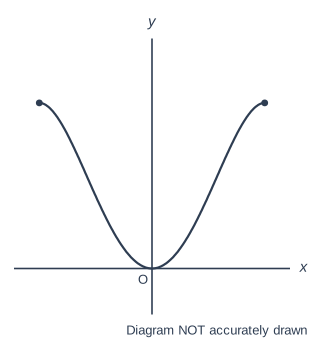
Figure 1 shows the cross-section of a drainage channel. The tops of the banks are at \(A\) and \(B\), and the lowest point of the channel is at \(O\).
In a model, the cross-section is the curve with equation
\[y = 0.6x^2 - 0.05x^4, \quad -\sqrt{6} \leqslant x \leqslant \sqrt{6}\]
where \(y\) metres is the height above \(O\) of a point on the bank whose horizontal distance from \(O\) is \(x\) metres.

Show that \(A\) and \(B\) are stationary points of the curve, and find the depth of the channel.
Show that \(O\) is a minimum point of the curve.
Using calculus, find the exact value of \(x\), where \(0 < x < \sqrt{6}\), at which the bank is steepest, justifying your answer, and find the exact value of the steepest gradient.
A mowing machine can be used safely only on a slope that makes an angle of less than \(45^\circ\) with the horizontal. Explain whether, according to the model, the machine can be used safely on every part of the bank from \(O\) to \(B\).

A sketch on a pair of axes (x across, y up) with no scale marked, the axes crossing at the origin O. It is marked "Diagram NOT accurately drawn". The curve is a curve: it meets the x-axis once; this point cannot be read off, as the sketch has no scale; it has a minimum point, which cannot be read off, as the sketch has no scale. Point A is marked with a dot; its coordinates cannot be read off, as the sketch has no scale. Point B is marked with a dot; its coordinates cannot be read off, as the sketch has no scale.

Model answer

\(\dfrac{dy}{dx} = 1.2x - 0.2x^3 = 0.2x\left(6 - x^2\right)\)
At \(x = \pm\sqrt{6}\), \(6 - x^2 = 0\), so \(\dfrac{dy}{dx} = 0\): \(A\) and \(B\) are stationary points.
Depth: \(y = 0.6 \times 6 - 0.05 \times 36 = 3.6 - 1.8 = 1.8\) m
\(\dfrac{d^2y}{dx^2} = 1.2 - 0.6x^2\)
At \(x = 0\): \(\dfrac{dy}{dx} = 0\) and \(\dfrac{d^2y}{dx^2} = 1.2 > 0\), so \(O\) is a minimum point.
The gradient is greatest where \(\dfrac{d^2y}{dx^2} = 0\): \(0.6x^2 = 1.2 \Rightarrow x = \sqrt{2}\) (for \(0 < x < \sqrt{6}\))
\(\dfrac{d^2y}{dx^2} > 0\) for \(0 < x < \sqrt{2}\) and \(< 0\) for \(\sqrt{2} < x < \sqrt{6}\), so the gradient increases and then decreases: it is greatest at \(x = \sqrt{2}\).
Steepest gradient \(= 0.2\sqrt{2}(6 - 2) = 0.8\sqrt{2} = \dfrac{4\sqrt{2}}{5}\)
A slope of \(45^\circ\) has gradient 1, and \(0.8\sqrt{2} \approx 1.13 > 1\) (about \(48.5^\circ\)), so near \(x = \sqrt{2}\) the bank is steeper than \(45^\circ\): the machine cannot be used safely on every part of the bank.

Explanation

The banks' tops and the bottom of the channel are stationary points, found from \(\dfrac{dy}{dx} = 0\), and the second derivative shows that \(O\) is a minimum. The bank is steepest where the gradient itself is greatest, at the point of inflection where \(\dfrac{d^2y}{dx^2} = 0\) and changes sign, so the steepest gradient is \(\dfrac{4\sqrt{2}}{5}\), which is more than the gradient 1 of a \(45^\circ\) slope. A common error is to look for the steepest point by setting \(\dfrac{dy}{dx} = 0\), which finds where the bank is flat.

Mark scheme
  1. 1 mark

    M1 Differentiates: at least one power of \(x\) reduced by 1. An answer with no working scores 0 marks for the show-thats and the calculus.

    An answer with no working scores 0 marks for the show-thats and for the steepest point, which the question asks to be found using calculus; a depth of 1.8 m stated with no working scores its B1, and the final B1 can be scored for a correct comparison and conclusion.

  2. 1 mark

    A1 \(\dfrac{dy}{dx} = 1.2x - 0.2x^3\)

  3. 1 mark

    A1* \(\dfrac{dy}{dx} = 0.2x\left(6 - x^2\right) = 0\) when \(x = \pm\sqrt{6}\) (and \(x = 0\)), so \(A\) and \(B\) are stationary points, cso

    Depends on the M mark (cso). Factorising, or substituting \(x = \pm\sqrt{6}\) and showing \(\dfrac{dy}{dx} = 0\) with a conclusion, is acceptable.

  4. 1 mark

    B1 Depth of the channel \(= 1.8\) m (from \(y = 0.6 \times 6 - 0.05 \times 36\))

    Units not required, but penalise wrong units.

  5. 1 mark

    M1 Differentiates again: \(\dfrac{d^2y}{dx^2} = 1.2 - 0.6x^2\) (at least one power of their \(\dfrac{dy}{dx}\) reduced)

    Depends on the first M mark.

  6. 1 mark

    A1 At \(x = 0\), \(\dfrac{dy}{dx} = 0\) and \(\dfrac{d^2y}{dx^2} = 1.2 > 0\), so \(O\) is a minimum point

    Needs both the stationary condition and the positive second derivative (or a correct sign-change argument for \(\dfrac{dy}{dx}\)), with a conclusion.

  7. 1 mark

    M1 Sets their \(\dfrac{d^2y}{dx^2} = 0\) to find where the gradient is greatest: \(0.6x^2 = 1.2\)

    Depends on the M mark for the second derivative. Setting \(\dfrac{dy}{dx} = 0\) again is M0.

  8. 1 mark

    A1 \(x = \sqrt{2}\), with a justification that the gradient is a maximum there: \(\dfrac{d^2y}{dx^2}\) changes from positive to negative at \(x = \sqrt{2}\) (or \(\dfrac{d^3y}{dx^3} = -1.2x < 0\) at \(x = \sqrt{2}\))

    Exact value required (not 1.41 alone). The justification is needed for this mark.

  9. 1 mark

    A1 Steepest gradient \(= 0.8\sqrt{2}\), i.e. \(\dfrac{4\sqrt{2}}{5}\)

    Depends on the third M mark. From \(0.2\sqrt{2}(6 - 2)\). Accept \(\dfrac{4\sqrt{2}}{5}\) or \(\sqrt{1.28}\); a decimal (1.13) alone is A0, as the exact value is asked for, but isw after an exact value.

  10. 1 mark

    B1 A slope of \(45^\circ\) has gradient 1, and the steepest gradient \(0.8\sqrt{2} \approx 1.13 > 1\) (an angle of about \(48.5^\circ\)), so the machine cannot be used safely on every part of the bank

    Needs the comparison with a gradient of 1 (or a comparison of angles, \(\arctan(1.13) \approx 48.5^\circ > 45^\circ\)) and the conclusion. Follow through their steepest gradient. Do not accept a conclusion with no comparison.

Ready to try the rest? Every answer you write is marked against the mark scheme, so you can see exactly where the marks are.

Study Helper Hints first, answers after you try

Stuck on this one? Ask for a hint and I’ll point you in the right direction, without giving the answer away. Once you’ve checked your answer, I’ll show you how the marks are awarded.