Level:
Correct: 0
Incorrect: 0
Marks: 0/0
Exam Practice
Course:
Topics:
Edexcel A-Level Maths (Paper 2) Smart practice A mixed round aimed at your weak spots
Unit 1
Proof
Unit 2
Algebra and functions
Unit 3
Coordinate geometry in the (x, y) plane
Unit 4
Sequences and series
Unit 5
Trigonometry
Unit 6
Exponentials and logarithms
Unit 7
Differentiation
Unit 8
Integration
Unit 9
Numerical methods
Unit 10
Vectors
Avg
score:
–
Topics
done:
0/36

Logarithms and logarithmic graphs

Practise 18 exam-style questions on Logarithms and logarithmic graphs for Edexcel A-Level Maths (Paper 2). Write your answer as you would in the exam and get it marked in seconds against the mark scheme, point by point, with the Study Helper on hand if you get stuck.

  • 18 questions
  • 2–9 marks each
  • Instant marking
  • No sign-up needed
18 questions, marked as you go

Sample questions with model answers

Here are 4 of the questions in this topic, each with a model answer, an explanation of why it earns the marks and the mark scheme an examiner would use.

Question 1

3 marks

A company makes steel storage tanks in a range of sizes, all of the same shape. A model relates the cost, £\(C\), of making a tank to its capacity, \(V\) litres, by \(C = aV^n\), where \(a\) and \(n\) are constants. A graph of \(\log_{10} C\) against \(\log_{10} V\) is a straight line with gradient 0.75.

Tank \(X\) has 16 times the capacity of tank \(Y\). Show that, according to the model, tank \(X\) costs 8 times as much to make as tank \(Y\).

Find, according to the model, the factor by which the cost of making a tank increases when its capacity doubles. Give your answer to 3 significant figures.

Model answer

\(C = aV^n\) gives \(\log_{10} C = \log_{10} a + n\log_{10} V\), so the gradient of the line is \(n = 0.75\).
For tanks \(X\) and \(Y\): \(\dfrac{C_X}{C_Y} = \dfrac{aV_X^{0.75}}{aV_Y^{0.75}} = \left(\dfrac{V_X}{V_Y}\right)^{0.75} = 16^{0.75}\)
\(16^{0.75} = (2^4)^{\frac{3}{4}} = 2^3 = 8\), so tank \(X\) costs 8 times as much to make as tank \(Y\).
Doubling the capacity multiplies \(C\) by \(2^{0.75} = 1.68\) (3 s.f.).

Explanation

Taking logarithms of \(C = aV^n\) gives a straight line whose gradient is \(n\), so \(n = 0.75\). Comparing two tanks, \(a\) cancels and the ratio of the costs is the ratio of the capacities raised to the power 0.75, so 16 times the capacity gives \(16^{0.75} = 8\) times the cost. A common error is to multiply the capacity ratio by 0.75 instead of using it as a power.

Mark scheme
  1. 1 mark

    M1 Uses \(\log_{10} C = \log_{10} a + n\log_{10} V\) to identify \(n = 0.75\) and forms \(\dfrac{C_X}{C_Y} = \left(\dfrac{V_X}{V_Y}\right)^{0.75}\) (the constant \(a\) cancels). An answer with no working scores 0 marks for the show-that

    An answer with no working scores 0 marks for the show-that; a factor of 1.68 with no working scores 1 mark. Using the gradient as \(a\) scores M0. Accept \(n = \tfrac{3}{4}\).

  2. 1 mark

    A1* \(16^{0.75} = (2^4)^{\frac{3}{4}} = 2^3 = 8\), so tank \(X\) costs 8 times as much as tank \(Y\), cso

    Accept a correct log argument: \(\log_{10} C_X - \log_{10} C_Y = 0.75\log_{10} 16 = \log_{10} 8\).

  3. 1 mark

    B1 1.68

    From \(2^{0.75} = 1.6817...\). Accept awrt 1.68, i.e. [1.675, 1.685).
Question 2

4 marks

Solutions relying entirely on calculator technology are not acceptable.

The variables \(x\) and \(y\) satisfy a relationship of the form \(y = kb^x\), where \(k\) and \(b\) are positive constants.

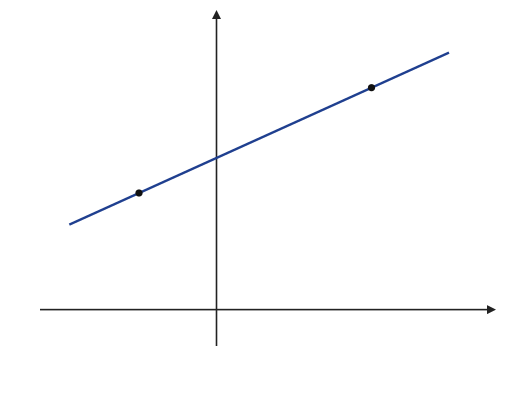
Figure 1 shows the graph of \(\ln y\) against \(x\). It is a straight line passing through the points \((-1, \ln 10)\) and \((2, \ln 80)\).

Find the exact values of \(k\) and \(b\).

Figure 1: a straight-line graph with x on the horizontal axis and ln y on the vertical axis. The line has a positive gradient and crosses the vertical axis above the origin. Two points on the line are marked: (-1, ln 10), to the left of the vertical axis, and (2, ln 80), to the right of it.

Model answer

\(y = kb^x\) gives \(\ln y = \ln k + x\ln b\): a straight line with gradient \(\ln b\) and intercept \(\ln k\).
Gradient \(= \dfrac{\ln 80 - \ln 10}{2 - (-1)} = \dfrac{1}{3}\ln\dfrac{80}{10} = \dfrac{1}{3}\ln 8 = \ln 2\), so \(b = 2\)
At \(x = -1\): \(\ln 10 = \ln k - \ln 2\), so \(\ln k = \ln 10 + \ln 2 = \ln 20\) and \(k = 20\)
So \(y = 20 \times 2^x\).

Explanation

Taking natural logarithms of \(y = kb^x\) gives a straight line whose gradient is \(\ln b\) and whose intercept is \(\ln k\). The laws of logarithms turn the gradient \(\frac{\ln 80 - \ln 10}{3}\) into \(\ln 2\), and, because the first point has \(x = -1\), the intercept is \(\ln 10 + \ln 2 = \ln 20\). Common errors are taking the gradient itself as \(b\) and using \(\ln 10\) as the intercept.

Mark scheme
  1. 1 mark

    M1 Uses \(\ln y = \ln k + x\ln b\) and finds the gradient using a law of logarithms: \(\dfrac{\ln 80 - \ln 10}{2 - (-1)} = \dfrac{1}{3}\ln 8\). An answer with no working scores 0 marks

    An answer with no working scores 0 marks: the question demands working, so \(k = 20\) and \(b = 2\) with no working score 0 marks. Alternative: substitutes both points into \(y = kb^x\), \(kb^{-1} = 10\) and \(kb^2 = 80\), and divides to get \(b^3 = 8\); this scores M1, and then A1 for \(b = 2\).

  2. 1 mark

    A1 \(\ln b = \ln 2\), so \(b = 2\)

    From \(\tfrac{1}{3}\ln 8 = \ln 8^{\frac{1}{3}} = \ln 2\). Decimal working only (0.6931...) scores A0.

  3. 1 mark

    M1 Finds the intercept: \(\ln k = \ln 10 + \ln 2\) (from \(\ln 10 = \ln k - \ln b\)), or substitutes into \(kb^{-1} = 10\)

    Independent of the A mark; ft their \(b\). Taking \(\ln 10\) itself as the intercept scores M0 (the point is not on the vertical axis).

  4. 1 mark

    A1 \(\ln k = \ln 20\), so \(k = 20\)

    cao

Question 3

5 marks

In this question you must show all stages of your working.

In October 2024, the number \(2^{136279841} - 1\) was shown to be prime. It was then the largest known prime number.

Using logarithms, find the number of digits in the number \(2^{136279841}\).

Explain why \(2^{136279841} - 1\) has the same number of digits as \(2^{136279841}\).

Model answer

\(\log_{10}\left(2^{136279841}\right) = 136279841\log_{10} 2 = 41\,024\,319.9\ldots\)
So \(10^{41024319} < 2^{136279841} < 10^{41024320}\).
A number \(N\) with \(10^{k} \leqslant N < 10^{k + 1}\) has \(k + 1\) digits, so \(2^{136279841}\) has \(41\,024\,319 + 1 = 41\,024\,320\) digits.
\(2^{136279841}\) is not divisible by 5, so it is not a power of 10: its last digit is 2, 4, 6 or 8. Subtracting 1 changes only the last digit (to 1, 3, 5 or 7), so \(2^{136279841} - 1\) also has 41 024 320 digits.

Explanation

The number of digits of a positive whole number \(N\) is one more than the whole-number part of \(\log_{10} N\), and the power law gives \(\log_{10} 2^{136279841} = 136279841\log_{10} 2\). Since a power of 2 never ends in 0, subtracting 1 only changes the last digit. A common error is to give the whole-number part of the logarithm, 41 024 319, as the number of digits.

Mark scheme
  1. 1 mark

    M1 Uses logarithms to base 10: \(\log_{10}\left(2^{136279841}\right) = 136279841\log_{10} 2\). An answer with no working scores 0 marks

    An answer with no working scores 0 marks for the number of digits: the question says "using logarithms" (an answer of 41 024 320 digits with no working scores 0 marks).

  2. 1 mark

    A1 \(= 41\,024\,319.9\ldots\)

    Accept 41 024 319.9 or 41 024 320.0 as shown on a calculator display, provided the method is clear.

  3. 1 mark

    M1 Explains that \(10^{41024319} < 2^{136279841} < 10^{41024320}\), so the number of digits is the whole-number part of the logarithm plus 1

    Requires a correct link between the logarithm and the number of digits (e.g. "\(10^k\) has \(k + 1\) digits").

  4. 1 mark

    A1 41 024 320 digits

    cso. 41 024 319 scores A0.

  5. 1 mark

    B1 A correct reason, e.g. \(2^{136279841}\) is not a power of 10 (it is not divisible by 5; its last digit is 2, 4, 6 or 8), so subtracting 1 changes only its last digit and does not reduce the number of digits

    Accept: \(2^{136279841}\) and \(10^{41024319}\) are whole numbers with \(2^{136279841} > 10^{41024319}\), so \(2^{136279841} - 1 \geqslant 10^{41024319}\), which still has 41 024 320 digits. Do not accept "1 is very small compared with the number" alone.

Question 4

7 marks

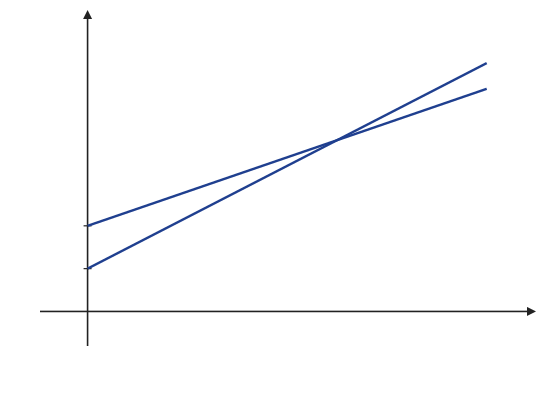
A forester models the height, \(h\) metres, of a tree in terms of the diameter of its trunk, \(d\) cm. Figure 1 shows the graphs of \(\log_{10} h\) against \(\log_{10} d\) for two species of tree, \(P\) and \(Q\). They are straight lines with equations

species \(P\): \(\log_{10} h = 0.3 + 0.6\log_{10} d\)
species \(Q\): \(\log_{10} h = 0.6 + 0.4\log_{10} d\)

Write the model for species \(P\) in the form \(h = ad^n\), giving the value of \(a\) to 3 significant figures.

Find, according to the models, the trunk diameter at which trees of species \(P\) and \(Q\) have the same height, and find this height. Give each answer to 3 significant figures.

State, with a reason, which species the models predict is taller for trees with a larger trunk diameter than this.

Figure 1: a graph with log₁₀ d on the horizontal axis and log₁₀ h on the vertical axis, showing two straight lines labelled P and Q. Line P crosses the vertical axis at 0.3 and line Q at 0.6. Line P is steeper than line Q, and the two lines cross.

Model answer

Species \(P\): \(h = 10^{0.3 + 0.6\log_{10} d} = 10^{0.3} \times \left(10^{\log_{10} d}\right)^{0.6} = 10^{0.3}d^{0.6}\)
\(10^{0.3} = 1.995\ldots\), so \(h = 2.00d^{0.6}\) (3 s.f.)
Same height: \(0.3 + 0.6\log_{10} d = 0.6 + 0.4\log_{10} d\)
\(0.2\log_{10} d = 0.3\), so \(\log_{10} d = 1.5\) and \(d = 10^{1.5} = 31.6\) cm (3 s.f.)
\(\log_{10} h = 0.3 + 0.6 \times 1.5 = 1.2\), so \(h = 10^{1.2} = 15.8\) m (3 s.f.)
For a larger trunk diameter, \(\log_{10} d > 1.5\), and line \(P\) has the greater gradient (0.6 > 0.4), so it is above line \(Q\): the models predict that species \(P\) is taller.

Explanation

Each line has the form \(\log_{10} h = \log_{10} a + n\log_{10} d\), so the intercept gives \(a = 10^{0.3}\) and the gradient gives \(n = 0.6\). The trees have the same height where the lines cross, at \(\log_{10} d = 1.5\), and beyond that the steeper line, \(P\), gives the greater height. Common errors are writing \(a = 0.3\) instead of \(10^{0.3}\) and giving the logarithms 1.5 and 1.2 as the diameter and height.

Mark scheme
  1. 1 mark

    M1 Raises 10 to the power of each side and uses the laws of indices: \(h = 10^{0.3 + 0.6\log_{10} d} = 10^{0.3} \times d^{0.6}\); or correct final answers of \(h = 2.00d^{0.6}\), \(d = 31.6\) and \(h = 15.8\) with no working

    Correct answers of \(h = 2.00d^{0.6}\), a diameter of 31.6 cm and a height of 15.8 m with no working score 6 marks (the B mark needs a reason). \(h = 0.3d^{0.6}\) scores M0. Accept \(\log_{10} h = \log_{10}\left(10^{0.3}d^{0.6}\right)\) as the first step.

  2. 1 mark

    A1 \(h = 2.00d^{0.6}\)

    Requires the complete equation with \(a = 2.00\) (accept 1.995 or 1.9953 or \(10^{0.3}\)). Just stating \(a = 2.00\) and \(n = 0.6\) scores A0.

  3. 1 mark

    M1 Equates the two expressions for \(\log_{10} h\) and solves for \(\log_{10} d\): \(0.3 + 0.6L = 0.6 + 0.4L\), so \(L = 1.5\)

    Alternative: equates \(10^{0.3}d^{0.6} = 10^{0.6}d^{0.4}\) to get \(d^{0.2} = 10^{0.3}\); accept this route throughout.

  4. 1 mark

    A1 \(d = 10^{1.5} = 31.6\) cm

    Accept awrt 31.6, i.e. [31.55, 31.65). Units not required.

  5. 1 mark

    M1 (dM1) Finds the height: \(\log_{10} h = 0.3 + 0.6 \times 1.5 = 1.2\), so \(h = 10^{1.2}\)

    Depends on the previous M mark (the value of \(\log_{10} d\)). Accept substitution into either line.

  6. 1 mark

    A1 \(h = 15.8\) m

    Accept awrt 15.8, i.e. [15.75, 15.85). Units not required.

  7. 1 mark

    B1 Species \(P\), because its line has the greater gradient (0.6 > 0.4), so for \(\log_{10} d > 1.5\) its value of \(\log_{10} h\) is greater

    Accept an argument from \(\dfrac{h_P}{h_Q} = 0.5d^{0.2}\), which is greater than 1 when \(d > 31.6\). A reason is required.

Ready to try the rest? Every answer you write is marked against the mark scheme, so you can see exactly where the marks are.

Study Helper Hints first, answers after you try

Stuck on this one? Ask for a hint and I’ll point you in the right direction, without giving the answer away. Once you’ve checked your answer, I’ll show you how the marks are awarded.