
Level:
Correct: 0
Incorrect: 0
Marks: 0/0
Exam Practice
Course:
Topics:
Edexcel A-Level Maths (Paper 2) Smart practice A mixed round aimed at your weak spots
Unit 1
Proof
Unit 2
Algebra and functions
Unit 3
Coordinate geometry in the (x, y) plane
Unit 4
Sequences and series
Unit 5
Trigonometry
Unit 6
Exponentials and logarithms
Unit 7
Differentiation
Unit 8
Integration
Unit 9
Numerical methods
Unit 10
Vectors
Avg
score:
–
Topics
done:
0/36

Integration using partial fractions

Practise 16 exam-style questions on Integration using partial fractions for Edexcel A-Level Maths (Paper 2). Write your answer as you would in the exam and get it marked in seconds against the mark scheme, point by point, with the Study Helper on hand if you get stuck.

  • 16 questions
  • 2–11 marks each
  • Instant marking
  • No sign-up needed
16 questions, marked as you go

Sample questions with model answers

Here are 4 of the questions in this topic, each with a model answer, an explanation of why it earns the marks and the mark scheme an examiner would use.

Question 1

3 marks

Given that \(k\) is a positive constant and
\[\int_0^k \dfrac{12}{(3x + 2)^2}\,dx = \dfrac{3}{2}\]
use algebraic integration to find the value of \(k\).

Model answer

\(\displaystyle\int \dfrac{12}{(3x + 2)^2}\,dx = \dfrac{12(3x + 2)^{-1}}{(-1) \times 3} = -\dfrac{4}{3x + 2}\)
\(\left[-\dfrac{4}{3x + 2}\right]_0^k = -\dfrac{4}{3k + 2} + \dfrac{4}{2} = 2 - \dfrac{4}{3k + 2}\)
\(2 - \dfrac{4}{3k + 2} = \dfrac{3}{2}\), so \(\dfrac{4}{3k + 2} = \dfrac{1}{2}\)
\(3k + 2 = 8\), so \(k = 2\)

Explanation

Write the integrand as \(12(3x + 2)^{-2}\): raising the power to \(-1\) and dividing by \(-1\) and by 3 gives \(-4(3x + 2)^{-1}\). Substituting the limits gives \(2 - \dfrac{4}{3k + 2}\), which is set equal to \(\dfrac{3}{2}\) and solved. Common errors are forgetting to divide by the 3 from \(3x + 2\) and a sign error with the lower limit.

Mark scheme
  1. 1 mark

    M1 Integrates to the form \(\alpha(3x + 2)^{-1}\). An answer with no working scores 0 marks.

    An answer of \(k = 2\) with no working scores 0 marks: the question asks for algebraic integration, so the integration must be seen (a value found by trial on a calculator is not enough).

  2. 1 mark

    A1 \(-4(3x + 2)^{-1}\) oe, e.g. \(-\dfrac{4}{3x + 2}\)

    Common errors are \(-12(3x + 2)^{-1}\), from not dividing by 3, and \(-36(3x + 2)^{-1}\), from multiplying by 3.

  3. 1 mark

    A1 \(k = 2\) cso, from correct use of the limits, e.g. \(2 - \dfrac{4}{3k + 2} = \dfrac{3}{2}\)

    Requires the M mark. The lower limit gives \(-\dfrac{4}{2} = -2\), which is subtracted. \(k = 2\) only.
Question 2

6 marks

\[\mathrm{f}(x) = \dfrac{x^2 + 12x - 4}{x^3 - 4x}, \quad x > 2\]
Express \(\mathrm{f}(x)\) in partial fractions.
Hence find \(\displaystyle\int \mathrm{f}(x)\,dx\), giving your answer in the form \(\ln \mathrm{g}(x) + c\), where \(\mathrm{g}(x)\) is a single algebraic fraction.

Model answer

\(x^3 - 4x = x(x^2 - 4) = x(x - 2)(x + 2)\)
\(x^2 + 12x - 4 \equiv A(x - 2)(x + 2) + Bx(x + 2) + Cx(x - 2)\)
\(x = 0\): \(-4 = -4A\), \(A = 1\)
\(x = 2\): \(24 = 8B\), \(B = 3\)
\(x = -2\): \(-24 = 8C\), \(C = -3\)
\(\mathrm{f}(x) = \dfrac{1}{x} + \dfrac{3}{x - 2} - \dfrac{3}{x + 2}\)
\(\displaystyle\int \mathrm{f}(x)\,dx = \ln x + 3\ln(x - 2) - 3\ln(x + 2) + c\)
\(= \ln\dfrac{x(x - 2)^3}{(x + 2)^3} + c\)

Explanation

Factorise the denominator fully as \(x(x - 2)(x + 2)\), then substitute \(x = 0\), 2 and \(-2\) into the identity to find the three constants. Each term integrates to a logarithm, and the laws of logarithms combine \(\ln x + 3\ln(x - 2) - 3\ln(x + 2)\) into one logarithm of a single fraction. Common errors are not factorising \(x^2 - 4\) and leaving the answer as several logarithms.

Mark scheme
  1. 1 mark

    M1 Factorises \(x^3 - 4x = x(x - 2)(x + 2)\) and uses a correct method to find at least one constant in \(\dfrac{A}{x} + \dfrac{B}{x - 2} + \dfrac{C}{x + 2}\), e.g. \(x^2 + 12x - 4 \equiv A(x - 2)(x + 2) + Bx(x + 2) + Cx(x - 2)\) with \(x = 0\), 2 or \(-2\) substituted; a correct final answer of \(\ln\dfrac{x(x - 2)^3}{(x + 2)^3} + c\) with no working scores 3 marks (the last three points), or 6 marks if the correct partial fractions are also stated

    An answer of \(\ln\dfrac{x(x - 2)^3}{(x + 2)^3} + c\) with no working scores 3 marks (the last three), as the partial fractions asked for are not given; if the correct partial fractions \(\dfrac{1}{x} + \dfrac{3}{x - 2} - \dfrac{3}{x + 2}\) are also stated (no working needed) it scores 6 marks.

  2. 1 mark

    A1 Two of \(A = 1\), \(B = 3\), \(C = -3\)

  3. 1 mark

    A1 All three correct: \(\mathrm{f}(x) = \dfrac{1}{x} + \dfrac{3}{x - 2} - \dfrac{3}{x + 2}\)

    Requires the M mark. Correct partial fractions with no working score M1A1A1.

  4. 1 mark

    M1 Integrates their partial fractions to the form \(\alpha\ln x + \beta\ln(x - 2) + \gamma\ln(x + 2)\)

    Not dependent on the first M mark.

  5. 1 mark

    A1ft \(\ln x + 3\ln(x - 2) - 3\ln(x + 2)\), ft their \(A\), \(B\) and \(C\)

    Modulus signs are not needed, as \(x > 2\). \(+ c\) is not needed for this mark.

  6. 1 mark

    A1 \(\ln\dfrac{x(x - 2)^3}{(x + 2)^3} + c\) cso

    Requires the second M mark. Must be one logarithm of a single fraction, with \(+ c\). Accept \(\ln\left|\dfrac{x(x - 2)^3}{(x + 2)^3}\right| + c\), \(\ln\dfrac{Ax(x - 2)^3}{(x + 2)^3}\) with the constant written as \(\ln A\) and equivalent typed forms. Do not accept two logarithms, such as \(\ln x(x - 2)^3 - \ln(x + 2)^3 + c\).

Question 3

7 marks

In this question you must show all stages of your working.
Solutions relying entirely on calculator technology are not acceptable.

Given that \(a\) is a positive constant and
\[\int_0^1 \dfrac{1}{(x + a)(x + a + 1)}\,dx = \ln\dfrac{16}{15}\]
find the value of \(a\).

Model answer

\(1 \equiv P(x + a + 1) + Q(x + a)\)
\(x = -a\): \(P = 1\); \(x = -a - 1\): \(Q = -1\)
\(\displaystyle\int_0^1 \left(\dfrac{1}{x + a} - \dfrac{1}{x + a + 1}\right) dx = \left[\ln(x + a) - \ln(x + a + 1)\right]_0^1\)
\(= \ln(a + 1) - \ln(a + 2) - \ln a + \ln(a + 1) = \ln\dfrac{(a + 1)^2}{a(a + 2)}\)
So \(\dfrac{(a + 1)^2}{a(a + 2)} = \dfrac{16}{15}\)
\(15a^2 + 30a + 15 = 16a^2 + 32a\)
\(a^2 + 2a - 15 = 0\), \((a + 5)(a - 3) = 0\)
\(a = 3\) or \(a = -5\); since \(a > 0\), \(a = 3\)

Explanation

The partial fractions are \(\dfrac{1}{x + a} - \dfrac{1}{x + a + 1}\), so the integral is a difference of logarithms in which \(\ln(a + 1)\) appears twice. Combining gives \(\ln\dfrac{(a + 1)^2}{a(a + 2)}\); equating the arguments of the logarithms leads to \(a^2 + 2a - 15 = 0\), and the condition \(a > 0\) rejects \(a = -5\). Common errors are sign slips when the lower limit is subtracted and "cancelling" the logarithms term by term.

Mark scheme
  1. 1 mark

    M1 Correct method for partial fractions in terms of \(a\): \(\dfrac{1}{(x + a)(x + a + 1)} \equiv \dfrac{P}{x + a} + \dfrac{Q}{x + a + 1}\), e.g. \(1 \equiv P(x + a + 1) + Q(x + a)\) with \(x = -a\) or \(x = -a - 1\) substituted. An answer with no working scores 0 marks.

    An answer of \(a = 3\) with no working scores 0 marks: the question demands working, and a value found by trial on a calculator is not enough.

  2. 1 mark

    A1 \(\dfrac{1}{x + a} - \dfrac{1}{x + a + 1}\)

  3. 1 mark

    M1 Integrates to the form \(\alpha\ln(x + a) + \beta\ln(x + a + 1)\)

    Not dependent on the first M mark.

  4. 1 mark

    M1 (dM1) Substitutes the limits 1 and 0 and subtracts: \(\left(\ln(a + 1) - \ln(a + 2)\right) - \left(\ln a - \ln(a + 1)\right)\)

    Depends on the previous M mark.

  5. 1 mark

    A1 \(\ln\dfrac{(a + 1)^2}{a(a + 2)} = \ln\dfrac{16}{15}\) oe, or \(\dfrac{(a + 1)^2}{a(a + 2)} = \dfrac{16}{15}\)

    Any correct equation in \(a\) without logarithms, or an equivalent single-logarithm equation.

  6. 1 mark

    M1 Removes the logarithms correctly and forms and solves a three-term quadratic in \(a\): \(15(a + 1)^2 = 16a(a + 2)\), so \(a^2 + 2a - 15 = 0\)

    Requires an equation of the form \(\ln\mathrm{f}(a) = \ln\dfrac{16}{15}\) or \(\mathrm{f}(a) = \dfrac{16}{15}\) from a correct method; the quadratic may be solved by any valid method.

  7. 1 mark

    A1 \(a = 3\) only, with \(a = -5\) rejected (as \(a > 0\))

    \(a = 3\) and \(a = -5\) both given as final answers is A0.

Question 4

9 marks

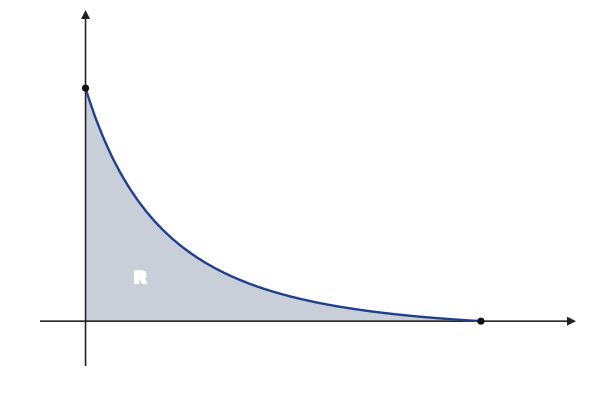
A garden designer builds a grassy bank of soil against a vertical wall. Figure 1 shows a vertical cross-section of the bank, at right angles to the wall. The cross-section is the region \(R\) bounded by the curve \(C\), the horizontal ground \(OB\) and the wall \(OA\).

In a model, \(O\) is the origin, \(OB\) lies along the \(x\)-axis, \(OA\) lies along the \(y\)-axis and \(C\) has equation
\[y = \dfrac{3 - x}{(x + 1)(x + 2)}, \quad 0 \leqslant x \leqslant 3\]
where \(x\) and \(y\) are measured in metres.

Use the model to write down the height \(OA\) of the bank where it meets the wall.
Using algebraic integration, find the exact area of \(R\), giving your answer in the form \(\ln\dfrac{2^m}{5^n}\), where \(m\) and \(n\) are integers.
The bank runs for 2.4 m along the wall and has the same cross-section along its whole length. Find, according to the model, the volume of soil in the bank, giving your answer in m\(^3\) to 3 significant figures.

Figure 1: the cross-section of the bank on a pair of axes with origin O. The wall OA lies along the y-axis and the ground OB along the x-axis. The curve C runs from A, on the wall, down to B on the ground, falling steeply at first and then more gently. The region R between the curve, the ground and the wall is shaded.

Model answer

At \(x = 0\): \(y = \dfrac{3}{1 \times 2} = 1.5\), so \(OA = 1.5\) m
\(3 - x \equiv A(x + 2) + B(x + 1)\)
\(x = -1\): \(4 = A\); \(x = -2\): \(5 = -B\), \(B = -5\)
Area \(= \displaystyle\int_0^3 \left(\dfrac{4}{x + 1} - \dfrac{5}{x + 2}\right) dx = \left[4\ln(x + 1) - 5\ln(x + 2)\right]_0^3\)
\(= (4\ln 4 - 5\ln 5) - (4\ln 1 - 5\ln 2)\)
\(= 8\ln 2 - 5\ln 5 + 5\ln 2 = 13\ln 2 - 5\ln 5 = \ln\dfrac{2^{13}}{5^5}\) m\(^2\)
Volume \(= 2.4 \times \ln\dfrac{2^{13}}{5^5} = 2.4 \times 0.96372... = 2.31\) m\(^3\) (3 s.f.)

Explanation

The height at the wall is the value of \(y\) at \(x = 0\), and the curve meets the ground at \(x = 3\), so the area is the integral from 0 to 3. Partial fractions give \(\dfrac{4}{x + 1} - \dfrac{5}{x + 2}\), and \(\ln 4 = 2\ln 2\) with the laws of logarithms gives the form \(\ln\dfrac{2^{13}}{5^5}\); the volume of the prism-shaped bank is this area times its length. Common errors are sign slips in the partial fractions, a wrong sign when the value at \(x = 0\) is subtracted, and giving the volume to more or fewer than 3 significant figures.

Mark scheme
  1. 1 mark

    B1 \(OA = 1.5\) m (from \(y = \dfrac{3}{1 \times 2}\) at \(x = 0\)). Answers of 1.5 m, \(\ln\dfrac{2^{13}}{5^5}\) and 2.31 m\(^3\) with no working score 3 marks (this B1 and the M1A1 for the volume).

    Max 3 if no algebraic integration is seen. An answer of 1.5 m, \(\ln\dfrac{2^{13}}{5^5}\) and 2.31 m\(^3\) with no working scores 3 marks: this B1 and the last two marks (the volume, awrt 2.31, i.e. in [2.305, 2.315), may come from a calculator value of the area), but none of the six marks for the area, which must be found by algebraic integration. Units are not required for 1.5, but penalise wrong units.

  2. 1 mark

    M1 Correct method for the constants in \(\dfrac{A}{x + 1} + \dfrac{B}{x + 2}\), e.g. \(3 - x \equiv A(x + 2) + B(x + 1)\) with \(x = -1\) or \(x = -2\) substituted

  3. 1 mark

    A1 \(\dfrac{4}{x + 1} - \dfrac{5}{x + 2}\)

  4. 1 mark

    M1 Integrates to the form \(\alpha\ln(x + 1) + \beta\ln(x + 2)\)

    Not dependent on the previous M mark.

  5. 1 mark

    A1 \(4\ln(x + 1) - 5\ln(x + 2)\)

  6. 1 mark

    M1 (dM1) Substitutes the limits 3 and 0 and subtracts: \((4\ln 4 - 5\ln 5) - (4\ln 1 - 5\ln 2)\)

    Depends on the second M mark (the integration). The limits must be 0 and 3.

  7. 1 mark

    A1 \(\ln\dfrac{2^{13}}{5^5}\) (m\(^2\)) cso

    Accept \(m = 13\), \(n = 5\), and \(\ln\dfrac{8192}{3125}\). \(13\ln 2 - 5\ln 5\) is not in the form asked unless \(m = 13\) and \(n = 5\) are then stated. A decimal only (0.964) is A0.

  8. 1 mark

    M1 Multiplies their area by 2.4

    Their area may be exact or a decimal, including a calculator value of the integral (0.9637...).

  9. 1 mark

    A1 awrt 2.31 m\(^3\), i.e. in [2.305, 2.315)

    Units are not required, but penalise wrong units. Answers that round to 2.31, such as 2.313, are accepted; 2.3 alone is A0 unless awrt 2.31 is seen first (then isw).

Ready to try the rest? Every answer you write is marked against the mark scheme, so you can see exactly where the marks are.

Study Helper Hints first, answers after you try

Stuck on this one? Ask for a hint and I’ll point you in the right direction, without giving the answer away. Once you’ve checked your answer, I’ll show you how the marks are awarded.