Question 1
3 marksThe function f is defined by
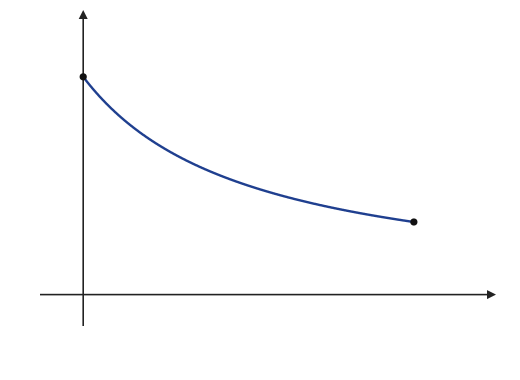
\[f(x) = 7 - \sqrt{2x + a}, \quad x \geqslant -\dfrac{a}{2}\]
where a is a positive constant.
Given that \(f^{-1}(4) = 2\), find the value of a.
State the range of f.
Model answer
\(f^{-1}(4) = 2\) means that \(f(2) = 4\).
\(7 - \sqrt{4 + a} = 4\)
\(\sqrt{4 + a} = 3\)
\(4 + a = 9\), so \(a = 5\)
\(\sqrt{2x + 5}\) is 0 when \(x = -\dfrac{5}{2}\) and takes every value \(\geqslant 0\), so \(7 - \sqrt{2x + 5}\) takes every value \(\leqslant 7\).
Range: \(f(x) \leqslant 7\)
Explanation
If \(f^{-1}(4) = 2\) then f maps 2 to 4, so substituting \(x = 2\) into f and setting it equal to 4 gives a without finding the inverse function. A square root is never negative, so f(x) is never more than 7. Common errors are using \(f(4) = 2\), which gives \(a = 17\), and writing the range in terms of x.
Mark scheme
-
1 mark
M1 Uses \(f^{-1}(4) = 2 \Rightarrow f(2) = 4\), forming \(7 - \sqrt{4 + a} = 4\); or a correct final answer of \(a = 5\) with no working
An answer of \(a = 5\) and \(f(x) \leqslant 7\) with no working scores 3 marks. Alternative: finds \(f^{-1}(x) = \dfrac{(7 - x)^2 - a}{2}\) and sets \(\dfrac{9 - a}{2} = 2\), for M1. Using \(f(4) = 2\) instead, \(7 - \sqrt{8 + a} = 2\), gives the common wrong answer \(a = 17\): M0 A0.
-
1 mark
A1 \(a = 5\)
From \(\sqrt{4 + a} = 3\).
-
1 mark
B1 \(f(x) \leqslant 7\)
Independent of the value of a: the square root is 0 at the start of the domain and takes every non-negative value. Accept \(y \leqslant 7\), \(f \leqslant 7\), \((-\infty, 7]\), \(\{f(x) : f(x) \leqslant 7\}\). Do not accept \(x \leqslant 7\), \(f(x) < 7\) or \(f(x) \geqslant 7\).