
Level:
Correct: 0
Incorrect: 0
Marks: 0/0
Exam Practice
Course:
Topics:
Edexcel A-Level Maths (Paper 2) Smart practice A mixed round aimed at your weak spots
Unit 1
Proof
Unit 2
Algebra and functions
Unit 3
Coordinate geometry in the (x, y) plane
Unit 4
Sequences and series
Unit 5
Trigonometry
Unit 6
Exponentials and logarithms
Unit 7
Differentiation
Unit 8
Integration
Unit 9
Numerical methods
Unit 10
Vectors
Avg
score:
–
Topics
done:
0/36

Addition and double angle formulae and R cos(θ ± α)

Practise 20 exam-style questions on Addition and double angle formulae and R cos(θ ± α) for Edexcel A-Level Maths (Paper 2). Write your answer as you would in the exam and get it marked in seconds against the mark scheme, point by point, with the Study Helper on hand if you get stuck.

  • 20 questions
  • 2–11 marks each
  • Instant marking
  • No sign-up needed
20 questions, marked as you go

Sample questions with model answers

Here are 4 of the questions in this topic, each with a model answer, an explanation of why it earns the marks and the mark scheme an examiner would use.

Question 1

3 marks

Solutions relying entirely on calculator technology are not acceptable.

Given that \(\operatorname{cosec}\theta = -4\), where \(\pi < \theta < \dfrac{3\pi}{2}\), find the exact value of \(\tan 2\theta\).

Model answer

\(\sin\theta = \dfrac{1}{\operatorname{cosec}\theta} = -\dfrac{1}{4}\)
\(\cos^2\theta = 1 - \dfrac{1}{16} = \dfrac{15}{16}\), and \(\cos\theta < 0\) for \(\pi < \theta < \dfrac{3\pi}{2}\), so \(\cos\theta = -\dfrac{\sqrt{15}}{4}\)
\(\tan\theta = \dfrac{\sin\theta}{\cos\theta} = \dfrac{1}{\sqrt{15}}\)
\(\tan 2\theta = \dfrac{2\tan\theta}{1 - \tan^2\theta} = \dfrac{\frac{2}{\sqrt{15}}}{1 - \frac{1}{15}} = \dfrac{2}{\sqrt{15}} \times \dfrac{15}{14} = \dfrac{15}{7\sqrt{15}} = \dfrac{\sqrt{15}}{7}\)

Explanation

First find \(\sin\theta = -\dfrac{1}{4}\), then \(\cos\theta\) from \(\sin^2\theta + \cos^2\theta = 1\), taking the negative root because θ is in the third quadrant, so \(\tan\theta\) is positive. The double angle formula for tan then gives the exact answer. Common errors are a wrong sign for \(\cos\theta\) or \(\tan\theta\) and leaving the answer as a decimal.

Mark scheme
  1. 1 mark

    B1 \(\sin\theta = -\dfrac{1}{4}\) and \(\cos\theta = -\dfrac{\sqrt{15}}{4}\), or \(\tan\theta = \dfrac{1}{\sqrt{15}}\) oe. An answer with no working scores 0 marks.

    An answer of \(\tan 2\theta = \dfrac{\sqrt{15}}{7}\) with no working scores 0 marks: the question says that solutions relying entirely on calculator technology are not acceptable. If \(\cos\theta\) is used it must be negative (θ is in the third quadrant). \(\tan\theta = \dfrac{1}{\sqrt{15}}\) may come from \(\cot^2\theta = \operatorname{cosec}^2\theta - 1 = 15\) with \(\tan\theta > 0\) in the third quadrant.

  2. 1 mark

    M1 Uses \(\tan 2\theta = \dfrac{2\tan\theta}{1 - \tan^2\theta}\) with their \(\tan\theta\), or \(\sin 2\theta = 2\sin\theta\cos\theta\) and a correct \(\cos 2\theta\) formula with their values and divides

    The double angle formula must be correct. For reference: \(\sin 2\theta = \dfrac{\sqrt{15}}{8}\) and \(\cos 2\theta = \dfrac{7}{8}\). Finding θ on a calculator (3.394 rad) and then tan 2θ scores M0.

  3. 1 mark

    A1 \(\tan 2\theta = \dfrac{\sqrt{15}}{7}\) cso

    Accept \(\dfrac{1}{7}\sqrt{15}\) or \(\sqrt{\dfrac{15}{49}}\). A decimal (0.553) scores A0. \(\pm\dfrac{\sqrt{15}}{7}\) as the final answer scores A0.
Question 2

6 marks

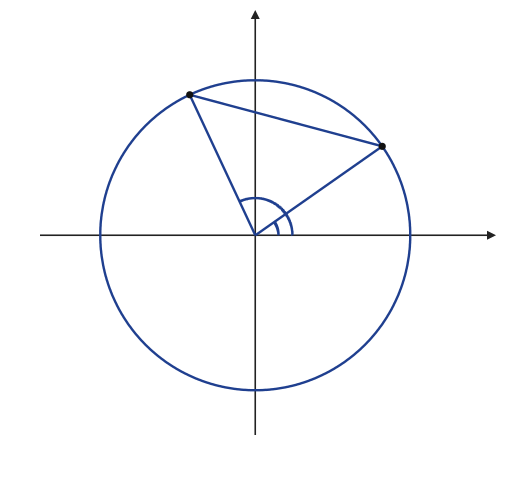
Figure 1 shows the circle with equation \(x^2 + y^2 = 1\), which has centre \(O\). The points \(P(\cos A, \sin A)\) and \(Q(\cos B, \sin B)\) lie on the circle, where \(0 < B < A < \pi\), so that \(OP\) and \(OQ\) make angles \(A\) and \(B\) respectively with the positive \(x\)-axis.

By finding \(PQ^2\) in two different ways, prove that
\[\cos(A - B) \equiv \cos A\cos B + \sin A\sin B\]
Hence, by replacing \(B\) with \(-B\), show that \(\cos(A + B) \equiv \cos A\cos B - \sin A\sin B\).

Figure 1: a sketch of a circle with centre O at the origin of x and y axes. Two points P and Q lie on the upper half of the circle, labelled P(cos A, sin A) on the left and Q(cos B, sin B) on the right. Line segments join O to P, O to Q and P to Q, forming triangle POQ. Angle A is marked at O from the positive x-axis to OP, and the smaller angle B from the positive x-axis to OQ.

Model answer

OP = OQ = 1 (radii) and angle \(POQ = A - B\).
Cosine rule in triangle POQ: \(PQ^2 = 1^2 + 1^2 - 2(1)(1)\cos(A - B) = 2 - 2\cos(A - B)\)
Distance formula: \(PQ^2 = (\cos A - \cos B)^2 + (\sin A - \sin B)^2\)
\(= \cos^2 A - 2\cos A\cos B + \cos^2 B + \sin^2 A - 2\sin A\sin B + \sin^2 B\)
\(= (\cos^2 A + \sin^2 A) + (\cos^2 B + \sin^2 B) - 2(\cos A\cos B + \sin A\sin B)\)
\(= 2 - 2(\cos A\cos B + \sin A\sin B)\)
Equating: \(2 - 2\cos(A - B) = 2 - 2(\cos A\cos B + \sin A\sin B)\)
So \(\cos(A - B) \equiv \cos A\cos B + \sin A\sin B\), as required.
Replacing B with −B: \(\cos(A + B) = \cos A\cos(-B) + \sin A\sin(-B)\)
Since \(\cos(-B) = \cos B\) and \(\sin(-B) = -\sin B\): \(\cos(A + B) \equiv \cos A\cos B - \sin A\sin B\)

Explanation

The cosine rule in triangle POQ, with OP = OQ = 1 and angle \(POQ = A - B\), gives \(PQ^2 = 2 - 2\cos(A - B)\); the distance formula gives \(PQ^2 = 2 - 2(\cos A\cos B + \sin A\sin B)\) after using \(\cos^2 + \sin^2 = 1\) twice. Equating the two proves the result, and replacing B with −B works because cos is an even function and sin is odd. Marks are commonly lost for expanding the squares incorrectly and for not writing a conclusion.

Mark scheme
  1. 1 mark

    B1 States or uses angle \(POQ = A - B\) and \(OP = OQ = 1\). An answer with no working scores 0 marks.

    An answer with no working scores 0 marks: this is a proof, and restating the identities earns nothing. This mark may be implied by a correct cosine rule with sides 1, 1 and angle \(A - B\).

  2. 1 mark

    M1 Uses the cosine rule in triangle \(POQ\): \(PQ^2 = 1^2 + 1^2 - 2(1)(1)\cos(A - B) = 2 - 2\cos(A - B)\)

    The cosine rule must be correct with their angle POQ.

  3. 1 mark

    M1 Uses the distance formula: \(PQ^2 = (\cos A - \cos B)^2 + (\sin A - \sin B)^2\)

  4. 1 mark

    M1 (dM1) Expands the brackets and uses \(\cos^2 A + \sin^2 A = 1\) and \(\cos^2 B + \sin^2 B = 1\) to reach \(PQ^2 = 2 - 2(\cos A\cos B + \sin A\sin B)\)

    Depends on the previous M mark. Both cross terms \(-2\cos A\cos B\) and \(-2\sin A\sin B\) must appear.

  5. 1 mark

    A1* Equates the two expressions for \(PQ^2\) and concludes that \(\cos(A - B) \equiv \cos A\cos B + \sin A\sin B\) cso

    Needs both expressions for \(PQ^2\) (the M marks in points 2 and 4), no errors (including the notation, e.g. \(\cos A^2\) for \(\cos^2 A\) not recovered) and a minimal conclusion such as "hence proven".

  6. 1 mark

    B1 Replaces \(B\) with \(-B\) and uses \(\cos(-B) = \cos B\) and \(\sin(-B) = -\sin B\) to obtain \(\cos(A + B) \equiv \cos A\cos B - \sin A\sin B\)

    Both \(\cos(-B) = \cos B\) and \(\sin(-B) = -\sin B\) must be stated or clearly used. Quoting the formula for \(\cos(A + B)\) without using the result just proved scores B0.

Question 3

6 marks

In this question you must show all stages of your working.

Show that the equation
\[\tan(x + 45^\circ) = k\tan x\]
where \(k\) is a constant, can be written as
\[k\tan^2 x + (1 - k)\tan x + 1 = 0\]
Hence find the set of values of \(k\) for which the equation \(\tan(x + 45^\circ) = k\tan x\) has no real solutions. Give your answer in set notation, with the limits as exact surds.

[You may use \(\tan(A \pm B) = \dfrac{\tan A \pm \tan B}{1 \mp \tan A\tan B}\)]

Model answer

\(\tan(x + 45^\circ) = \dfrac{\tan x + \tan 45^\circ}{1 - \tan x\tan 45^\circ} = \dfrac{\tan x + 1}{1 - \tan x}\)
\(\dfrac{\tan x + 1}{1 - \tan x} = k\tan x\)
\(\tan x + 1 = k\tan x - k\tan^2 x\)
\(k\tan^2 x + (1 - k)\tan x + 1 = 0\), as required.
No real solutions when the quadratic in \(\tan x\) has no real roots: \(b^2 - 4ac < 0\)
\((1 - k)^2 - 4k < 0\)
\(k^2 - 6k + 1 < 0\)
Critical values: \(k = \dfrac{6 \pm \sqrt{36 - 4}}{2} = 3 \pm 2\sqrt{2}\)
\(\{k : 3 - 2\sqrt{2} < k < 3 + 2\sqrt{2}\}\)

Explanation

The \(\tan(A + B)\) formula turns the equation into a quadratic in \(\tan x\), and since \(\tan x\) can take any real value, the equation has no solutions exactly when this quadratic has no real roots. The discriminant condition gives \(k^2 - 6k + 1 < 0\), whose solution is between \(3 - 2\sqrt{2}\) and \(3 + 2\sqrt{2}\). Common errors are including the end values (they give a repeated root, so a solution) and writing the answer without set notation.

Mark scheme
  1. 1 mark

    M1 Uses the formula with \(\tan 45^\circ = 1\): \(\dfrac{\tan x + 1}{1 - \tan x} = k\tan x\). An answer with no working scores 0 marks.

    An answer of \(\{k : 3 - 2\sqrt{2} < k < 3 + 2\sqrt{2}\}\) with no working scores 0 marks: the question demands working.

  2. 1 mark

    A1* Multiplies by \(1 - \tan x\) and rearranges to \(k\tan^2 x + (1 - k)\tan x + 1 = 0\) cso

    An intermediate line such as \(\tan x + 1 = k\tan x - k\tan^2 x\) must be seen.

  3. 1 mark

    M1 Uses \(b^2 - 4ac < 0\) for the quadratic in \(\tan x\) with \(a = k\), \(b = 1 - k\), \(c = 1\): \((1 - k)^2 - 4k < 0\)

    Allow ≤, = or > for this mark (the correct inequality is needed for the final mark). May use the given quadratic even if it was not shown.

  4. 1 mark

    A1 \(k^2 - 6k + 1 < 0\) oe

  5. 1 mark

    M1 (dM1) Finds the critical values \(k = 3 \pm 2\sqrt{2}\) of their quadratic in k (formula or completing the square) and chooses the region between them

    Depends on the M mark in point 3 (not on the A mark just before).

  6. 1 mark

    A1 \(\{k : 3 - 2\sqrt{2} < k < 3 + 2\sqrt{2}\}\) cso

    Accept \(\{k : k > 3 - 2\sqrt{2}\} \cap \{k : k < 3 + 2\sqrt{2}\}\) and \(\{k \in \mathbb{R} : 3 - \sqrt{8} < k < 3 + \sqrt{8}\}\). Do not accept: the inequality without set notation, interval notation alone, ≤ signs (k = 3 ± 2√2 gives a repeated root, so the equation has a solution), or decimal limits only (0.172 < k < 5.83). Note: k = 0 gives tan x = −1, which has solutions, and 0 is outside the set; tan x = 1 (where tan(x + 45°) is undefined) never satisfies the quadratic, so no other values need to be checked.

Question 4

9 marks

Solutions relying entirely on calculator technology are not acceptable.

The curve \(C\) has equation
\[y = 2 + \sqrt{2}\cos 2x - \sqrt{2}\sin 2x, \quad 0 \leqslant x \leqslant \pi\]

Express \(\sqrt{2}\cos 2x - \sqrt{2}\sin 2x\) in the form \(R\cos(2x + \alpha)\), where \(R > 0\) and \(0 < \alpha < \dfrac{\pi}{2}\), giving the exact values of \(R\) and \(\alpha\).

Hence find the exact coordinates of
• the point where \(C\) meets the \(y\)-axis
• the maximum point of \(C\)
• the minimum point of \(C\).

Explain why \(C\) touches the \(x\)-axis but does not cross it.

[You may use \(\cos(A \pm B) = \cos A\cos B \mp \sin A\sin B\)]

Model answer

\(R\cos(2x + \alpha) = R\cos 2x\cos\alpha - R\sin 2x\sin\alpha\)
\(R\cos\alpha = \sqrt{2}\), \(R\sin\alpha = \sqrt{2}\), so \(R = \sqrt{2 + 2} = 2\) and \(\tan\alpha = 1\), \(\alpha = \dfrac{\pi}{4}\)
\(y = 2 + 2\cos\left(2x + \dfrac{\pi}{4}\right)\)
At \(x = 0\): \(y = 2 + 2\cos\dfrac{\pi}{4} = 2 + \sqrt{2}\), so \(\left(0, 2 + \sqrt{2}\right)\)
For \(0 \leqslant x \leqslant \pi\), \(\dfrac{\pi}{4} \leqslant 2x + \dfrac{\pi}{4} \leqslant \dfrac{9\pi}{4}\)
Maximum: \(\cos\left(2x + \dfrac{\pi}{4}\right) = 1\), \(2x + \dfrac{\pi}{4} = 2\pi\), \(x = \dfrac{7\pi}{8}\), \(y = 4\): \(\left(\dfrac{7\pi}{8}, 4\right)\)
Minimum: \(\cos\left(2x + \dfrac{\pi}{4}\right) = -1\), \(2x + \dfrac{\pi}{4} = \pi\), \(x = \dfrac{3\pi}{8}\), \(y = 0\): \(\left(\dfrac{3\pi}{8}, 0\right)\)
Since \(\cos\left(2x + \dfrac{\pi}{4}\right) \geqslant -1\), \(y \geqslant 0\) everywhere, with \(y = 0\) only at \(x = \dfrac{3\pi}{8}\). The minimum point is on the \(x\)-axis, so \(C\) touches the axis there and does not cross it.

Explanation

Matching \(R\cos 2x\cos\alpha - R\sin 2x\sin\alpha\) with the expression gives \(R = 2\) and \(\tan\alpha = 1\), so \(y = 2 + 2\cos\left(2x + \dfrac{\pi}{4}\right)\). The maximum and minimum come from \(\cos\left(2x + \dfrac{\pi}{4}\right) = \pm 1\), with the angle \(2x + \dfrac{\pi}{4}\) taken over \(\left[\dfrac{\pi}{4}, \dfrac{9\pi}{4}\right]\). The least value of y is exactly 0, so the curve touches the x-axis at its minimum point without crossing it. Common errors are a sign error in \(\alpha\) and solving for \(2x\) instead of \(x\).

Mark scheme
  1. 1 mark

    B1 \(R = 2\). An answer with no working scores 0 marks.

    An answer with no working scores 0 marks: solutions relying entirely on calculator technology are not acceptable, so the method for \(R\), \(\alpha\) and each point must be seen.

  2. 1 mark

    M1 \(R\cos\alpha = \sqrt{2}\) and \(R\sin\alpha = \sqrt{2}\), so \(\tan\alpha = 1\) (or \(\pm 1\))

  3. 1 mark

    A1 \(\alpha = \dfrac{\pi}{4}\)

    Exact. 0.785 scores A0. Degrees (45°) score A0.

  4. 1 mark

    B1 \(\left(0, 2 + \sqrt{2}\right)\)

    From \(y = 2 + 2\cos\dfrac{\pi}{4}\) or directly from the original equation. Exact.

  5. 1 mark

    M1 For the maximum, uses \(\cos\left(2x + \dfrac{\pi}{4}\right) = 1\) with \(2x + \dfrac{\pi}{4} = 2\pi\) (the only value in \(\left[\dfrac{\pi}{4}, \dfrac{9\pi}{4}\right]\))

    ft their \(\alpha\). Calculus is acceptable: \(\dfrac{dy}{dx} = -4\sin\left(2x + \dfrac{\pi}{4}\right) = 0\).

  6. 1 mark

    A1 Maximum \(\left(\dfrac{7\pi}{8}, 4\right)\)

    Both coordinates, exact.

  7. 1 mark

    M1 For the minimum, uses \(\cos\left(2x + \dfrac{\pi}{4}\right) = -1\) with \(2x + \dfrac{\pi}{4} = \pi\)

    ft their \(\alpha\).

  8. 1 mark

    A1 Minimum \(\left(\dfrac{3\pi}{8}, 0\right)\)

    Both coordinates, exact.

  9. 1 mark

    B1 \(y = 2 + 2\cos\left(2x + \dfrac{\pi}{4}\right) \geqslant 2 - 2 = 0\) for all \(x\), so the curve never goes below the \(x\)-axis, and its least value 0 occurs only at the minimum point \(\left(\dfrac{3\pi}{8}, 0\right)\): the curve meets the axis there and turns back, so it touches but does not cross

    Needs the least value of y being 0, attained at the minimum point (on the x-axis), and y ≥ 0 elsewhere. "The minimum is on the x-axis" alone is enough for B1 if the minimum (3π/8, 0) has been found.

Ready to try the rest? Every answer you write is marked against the mark scheme, so you can see exactly where the marks are.

Study Helper Hints first, answers after you try

Stuck on this one? Ask for a hint and I’ll point you in the right direction, without giving the answer away. Once you’ve checked your answer, I’ll show you how the marks are awarded.