
Level:
Correct: 0
Incorrect: 0
Marks: 0/0
Exam Practice
Course:
Topics:
Edexcel A-Level Maths (Paper 2) Smart practice A mixed round aimed at your weak spots
Unit 1
Proof
Unit 2
Algebra and functions
Unit 3
Coordinate geometry in the (x, y) plane
Unit 4
Sequences and series
Unit 5
Trigonometry
Unit 6
Exponentials and logarithms
Unit 7
Differentiation
Unit 8
Integration
Unit 9
Numerical methods
Unit 10
Vectors
Avg
score:
–
Topics
done:
0/36

Sine and cosine rules, radians, arcs and sectors

Practise 18 exam-style questions on Sine and cosine rules, radians, arcs and sectors for Edexcel A-Level Maths (Paper 2). Write your answer as you would in the exam and get it marked in seconds against the mark scheme, point by point, with the Study Helper on hand if you get stuck.

  • 18 questions
  • 2–10 marks each
  • Instant marking
  • No sign-up needed
18 questions, marked as you go

Sample questions with model answers

Here are 4 of the questions in this topic, each with a model answer, an explanation of why it earns the marks and the mark scheme an examiner would use.

Question 1

3 marks

Solutions relying entirely on calculator technology are not acceptable.

In triangle \(ABC\), \(AB = 12\) cm, angle \(ACB = \dfrac{\pi}{4}\) radians and angle \(ABC = \dfrac{\pi}{3}\) radians.

Find the exact length of \(AC\), giving your answer in the form \(p\sqrt{6}\) cm, where \(p\) is an integer.

Model answer

Sine rule: \(\dfrac{AC}{\sin ABC} = \dfrac{AB}{\sin ACB}\)
\(AC = \dfrac{12\sin\frac{\pi}{3}}{\sin\frac{\pi}{4}} = \dfrac{12 \times \frac{\sqrt{3}}{2}}{\frac{\sqrt{2}}{2}} = \dfrac{12\sqrt{3}}{\sqrt{2}}\)
\(= \dfrac{12\sqrt{3}\sqrt{2}}{2} = 6\sqrt{6}\) cm

Explanation

\(AC\) is opposite the angle \(\dfrac{\pi}{3}\) and \(AB\) is opposite \(\dfrac{\pi}{4}\), so the sine rule links them directly. Using the exact values of \(\sin\dfrac{\pi}{3}\) and \(\sin\dfrac{\pi}{4}\) and rationalising the denominator gives \(6\sqrt{6}\). Common errors are pairing a side with the wrong angle and leaving the surd unsimplified.

Mark scheme
  1. 1 mark

    M1 Uses the sine rule with each side opposite its angle: \(\dfrac{AC}{\sin\frac{\pi}{3}} = \dfrac{12}{\sin\frac{\pi}{4}}\). An answer with no working scores 0 marks.

    An answer of \(6\sqrt{6}\) with no working scores 0 marks: the question says solutions relying on calculator technology are not acceptable, so the exact values must be seen. Pairing 12 with \(\sin\frac{\pi}{3}\) is M0.

  2. 1 mark

    M1 (dM1) Uses the exact values \(\sin\dfrac{\pi}{3} = \dfrac{\sqrt{3}}{2}\) and \(\sin\dfrac{\pi}{4} = \dfrac{\sqrt{2}}{2}\) (or \(\dfrac{1}{\sqrt{2}}\)) and reaches \(AC = \dfrac{12\sqrt{3}}{\sqrt{2}}\) or equivalent

    Depends on the first M mark.

  3. 1 mark

    A1 \(AC = 6\sqrt{6}\) cm, cso

    \(p = 6\). The surd must be simplified: \(\dfrac{12\sqrt{3}}{\sqrt{2}}\) or \(\sqrt{216}\) as a final answer is A0. A decimal (14.7) is A0.
Question 2

4 marks

Lena has a circle of card of radius 14 cm. To make party hats, she cuts sectors from the card, each with a curved edge of length 14 cm.

Explain why the angle at the centre of each sector is 1 radian.

Find the greatest number of these sectors that Lena can cut from the circle of card, and the exact area of the card left over, giving your answer in the form \((a\pi - b)\) cm\(^2\), where \(a\) and \(b\) are integers.

Model answer

Using \(s = r\theta\): \(14 = 14\theta\), so \(\theta = 1\) radian (an arc equal to the radius subtends 1 radian).
The whole circle is \(2\pi \approx 6.28\) radians, and \(6 < 2\pi < 7\), so Lena can cut 6 sectors.
The card left over is a sector with angle \(2\pi - 6\) radians.
Area \(= \dfrac{1}{2} \times 14^2 \times (2\pi - 6) = 98(2\pi - 6) = (196\pi - 588)\) cm\(^2\)

Explanation

A radian is the angle subtended by an arc whose length equals the radius, which is what \(s = r\theta\) gives here. The full angle at the centre is \(2\pi\) radians, about 6.28, so only 6 whole sectors fit and the leftover sector has angle \(2\pi - 6\). Common errors are using 360 for the full angle and leaving out the \(\dfrac{1}{2}\) in \(A = \dfrac{1}{2}r^2\theta\).

Mark scheme
  1. 1 mark

    B1 Uses \(s = r\theta\): \(14 = 14\theta\), so \(\theta = 1\) (or states that an arc equal in length to the radius subtends 1 radian at the centre); correct final answers of 6 sectors and \((196\pi - 588)\) cm\(^2\) with no working score the other 3 marks

    Correct final answers of 6 sectors and \((196\pi - 588)\) cm\(^2\) with no working score 3 marks (all except this first B1, which needs the explanation). A statement such as "\(\dfrac{14}{14} = 1\)" with no reference to \(s = r\theta\) or to the definition of a radian is B0.

  2. 1 mark

    B1 6 sectors (as \(6 < 2\pi < 7\))

    A correct answer of 6 scores this mark; the reason (e.g. \(2\pi \approx 6.28\), or \(6 \times 14 = 84 < 28\pi \approx 88.0 < 7 \times 14\)) need not be given. An answer of 7 is B0.

  3. 1 mark

    M1 Area left \(= \dfrac{1}{2} \times 14^2 \times (2\pi - 6)\), or \(\pi \times 14^2 - 6 \times \dfrac{1}{2} \times 14^2 \times 1\)

    Allow ft on their number of sectors \(n\) for M1: \(196\pi - 98n\).

  4. 1 mark

    A1 \((196\pi - 588)\) cm\(^2\), i.e. \(a = 196\), \(b = 588\), cao

    Not \(98(2\pi - 6)\) as the final answer (not in the form asked), unless expanded. A decimal (27.8) alone is A0.

Question 3

6 marks

In triangle \(ABC\), \(AB = 15\) cm, \(AC = 6\) cm and angle \(BAC = 0.9\) radians.

Find the length of \(BC\), the area of triangle \(ABC\) and the size of angle \(ACB\) in radians. Give each answer to 3 significant figures.

Model answer

\(BC^2 = 15^2 + 6^2 - 2 \times 15 \times 6\cos 0.9 = 261 - 111.88... = 149.11...\)
\(BC = 12.2\) cm (3 s.f.)
Area \(= \dfrac{1}{2} \times 15 \times 6 \times \sin 0.9 = 35.2\) cm\(^2\) (3 s.f.)
\(\cos ACB = \dfrac{6^2 + 149.11... - 15^2}{2 \times 6 \times 12.211...} = \dfrac{-39.88...}{146.53...} = -0.2722...\)
Angle \(ACB = 1.85\) radians (3 s.f.)

Explanation

The cosine rule gives \(BC\) from two sides and the included angle, with the calculator in radian mode, and \(\dfrac{1}{2}ab\sin C\) gives the area. Angle \(ACB\) is opposite the longest side, \(AB\), and the cosine rule shows it is obtuse. The common error is to use the sine rule and give the acute angle 1.30 radians, which is the wrong one of the two angles with the same sine.

Mark scheme
  1. 1 mark

    M1 Uses the cosine rule: \(BC^2 = 15^2 + 6^2 - 2 \times 15 \times 6\cos 0.9\); or correct final answers of 12.2 cm, 35.2 cm\(^2\) and 1.85 radians with no working

    Correct final answers of 12.2 cm, 35.2 cm\(^2\) and 1.85 radians with no working score 3 marks (one A mark for each). A calculator in degree mode gives \(BC = 9.00\): M1 A0.

  2. 1 mark

    A1 \(BC =\) awrt 12.2 cm, i.e. in [12.15, 12.25)

    From 12.211...; \(BC^2 = 149.11...\)

  3. 1 mark

    M1 Area \(= \dfrac{1}{2} \times 15 \times 6 \times \sin 0.9\)

    Accept \(45\sin 0.9\).

  4. 1 mark

    A1 Area \(=\) awrt 35.2 cm\(^2\), i.e. in [35.15, 35.25)

    From 35.2497...

  5. 1 mark

    M1 A correct method for angle \(ACB\) that gives an obtuse angle: the cosine rule \(\cos ACB = \dfrac{6^2 + BC^2 - 15^2}{2 \times 6 \times BC}\); or the sine rule with \(ACB = \pi - \arcsin\left(\dfrac{15\sin 0.9}{BC}\right)\); or finding angle \(ABC\) (acute, opposite the shortest side) by the sine rule and then \(ACB = \pi - 0.9 - ABC\)

    The sine rule alone gives \(\sin ACB = 0.962...\) and the acute value 1.30: an answer of 1.30 scores M0 A0, as \(AB\) is the longest side, so \(ACB\) is the largest angle, and \(\cos ACB < 0\).

  6. 1 mark

    A1 Angle \(ACB =\) awrt 1.85 radians, i.e. in [1.845, 1.855)

    From 1.8465... (\(105.8^\circ\)). An answer in degrees only is A0.

Question 4

8 marks

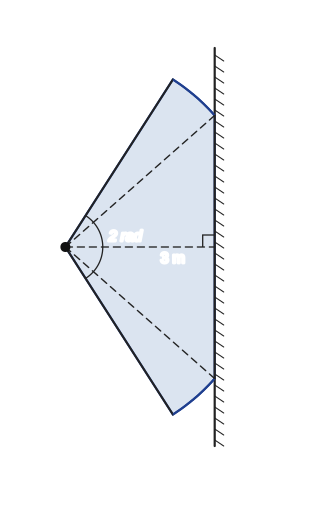
Figure 1 shows the plan of part of a room. An oscillating fan is placed at the point \(O\), which is 3 m from a straight wall. The point \(N\) is the point on the wall nearest to \(O\), so \(ON = 3\) m. The fan turns from side to side, between the directions \(OA\) and \(OB\), through a total angle \(AOB\) of 2 radians, and \(ON\) bisects this angle.

The air from the fan is modelled as reaching every point of the floor that is within 4 m of \(O\) and inside angle \(AOB\), except where the wall stops it. This region is shaded in Figure 1. The edge of the region meets the wall at the points \(P\) and \(Q\), where \(OP = OQ = 4\) m.

Show that angle \(PON = 0.723\) radians, correct to 3 significant figures.

Find the area of the floor that the air from the fan reaches, giving your answer in m\(^2\) to 3 significant figures.

Figure 1: plan view. A straight wall is drawn as a vertical line on the right, hatched on its far side and labelled wall. The point O is to the left of the wall, with a dashed line from O to the point N on the wall, marked with a right angle at N and labelled 3 m. Two straight lines OA and OB go out from O, one below and one above ON, and the angle AOB is marked 2 rad. OA is labelled 4 m. Short arcs, centred on O, run from A to the point P on the wall and from the point Q on the wall to B. Dashed lines join O to P and O to Q. The shaded region is bounded by OA, the arc from A to P, the wall from P to Q, the arc from Q to B and BO.

Model answer

Triangle \(OPN\) is right-angled at \(N\), with \(OP = 4\) and \(ON = 3\).
\(\cos PON = \dfrac{3}{4}\), so angle \(PON = \arccos 0.75 = 0.72273... = 0.723\) radians (3 s.f.)
\(PN = \sqrt{4^2 - 3^2} = \sqrt{7}\), so \(PQ = 2\sqrt{7}\)
Area of triangle \(OPQ = \dfrac{1}{2} \times 2\sqrt{7} \times 3 = 3\sqrt{7} = 7.937...\) m\(^2\)
Angle \(AON = BON = 1\) radian, so angle \(AOP = QOB = 1 - 0.72273... = 0.27726...\) radians
Two sectors: \(2 \times \dfrac{1}{2} \times 4^2 \times 0.27726... = 4.4362...\) m\(^2\)
Total area \(= 7.937... + 4.436... = 12.4\) m\(^2\) (3 s.f.)

Explanation

The wall cuts the 2-radian sector of radius 4 m, so the region is the isosceles triangle \(OPQ\) (whose height is \(ON = 3\)) plus two thin sectors between the radii \(OA\), \(OP\) and \(OQ\), \(OB\). The angle \(PON\) comes from \(\cos PON = \dfrac{3}{4}\), and each small sector has angle \(1 - 0.7227...\) because \(ON\) bisects the 2-radian angle. Common errors are treating the whole region as a sector, using half the fan angle as 2 radians, and adding only one of the two sectors.

Mark scheme
  1. 1 mark

    M1 Uses the right-angled triangle \(OPN\): \(\cos PON = \dfrac{3}{4}\). An answer of 12.4 m\(^2\) with no working scores 1 mark; the show-that needs working.

    An answer of 12.4 m\(^2\) with no working scores 1 mark (the final A1); the show-that marks need working. Alternatives: \(PN = \sqrt{4^2 - 3^2} = \sqrt{7}\) and \(\tan PON = \dfrac{\sqrt{7}}{3}\), or \(\sin PON = \dfrac{\sqrt{7}}{4}\).

  2. 1 mark

    A1* Angle \(PON = \arccos\dfrac{3}{4} = 0.72273... = 0.723\) radians (3 s.f.), with more than 3 significant figures seen, cso

    The unrounded value (e.g. 0.7227; accept any value that rounds to 0.723 with 4 or more significant figures) must be seen before the given answer.

  3. 1 mark

    M1 Area of triangle \(OPQ\): \(\dfrac{1}{2} \times 2\sqrt{7} \times 3\), or \(\dfrac{1}{2} \times 4^2 \times \sin(2 \times 0.7227...)\)

    \(PQ = 2PN = 2\sqrt{7}\). Alternative method for the remaining marks: area \(=\) sector \(AOB\) of angle 2 radians (\(\dfrac{1}{2} \times 4^2 \times 2 = 16\)) minus the segment cut off by \(PQ\), where the segment \(= \dfrac{1}{2} \times 4^2 \times (1.4454... - \sin 1.4454...) = 3.626...\). Marks: M1 for the segment method and A1 for awrt 3.63, i.e. in [3.625, 3.635) (in place of the triangle marks), B1 for the 2-radian sector or angle \(AON = 1\), M1 for the sector area 16, dM1 for subtracting, A1 for 12.4.

  4. 1 mark

    A1 \(3\sqrt{7}\) or awrt 7.94 m\(^2\), i.e. in [7.935, 7.945)

    From 7.937...

  5. 1 mark

    B1 Uses angle \(AON =\) angle \(BON = 1\) radian (as \(ON\) bisects the angle of 2 radians)

    May be implied by a correct sector angle of \(1 - 0.7227...\) or a correct total.

  6. 1 mark

    M1 Area of the two sectors \(AOP\) and \(QOB\), each of radius 4 m and angle (their 1) \(- 0.7227...\): \(2 \times \dfrac{1}{2} \times 4^2 \times (1 - 0.7227...)\)

    \(= 4.436...\) m\(^2\). Allow \(\dfrac{1}{2} \times 4^2 \times (2 - 2 \times 0.7227...)\) for the two together.

  7. 1 mark

    M1 (dM1) Total area \(=\) triangle \(OPQ\) \(+\) both sectors

    Depends on the previous M mark and also on the triangle M mark. Adding only one sector is M0.

  8. 1 mark

    A1 Area \(=\) awrt 12.4 m\(^2\), i.e. in [12.35, 12.45)

    From 12.3735... Units not needed. Using the rounded 0.723 gives 12.369, which is fine.

Ready to try the rest? Every answer you write is marked against the mark scheme, so you can see exactly where the marks are.

Study Helper Hints first, answers after you try

Stuck on this one? Ask for a hint and I’ll point you in the right direction, without giving the answer away. Once you’ve checked your answer, I’ll show you how the marks are awarded.