
Level:
Correct: 0
Incorrect: 0
Marks: 0/0
Exam Practice
Course:
Topics:
Avg
score:
–
Topics
done:
0/22

Spread and prevention of communicable diseases

Practise 18 exam-style questions on Spread and prevention of communicable diseases for OCR GCSE Combined Science (Biology Paper 8). Write your answer as you would in the exam and get it marked in seconds against the mark scheme, point by point, with the Study Helper on hand if you get stuck.

  • 18 questions
  • 1–6 marks each
  • Instant marking
  • No sign-up needed
18 questions, marked as you go

Sample questions with model answers

Here are 4 of the questions in this topic, each with a model answer, an explanation of why it earns the marks and the mark scheme an examiner would use.

Question 1

1 mark

Clubroot is a disease of cabbages and related plants. It is caused by a protist that lives in the soil. Its spores can survive in the soil for up to 20 years.

Which action would best stop clubroot spreading from an infected field to other fields?

Choose your answer.

  • A washing soil off boots and machinery before leaving the field
  • B spraying the leaves of the cabbages with a fungicide
  • C watering the cabbages more often
  • D planting the cabbages further apart in the infected field

Model answer

A

Explanation

To stop a disease spreading, break the route the pathogen uses. The clubroot protist moves between fields in soil, so cleaning soil off machinery, wheels and boots is the key step. Because the spores survive for many years, an infected field remains a source of the disease for a long time.

Mark scheme
  1. 1 mark

    A / washing soil off boots and machinery before leaving the field

    The only correct answer is A: the spores are in the soil, so removing soil from machinery and boots stops them being carried to other fields. B is not correct because the pathogen is a protist in the soil that infects the roots, so spraying the leaves with a fungicide would not reach it; C is not correct because watering does not stop spores moving between fields (wet soil can even help the spores infect roots); D is not correct because spacing the plants in the infected field does not stop spores in soil being carried to other fields. ALLOW the letter or the option. If more than one option is given, do not award the mark.
Question 2

2 marks

Septoria leaf blotch is a disease of wheat caused by a fungus. Its spores are splashed from leaf to leaf by raindrops.

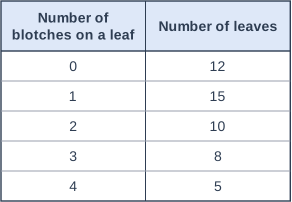
A student collected 50 wheat leaves at random from a field and counted the number of Septoria blotches on each leaf. The frequency table shows the results.

Calculate the mean number of blotches per leaf.

Table with columns "Number of blotches on a leaf", "Number of leaves". Number of blotches on a leaf: 0; Number of leaves: 12 | Number of blotches on a leaf: 1; Number of leaves: 15 | Number of blotches on a leaf: 2; Number of leaves: 10 | Number of blotches on a leaf: 3; Number of leaves: 8 | Number of blotches on a leaf: 4; Number of leaves: 5.

Model answer

Total number of blotches = (0 × 12) + (1 × 15) + (2 × 10) + (3 × 8) + (4 × 5) = 0 + 15 + 20 + 24 + 20 = 79
Mean = 79 ÷ 50 = 1.58 blotches per leaf

Explanation

In a frequency table, multiply each value by its frequency, add the products and divide by the total frequency (50 leaves). Common errors are to average the values 0 to 4, giving 2, or to average the frequencies, giving 10. Collecting the leaves at random makes the sample more likely to represent the whole field.

Mark scheme
  1. 1 mark

    total number of blotches = (0 × 12) + (1 × 15) + (2 × 10) + (3 × 8) + (4 × 5) = 79; or a correct final answer of 1.58 with no working

    An answer of 1.58 with no working scores 2 marks. ALLOW 1.6. An answer of 2 (mean of 0, 1, 2, 3 and 4) or 10 (mean of the numbers of leaves) scores 0.

  2. 1 mark

    evaluation: 79 ÷ 50 = 1.58 (blotches per leaf)

    ALLOW 1.6. ALLOW ECF for 1 mark from one arithmetic slip in the total, divided by 50.

Question 3

3 marks

Bacillus cereus is a bacterium that can cause food poisoning. Its spores can survive cooking.

A portion of cooked rice was left overnight in a warm kitchen. At the start it contained 150 Bacillus cereus bacteria per gram. In the warm kitchen the bacteria divided into two every 40 minutes.

A food scientist says that rice containing more than 100 000 of these bacteria per gram is likely to cause food poisoning.

Calculate the number of Bacillus cereus bacteria per gram after 8 hours. Use your answer to decide whether the rice is then likely to cause food poisoning.

Model answer

Time = 8 × 60 = 480 minutes
Number of divisions = 480 ÷ 40 = 12
Number of bacteria = 150 × 2¹² = 150 × 4096 = 614 400 per gram (6.1 × 10⁵ per gram)
614 400 is more than 100 000 (about six times as many), so the rice is likely to cause food poisoning.

Explanation

Each division doubles the number of bacteria, so after n divisions the number is 150 × 2ⁿ. Convert the time to minutes before dividing by the time for one division, and multiply by 2 for each division rather than adding. The calculation shows how quickly the number of pathogens in food can rise, which is why cooked rice should be cooled quickly and kept in a fridge.

Mark scheme
  1. 1 mark

    number of divisions = (8 × 60) ÷ 40 = 480 ÷ 40 = 12; or a correct final answer of 614 400 (6.1 × 10⁵) bacteria per gram with no working

    An answer of 614 400 (6.1 × 10⁵) bacteria per gram with no working scores marking points 1 and 2. ALLOW 12 doublings shown as a list (150, 300, 600, 1200 ...). An answer of 3600 (150 × 2 × 12, adding instead of doubling) or 1800 (150 × 12) scores marking point 1 only if 12 divisions are shown.

  2. 1 mark

    evaluation: 150 × 2¹² = 150 × 4096 = 614 400 (bacteria per gram)

    ALLOW 6.144 × 10⁵ / 6.14 × 10⁵ / 6.1 × 10⁵ / 614 000 / 610 000. IGNORE units.

  3. 1 mark

    decision: the calculated number is more than the food scientist's limit (about six times as many), so the rice is likely to cause food poisoning

    The decision must be supported by a comparison of the calculated number with 100 000 (for example 614 400 is more than 100 000). ALLOW ECF from a wrong calculated number if the comparison with 100 000 is correct. A decision with no comparison scores 0.

Question 4

4 marks

Xylella fastidiosa is a bacterium that infects many types of plant, including lavender, rosemary and olive trees. It is spread from plant to plant by insects that feed on the sap in xylem vessels. It has killed millions of olive trees in southern Italy, but by 2025 it had not become established in the UK.

An infected plant may show no symptoms for several years.

UK plant health inspectors take samples from imported plants and test them for the DNA of Xylella. If an infected plant is found, it is destroyed, together with other host plants growing near it.

Explain why the inspectors use DNA tests instead of only looking at the plants for symptoms, and why plants near an infected plant are also destroyed.

Model answer

An infected plant can carry Xylella for several years without showing any symptoms, so inspectors looking for symptoms would miss many infected plants. A DNA test detects the bacterium's DNA even before symptoms appear, and it identifies Xylella itself rather than other causes of damaged leaves. This means infected plants can be destroyed before insects spread the bacteria to other plants in the UK.
Plants growing near an infected plant may already have been infected by insects feeding on their xylem sap, even though they show no symptoms yet. Destroying them as well removes all the plants that could carry the bacteria, so the disease cannot spread further.

Explanation

Visual identification only works once symptoms appear; DNA testing can find a pathogen in a plant that looks healthy. Destroying infected plants and nearby host plants removes sources of infection before a vector can spread the pathogen. Good answers explain both decisions; weak answers say only that DNA tests are 'more accurate'.

Mark scheme
  1. 1 mark

    infected plants may show no symptoms (for years), so looking for symptoms / visual identification would miss them

    max 4. Max 3 if the answer does not explain why nearby plants are destroyed.

  2. 1 mark

    the DNA test detects the bacterium (its DNA) even before symptoms appear / identifies this particular pathogen

    ALLOW symptoms such as dying leaves can have other causes, but the DNA test is specific to Xylella.

  3. 1 mark

    so infected plants can be found and destroyed before insects spread the bacteria to other plants / before it becomes established in the UK

    ALLOW so infected plants are not sold and planted.

  4. 1 mark

    plants near an infected plant may already have been infected (by the insects) but not yet show symptoms

    ALLOW the insects that carry the bacteria move between nearby plants.

  5. 1 mark

    destroying them removes all the plants that the insects could carry the bacteria from / to, so the disease cannot spread further

    ALLOW removes possible sources of infection.

Ready to try the rest? Every answer you write is marked against the mark scheme, so you can see exactly where the marks are.

Study Helper Hints first, answers after you try

Stuck on this one? Ask for a hint and I’ll point you in the right direction, without giving the answer away. Once you’ve checked your answer, I’ll show you how the marks are awarded.