
Level:
Correct: 0
Incorrect: 0
Marks: 0/0
Exam Practice
Course:
Topics:
Avg
score:
–
Topics
done:
0/22

Genetic terms and the genome

Practise 15 exam-style questions on Genetic terms and the genome for OCR GCSE Combined Science (Biology Paper 8). Write your answer as you would in the exam and get it marked in seconds against the mark scheme, point by point, with the Study Helper on hand if you get stuck.

  • 15 questions
  • 1–6 marks each
  • Instant marking
  • No sign-up needed
15 questions, marked as you go

Sample questions with model answers

Here are 4 of the questions in this topic, each with a model answer, an explanation of why it earns the marks and the mark scheme an examiner would use.

Question 1

1 mark

In rabbits, one gene affects the colour of the fur. Scientists have found four variants (alleles) of this gene: full colour, chinchilla, Himalayan and albino.

What is the largest number of different variants of this gene that one body cell of a rabbit can contain?

Choose your answer.

  • A 1
  • B 2
  • C 3
  • D 4

Model answer

B

Explanation

A gene has a fixed position on a chromosome, and body cells contain two copies of each chromosome, one inherited from each parent. So a rabbit has two alleles of the fur-colour gene: two copies of the same variant (homozygous) or two different variants (heterozygous). A population can contain many variants of a gene, but no single body cell can hold more than two of them.

Mark scheme
  1. 1 mark

    B / 2

    The only correct answer is B: the chromosomes in a body cell are in pairs and each chromosome of the pair carries one copy of the gene, so a body cell has two alleles of the gene, which can be two different variants (a heterozygous rabbit). A is not correct because one allele of each gene is what a gamete contains, not a body cell; C and D are not correct because the four variants are found in the population as a whole, but each rabbit inherits only one allele of the gene from each parent. ALLOW the letter or the number. If more than one option is given, do not award the mark.
Question 2

2 marks

A vet takes a sample of cells from inside a dog's cheek. One laboratory reads the dog's whole genome from the sample. Another laboratory tests only the dog's genotype for coat length.

Explain the difference between the dog's genome and its genotype for coat length.

Model answer

The genome is the entire genetic material of the dog: all of the DNA in all of its chromosomes. Its genotype for coat length is only the pair of alleles it has for the one gene that controls coat length, for example Ll.

Explanation

The genome is everything: all of the DNA, with all of the genes, in a complete set of the organism's chromosomes. A genotype is much narrower: the alleles an organism has for one particular gene (or a few genes). Do not confuse the genotype (the alleles) with the phenotype (the coat length that results).

Mark scheme
  1. 1 mark

    genome: all of the genetic material / all of the DNA of the dog

    ALLOW all of the genes / all of the chromosomes of the dog / the entire genetic material. DO NOT ALLOW all the genes on one chromosome / all of the proteins / all of the characteristics.

  2. 1 mark

    genotype for coat length: the (two) alleles the dog has for the coat-length gene

    ALLOW the combination of alleles for that (one) gene. ALLOW a correct example such as Ll or LL. DO NOT ALLOW the length of the coat (this is the phenotype) / the gene for coat length (the gene, not the alleles the dog has).

Question 3

3 marks

Each human chromosome is one very long DNA molecule. Genes are sections of this DNA.

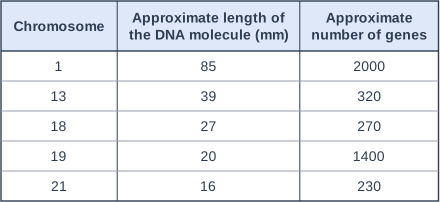
The table shows approximate data for five human chromosomes, rounded from human genome databases.

A student says: 'The longer a chromosome is, the more genes it carries.'

Evaluate the student's statement. Use data from the table in your answer.

Table with columns "Chromosome", "Approximate length of the DNA molecule (mm)", "Approximate number of genes". Chromosome: 1; Approximate length of the DNA molecule (mm): 85; Approximate number of genes: 2000 | Chromosome: 13; Approximate length of the DNA molecule (mm): 39; Approximate number of genes: 320 | Chromosome: 18; Approximate length of the DNA molecule (mm): 27; Approximate number of genes: 270 | Chromosome: 19; Approximate length of the DNA molecule (mm): 20; Approximate number of genes: 1400 | Chromosome: 21; Approximate length of the DNA molecule (mm): 16; Approximate number of genes: 230.

Model answer

Some data support the statement: chromosome 1 is the longest (85 mm) and carries the most genes (about 2000), and chromosomes 13, 18 and 21 carry fewer genes as they get shorter (320, 270 and 230 genes for 39 mm, 27 mm and 16 mm).

However, chromosome 19 is only 20 mm long, shorter than chromosomes 13 and 18, but it carries about 1400 genes, far more than either of them.

So the statement is only a general trend and is not always true: the genes are packed much more closely on some chromosomes than on others (about 70 genes per mm on chromosome 19 but only about 8 per mm on chromosome 13).

Explanation

To evaluate a statement, give the evidence that supports it, the evidence against it, and a reasoned conclusion, quoting values from the table. Chromosome 19 is the key: it is short but gene-rich. A chromosome is one long DNA molecule and a gene is a section of it, so the number of genes depends on how much of that DNA is genes as well as on its length.

Mark scheme
  1. 1 mark

    support: the longest chromosome, chromosome 1 (85 mm), carries the most genes (about 2000) / for chromosomes 13, 18 and 21, the longer chromosome carries more genes (39 mm 320, 27 mm 270, 16 mm 230)

    Max 2 if no data from the table are used. ALLOW any correct comparison of two chromosomes from 1, 13, 18 and 21 in which the longer one has more genes.

  2. 1 mark

    against: chromosome 19 is shorter (20 mm) than chromosomes 13 and 18 (39 mm and 27 mm) but carries many more genes (about 1400 compared with 320 and 270)

    ALLOW a comparison of chromosome 19 with chromosome 13 only or with chromosome 18 only. ALLOW chromosome 19 is only about a quarter of the length of chromosome 1 but has about 70 % of its number of genes.

  3. 1 mark

    conclusion: the statement is not always true / is only a general trend, because genes are packed more closely on some chromosomes than on others

    ALLOW the number of genes per mm is different on different chromosomes, for example about 70 per mm on chromosome 19 but about 8 per mm on chromosome 13. ALLOW some chromosomes have more DNA between their genes. A conclusion with no reason does not score.

Question 4

4 marks

Pea seeds can be round or wrinkled. Seed shape is controlled by one gene with two alleles, R and r.

• Allele R codes for a working form of an enzyme that the developing seed uses to make most of its starch from sugar.
• Allele r codes for a form of this enzyme that does not work. Other enzymes in the seed can still make some starch.

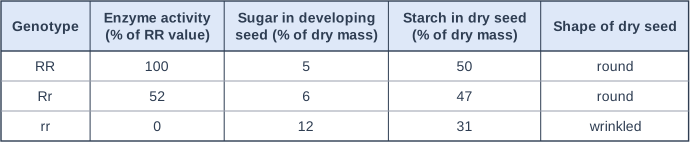
A scientist measured the enzyme activity and the sugar content of developing seeds of each genotype. She also measured the starch in the seeds when they were dry. The table shows her results.

While they are developing, rr seeds take in much more water than RR or Rr seeds. At the end of their development the seeds dry out, and the rr seeds lose more water, shrink and become wrinkled.

Use the data and your knowledge of enzymes and osmosis to explain:
• why rr seeds take in more water while they are developing
• why allele R is described as dominant, even though Rr seeds have only about half the enzyme activity of RR seeds.

Table with columns "Genotype", "Enzyme activity (% of RR value)", "Sugar in developing seed (% of dry mass)", "Starch in dry seed (% of dry mass)", "Shape of dry seed". Genotype: RR; Enzyme activity (% of RR value): 100; Sugar in developing seed (% of dry mass): 5; Starch in dry seed (% of dry mass): 50; Shape of dry seed: round | Genotype: Rr; Enzyme activity (% of RR value): 52; Sugar in developing seed (% of dry mass): 6; Starch in dry seed (% of dry mass): 47; Shape of dry seed: round | Genotype: rr; Enzyme activity (% of RR value): 0; Sugar in developing seed (% of dry mass): 12; Starch in dry seed (% of dry mass): 31; Shape of dry seed: wrinkled.

Model answer

rr seeds have no working enzyme (0 % activity), so much of the sugar in the developing seed is not converted to starch. The data show this: rr seeds contain 12 % sugar compared with 5 % in RR seeds, and when dry they contain only 31 % starch compared with 50 %.

Sugar dissolves in the cytoplasm, but starch is insoluble. The extra dissolved sugar gives the cells of rr seeds a lower water potential, so more water moves into them by osmosis from the tissues around the seed. When the seeds dry out, the rr seeds lose this extra water, shrink and wrinkle.

Rr seeds have only about half of the enzyme activity (52 %), but enzymes are catalysts and are not used up, so this is enough to convert nearly all of the sugar to starch: Rr seeds contain 6 % sugar and 47 % starch, almost the same as RR seeds. So Rr seeds do not take in extra water and are round, like RR seeds. One copy of R is enough to give the round phenotype, so R is dominant; r only affects the phenotype when there is no R allele, in rr seeds, so it is recessive.

Explanation

Link each step: the genotype decides whether the working enzyme is made, the enzyme decides how much sugar is turned into starch, and the dissolved sugar lowers the water potential so that water enters by osmosis. Dominance does not need a full dose of working enzyme: because enzymes are catalysts, half of the activity still gives almost the same starch content and the same phenotype. Common errors are saying that R switches off or destroys r, and saying that starch draws water in (starch is insoluble; it is the dissolved sugar that lowers the water potential).

Mark scheme
  1. 1 mark

    rr seeds have no working enzyme (0 %), so less of the sugar is converted to starch: rr seeds contain more sugar (12 % compared with 5 %) and less starch (31 % compared with 50 %)

    1 mark for each point. Max 3 if no data from the table are used. ALLOW the sugar is not made into starch / stays as sugar in rr seeds. IGNORE explanations of why the r form of the enzyme does not work (this is not needed).

  2. 1 mark

    the extra (dissolved) sugar gives the cells of rr seeds a lower water potential, so more water moves into them by osmosis

    ALLOW a higher concentration of dissolved sugar / of solute / a lower water concentration in the rr seeds, so water enters by osmosis. ALLOW a steeper water potential gradient into the seed. ALLOW starch is insoluble so does not lower the water potential, as part of this point. DO NOT ALLOW water enters by active transport / sugar moves out of the seed by osmosis / starch draws in water.

  3. 1 mark

    Rr seeds have only about half the enzyme activity (52 %), but enzymes are catalysts / are not used up, so this is enough to convert almost as much sugar to starch as in RR seeds (47 % compared with 50 % starch / 6 % compared with 5 % sugar)

    ALLOW each enzyme molecule can be used again, so the starch is made more slowly but (nearly) the same amount is made. ALLOW Rr seeds have one allele that codes for the working enzyme, which is enough.

  4. 1 mark

    so Rr seeds do not take in extra water and are round like RR seeds: one copy of R is enough to give the round phenotype, so R is dominant

    ALLOW the R allele shows its effect even when only one copy is present. ALLOW r is recessive because only rr / homozygous recessive seeds are wrinkled. DO NOT ALLOW the R allele stops / destroys / switches off the r allele / R is stronger than r (with no explanation).

Ready to try the rest? Every answer you write is marked against the mark scheme, so you can see exactly where the marks are.

Study Helper Hints first, answers after you try

Stuck on this one? Ask for a hint and I’ll point you in the right direction, without giving the answer away. Once you’ve checked your answer, I’ll show you how the marks are awarded.