
Level:
Correct: 0
Incorrect: 0
Marks: 0/0
Exam Practice
Course:
Topics:
Avg
score:
–
Topics
done:
0/22

Cycling of materials and the role of microorganisms

Practise 19 exam-style questions on Cycling of materials and the role of microorganisms for OCR GCSE Combined Science (Biology Paper 8). Write your answer as you would in the exam and get it marked in seconds against the mark scheme, point by point, with the Study Helper on hand if you get stuck.

  • 19 questions
  • 1–6 marks each
  • Instant marking
  • No sign-up needed
19 questions, marked as you go

Sample questions with model answers

Here are 4 of the questions in this topic, each with a model answer, an explanation of why it earns the marks and the mark scheme an examiner would use.

Question 1

1 mark

A mole dies in a field. The proteins in its body contain nitrogen.

• Nitrifying bacteria convert ammonium compounds into nitrates.
• Denitrifying bacteria convert nitrates into nitrogen gas.
• Nitrogen-fixing bacteria convert nitrogen gas into nitrogen compounds.

Which sequence shows the order in which microorganisms act on this nitrogen, so that it can be absorbed by plant roots?

Choose your answer.

  • A decomposers, then nitrifying bacteria
  • B decomposers, then denitrifying bacteria
  • C nitrifying bacteria, then decomposers
  • D nitrogen-fixing bacteria, then nitrifying bacteria

Model answer

A

Explanation

Nitrogen in the proteins of dead organisms is returned to the soil in two steps: decomposers (bacteria and fungi) break the proteins down and release ammonium compounds, and then nitrifying bacteria convert these into nitrates, the form most plants absorb through their roots. Denitrifying bacteria do the opposite of what plants need: they turn nitrates into nitrogen gas, which is lost to the air.

Mark scheme
  1. 1 mark

    A / decomposers, then nitrifying bacteria

    The only correct answer is A: decomposers break down the proteins into ammonium compounds (ammonia), then nitrifying bacteria convert the ammonium compounds into nitrates, which plant roots absorb. B is not correct because denitrifying bacteria convert nitrates into nitrogen gas, which plant roots cannot absorb or use; C is not correct because nitrifying bacteria act on ammonium compounds, which are only released after decomposers have broken down the proteins; D is not correct because nitrogen-fixing bacteria convert nitrogen gas from the air, not the nitrogen in the proteins of dead organisms. ALLOW the letter or the option. If more than one option is given, do not award the mark.
Question 2

2 marks

On some moorlands in Scotland, patches of old heather are burned. New heather shoots then grow from the bases of the burned plants.

Explain how carbon atoms in the burned heather can become part of the new heather shoots.

Model answer

When the heather burns, combustion releases the carbon in its carbon compounds as carbon dioxide into the air. The new heather shoots take in carbon dioxide from the air through their leaves for photosynthesis, which makes glucose. The glucose is used to make cellulose and other carbon compounds that build the new shoots.

Explanation

Two stages of the carbon cycle link burning and growth: combustion puts carbon into the air as carbon dioxide, and photosynthesis takes it out again into glucose. A common mistake is to think that the new shoots get carbon from the ash or the soil through their roots; plants get their carbon from carbon dioxide in the air.

Mark scheme
  1. 1 mark

    burning / combustion (of the heather) releases the carbon (in its carbon compounds) as carbon dioxide into the air

    ALLOW the heather burns to produce carbon dioxide. DO NOT ALLOW burning releases carbon monoxide only. IGNORE smoke / ash.

  2. 1 mark

    the new heather (shoots) take in carbon dioxide (from the air) for photosynthesis, making glucose / carbon compounds that are used to build the shoots

    ALLOW photosynthesis turns the carbon dioxide into glucose, which is used to make cellulose / starch / proteins for growth. DO NOT ALLOW the roots absorb carbon dioxide or carbon from the soil.

Question 3

3 marks

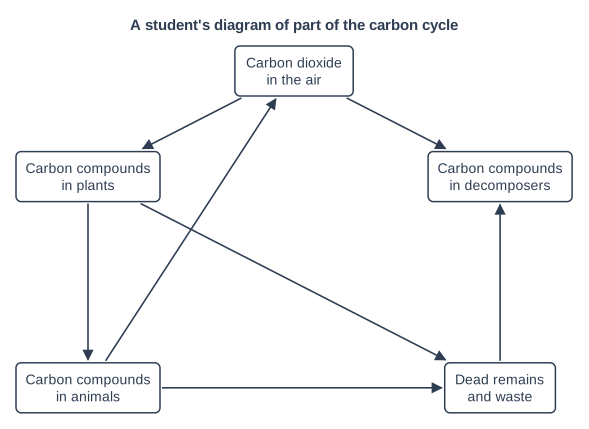
A student drew this diagram of part of the carbon cycle.

One arrow is drawn in the wrong direction, and one process that returns carbon to the air is missing.

Identify the arrow that is drawn in the wrong direction and explain why it should point the other way.

Name the missing process and give the two boxes it should join.

A student's diagram of part of the carbon cycle. Diagram of 5 boxes joined by 7 arrows. The boxes are: "Carbon dioxide in the air" (top row, centre), "Carbon compounds in plants" (second row, left), "Carbon compounds in decomposers" (second row, right), "Carbon compounds in animals" (bottom row, left), "Dead remains and waste" (bottom row, right). Arrows go from "Carbon dioxide in the air" to "Carbon compounds in plants", labelled "photosynthesis"; from "Carbon compounds in plants" to "Carbon compounds in animals", labelled "feeding"; from "Carbon compounds in animals" to "Carbon dioxide in the air", labelled "respiration"; from "Carbon compounds in plants" to "Dead remains and waste", labelled "death"; from "Carbon compounds in animals" to "Dead remains and waste", labelled "death and waste"; from "Dead remains and waste" to "Carbon compounds in decomposers", labelled "feeding"; from "Carbon dioxide in the air" to "Carbon compounds in decomposers", labelled "respiration".

Model answer

The arrow labelled respiration between the carbon dioxide in the air and the decomposers is the wrong way round. Decomposers respire, and respiration releases carbon dioxide into the air, so the arrow should point from the decomposers to the air; decomposers get their carbon from the dead remains, not from the air.
The missing process is respiration by plants, which should be an arrow from the carbon compounds in plants to the carbon dioxide in the air.

Explanation

Check each arrow against what the process does: respiration always releases carbon dioxide, so every respiration arrow must point towards the air, and only photosynthesis takes carbon dioxide out of the air. Plants respire all the time, so a respiration arrow from plants to the air belongs on every carbon cycle. A common error is to forget that plants respire as well as photosynthesise.

Mark scheme
  1. 1 mark

    the arrow labelled respiration between carbon dioxide in the air and (carbon compounds in) decomposers

    ALLOW the arrow from the air to the decomposers. DO NOT ALLOW any other arrow.

  2. 1 mark

    decomposers respire, which releases carbon dioxide into the air / decomposers do not take in carbon dioxide from the air (they get their carbon by feeding on dead remains and waste)

    ALLOW respiration produces carbon dioxide, so the arrow should go from the decomposers to the air.

  3. 1 mark

    (plant) respiration, from (carbon compounds in) plants to (carbon dioxide in) the air

    ALLOW combustion / burning of plants (wood), from plants to the air. Both the process and the two boxes (carbon compounds in plants and carbon dioxide in the air) are needed. DO NOT ALLOW an arrow from the air to the plants. DO NOT ALLOW photosynthesis. DO NOT ALLOW respiration by animals or decomposers (already on the diagram).

Question 4

4 marks

Scientists studied two valleys in a forest. Each valley has a stream that carries away the rainwater that drains from it. Both valleys had the same rainfall.

After the first year, all the trees in valley A were cut down. The cut branches and leaves were left on the ground, and new plants were stopped from growing. Valley B was left as forest.

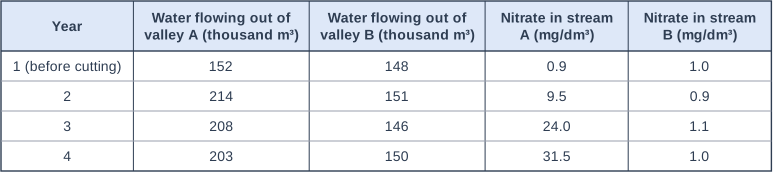
The table shows the scientists' results.

Explain the differences between the streams from valleys A and B after the trees were cut down. Use data from the table in your answer.

Table with columns "Year", "Water flowing out of valley A (thousand m³)", "Water flowing out of valley B (thousand m³)", "Nitrate in stream A (mg/dm³)", "Nitrate in stream B (mg/dm³)". Year: 1 (before cutting); Water flowing out of valley A (thousand m³): 152; Water flowing out of valley B (thousand m³): 148; Nitrate in stream A (mg/dm³): 0.9; Nitrate in stream B (mg/dm³): 1.0 | Year: 2; Water flowing out of valley A (thousand m³): 214; Water flowing out of valley B (thousand m³): 151; Nitrate in stream A (mg/dm³): 9.5; Nitrate in stream B (mg/dm³): 0.9 | Year: 3; Water flowing out of valley A (thousand m³): 208; Water flowing out of valley B (thousand m³): 146; Nitrate in stream A (mg/dm³): 24.0; Nitrate in stream B (mg/dm³): 1.1 | Year: 4; Water flowing out of valley A (thousand m³): 203; Water flowing out of valley B (thousand m³): 150; Nitrate in stream A (mg/dm³): 31.5; Nitrate in stream B (mg/dm³): 1.0.

Model answer

After the trees were cut down, more water flowed out of valley A: about 210 thousand m³ a year compared with about 150 thousand m³ before cutting, while valley B stayed at about 150 thousand m³. With no trees in valley A there was no transpiration, so the water taken up from the soil was no longer lost as water vapour from leaves, and more of the rain drained into the stream.
The nitrate concentration in stream A rose from 0.9 to 31.5 mg/dm³, while stream B stayed at about 1 mg/dm³. Decomposers broke down the dead leaves, branches and roots, releasing ammonium compounds that nitrifying bacteria converted into nitrates. There were no plant roots to absorb the nitrates, and because nitrates dissolve in water they were washed out of the soil into the stream.

Explanation

Use the data for both variables and compare valley A with the control valley B. Trees return much of the rain to the air by transpiration and take up nitrates from the soil, so removing them changes both the water cycle and the nitrogen cycle in the valley. Strong answers explain where the extra nitrate comes from (decomposition and nitrification) as well as why it is no longer absorbed.

Mark scheme
  1. 1 mark

    after cutting, more water flowed out of valley A than valley B / the flow from valley A increased (from 152 to about 210 thousand m³) while the flow from valley B stayed about 150 thousand m³

    Max 4. Max 3 if no data from the table are used. ALLOW about 40% more water / about 60 thousand m³ more water flowed out of valley A.

  2. 1 mark

    there were no trees / plants in valley A, so there was no / less transpiration (water vapour lost from leaves through stomata), so more of the rainwater drained into the stream

    ALLOW less water taken up by roots and returned to the air. ALLOW less evaporation of rain from leaves. DO NOT ALLOW more rain fell on valley A.

  3. 1 mark

    the nitrate concentration in stream A increased (from 0.9 to 31.5 mg/dm³) while stream B stayed at about 1 mg/dm³

    ALLOW nitrate in stream A rose to about 30 times / 35 times its starting value.

  4. 1 mark

    decomposers broke down the dead leaves / branches / roots (left in valley A), releasing ammonium compounds, which nitrifying bacteria converted to nitrates

    ALLOW decomposition of the dead plant material released nitrogen compounds / nitrates into the soil.

  5. 1 mark

    there were no plant roots to absorb the nitrates (by active transport), so the nitrates stayed in the soil

    ALLOW no plants to take up the nitrates to make proteins.

  6. 1 mark

    nitrates are soluble / dissolve in water, so they were washed out of the soil into the stream (by the extra water draining through it)

    ALLOW nitrates were leached / carried by run-off into the stream.

Ready to try the rest? Every answer you write is marked against the mark scheme, so you can see exactly where the marks are.

Study Helper Hints first, answers after you try

Stuck on this one? Ask for a hint and I’ll point you in the right direction, without giving the answer away. Once you’ve checked your answer, I’ll show you how the marks are awarded.