
Level:
Correct: 0
Incorrect: 0
Marks: 0/0
Exam Practice
Course:
Topics:
Avg
score:
–
Topics
done:
0/22

Genome, environment and variation; mutations

Practise 14 exam-style questions on Genome, environment and variation; mutations for OCR GCSE Combined Science (Biology Paper 8). Write your answer as you would in the exam and get it marked in seconds against the mark scheme, point by point, with the Study Helper on hand if you get stuck.

  • 14 questions
  • 1–6 marks each
  • Instant marking
  • No sign-up needed
14 questions, marked as you go

Sample questions with model answers

Here are 4 of the questions in this topic, each with a model answer, an explanation of why it earns the marks and the mark scheme an examiner would use.

Question 1

1 mark

Common water-crowfoot is a plant that grows in ponds and streams. One plant has thin, thread-like leaves under the water and broad, flat leaves floating on the surface. All of the cells of the plant have the same genome. Other plants growing in the same pond, such as Canadian pondweed, have only one type of leaf.

Which statement explains why one plant has two types of leaf?

Choose your answer.

  • A Leaf shape is controlled only by the environment.
  • B The environment changes the genome of the leaves that float.
  • C The floating leaves have different alleles from the leaves under the water.
  • D The same genome produces different phenotypes in different environments.

Model answer

D

Explanation

The phenotype develops from the interaction between the genome and the environment. Water-crowfoot leaves all have the same genome, so a leaf's shape depends on whether it develops under the water or at the surface. The environment affects how the phenotype develops but it does not change the genome or the alleles.

Mark scheme
  1. 1 mark

    D / the same genome produces different phenotypes in different environments

    The only correct answer is D: every leaf has the same genome, so the different leaf shapes are caused by the different conditions (under the water or in the air) in which each leaf develops. A is not correct because the genome is also needed: other plants growing in the same pond, such as Canadian pondweed, have only one type of leaf, so the ability to make both shapes is inherited; B is not correct because the environment does not change the genome; C is not correct because all the cells of the plant have the same genome, so the leaves have the same alleles. ALLOW the letter or the statement. If more than one option is given, do not award the mark.
Question 2

2 marks

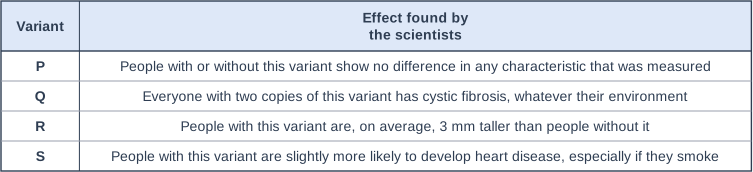
Scientists studied four variants of human genes. The table describes the effect of each variant.

For each variant, P, Q, R and S, state whether it has no effect on the phenotype, influences the phenotype or determines the phenotype.

Table with columns "Variant", "Effect found by the scientists". Variant: P; Effect found by the scientists: People with or without this variant show no difference in any characteristic that was measured | Variant: Q; Effect found by the scientists: Everyone with two copies of this variant has cystic fibrosis, whatever their environment | Variant: R; Effect found by the scientists: People with this variant are, on average, 3 mm taller than people without it | Variant: S; Effect found by the scientists: People with this variant are slightly more likely to develop heart disease, especially if they smoke.

Model answer

P: no effect on the phenotype
Q: determines the phenotype
R: influences the phenotype
S: influences the phenotype

Explanation

Most variants have no effect on the phenotype (P), some influence it by changing a characteristic a little or changing the chance of something happening (R and S), and very few determine it, giving the phenotype whatever the environment (Q). Variant S is not 'determines', because people with it may never develop heart disease and the environment (smoking) also matters.

Mark scheme
  1. 2 marks

    P: no effect; Q: determines (the phenotype); R: influences (the phenotype); S: influences (the phenotype)

    All four correct = 2 marks. Two or three correct = 1 mark. One or none correct = 0 marks. Mark each variant as a whole: if more than one effect is given for a variant, that variant is not correct. ALLOW 'has some influence' / 'affects' for influences. DO NOT ALLOW 'determines' for R or S.

Question 3

3 marks

Adult flamingos usually have pink feathers. The pink colour comes from pigments called carotenoids, which flamingos take in from the algae and shrimps they eat.

• Flamingos in a zoo that were fed food with no carotenoids grew pale, almost white feathers.
• Later, carotenoids were added to their food. The flamingos' new feathers grew pink.
• Ducks kept in the same enclosure, eating the same food, did not grow pink feathers.

Explain what these observations show about how the colour of a flamingo's feathers develops.

Model answer

The colour depends on the environment: when the flamingos' food had no carotenoids their feathers were pale, and when carotenoids were added their new feathers grew pink, so the pigment must come from their diet.

The colour also depends on the genome: ducks eating exactly the same food did not grow pink feathers, so flamingos must have genes that allow them to take in the pigment and use it to colour their feathers.

So the phenotype (feather colour) develops from the interaction between the genome and the environment: both are needed.

Explanation

Each observation is a comparison with one factor changed. Changing the food of the same flamingos shows the effect of the environment; giving the same food to a different species shows the effect of the genome. A full answer uses both comparisons and concludes that the phenotype depends on the interaction of the two.

Mark scheme
  1. 1 mark

    the colour depends on the environment / diet: without carotenoids in the food the feathers are pale, with carotenoids they are pink

    1 mark for each point. ALLOW the pigment must come from the food (it cannot be made by the flamingo).

  2. 1 mark

    the colour also depends on the genome: flamingos have genes / alleles that allow them to take in and use the pigment to colour their feathers, but ducks (with a different genome) do not

    ALLOW flamingos have enzymes (coded for by their genes) that process the carotenoids. ALLOW ducks eating the same food do not turn pink, so the difference must be genetic. DO NOT ALLOW carotenoids change the flamingos' genes.

  3. 1 mark

    so feather colour (the phenotype) results from the interaction of the genome and the environment / needs both the right genome and the right environment

    ALLOW neither the genome nor the environment alone decides the colour.

Question 4

4 marks

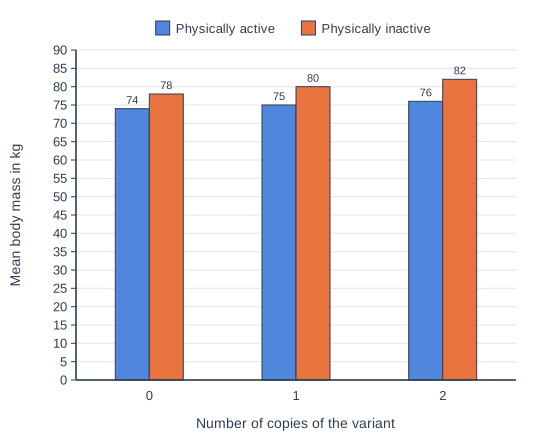
Scientists studied one variant of a gene in 6000 adults. Each adult had 0, 1 or 2 copies of the variant. The scientists also recorded whether each adult was physically active or physically inactive.

The graph shows the mean body mass of each group. In every group, the body masses of the individual adults ranged from less than 55 kg to more than 110 kg.

Use the data to explain why the variant is described as influencing body mass rather than determining it, and how the data show that the genome and the environment interact.

Dual bar chart of mean body mass in kg for each number of copies of the variant, comparing Physically active and Physically inactive (a key above the chart shows which bar is which). 0: Physically active 74, Physically inactive 78; 1: Physically active 75, Physically inactive 80; 2: Physically active 76, Physically inactive 82.

Model answer

The variant affects body mass: mean body mass rises with the number of copies, from 78 kg (0 copies) to 82 kg (2 copies) in inactive adults. However, the effect is small, only 2 to 4 kg, and in every group body masses range from below 55 kg to above 110 kg, so knowing how many copies a person has does not tell you their body mass. The variant influences body mass but does not determine it.

The environment also matters: active adults have a lower mean body mass than inactive adults with the same number of copies, for example 76 kg compared with 82 kg for 2 copies.

The genome and environment interact because the variant has a bigger effect in inactive adults (an increase of 4 kg) than in active adults (an increase of 2 kg), so being active reduces the effect of the variant.

Explanation

A variant that determines a phenotype gives a predictable result whatever the environment; one that influences a phenotype only shifts the average a little, with large overlap between groups. To show an interaction, compare the effect of one factor at each level of the other: here the effect of the variant is twice as large in inactive adults. Quote the means from the graph and the range given in the question.

Mark scheme
  1. 1 mark

    mean body mass increases with the number of copies of the variant (for example from 78 kg to 82 kg in inactive adults), so the variant / genome affects body mass

    1 mark for each point. Max 3 if no data from the graph are used. ALLOW from 74 kg to 76 kg in active adults.

  2. 1 mark

    but the effect is small (only 2 to 4 kg) and the masses in every group overlap / range from below 55 kg to above 110 kg, so a person's genotype does not decide their body mass (it influences it)

    ALLOW a person with 2 copies can have any body mass in the range / can have a lower mass than a person with no copies. ALLOW body mass is also affected by many other genes and by the environment.

  3. 1 mark

    physical activity (the environment) also affects body mass: active adults have a lower mean body mass for each number of copies (for example 76 kg compared with 82 kg for 2 copies)

    ALLOW 74 compared with 78 kg (0 copies) or 75 compared with 80 kg (1 copy).

  4. 1 mark

    interaction: the variant has a bigger effect in inactive adults (4 kg) than in active adults (2 kg) / being active reduces the effect of the variant

    ALLOW the difference between active and inactive adults is larger for people with more copies (4, 5 and 6 kg). DO NOT ALLOW exercise changes / removes the variant.

Ready to try the rest? Every answer you write is marked against the mark scheme, so you can see exactly where the marks are.

Study Helper Hints first, answers after you try

Stuck on this one? Ask for a hint and I’ll point you in the right direction, without giving the answer away. Once you’ve checked your answer, I’ll show you how the marks are awarded.