
Level:
Correct: 0
Incorrect: 0
Marks: 0/0
Exam Practice
Course:
Topics:
Avg
score:
–
Topics
done:
0/22

Interdependence and competition

Practise 16 exam-style questions on Interdependence and competition for OCR GCSE Combined Science (Biology Paper 8). Write your answer as you would in the exam and get it marked in seconds against the mark scheme, point by point, with the Study Helper on hand if you get stuck.

  • 16 questions
  • 1–6 marks each
  • Instant marking
  • No sign-up needed
16 questions, marked as you go

Sample questions with model answers

Here are 4 of the questions in this topic, each with a model answer, an explanation of why it earns the marks and the mark scheme an examiner would use.

Question 1

1 mark

Peregrine falcons nest on tall buildings in many UK cities. They are predators of other birds.

One pair of peregrines brought 160 birds to their nest during a breeding season. Of these, 104 were feral pigeons.

What percentage of the birds brought to the nest were feral pigeons?

Choose your answer.

  • A 1.5%
  • B 35%
  • C 65%
  • D 154%

Model answer

C

Explanation

Percentage = part ÷ whole × 100 = 104 ÷ 160 × 100 = 65%. A percentage of a whole can never be more than 100%, which rules out option D. The result shows that the peregrines depend heavily on one prey species, so a change in the pigeon population would affect them.

Mark scheme
  1. 1 mark

    C / 65%

    The only correct answer is C: 104 ÷ 160 × 100 = 65%. A is not correct because it divides the wrong way round and leaves out the × 100 (160 ÷ 104 = 1.54); B is not correct because 35% is the percentage of birds that were not feral pigeons; D is not correct because it divides the wrong way round (160 ÷ 104 × 100 = 154%). ALLOW the letter or the option. If more than one option is given, do not award the mark.
Question 2

2 marks

Jays are birds that collect acorns in autumn. They bury the acorns one or two at a time in the ground, up to several hundred metres from the oak tree. In winter the jays dig up and eat many of the acorns, but some are never found and grow into new oak trees.

Explain why the relationship between jays and oak trees is described as mutualism.

Model answer

Both species benefit, so the relationship is mutualism. The jays get a store of food (acorns) that they can dig up and eat during the winter. The oak trees benefit because their acorns are carried away from the parent tree and buried in the soil, so the ones the jays do not find can germinate and grow into new oak trees, away from the shade of the parent tree.

Explanation

To describe a relationship as mutualism, give the benefit to each organism. The jays' benefit (food) is obvious; the oak's benefit is seed dispersal: acorns are spread and planted where they face less competition from the parent tree. Answers that describe only one partner can score only one mark.

Mark scheme
  1. 1 mark

    the jays benefit because they get food (acorns) stored for the winter

    ALLOW jays get a food supply when other food is scarce.

  2. 1 mark

    the oak trees benefit because their seeds (acorns) are spread away from the parent tree and buried, so more of them grow into new trees (with less competition from the parent tree)

    ALLOW seed dispersal (of the acorns). ALLOW the acorns are planted in the soil so they can germinate. IGNORE the oak gets help on its own.

Question 3

3 marks

A student kept different numbers of mealworms (beetle larvae) in containers. Each container had the same mass of bran, which is the mealworms' food, and all the containers were kept at 25 °C.

After 4 weeks, the student found the mean mass of the mealworms in each container and the percentage that were still alive.

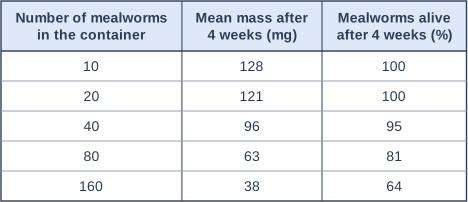
The table shows the results.

Describe and explain the effect of the number of mealworms on their mean mass and survival.

Table with columns "Number of mealworms in the container", "Mean mass after 4 weeks (mg)", "Mealworms alive after 4 weeks (%)". Number of mealworms in the container: 10; Mean mass after 4 weeks (mg): 128; Mealworms alive after 4 weeks (%): 100 | Number of mealworms in the container: 20; Mean mass after 4 weeks (mg): 121; Mealworms alive after 4 weeks (%): 100 | Number of mealworms in the container: 40; Mean mass after 4 weeks (mg): 96; Mealworms alive after 4 weeks (%): 95 | Number of mealworms in the container: 80; Mean mass after 4 weeks (mg): 63; Mealworms alive after 4 weeks (%): 81 | Number of mealworms in the container: 160; Mean mass after 4 weeks (mg): 38; Mealworms alive after 4 weeks (%): 64.

Model answer

As the number of mealworms in a container increases, their mean mass after 4 weeks decreases from 128 mg (10 mealworms) to 38 mg (160 mealworms), and the percentage alive falls from 100% to 64%. Every container had the same mass of bran, so the mealworms competed with each other for this limited food. With more mealworms, each one got less food, so they grew less, and in the most crowded containers some starved and died.

Explanation

Describe the trend with figures for both variables, then explain it. Because the mass of food is fixed, more individuals means more competition and less food for each, which slows growth and increases deaths. This is how competition limits the size of a population.

Mark scheme
  1. 1 mark

    as the number of mealworms increases, the mean mass decreases (from 128 mg to 38 mg) and fewer survive (from 100% to 64%)

    Max 2 if no data from the table are used. ALLOW mean mass and survival change little between 10 and 20 mealworms, then fall.

  2. 1 mark

    the mealworms compete with each other for the (limited) food / bran

    ALLOW competition for space. The idea of competition is needed for this mark.

  3. 1 mark

    with more mealworms, each one gets less food, so they grow less and some starve / die

    ALLOW so competition limits the size of the population.

Question 4

5 marks

The holly leaf miner is a small fly. Its larva lives inside a holly leaf, eating the cells between the upper and lower surfaces of the leaf. This makes a pale patch called a mine.

• Blue tits peck open the mines and eat the larvae, leaving a V-shaped tear.
• Tiny wasps lay their eggs inside the larvae. The wasp larvae feed on the leaf miner larva and kill it. An adult wasp leaves through a tiny round hole.

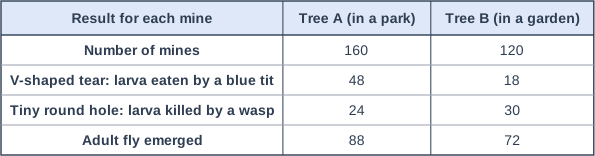
In June, a student collected 50 leaves from each of two holly trees and examined every mine. The table shows her results.

Calculate the percentage of the leaf miner larvae on tree A that were killed by blue tits or by wasps.

Explain how blue tits and wasps affect the population of holly leaf miners, and how this benefits the holly tree.

Table with columns "Result for each mine", "Tree A (in a park)", "Tree B (in a garden)". Result for each mine: Number of mines; Tree A (in a park): 160; Tree B (in a garden): 120 | Result for each mine: V-shaped tear: larva eaten by a blue tit; Tree A (in a park): 48; Tree B (in a garden): 18 | Result for each mine: Tiny round hole: larva killed by a wasp; Tree A (in a park): 24; Tree B (in a garden): 30 | Result for each mine: Adult fly emerged; Tree A (in a park): 88; Tree B (in a garden): 72.

Model answer

Killed by blue tits or wasps = 48 + 24 = 72 larvae
Percentage = 72 ÷ 160 × 100 = 45%
Blue tits are predators that eat the leaf miner larvae, and the wasps are parasites that develop inside the larvae and kill them. Both reduce the number of larvae that survive to become adult flies, so fewer flies breed and lay eggs and the leaf miner population is kept smaller. This benefits the holly because each larva eats the cells inside the leaf, which contain chloroplasts. With fewer mines, more of each leaf can photosynthesise, so the holly makes more glucose for growth.

Explanation

Add the larvae killed in both ways before working out the percentage of all 160 mines on tree A; 55% is the percentage that survived, not the percentage killed. The explanation needs both relationships (predation and parasitism), their effect on the leaf miner population, and why that matters to the tree: the larvae destroy leaf tissue that would otherwise photosynthesise.

Mark scheme
  1. 1 mark

    (48 + 24) ÷ 160 × 100 / 72 ÷ 160 × 100; or a correct final answer of 45% with no working

    An answer of 45% with no working scores marking points 1 and 2. ALLOW 1 mark for 30 (blue tits only), 15 (wasps only) or 55 (the percentage from which adult flies emerged).

  2. 1 mark

    45 (%)

  3. 1 mark

    blue tits are predators that eat the larvae, and the wasps are parasites that live inside the larvae and kill them

    ALLOW both kill leaf miner larvae (predation and parasitism).

  4. 1 mark

    so fewer larvae become adult flies that can breed / lay eggs, so the leaf miner population is kept smaller

    ALLOW they control the number of leaf miners.

  5. 1 mark

    the larvae eat the cells inside the leaf (which contain chloroplasts), so fewer mines means more of the leaf can photosynthesise, so the holly makes more glucose (for growth)

    The idea of photosynthesis is needed for this mark. ALLOW mines reduce the area of leaf that can photosynthesise.

Ready to try the rest? Every answer you write is marked against the mark scheme, so you can see exactly where the marks are.

Study Helper Hints first, answers after you try

Stuck on this one? Ask for a hint and I’ll point you in the right direction, without giving the answer away. Once you’ve checked your answer, I’ll show you how the marks are awarded.