
Level:
Correct: 0
Incorrect: 0
Marks: 0/0
Exam Practice
Course:
Topics:
Avg
score:
–
Topics
done:
0/22

Field investigations: distribution and abundance

Practise 18 exam-style questions on Field investigations: distribution and abundance for OCR GCSE Combined Science (Biology Paper 8). Write your answer as you would in the exam and get it marked in seconds against the mark scheme, point by point, with the Study Helper on hand if you get stuck.

  • 18 questions
  • 1–6 marks each
  • Instant marking
  • No sign-up needed
18 questions, marked as you go

Sample questions with model answers

Here are 4 of the questions in this topic, each with a model answer, an explanation of why it earns the marks and the mark scheme an examiner would use.

Question 1

1 mark

Lugworms live in burrows in the sand on beaches. Each lugworm leaves a coiled cast of sand on the surface, so the casts can be counted to estimate the number of lugworms.

A student counted the casts in 80 quadrats placed at random on a beach. The 90th percentile of her results was 14 casts per quadrat.

Which statement is correct?

Choose your answer.

  • A About 90% of the quadrats had 14 casts or fewer.
  • B About 90% of the quadrats had more than 14 casts.
  • C The highest number of casts in any quadrat was 14.
  • D The mean number of casts per quadrat was 14.

Model answer

A

Explanation

A percentile tells you what percentage of the results lie at or below a value. The 90th percentile is near the top of the range: only about 10% of the results are above it. Do not confuse it with the maximum or the mean.

Mark scheme
  1. 1 mark

    A / about 90% of the quadrats had 14 casts or fewer

    The only correct answer is A: the 90th percentile is the value below which about 90% of the results lie, so about 72 of the 80 quadrats had 14 casts or fewer and about 8 had more. B is not correct because it reverses the meaning: only about 10% had more than 14; C is not correct because the highest value would be the 100th percentile, and about 10% of quadrats had more than 14; D is not correct because the mean is a different average and cannot be found from one percentile. ALLOW the letter or the option. If more than one option is given, do not award the mark.
Question 2

2 marks

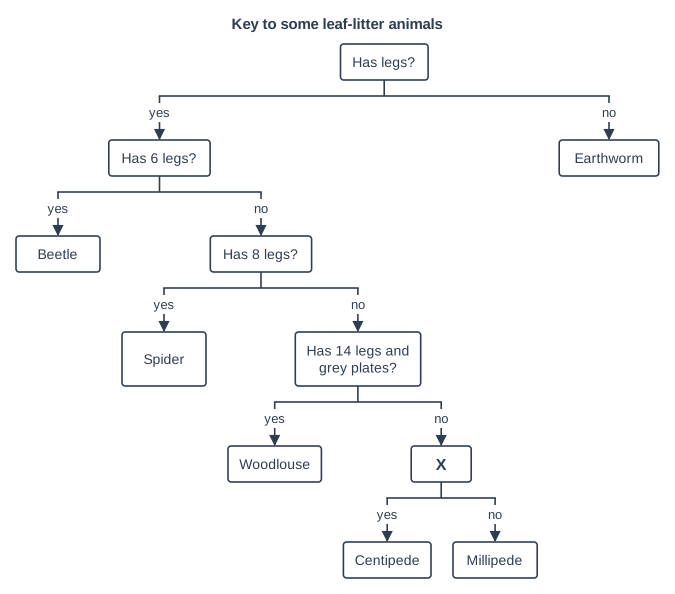
A student used a pooter to collect animals from leaf litter in a wood. The diagram shows the key she used to identify them.

• Centipedes have one pair of legs on each body segment.
• Millipedes have two pairs of legs on each body segment.

Write a question that could go in box X.

The student also collected an ant, which has 6 legs. Explain one problem this shows with the key.

Key to some leaf-litter animals. Flow chart of 11 boxes joined by arrows, read from top to bottom. The first box is "Has legs?". From "Has legs?", 2 arrows branch out side by side: the left arrow, labelled "yes", leads to "Has 6 legs?"; the right arrow, labelled "no", leads to "Earthworm". From "Has 6 legs?", 2 arrows branch out side by side: the left arrow, labelled "yes", leads to "Beetle"; the right arrow, labelled "no", leads to "Has 8 legs?". From "Has 8 legs?", 2 arrows branch out side by side: the left arrow, labelled "yes", leads to "Spider"; the right arrow, labelled "no", leads to "Has 14 legs and grey plates?". From "Has 14 legs and grey plates?", 2 arrows branch out side by side: the left arrow, labelled "yes", leads to "Woodlouse"; the right arrow, labelled "no", leads to box X. From box X, 2 arrows branch out side by side: the left arrow, labelled "yes", leads to "Centipede"; the right arrow, labelled "no", leads to "Millipede".

Model answer

X: Does it have one pair of legs on each body segment?
An ant has 6 legs, so the key would lead to 'Beetle' and the ant would be identified wrongly. The key only works for the animals it was written for; it would need another question, such as 'Does it have hard wing cases?', to separate ants from beetles.

Explanation

Each box in a key asks a question with two answers that splits the remaining animals into two groups. The question in box X must give 'yes' for the animal on the 'yes' arrow. A key can only identify the organisms it was made for: an animal not in the key will be put in the wrong group.

Mark scheme
  1. 1 mark

    a question that a centipede answers 'yes' and a millipede answers 'no', for example 'Does it have one pair of legs on each body segment?'

    ALLOW 'Does it have only one pair of legs on each segment?' / 'Does it have fewer than two pairs of legs on each segment?'. DO NOT ALLOW a question that a millipede answers 'yes' (for example 'Does it have two pairs of legs on each segment?'), because the 'yes' arrow leads to Centipede. DO NOT ALLOW 'Does it have lots of legs?' (true for both).

  2. 1 mark

    the ant would be (wrongly) identified as a beetle / the key only works for the animals it was written for, so it cannot identify the ant

    ALLOW the key needs another question to separate ants from beetles (for example 'Does it have hard wing cases?'). IGNORE 'the key is wrong' with no explanation.

Question 3

3 marks

Two students want to compare the number of grasshoppers in an area of long grass and an area of short grass in a park. They will catch the grasshoppers with sweep nets.

Describe how they should collect and count the grasshoppers so that the results from the two areas can be compared fairly.

Model answer

In each area they should take several samples at random places. For each sample they should use the same net and make the same number of sweeps, for example 10 sweeps, swept in the same way at the same height through the grass. They should empty the net into a white tray each time, count the grasshoppers and release them away from the sampling area so they are not counted again. They should sample both areas at the same time of day and in the same weather, because grasshoppers are more active when it is warm and sunny, and then compare the mean number per sample.

Explanation

Sweep netting only gives relative numbers, so the sampling effort must be the same in both areas: the same net, the same number and type of sweeps, and the same conditions. Several samples at random places, with a mean, make the results more representative. Vague answers such as 'make it fair' do not score.

Mark scheme
  1. 3 marks

    any three from: the same number of sweeps in each sample (for example 10 sweeps) / sweep for the same length of time; sweep in the same way each time (same net, same width, speed and height of sweep); take several samples at random places in each area and calculate a mean; sample both areas at the same time of day / in the same weather; empty the net into a tray, count the grasshoppers, then release them away from the sampling area so they are not caught and counted again

    1 mark for each of the five ideas, max 3. ALLOW use a key to make sure only grasshoppers are counted, as part of the counting idea. ALLOW grasshoppers are more active when it is warm and sunny, as part of the time-of-day / weather idea. IGNORE 'make it a fair test' on its own. IGNORE safety points.

Question 4

4 marks

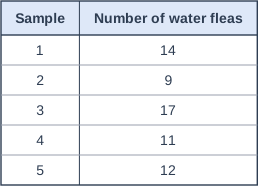
A student wanted to estimate the number of water fleas in a small garden pond. She used a jug to collect five samples of pond water from different places in the pond. Each sample had a volume of 250 cm³. She poured each sample through a fine net and counted the water fleas caught.

The table shows her results.

The pond contains 3.2 m³ of water.
1 m³ = 1 000 000 cm³

Estimate the number of water fleas in the pond.
Give your answer in standard form to 2 significant figures.

Table with columns "Sample", "Number of water fleas". Sample: 1; Number of water fleas: 14 | Sample: 2; Number of water fleas: 9 | Sample: 3; Number of water fleas: 17 | Sample: 4; Number of water fleas: 11 | Sample: 5; Number of water fleas: 12.

Model answer

Mean = (14 + 9 + 17 + 11 + 12) ÷ 5 = 63 ÷ 5 = 12.6 water fleas per 250 cm³
Volume of pond = 3.2 × 1 000 000 = 3 200 000 cm³
Number of 250 cm³ volumes = 3 200 000 ÷ 250 = 12 800
Estimate = 12.6 × 12 800 = 161 280
= 1.6 × 10⁵ water fleas

Explanation

Scaling up needs the mean of the samples and the number of sample-sized volumes in the whole habitat, so convert m³ to cm³ first (1 m³ = 1 000 000 cm³). Using the total instead of the mean, or 1000 cm³ per m³, are the common errors. The estimate assumes the water fleas are spread evenly through the pond, which is unlikely, so samples from many places are needed.

Mark scheme
  1. 1 mark

    mean = 63 ÷ 5 = 12.6 (water fleas per 250 cm³); or a correct final answer of 1.6 × 10⁵ with no working

    An answer of 1.6 × 10⁵ with no working scores 4 marks. ALLOW 2 marks for 8.1 × 10⁵ (the total of 63 used instead of the mean). ALLOW 2 marks for 1.6 × 10² (1 m³ taken as 1000 cm³).

  2. 1 mark

    volume of pond = 3 200 000 cm³ and 3 200 000 ÷ 250 = 12 800 (samples' worth of water); or a correct final answer of 1.6 × 10⁵ with no working

    ALLOW number per cm³ = 12.6 ÷ 250 = 0.0504 as an alternative route for this mark.

  3. 1 mark

    12.6 × 12 800 = 161 280; or a correct final answer of 1.6 × 10⁵ with no working

    ALLOW 0.0504 × 3 200 000 = 161 280. ALLOW 161 000 / 160 000.

  4. 1 mark

    1.6 × 10⁵

    This mark is for standard form to 2 significant figures. ALLOW ECF from a valid calculation with an arithmetic slip. ALLOW 1.6 × 10 to the power 5 / 1.6E5. DO NOT ALLOW 160 000 for this mark (not in standard form).

Ready to try the rest? Every answer you write is marked against the mark scheme, so you can see exactly where the marks are.

Study Helper Hints first, answers after you try

Stuck on this one? Ask for a hint and I’ll point you in the right direction, without giving the answer away. Once you’ve checked your answer, I’ll show you how the marks are awarded.