
Level:
Correct: 0
Incorrect: 0
Marks: 0/0
Exam Practice
Course:
Topics:
Avg
score:
–
Topics
done:
0/23

Practical skills (biology PAGs B1-B5)

Practise 16 exam-style questions on Practical skills (biology PAGs B1-B5) for OCR GCSE Combined Science (Biology Paper 7). Write your answer as you would in the exam and get it marked in seconds against the mark scheme, point by point, with the Study Helper on hand if you get stuck.

  • 16 questions
  • 1–6 marks each
  • Instant marking
  • No sign-up needed
16 questions, marked as you go

Sample questions with model answers

Here are 4 of the questions in this topic, each with a model answer, an explanation of why it earns the marks and the mark scheme an examiner would use.

Question 1

1 mark

A student used a digital thermometer to measure the temperature of a water bath five times. Without the student knowing, the thermometer always reads 2.0 °C higher than the true temperature.

Compared with readings from an accurate thermometer, what is the effect on the mean and on the spread of the five readings?

Choose your answer.

  • A The mean is the same and the spread is larger.
  • B The mean is the same and the spread is the same.
  • C The mean is too high and the spread is larger.
  • D The mean is too high and the spread is the same.

Model answer

D (The mean is too high and the spread is the same.)

Explanation

A systematic error makes every reading wrong by the same amount in the same direction, so it affects accuracy (the mean is wrong) but not precision (the spread). Repeating the readings and taking a mean cannot remove a systematic error; the thermometer must be checked against a reliable one. Random errors are different: they make readings scatter around the true value.

Mark scheme
  1. 1 mark

    D / The mean is too high and the spread is the same.

    The only correct answer is D: this is a systematic error, which shifts every reading by the same amount (2.0 °C), so the mean is 2.0 °C too high but the readings are just as close together as before. A and B are not correct because every reading, and so the mean, is too high; C is not correct because a constant error does not make the readings more spread out (random errors do that). ALLOW the letter or the option. If more than one option is given, do not award the mark.
Question 2

2 marks

Two groups of students in different schools used the same method to measure the diameter of chloroplasts in the leaf cells of the same species of moss. Each group made three measurements.

Group 1: 5.2 µm, 5.4 µm, 5.3 µm
Group 2: 6.4 µm, 6.3 µm, 6.5 µm

Explain whether the results are repeatable and whether they are reproducible.

Model answer

The results are repeatable, because each group's three measurements are very close together (they vary by only 0.2 µm). They are not reproducible, because the second group, using the same method, got clearly different values: a mean of 6.4 µm compared with 5.3 µm.

Explanation

Repeatable means the same person or group gets similar results when they repeat the measurement with the same method. Reproducible means a different person or group, or a different method, gets similar results. Here the repeats agree within each group, but the two groups disagree, which suggests a systematic difference such as how each group's eyepiece scale was calibrated.

Mark scheme
  1. 1 mark

    the results are repeatable, because each group's three measurements are close together

    ALLOW repeatable because the repeat readings within each group differ by only 0.2 µm. DO NOT ALLOW repeatable because both groups got the same results.

  2. 1 mark

    the results are not reproducible, because the two groups (using the same method) got different values (means of 5.3 µm and 6.4 µm)

    ALLOW not reproducible because Group 2's values are all about 1 µm higher than Group 1's. IGNORE suggestions of why the groups differ.

Question 3

3 marks

A student used a light microscope to look at a prepared, stained smear of human blood. She wanted to estimate the number of white blood cells for every 1000 red blood cells.

In 20 fields of view chosen at random across the smear, she counted 9600 red blood cells and 15 white blood cells.

Calculate the number of white blood cells for every 1000 red blood cells. Give your answer to 2 significant figures.

Explain why the fields of view should be chosen at random across the whole smear.

Model answer

White blood cells per 1000 red blood cells = 15 ÷ 9600 × 1000 = 1.5625 = 1.6 (2 significant figures)
The fields should be chosen at random so that the sample is representative and not biased. White blood cells are rare and not spread evenly over the smear, so if the student chose the fields herself she might pick fields with more (or fewer) white cells than usual.

Explanation

Divide the number of white cells by the number of red cells, then multiply by 1000 to get the number per 1000 red cells. Random sampling avoids the observer choosing unusual fields; counting many fields matters because white cells are rare, so any one field might contain none. Dividing the wrong way round (9600 ÷ 15) is a common slip.

Mark scheme
  1. 1 mark

    15 ÷ 9600 × 1000 = 1.5625; or a correct final answer of 1.6 with no working

    An answer of 1.6 with no working scores marking points 1 and 2. ALLOW 1.56 or 1.563 for marking point 1 only. An answer of 640 (9600 ÷ 15, the number of red blood cells for each white blood cell) scores 0 for marking points 1 and 2.

  2. 1 mark

    1.6

    ALLOW ECF for the significant-figure mark from a valid calculation.

  3. 1 mark

    so that the sample is representative / to avoid bias, because white blood cells are few and unevenly spread across the smear (so choosing fields could give too many or too few)

    ALLOW so the student does not choose fields that happen to contain white blood cells. ALLOW the cells may be spread differently in thick and thin parts of the smear. IGNORE to make it a fair test. IGNORE to make it more accurate, without a reason.

Question 4

4 marks

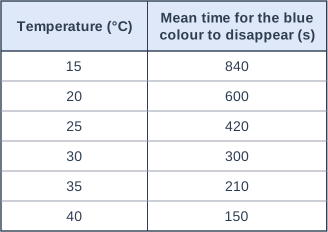
Methylene blue is a blue dye that turns colourless when it is mixed with respiring yeast. The faster the yeast respires, the sooner the blue colour disappears.

A student measured the time taken for the blue colour to disappear at different temperatures. The table shows the mean times.

The rate of respiration can be found using: rate = 1 ÷ time

Calculate the percentage increase in the rate of respiration between 20 °C and 40 °C.

Explain why the rate increases.

Table with columns "Temperature (°C)", "Mean time for the blue colour to disappear (s)". Temperature (°C): 15; Mean time for the blue colour to disappear (s): 840 | Temperature (°C): 20; Mean time for the blue colour to disappear (s): 600 | Temperature (°C): 25; Mean time for the blue colour to disappear (s): 420 | Temperature (°C): 30; Mean time for the blue colour to disappear (s): 300 | Temperature (°C): 35; Mean time for the blue colour to disappear (s): 210 | Temperature (°C): 40; Mean time for the blue colour to disappear (s): 150.

Model answer

Rate at 20 °C = 1 ÷ 600 = 0.00167 per second
Rate at 40 °C = 1 ÷ 150 = 0.00667 per second
Percentage increase = (0.00667 − 0.00167) ÷ 0.00167 × 100 = 300 %
Respiration is a series of reactions controlled by enzymes. At a higher temperature the enzyme and substrate molecules have more kinetic energy, so they collide more often and more enzyme-substrate complexes form each second, so the yeast respires faster and removes the colour sooner.

Explanation

When the measurement is a time, the rate is 1 ÷ time, so a shorter time means a faster rate. The time fell to a quarter, so the rate became four times as fast, which is an increase of 300 %. Giving 400 % (four times the rate) or 75 % (the fall in time) are the common errors.

Mark scheme
  1. 1 mark

    rate at 20 °C = 1 ÷ 600 = 0.00167 (per second) and rate at 40 °C = 1 ÷ 150 = 0.00667 (per second); or a correct final answer of 300 % (or any answer from 299 to 300 %) with no working

    An answer of 300 % (or any answer from 299 to 300 %) with no working scores marking points 1, 2 and 3. ALLOW 1.67 × 10⁻³ and 6.67 × 10⁻³. ALLOW 2 marks for 400 % (the new rate as a percentage of the old rate) or for 4 times. 75 % (the percentage decrease in time) scores 0.

  2. 1 mark

    (0.00667 − 0.00167) ÷ 0.00167 × 100; or a correct final answer of 300 % (or any answer from 299 to 300 %) with no working

    ALLOW 0.005 ÷ 0.00167 × 100. ALLOW using 600 ÷ 150 = 4, then (4 − 1) × 100.

  3. 1 mark

    300 (%)

    ALLOW 299 to 300 (from rounded rates).

  4. 1 mark

    at a higher temperature, the enzymes (for respiration) and substrate molecules have more kinetic energy, so there are more frequent (successful) collisions / more enzyme-substrate complexes form

    ALLOW the reactions of respiration are controlled by enzymes, which work faster as temperature rises towards the optimum. DO NOT ALLOW the enzymes are denatured.

Ready to try the rest? Every answer you write is marked against the mark scheme, so you can see exactly where the marks are.

Study Helper Hints first, answers after you try

Stuck on this one? Ask for a hint and I’ll point you in the right direction, without giving the answer away. Once you’ve checked your answer, I’ll show you how the marks are awarded.