
Level:
Correct: 0
Incorrect: 0
Marks: 0/0
Exam Practice
Course:
Topics:
Avg
score:
–
Topics
done:
0/23

Factors affecting the rate of photosynthesis

Practise 18 exam-style questions on Factors affecting the rate of photosynthesis for OCR GCSE Combined Science (Biology Paper 7). Write your answer as you would in the exam and get it marked in seconds against the mark scheme, point by point, with the Study Helper on hand if you get stuck.

  • 18 questions
  • 1–6 marks each
  • Instant marking
  • No sign-up needed
18 questions, marked as you go

Sample questions with model answers

Here are 4 of the questions in this topic, each with a model answer, an explanation of why it earns the marks and the mark scheme an examiner would use.

Question 1

1 mark

A student moves a lamp from 20 cm to 50 cm away from a tray of cress seedlings.

The inverse square law gives the relative light intensity at the seedlings:

relative light intensity = 1 ÷ (distance from light source)²

By what percentage does the light intensity at the seedlings decrease?

Choose your answer.

  • A 16%
  • B 40%
  • C 60%
  • D 84%

Model answer

1 ÷ 20² = 0.0025 and 1 ÷ 50² = 0.0004
0.0004 ÷ 0.0025 = 0.16, so the light intensity falls to 16% of its first value.
Decrease = 100 − 16 = 84%. Answer D

Explanation

With the inverse square law the light intensity changes by the square of the ratio of the distances: (20 ÷ 50)² = 0.16. Common mistakes are to forget to square the ratio (giving 40% or 60%) or to give the new light intensity (16%) instead of the decrease.

Mark scheme
  1. 1 mark

    D / 84%

    The only correct answer is D: the new light intensity is (20 ÷ 50)² = 0.16 of the first value, which is 16% of it, so the decrease is 100 − 16 = 84%. A is not correct because 16% is the new light intensity as a percentage of the first value, not the decrease; B is not correct because 40% (20 ÷ 50) leaves out the square; C is not correct because a 60% decrease would happen only if the light intensity were inversely proportional to the distance, not to its square. ALLOW the letter or the option. If more than one option is given, do not award the mark.
Question 2

2 marks

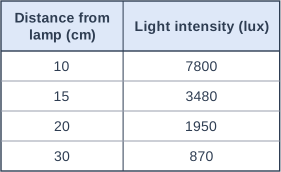
A student used a light meter to measure the light intensity at different distances from an LED lamp in a dark room.

The table shows the results.

The inverse square law states that light intensity is inversely proportional to the square of the distance from the light source.

Show that the student's results follow the inverse square law.

Table with columns "Distance from lamp (cm)", "Light intensity (lux)". Distance from lamp (cm): 10; Light intensity (lux): 7800 | Distance from lamp (cm): 15; Light intensity (lux): 3480 | Distance from lamp (cm): 20; Light intensity (lux): 1950 | Distance from lamp (cm): 30; Light intensity (lux): 870.

Model answer

Light intensity × distance²:
7800 × 10² = 780 000
3480 × 15² = 783 000
1950 × 20² = 780 000
870 × 30² = 783 000
These values are all about the same, so light intensity × distance² is constant. The light intensity is inversely proportional to the square of the distance, as the inverse square law states.

Explanation

If one quantity is inversely proportional to the square of another, multiplying the first by the square of the second always gives the same number. Calculating this product for every result is the clearest way to show it; another way is to show that doubling the distance gives a quarter of the light intensity. Saying only that the light intensity falls as the distance increases is not enough, because that is true of many relationships.

Mark scheme
  1. 1 mark

    calculates light intensity × (distance)² for at least two distances, e.g. 7800 × 10² = 780 000 and 1950 × 20² = 780 000 / shows that doubling the distance reduces the light intensity to a quarter, e.g. 7800 ÷ 1950 = 4 when the distance doubles from 10 cm to 20 cm

    ALLOW 3480 × 15² = 783 000 or 870 × 30² = 783 000. ALLOW 3480 ÷ 870 = 4 (15 cm to 30 cm), or 7800 ÷ 870 = 9 (8.97) when the distance trebles from 10 cm to 30 cm. ALLOW distances in m (e.g. 7800 × 0.10² = 78). Restating the law, or 'the further away the lamp, the lower the light intensity', on its own scores 0.

  2. 1 mark

    uses all four results to show that light intensity × (distance)² is (about) constant (780 000 to 783 000), so light intensity is inversely proportional to the square of the distance

    ALLOW two comparisons that between them use all four results (e.g. 10 cm to 20 cm and 15 cm to 30 cm each give one quarter) with the conclusion that the law is followed. ALLOW 'approximately the same' / 'equal within experimental error' for constant.

Question 3

3 marks

A student counted the bubbles of oxygen released by some pondweed. In 40 seconds the pondweed released 14 bubbles. The mean volume of one bubble was 0.020 cm³.

Calculate the rate of oxygen production in cm³ per minute.

Model answer

Volume of oxygen in 40 s = 14 × 0.020 = 0.28 cm³
Rate = 0.28 ÷ 40 = 0.007 cm³ per second
0.007 × 60 = 0.42 cm³ per minute

Explanation

A rate is an amount divided by a time. First find the volume of oxygen (number of bubbles × volume of one bubble), then either divide by the time in minutes (40 s = 0.667 min) or work out the rate per second and multiply by 60. Common mistakes are to leave the answer in bubbles per minute (21) or in cm³ per second (0.007).

Mark scheme
  1. 1 mark

    volume of oxygen = 14 × 0.020 = 0.28 (cm³); or a correct final answer of 0.42 cm³ per minute with no working

    An answer of 0.42 cm³ per minute with no working scores 3 marks. ALLOW 2 marks for 0.007 (cm³ per second: not converted to minutes). ALLOW 1 mark for 21 (bubbles per minute: bubble volume not used) or for 0.19 (0.28 × 40 ÷ 60: time conversion upside down).

  2. 1 mark

    (rate =) 0.28 ÷ 40 × 60 / 0.28 ÷ (40 ÷ 60) / 0.28 × 1.5 / 0.007 × 60; or a correct final answer of 0.42 cm³ per minute with no working

    ALLOW ECF from an incorrect volume in marking point 1. ALLOW 14 ÷ 40 × 60 = 21 bubbles per minute followed by 21 × 0.020.

  3. 1 mark

    evaluation: 0.42 (cm³ per minute)

    IGNORE units.

Question 4

4 marks

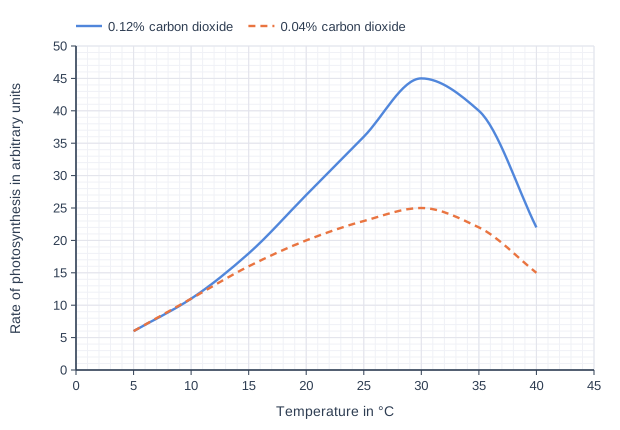
A scientist measured the rate of photosynthesis of pea leaves at different temperatures, at two carbon dioxide concentrations: 0.04% and 0.12%. The light intensity was high and the same for all the measurements.

The graph shows the results.

Calculate the percentage increase in the rate of photosynthesis at 30 °C when the carbon dioxide concentration is increased from 0.04% to 0.12%.

Explain why increasing the carbon dioxide concentration has no effect on the rate at 10 °C.

Line graph of rate of photosynthesis in arbitrary units (y-axis, 0 to 50) against temperature in °C (x-axis, 0 to 45). "0.12% carbon dioxide" is a smooth curve through (5, 6), (10, 11), (15, 18), (20, 27), (25, 36), (30, 45), (35, 40), (40, 22). "0.04% carbon dioxide" (dashed) is a smooth curve through (5, 6), (10, 11), (15, 16), (20, 20), (25, 23), (30, 25), (35, 22), (40, 15).

Model answer

From the graph at 30 °C: 0.12% carbon dioxide gives 45 and 0.04% gives 25 arbitrary units.
Percentage increase = (45 − 25) ÷ 25 × 100 = 80%
At 10 °C the rate is the same (11 arbitrary units) at both carbon dioxide concentrations because temperature is the limiting factor. The enzyme and substrate molecules have little kinetic energy, so they collide less often and few enzyme-substrate complexes form; the reactions cannot go faster, so extra carbon dioxide has no effect.

Explanation

Percentage increase = increase ÷ original value × 100, so divide by the rate at 0.04%, not the rate at 0.12%. The two curves are the same at low temperatures because temperature limits the rate there; they separate at higher temperatures, where carbon dioxide becomes the limiting factor for the 0.04% curve.

Mark scheme
  1. 1 mark

    (45 − 25) ÷ 25 × 100 / 20 ÷ 25 × 100; or a correct final answer of 80% with no working

    An answer of 80% with no working scores marking points 1 and 2. ALLOW ECF from graph readings within 1 arbitrary unit of 45 and 25 (e.g. (44 − 25) ÷ 25 × 100 = 76%). ALLOW 1 mark for a difference of 20 (arbitrary units) shown, e.g. 20 ÷ 45 × 100 = 44% (divided by the wrong rate).

  2. 1 mark

    evaluation: 80 (%)

    IGNORE units.

  3. 1 mark

    at this low temperature, temperature is the limiting factor

    ALLOW carbon dioxide is not the limiting factor at the low temperature.

  4. 1 mark

    the enzyme and substrate molecules have little (kinetic) energy, so there are few collisions / few enzyme-substrate complexes form, so the reactions cannot go faster even with more carbon dioxide

    ALLOW the enzymes (that control photosynthesis) work slowly at a low temperature. DO NOT ALLOW the enzymes are denatured.

Ready to try the rest? Every answer you write is marked against the mark scheme, so you can see exactly where the marks are.

Study Helper Hints first, answers after you try

Stuck on this one? Ask for a hint and I’ll point you in the right direction, without giving the answer away. Once you’ve checked your answer, I’ll show you how the marks are awarded.