Level:
Correct: 0
Incorrect: 0
Marks: 0/0
Exam Practice
Course:
Topics:
Avg
score:
–
Topics
done:
0/23

Factors affecting water uptake and the potometer

Practise 17 exam-style questions on Factors affecting water uptake and the potometer for OCR GCSE Combined Science (Biology Paper 7). Write your answer as you would in the exam and get it marked in seconds against the mark scheme, point by point, with the Study Helper on hand if you get stuck.

  • 17 questions
  • 1–6 marks each
  • Instant marking
  • No sign-up needed
17 questions, marked as you go

Sample questions with model answers

Here are 4 of the questions in this topic, each with a model answer, an explanation of why it earns the marks and the mark scheme an examiner would use.

Question 1

1 mark

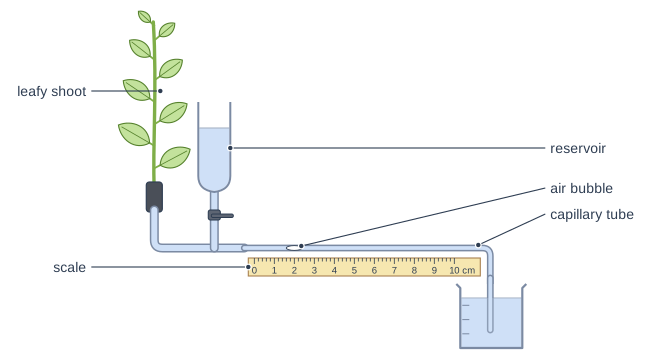
The diagram shows a bubble potometer.

A student found that the air bubble moved only a very short distance along the scale in 5 minutes, so the distance was hard to measure accurately.

Which change to the apparatus would make the bubble move a greater distance along the scale for the same volume of water taken up by the shoot?

Choose your answer.

  • A a capillary tube with a larger internal diameter
  • B a capillary tube with a smaller internal diameter
  • C a larger reservoir
  • D a scale with smaller divisions
Diagram of a leafy shoot connected to a water-filled glass tube with a scale. A leafy shoot at the top left is pushed into a short piece of rubber tubing on the end of a glass tube full of water. The tube runs down and then right; on the way it is joined from above by a reservoir of water with a tap underneath. It continues as a long capillary tube along a scale numbered 0 to 10 (cm), and its end bends down into a beaker of water. There is an air bubble in the liquid in the narrow tube, above the scale. The label "leafy shoot" points to the leafy stem at the top left; the label "reservoir" points to the wide glass container above the tap; the label "capillary tube" points to the long narrow tube along the numbered strip; the label "air bubble" points to the small gap in the liquid in the narrow tube; the label "scale" points to the numbered strip under the narrow tube.

Model answer

B (a capillary tube with a smaller internal diameter)

Explanation

The bubble moves because water is drawn out of the capillary tube into the shoot. A given volume of water occupies a longer length of a narrow tube than of a wide one, so the narrower the tube, the further the bubble moves. A finer scale (option D) is a tempting answer, but it only lets the same short distance be read more precisely.

Mark scheme
  1. 1 mark

    B / a capillary tube with a smaller internal diameter

    The only correct answer is B: the volume of water taken up = cross-sectional area of the tube × distance moved by the bubble, so in a narrower tube the same volume of water fills a longer length of tube and the bubble moves further. A is not correct because a wider tube makes the bubble move a shorter distance. C is not correct because the reservoir is only used to push the bubble back to the start of the scale; it does not change how far the bubble moves. D is not correct because smaller scale divisions improve the resolution of the reading but do not make the bubble move further. ALLOW the letter or the option. If more than one option is given, do not award the mark.
Question 2

2 marks

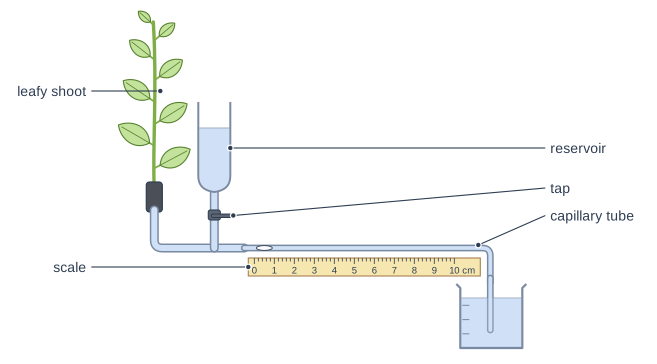
The diagram shows the bubble potometer a student used.

The student reset the air bubble to the start of the scale, then measured how far it moved in 10 minutes. The student forgot to close the tap under the reservoir before taking the reading.

Suggest and explain how this mistake would affect the rate of water uptake that the student calculated.

Diagram of a leafy shoot connected to a water-filled glass tube with a scale. A leafy shoot at the top left is pushed into a short piece of rubber tubing on the end of a glass tube full of water. The tube runs down and then right; on the way it is joined from above by a reservoir of water with a tap underneath. It continues as a long capillary tube along a scale numbered 0 to 10 (cm), and its end bends down into a beaker of water. There is an air bubble in the liquid in the narrow tube, above the scale. The label "leafy shoot" points to the leafy stem at the top left; the label "reservoir" points to the wide glass container above the tap; the label "tap" points to the small handle on the tube under the wide container; the label "capillary tube" points to the long narrow tube along the numbered strip; the label "scale" points to the numbered strip under the narrow tube.

Model answer

With the tap open, water could flow out of the reservoir into the tube, so some or all of the water taken up by the shoot would come from the reservoir instead of being drawn along the capillary tube. The bubble would move a shorter distance (or not at all), so the calculated rate of water uptake would be lower than the true rate.

Explanation

The bubble only measures water drawn along the capillary tube. The reservoir is used to push the bubble back to the start, and its tap must be closed during a reading; otherwise the shoot can draw water from the reservoir and the reading is too low. 'The results would be inaccurate' is not enough: say which way the error goes and why.

Mark scheme
  1. 1 mark

    (some of) the water taken up by the shoot would come from the reservoir instead of from the capillary tube

    ALLOW water would flow from the reservoir into the tube / to the shoot. IGNORE water would leak out of the reservoir.

  2. 1 mark

    so the bubble would move less / not at all, so the calculated rate would be lower than the true rate

    ALLOW the bubble could be pushed backwards / the reading would be too low / an underestimate. IGNORE the results would be inaccurate with no direction given.

Question 3

3 marks

Most plants open their stomata during the day and close them at night. Pineapple plants grow in hot, dry places. They open their stomata at night and close them during the day.

Scientists measured the volume of water taken up in 24 hours by a pineapple plant and by a bean plant of a similar size, in the same hot, dry conditions. The pineapple plant took up much less water.

Explain why the pineapple plant takes up less water than the bean plant.

Model answer

Most water is lost from leaves by transpiration, when water vapour diffuses out through open stomata. The bean plant has its stomata open during the hot day, when water evaporates from the cells inside the leaves and diffuses out fastest. The pineapple plant opens its stomata only at night, when the air is cooler and more humid, so water evaporates and diffuses out much more slowly. The pineapple therefore loses much less water by transpiration, so less water is drawn up the xylem and taken up by the roots to replace it.

Explanation

The rate of water uptake depends on the rate of transpiration, which depends on whether the stomata are open and on the conditions at that time. Opening the stomata only in the cool night is an adaptation that saves water in hot, dry places. Strong answers link temperature to evaporation and diffusion and then to water uptake.

Mark scheme
  1. 1 mark

    water vapour diffuses out of the leaves (transpiration) mainly through open stomata, so most water is lost while the stomata are open

    max 3. ALLOW closed stomata stop (most) water vapour diffusing out.

  2. 1 mark

    at night the air is cooler (and more humid), so water evaporates from the cells inside the leaves and diffuses out more slowly

    ALLOW the water molecules have less kinetic energy at night.

  3. 1 mark

    during the hot day, when water would be lost fastest, the pineapple's stomata are closed, but the bean's stomata are open

    ALLOW the bean loses most of its water in the heat of the day.

  4. 1 mark

    so the pineapple loses less water by transpiration, so less water is drawn up the xylem / needs to be taken up to replace it

    IGNORE the pineapple needs less water (unqualified).

Question 4

4 marks

A student set up a potometer with a leafy shoot under an LED lamp. LED lamps give out very little heat. Every 2 minutes, the student recorded the total distance the air bubble had moved since the start.

After 10 minutes, the student switched the lamp off. Nothing else was changed.

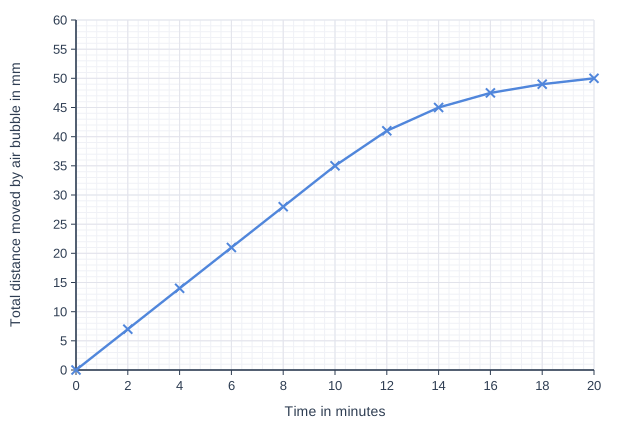
The graph shows the results.

Calculate the rate of water uptake during the first 10 minutes, in mm per minute.

Explain the change in the rate of water uptake after the lamp was switched off.

Line graph of total distance moved by air bubble in mm (y-axis, 0 to 60) against time in minutes (x-axis, 0 to 20). The line joins the points (0, 0), (2, 7), (4, 14), (6, 21), (8, 28), (10, 35), (12, 41), (14, 45), (16, 47.5), (18, 49), (20, 50).

Model answer

Rate = 35 mm ÷ 10 minutes = 3.5 mm per minute.
After the lamp was switched off, the rate of water uptake fell gradually until the bubble was hardly moving. In the dark the stomata close, so less water vapour diffuses out of the leaves and transpiration slows down. Less water is then drawn up the xylem to replace it. The stomata take several minutes to close, so the rate fell gradually instead of stopping straight away.

Explanation

The rate is the gradient of the straight part of the graph: 35 mm in 10 minutes. Using the whole graph (50 mm in 20 minutes) mixes the two conditions. After the lamp goes off the line gets less steep because the stomata close in the dark; the gradual bend shows that the stomata do not close instantly. The LED gives out little heat, so a fall in temperature is not the reason.

Mark scheme
  1. 1 mark

    35 ÷ 10 / any correct distance ÷ time from the straight part of the line between 0 and 10 minutes; or a correct final answer of 3.5 mm per minute with no working

    An answer of 3.5 mm per minute with no working scores marking points 1 and 2. ALLOW 7 ÷ 2 / 14 ÷ 4 / 21 ÷ 6 / 28 ÷ 8. DO NOT ALLOW 50 ÷ 20 = 2.5 (this includes the time after the lamp was switched off).

  2. 1 mark

    3.5 (mm per minute)

    IGNORE units.

  3. 2 marks

    in the dark the stomata close; so less water vapour diffuses out of the leaves / transpiration is slower; so less water is drawn up the xylem / taken up to replace it; the stomata close gradually / take several minutes to close, so the rate falls gradually rather than straight away

    1 mark for each of these ideas, max 2. ALLOW the rate decreases and then almost stops as the stomata close. IGNORE photosynthesis stops. IGNORE references to temperature (the lamp gives out very little heat). DO NOT ALLOW the stomata open in the dark.

Ready to try the rest? Every answer you write is marked against the mark scheme, so you can see exactly where the marks are.

Study Helper Hints first, answers after you try

Stuck on this one? Ask for a hint and I’ll point you in the right direction, without giving the answer away. Once you’ve checked your answer, I’ll show you how the marks are awarded.