
Level:
Correct: 0
Incorrect: 0
Marks: 0/0
Exam Practice
Course:
Topics:
Avg
score:
–
Topics
done:
0/23

Mitosis and the cell cycle

Practise 14 exam-style questions on Mitosis and the cell cycle for OCR GCSE Combined Science (Biology Paper 7). Write your answer as you would in the exam and get it marked in seconds against the mark scheme, point by point, with the Study Helper on hand if you get stuck.

  • 14 questions
  • 1–6 marks each
  • Instant marking
  • No sign-up needed
14 questions, marked as you go

Sample questions with model answers

Here are 4 of the questions in this topic, each with a model answer, an explanation of why it earns the marks and the mark scheme an examiner would use.

Question 1

1 mark

Which of these increases in a cell during the cell growth stage of the cell cycle, before DNA replication starts?

Choose your answer.

  • A the mass of DNA in the nucleus
  • B the number of chromosomes in the nucleus
  • C the number of nuclei in the cell
  • D the number of ribosomes and mitochondria

Model answer

D

Explanation

During cell growth the cell gets bigger and copies its sub-cellular structures, so that there will be enough of them for two new cells. The DNA is not copied until the next stage, DNA replication, so the mass of DNA and the number of chromosomes do not change while the cell grows.

Mark scheme
  1. 1 mark

    D / the number of ribosomes and mitochondria

    The only correct answer is D: as the cell grows it makes more sub-cellular structures, such as ribosomes and mitochondria, and more proteins. A is not correct because the mass of DNA stays the same until DNA replication; B is not correct because the number of chromosomes does not change during cell growth; C is not correct because the cell keeps one nucleus until it divides. ALLOW the letter or the option. If more than one option is given, do not award the mark.
Question 2

2 marks

Hair grows from cells at the base of each hair follicle in the skin. These cells divide by mitosis many times.

In each cell cycle, a hair follicle cell goes through two stages of growth before it divides.

Explain why it is important that the cell grows before it divides.

Model answer

When a cell divides, its cytoplasm is shared between two new cells, so each is about half the size of the parent. If the cell did not grow first, the cells would get smaller with every division. During growth the cell also makes more sub-cellular structures, such as mitochondria and ribosomes, so that each new cell gets enough of them to work properly.

Explanation

The two growth stages of the cell cycle make the cell bigger and copy its sub-cellular structures, so each new cell starts at the same size as its parent did and has all the structures it needs. Copying the chromosomes is DNA replication, a separate stage, so it does not answer a question about growth.

Mark scheme
  1. 1 mark

    dividing (into two) halves the size of the cell / without growth the new cells would get smaller every time the cells divide / growth means each new cell is the same size as the parent cell was

    max 2. ALLOW so the new cells are full-sized / big enough. IGNORE so the cell can divide (unqualified). IGNORE references to DNA replication or copying chromosomes, which is not growth.

  2. 1 mark

    the cell makes more sub-cellular structures (such as mitochondria or ribosomes) so that each new cell receives enough of them

    ALLOW organelles for sub-cellular structures. ALLOW so each new cell has a full set of sub-cellular structures. IGNORE so the cell has more energy unless linked to more mitochondria.

  3. 1 mark

    the cell makes the proteins / enzymes (and other materials) that the two new cells need

    ALLOW makes more cytoplasm / cell membrane for two cells. IGNORE just to make new cells.

Question 3

2 marks

Chicken cells are growing in a culture in a laboratory. Each cell divides about once every 16 hours.

A scientist looks at 300 cells and sees chromosomes moving to opposite ends of the cell in only 9 of them.

A student says: 'This shows that most of the cells in the culture are not going through the cell cycle.'

Explain why the student is wrong.

Model answer

Every cell divides about once every 16 hours, so all the cells are in the cell cycle. Most of them are in cell growth, DNA replication or more cell growth, when the chromosomes are not moving. The movement of chromosomes is only a short part of the cycle (about 3% of it), so only a few cells (9 out of 300) are in that stage at any moment.

Explanation

At any moment, the share of cells seen in a stage reflects how long that stage lasts compared with the whole cycle. Moving the chromosomes is quick, so few cells are caught doing it, even though every cell passes through it. The growth and DNA replication stages take most of the time.

Mark scheme
  1. 1 mark

    the other cells are in other stages of the cell cycle (cell growth / DNA replication / more cell growth), when the chromosomes are not moving

    max 2. ALLOW the other cells are growing or copying their DNA, which is also part of the cell cycle.

  2. 1 mark

    the movement of chromosomes is a short stage / only a small part of the cell cycle, so only a few cells are in this stage at any one time

    ALLOW only 3% of the cells (9 out of 300) are in this stage because it takes only about 3% of the cycle (about 0.5 hours of the 16-hour cycle).

  3. 1 mark

    every cell divides every 16 hours, so all the cells are in the cell cycle

    Must use the information that every cell divides. IGNORE the sample is too small / she should count more cells.

Question 4

4 marks

A scientist grows Chinese hamster cells in a culture. The cells are growing and dividing.

She measures the mass of DNA in the nucleus of each of 1000 cells and sorts the cells into three groups.

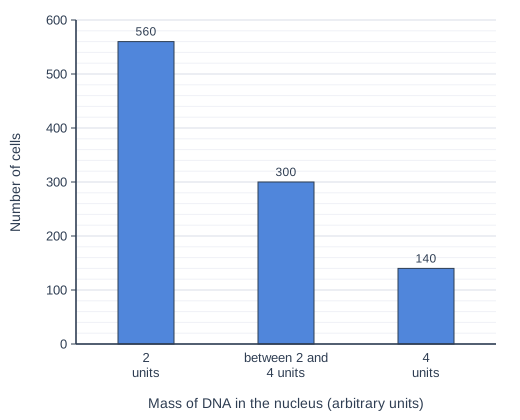
The bar chart shows her results.

Explain why the cells fall into these three groups.

Use the cell cycle and data from the bar chart in your answer.

Bar chart of number of cells for each Mass of DNA in the nucleus (arbitrary units): 2 units 560, between 2 and 4 units 300, 4 units 140.

Model answer

The 560 cells with 2 units of DNA are in the first cell growth stage: they have not yet copied their DNA. The 300 cells with between 2 and 4 units are part way through DNA replication. The 140 cells with 4 units have finished replicating their DNA and are in more cell growth or are moving their chromosomes, but have not divided yet; when they divide, each new cell gets 2 units again. The largest group is the cells with 2 units, so cells spend the longest part of the cycle (about 56%) growing before DNA replication, and the shortest part in more cell growth and the movement of chromosomes.

Explanation

Link each DNA mass to a stage: before replication (2 units), during replication (between 2 and 4) and after replication but before division (4). Because the cells are at random points in the cycle, the size of each group shows how long that part of the cycle lasts. A common error is to say the 2-unit cells are replicating their DNA: their DNA mass has not increased, so they are still growing.

Mark scheme
  1. 1 mark

    (2 units) these cells are in (the first) cell growth stage / have not yet replicated their DNA / have just been produced by division

    max 4. Max 3 if no data from the bar chart are used.

  2. 1 mark

    (between 2 and 4 units) these cells are (in the middle of) replicating / copying their DNA

    ALLOW in DNA replication.

  3. 1 mark

    (4 units) these cells have finished DNA replication and are in more cell growth / moving their chromosomes (but have not yet divided)

    ALLOW the DNA has doubled / been copied and the cell has not divided yet.

  4. 1 mark

    when the cell divides, the DNA is shared between two new cells, so it goes from 4 units back to 2 units

    ALLOW each new cell gets half the DNA.

  5. 1 mark

    use of data: the largest group (560 cells / 56%) has 2 units, so cells spend the longest time in (the first) cell growth stage / the smallest group (140 cells / 14%) has 4 units, so more cell growth and the movement of chromosomes take the shortest time

    ALLOW 300 cells (30%) are replicating their DNA, so this stage takes about 30% of the cycle. The data must be linked to the time spent in a stage.

Ready to try the rest? Every answer you write is marked against the mark scheme, so you can see exactly where the marks are.

Study Helper Hints first, answers after you try

Stuck on this one? Ask for a hint and I’ll point you in the right direction, without giving the answer away. Once you’ve checked your answer, I’ll show you how the marks are awarded.