
Level:
Correct: 0
Incorrect: 0
Marks: 0/0
Exam Practice
Course:
Topics:
Avg
score:
–
Topics
done:
0/23

Enzymes

Practise 19 exam-style questions on Enzymes for OCR GCSE Combined Science (Biology Paper 7). Write your answer as you would in the exam and get it marked in seconds against the mark scheme, point by point, with the Study Helper on hand if you get stuck.

  • 19 questions
  • 1–6 marks each
  • Instant marking
  • No sign-up needed
19 questions, marked as you go

Sample questions with model answers

Here are 4 of the questions in this topic, each with a model answer, an explanation of why it earns the marks and the mark scheme an examiner would use.

Question 1

1 mark

A student investigated the digestion of fat by the enzyme lipase.

The lipase digested 0.36 g of fat in 3.0 minutes.

What was the mean rate of fat digestion in mg/s?

(1 g = 1000 mg)

Choose your answer.

  • A 0.002 mg/s
  • B 0.12 mg/s
  • C 2.0 mg/s
  • D 120 mg/s

Model answer

C

Explanation

Mean rate = amount of substrate used ÷ time. Convert both quantities to the units asked for first: 0.36 g = 360 mg and 3.0 minutes = 180 s, so 360 ÷ 180 = 2.0 mg/s. Each wrong option comes from leaving out one or both conversions.

Mark scheme
  1. 1 mark

    C / 2.0 mg/s

    The only correct answer is C: 0.36 g = 360 mg and 3.0 minutes = 180 s, so the rate = 360 ÷ 180 = 2.0 mg/s. A is not correct because 0.36 ÷ 180 = 0.002 is the rate in g/s (the mass was not converted to mg). B is not correct because 0.36 ÷ 3.0 = 0.12 is the rate in g per minute. D is not correct because 360 ÷ 3.0 = 120 is the rate in mg per minute (the time was not converted to seconds). ALLOW the letter or the option. If more than one option is given, do not award the mark.

Question 2

2 marks

Lysosomes are small sub-cellular structures found in animal cells. They contain enzymes that break down worn-out parts of the cell. The pH inside a lysosome is about 5. The pH of the cytoplasm is about 7.2.

The enzymes in lysosomes work fastest at about pH 5. If a lysosome bursts and its enzymes leak into the cytoplasm, they do very little damage to the cell.

Suggest why.

Model answer

The cytoplasm has a pH of about 7.2, which is far from the optimum pH of these enzymes (about pH 5). At this pH the shape of their active sites changes, so the molecules of the cell no longer fit the active sites and few enzyme-substrate complexes form. The enzymes therefore break down very little of the cell.

Explanation

Each enzyme has an optimum pH; a pH far from the optimum changes the shape of the active site, so the substrate fits less well and the rate falls. Here this protects the cell: the enzymes only work well inside the acidic lysosome. Answers should link the change in pH to the active site and to fewer enzyme-substrate complexes.

Mark scheme
  1. 1 mark

    the pH of the cytoplasm (7.2) is far from the optimum pH of the enzymes (pH 5), so the shape of their active sites changes / the enzymes are (partly) denatured

    ALLOW the enzymes work much more slowly at pH 7.2. IGNORE the enzymes are killed.

  2. 1 mark

    so the substrates / the molecules of the cell do not fit the active sites / fewer enzyme-substrate complexes form, so little of the cell is broken down

    ALLOW the active sites are no longer complementary to their substrates.

Question 3

3 marks

Exposed photographic film is black because it has a layer of silver grains held in gelatin. Gelatin is a protein. When a strip of the film is placed in a solution of the protease trypsin, the trypsin digests the gelatin and the strip turns clear.

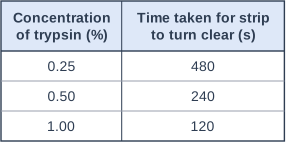
A student measured the time taken for strips of the film to turn clear in trypsin solutions of different concentrations. The temperature and pH were kept the same.

The table shows the student's results.

Use the pattern in the results to predict the time taken for a strip to turn clear in a 0.80% trypsin solution.

Explain your prediction.

Table with columns "Concentration of trypsin (%)", "Time taken for strip to turn clear (s)". Concentration of trypsin (%): 0.25; Time taken for strip to turn clear (s): 480 | Concentration of trypsin (%): 0.50; Time taken for strip to turn clear (s): 240 | Concentration of trypsin (%): 1.00; Time taken for strip to turn clear (s): 120.

Model answer

Each time the concentration doubles, the time halves (0.25% → 480 s, 0.50% → 240 s, 1.00% → 120 s), so concentration × time = 120.
Time at 0.80% = 120 ÷ 0.80 = 150 s.
A more concentrated trypsin solution has more enzyme molecules, so more active sites. More enzyme-substrate complexes form each second, so the gelatin is digested faster and the strip clears in a shorter time.

Explanation

Look at how the time changes when the concentration doubles: it halves each time, so the time is inversely proportional to the concentration (and the rate is directly proportional to it). Joining the points with a straight line gives about 168 s, which is wrong because the pattern is not linear. The explanation is about the number of active sites, not about kinetic energy, which only changes with temperature.

Mark scheme
  1. 1 mark

    the time is inversely proportional to the concentration / doubling the concentration halves the time / concentration × time is constant (= 120), so time = 120 ÷ 0.80; or a correct final answer of 150 s with no working

    An answer of 150 s with no working scores marking points 1 and 2. ALLOW 480 × 0.25 ÷ 0.80 / 240 × 0.50 ÷ 0.80 / 120 × 1.00 ÷ 0.80 / rate is proportional to concentration. A value read from a straight line between 240 s and 120 s (168 s) scores 0 for marking points 1 and 2; 96 s (120 × 0.80) scores 0 for marking points 1 and 2.

  2. 1 mark

    150 (s)

    IGNORE units.

  3. 1 mark

    (a higher concentration has) more trypsin molecules / active sites, so more enzyme-substrate complexes form per second / more gelatin is digested per second

    ALLOW more (frequent) collisions between gelatin and active sites. DO NOT ALLOW more collisions because the molecules have more (kinetic) energy (that is the effect of temperature). IGNORE 'more enzyme' on its own.

Question 4

4 marks

Plant seeds in pig feed contain phosphorus that is locked up in a substance called phytate. Pigs cannot break down phytate, so farmers add the enzyme phytase to pig feed. Phytase breaks down phytate in the pig's stomach, where the pH is about 3.

The feed is made into pellets by heating it to 80 °C for a short time.

A company tested two phytase enzymes, A and B. The table shows the results.

Evaluate which phytase the company should mix into the feed before it is made into pellets. Use data from the table in your answer.

Table with columns "Phytase", "Optimum pH", "Activity at pH 3 (% of the activity at the optimum pH)", "Activity left after heating to 80 °C for 2 minutes (%)". Phytase: A; Optimum pH: 3.0; Activity at pH 3 (% of the activity at the optimum pH): 100; Activity left after heating to 80 °C for 2 minutes (%): 15 | Phytase: B; Optimum pH: 4.5; Activity at pH 3 (% of the activity at the optimum pH): 70; Activity left after heating to 80 °C for 2 minutes (%): 85.

Model answer

Phytase A works best at pH 3, which is the pH of the stomach (100% activity), while B has only 70% of its activity at pH 3, because pH 3 is below its optimum of pH 4.5. But heating to 80 °C denatures most of phytase A: the shape of its active site changes, so phytate no longer fits. Only 15% of its activity is left, compared with 85% for B.
After pelleting, A would have about 100% × 15% = 15% of its maximum activity in the stomach, but B would have about 70% × 85% ≈ 60%. So the company should use phytase B.

Explanation

An evaluation weighs both factors. A suits the pH of the stomach, but B survives the heating used to make pellets. Combining the two columns (by multiplying the percentages) shows that B gives about four times as much activity in the pig's stomach. Answers that only quote one column, or that choose A because it has the right optimum pH, miss the effect of heating.

Mark scheme
  1. 1 mark

    A works better at pH 3 / A has its optimum at pH 3 (100% activity) but B has only 70% of its activity at pH 3

    Max 3 if no choice of phytase is made. IGNORE numbers copied from the table without a comparison.

  2. 1 mark

    B works better after heating / B keeps 85% of its activity after heating but A keeps only 15%

  3. 1 mark

    heating (to 80 °C) denatures (most of) phytase A / changes the shape of its active site, so phytate no longer fits / fewer enzyme-substrate complexes form

    ALLOW B is (more) heat-stable / B is not denatured as much. DO NOT ALLOW A is killed.

  4. 1 mark

    choose B, because its overall activity in the stomach after pelleting is higher / B gives about 60% (70% × 85%) of the maximum activity but A gives only 15% (100% × 15%)

    ALLOW 59.5% for B. ALLOW any reasoned comparison that combines both columns, e.g. B keeps more of its activity in the stomach after the pellets are made. DO NOT ALLOW a choice of A for this mark (it loses most of its activity when the pellets are made).

Ready to try the rest? Every answer you write is marked against the mark scheme, so you can see exactly where the marks are.

Study Helper Hints first, answers after you try

Stuck on this one? Ask for a hint and I’ll point you in the right direction, without giving the answer away. Once you’ve checked your answer, I’ll show you how the marks are awarded.