
Level:
Correct: 0
Incorrect: 0
Marks: 0/0
Exam Practice
Course:
Topics:
Avg
score:
–
Topics
done:
0/23

Investigating photosynthesis

Practise 15 exam-style questions on Investigating photosynthesis for OCR GCSE Combined Science (Biology Paper 7). Write your answer as you would in the exam and get it marked in seconds against the mark scheme, point by point, with the Study Helper on hand if you get stuck.

  • 15 questions
  • 1–6 marks each
  • Instant marking
  • No sign-up needed
15 questions, marked as you go

Sample questions with model answers

Here are 4 of the questions in this topic, each with a model answer, an explanation of why it earns the marks and the mark scheme an examiner would use.

Question 1

1 mark

A student put some pondweed in a sealed container of water with an oxygen sensor connected to a data logger.

A lamp was switched on at 0 minutes and switched off at 10 minutes.

The graph shows the concentration of dissolved oxygen in the water.

Which statement explains why the dissolved oxygen concentration fell after 10 minutes?

Choose your answer.

  • A Oxygen is used in photosynthesis when the lamp is off.
  • B Respiration stops in the dark, so oxygen is no longer released.
  • C The water cools down, so less oxygen can dissolve in it.
  • D With no light there is no photosynthesis, but respiration continues and uses oxygen.
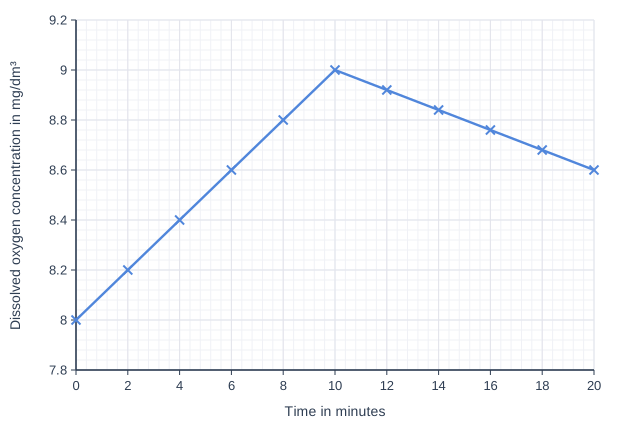
Line graph of dissolved oxygen concentration in mg/dm³ (y-axis, 7.8 to 9.2) against time in minutes (x-axis, 0 to 20). The line joins the points (0, 8), (2, 8.2), (4, 8.4), (6, 8.6), (8, 8.8), (10, 9), (12, 8.92), (14, 8.84), (16, 8.76), (18, 8.68), (20, 8.6).

Model answer

D

Explanation

In the light, the pondweed photosynthesises faster than it respires, so it releases oxygen and the concentration rises. In the dark there is no photosynthesis, but respiration continues, so the plant takes in oxygen and the concentration falls. A common misconception is that plants respire only in the dark.

Mark scheme
  1. 1 mark

    D / With no light there is no photosynthesis, but respiration continues and uses oxygen.

    The only correct answer is D: photosynthesis needs light, so when the lamp is off no oxygen is produced, while the pondweed's respiration (which goes on all the time) keeps taking in oxygen. A is not correct because photosynthesis produces oxygen and does not happen without light; B is not correct because respiration does not stop in the dark, and it uses oxygen rather than releasing it; C is not correct because colder water can hold more dissolved oxygen, not less, and cooling does not remove oxygen that is already dissolved. ALLOW the letter or the option. If more than one option is given, do not award the mark.
Question 2

2 marks

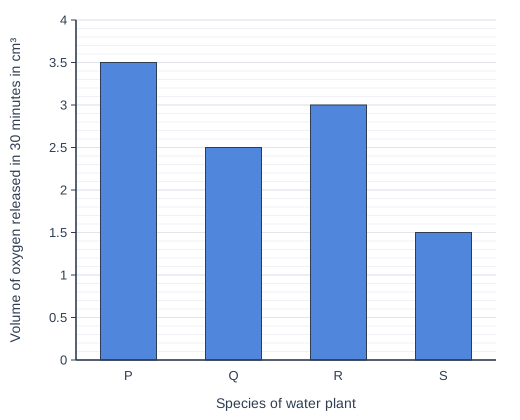
A scientist measured the volume of oxygen released in 30 minutes by four species of water plant, P, Q, R and S. She used the same mass of each plant, and the same light intensity and temperature for each.

The bar chart shows the results.

Calculate how many times faster species P photosynthesised than species S.

Give your answer to 2 significant figures.

Bar chart of volume of oxygen released in 30 minutes in cm³ for each species of water plant: P 3.5, Q 2.5, R 3, S 1.5.

Model answer

species P = 3.5 cm³ and species S = 1.5 cm³ in 30 minutes
3.5 ÷ 1.5 = 2.33
= 2.3 (2 significant figures)
Species P photosynthesised 2.3 times faster than species S.

Explanation

Both volumes were collected in the same time, so the ratio of the volumes is the ratio of the rates. 'How many times faster' needs a division, not a subtraction: 3.5 − 1.5 = 2.0 cm³ is the difference, not how many times faster. Read each bar carefully against the scale, then give the answer to 2 significant figures.

Mark scheme
  1. 1 mark

    3.5 ÷ 1.5; or a correct final answer of 2.3 (times) with no working

    An answer of 2.3 with no working scores 2 marks. Both readings (3.5 cm³ and 1.5 cm³) are needed for this mark. ALLOW 1 mark for 2.33 / 2.333 / 7/3 (correct value not given to 2 significant figures). 3.5 − 1.5 = 2.0 (the difference) scores 0. 1.5 ÷ 3.5 = 0.43 scores 0.

  2. 1 mark

    evaluation: 2.3 (times)

    ALLOW ECF from one misread bar (within 0.1 cm³ of the true value) when the answer is given to 2 significant figures.

Question 3

3 marks

A photosynthometer collects the gas released by a plant and draws it into a narrow capillary tube, where it forms a bubble. The length of the bubble is measured against a scale.

A student collected the gas released by some Cabomba for 8 minutes. The bubble in the capillary tube was 25 mm long. The internal diameter of the capillary tube is 1.2 mm.

The volume of the bubble can be calculated using:

volume = π × (radius)² × length

Calculate the rate of gas production in mm³ per hour.

Give your answer to 2 significant figures.

Model answer

radius = 1.2 ÷ 2 = 0.60 mm
volume = π × 0.60² × 25 = π × 0.36 × 25 = 28.3 mm³
rate = 28.3 ÷ 8 = 3.53 mm³ per minute
= 3.53 × 60 = 212 mm³ per hour
= 210 mm³ per hour (2 significant figures)

Explanation

The bubble is a cylinder, so its volume is π × r² × length; the question gives the diameter, so halve it to get the radius before squaring. Divide the volume by the 8 minutes, then multiply by 60 to give a rate per hour, and round to 2 significant figures. A photosynthometer measures much smaller volumes than a measuring cylinder, so it can detect small differences in rate.

Mark scheme
  1. 1 mark

    radius = 0.60 mm and volume = π × 0.60² × 25 = 28.3 (mm³); or a correct final answer of 210 mm³ per hour with no working

    An answer of 210 mm³ per hour with no working scores 3 marks. ALLOW 28.27 / 28.26 (π taken as 3.14) / 9π. Using the diameter as the radius (π × 1.2² × 25 = 113 mm³) scores 0 for this mark; ALLOW ECF for marking point 2 only (113 ÷ 8 × 60 = 848 shown scores 1 mark).

  2. 1 mark

    rate = 28.3 ÷ 8 × 60 (= 212); or a correct final answer of 210 mm³ per hour with no working

    ALLOW 28.3 × 7.5 / 3.53 × 60. ALLOW ECF from an incorrect volume. ALLOW 2 marks for 212 or 212.1 (correct value not given to 2 significant figures). 3.5 (mm³ per minute, not converted to per hour) scores marking point 1 only.

  3. 1 mark

    evaluation: 210 (mm³ per hour)

    ALLOW 2.1 × 10². ALLOW ECF for the significant-figure mark from a valid calculation. ALLOW 0.21 cm³ per hour.

Question 4

4 marks

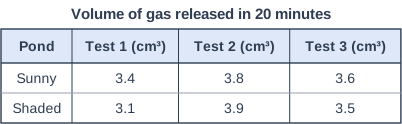
A student compared the rate of photosynthesis of pondweed taken from a sunny pond and from a shaded pond. She measured the volume of gas released in 20 minutes, three times for each.

The table shows her results.

The student concluded: 'Pondweed from the sunny pond photosynthesises faster than pondweed from the shaded pond.'

Evaluate this conclusion. Use the mean and the uncertainty (mean ± half the range) for each pond in your answer.

Volume of gas released in 20 minutes. Table with columns "Pond", "Test 1 (cm³)", "Test 2 (cm³)", "Test 3 (cm³)". Pond: Sunny; Test 1 (cm³): 3.4; Test 2 (cm³): 3.8; Test 3 (cm³): 3.6 | Pond: Shaded; Test 1 (cm³): 3.1; Test 2 (cm³): 3.9; Test 3 (cm³): 3.5.

Model answer

Sunny pond: mean = (3.4 + 3.8 + 3.6) ÷ 3 = 3.6 cm³; range 3.4 to 3.8, so uncertainty = 0.4 ÷ 2 = 0.2; result 3.6 ± 0.2 cm³.
Shaded pond: mean = (3.1 + 3.9 + 3.5) ÷ 3 = 3.5 cm³; range 3.1 to 3.9, so uncertainty = 0.8 ÷ 2 = 0.4; result 3.5 ± 0.4 cm³.
The mean for the sunny pond is only 0.1 cm³ higher, which is smaller than the uncertainty in either mean, and the ranges overlap. So the data do not support the conclusion: the difference could be caused by random error. More repeats would be needed to tell whether there is a real difference.

Explanation

A difference between two means is only meaningful if it is bigger than the spread of the results. Here the ranges overlap and the means differ by less than the uncertainties, so the student cannot conclude that one pondweed photosynthesises faster. Quoting the means alone, and saying 3.6 is bigger than 3.5, is not an evaluation.

Mark scheme
  1. 1 mark

    means: sunny pond 3.6 (cm³) and shaded pond 3.5 (cm³)

    Both means are needed for this mark. ALLOW 3.60 and 3.50. Max 3 if no judgement about the conclusion is made.

  2. 1 mark

    uncertainties: sunny 3.6 ± 0.2 (cm³) and shaded 3.5 ± 0.4 (cm³)

    ALLOW ranges of 0.4 and 0.8 correctly halved. ALLOW ECF from incorrect means.

  3. 1 mark

    the ranges of the results overlap / the difference between the means (0.1 cm³) is smaller than the uncertainties

    ALLOW sunny 3.4 to 3.8 and shaded 3.1 to 3.9 overlap. ALLOW the shaded pond has a larger spread / its results are less precise.

  4. 1 mark

    so the conclusion is not supported / the difference may be due to random error (more repeats are needed)

    ALLOW there is no clear difference between the rates. DO NOT ALLOW the conclusion is supported because 3.6 is greater than 3.5.

Ready to try the rest? Every answer you write is marked against the mark scheme, so you can see exactly where the marks are.

Study Helper Hints first, answers after you try

Stuck on this one? Ask for a hint and I’ll point you in the right direction, without giving the answer away. Once you’ve checked your answer, I’ll show you how the marks are awarded.