
Level:
Correct: 0
Incorrect: 0
Marks: 0/0
Exam Practice
Course:
Topics:
Avg
score:
–
Topics
done:
0/27

Variation, mutation and the Human Genome Project

Practise 18 exam-style questions on Variation, mutation and the Human Genome Project for Edexcel GCSE Combined Science (Biology Paper 1). Write your answer as you would in the exam and get it marked in seconds against the mark scheme, point by point, with the Study Helper on hand if you get stuck.

  • 18 questions
  • 1–6 marks each
  • Instant marking
  • No sign-up needed
18 questions, marked as you go

Sample questions with model answers

Here are 4 of the questions in this topic, each with a model answer, an explanation of why it earns the marks and the mark scheme an examiner would use.

Question 1

1 mark

Which statement describes the effect of most mutations on the phenotype?

Choose your answer.

  • A they have a large effect
  • B they always cause disease
  • C they have a small effect
  • D they have no effect

Model answer

D - they have no effect.

Explanation

Most genetic mutations have no effect on the phenotype, some have a small effect, and only rarely does a single mutation significantly affect the phenotype. The idea that mutations are always harmful or always cause disease is a common misconception.

Mark scheme
  1. 1 mark

    D / they have no effect (1)

    The only correct answer is D. A is not correct because it is rare for a single mutation to significantly affect the phenotype; B is not correct because most mutations do not cause disease and some may even be beneficial; C is not correct because only some mutations have a small effect, not most. Accept the letter or the option. If more than one option is given, do not award the mark.
Question 2

2 marks

Some characteristics are acquired during an organism's lifetime as a result of its environment.

Give two examples of acquired characteristics in humans.

Model answer

A scar from an injury, and the language a person speaks.

Explanation

Acquired characteristics are caused by the environment during a lifetime and are not coded for by the alleles a person inherits, so they cannot be passed on in the gametes. Scars, tattoos, accents and muscles built by training are examples. Features such as height or mass are affected by both genes and environment, so they are not good examples.

Mark scheme
  1. 1 mark

    a scar (1)

    Any two marks from the six points; max 2. Each different acquired characteristic is a separate mark. accept a named scar or injury, e.g. a broken nose

  2. 2 marks

    a tattoo / a piercing / dyed or bleached hair (2)

    1 mark for each different example in this list, max 2. accept pierced ears / a nose piercing; do not accept natural hair colour (inherited)

  3. 1 mark

    language spoken / accent (1)

    accept a named language, e.g. being able to speak French

  4. 1 mark

    a learned skill, e.g. being able to play the piano / ride a bike (1)

    accept any named learned skill

  5. 1 mark

    larger muscles as a result of training / exercise (1)

    ignore 'muscles' or 'strength' without reference to training

  6. 1 mark

    skin darkened by exposure to the Sun / a suntan (1)

    ignore eye colour, height, mass, blood group, natural hair colour (these are wholly or partly inherited)

Question 3

3 marks

Scientists studied one gene in a population of Atlantic salmon living in a river. They found 14 different alleles of this gene in the population.

Explain how so many different alleles arose, and why sexual reproduction on its own cannot produce new alleles.

Model answer

Each new allele arose by a mutation, a change in the base sequence of the gene. Over many generations, different mutations happened in different fish and were passed on to their offspring in gametes, so many alleles built up in the population. Sexual reproduction can only make new combinations of the alleles that already exist; it does not change the base sequence of any allele, so it cannot produce new alleles.

Explanation

There is usually extensive genetic variation within a population, and all the different alleles ultimately arose through mutations. Sexual reproduction increases variation by shuffling existing alleles into new combinations, but only mutation creates new alleles. Confusing these two sources of variation is a common error.

Mark scheme
  1. 1 mark

    new alleles arise by mutation / by changes in the DNA base sequence (of the gene) (1)

    An explanation including three from the four points; max 3

  2. 1 mark

    different mutations happened in different fish over many generations and were passed on to offspring (in gametes) (1)

    accept mutations build up / accumulate in the population over time

  3. 1 mark

    sexual reproduction only produces new combinations of alleles that already exist / mixes existing alleles (1)

    accept meiosis and fertilisation shuffle alleles

  4. 1 mark

    sexual reproduction does not change the base sequence of the alleles / does not create new versions of the gene (1)

    ignore 'sexual reproduction makes identical offspring' (incorrect)

Question 4

5 marks

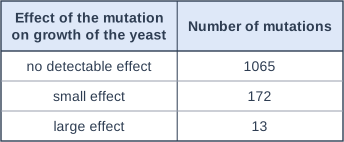
Scientists made 1250 different single mutations in the DNA of yeast cells. They measured the effect of each mutation on the growth of the yeast. The table shows the results.

Calculate the percentage of the mutations that had no detectable effect.

Explain how these data support the statement that most mutations have no effect on the phenotype, some have a small effect and, rarely, a single mutation has a significant effect.

Table with columns "Effect of the mutation on growth of the yeast", "Number of mutations". Effect of the mutation on growth of the yeast: no detectable effect; Number of mutations: 1065 | Effect of the mutation on growth of the yeast: small effect; Number of mutations: 172 | Effect of the mutation on growth of the yeast: large effect; Number of mutations: 13.

Model answer

Percentage with no detectable effect = 1065 ÷ 1250 × 100 = 85.2%
The data support the statement: most mutations (85.2%) had no detectable effect on growth; some (172, which is 13.8%) had a small effect; and only 13 mutations, about 1%, had a large effect, so a single mutation significantly affecting the phenotype is rare.

Explanation

Divide the number with no detectable effect by the total number of mutations, 1250, and multiply by 100. Each category of the statement can then be matched with a number from the table: a large majority with no effect, a smaller group with a small effect and a very small number with a large effect. Answers that just repeat the statement without quoting data do not gain the explanation marks.

Mark scheme
  1. 1 mark

    (1065 ÷ 1250) × 100 (1)

    An answer of 85.2 or 85 % with no working scores marking points 1 and 2; the explanation marks must be seen

  2. 1 mark

    85.2 (%) (1)

    accept 85; award 1 mark for 0.852

  3. 1 mark

    most mutations / 85.2% / 1065 out of 1250 had no (detectable) effect (1)

    ecf from their percentage; accept 'the large majority'

  4. 1 mark

    some mutations / 172 / 13.8% had a small effect (1)

    accept 13.76% / about 14%

  5. 1 mark

    only 13 / 1.04% / about 1 in 100 had a large effect, so a significant effect is rare (1)

    accept 1% / about 1 in 96; a comparison of numbers without the idea of rarity scores 0 for this point

Ready to try the rest? Every answer you write is marked against the mark scheme, so you can see exactly where the marks are.

Study Helper Hints first, answers after you try

Stuck on this one? Ask for a hint and I’ll point you in the right direction, without giving the answer away. Once you’ve checked your answer, I’ll show you how the marks are awarded.