
Level:
Correct: 0
Incorrect: 0
Marks: 0/0
Exam Practice
Course:
Topics:
Avg
score:
–
Topics
done:
0/27

Health and communicable and non-communicable disease

Practise 13 exam-style questions on Health and communicable and non-communicable disease for Edexcel GCSE Combined Science (Biology Paper 1). Write your answer as you would in the exam and get it marked in seconds against the mark scheme, point by point, with the Study Helper on hand if you get stuck.

  • 13 questions
  • 1–6 marks each
  • Instant marking
  • No sign-up needed
13 questions, marked as you go

Sample questions with model answers

Here are 4 of the questions in this topic, each with a model answer, an explanation of why it earns the marks and the mark scheme an examiner would use.

Question 1

1 mark

Which disease is a non-communicable disease?

Choose your answer.

  • A malaria
  • B tuberculosis
  • C Chalara ash dieback
  • D type 2 diabetes

Model answer

D - type 2 diabetes.

Explanation

Type 2 diabetes is not caused by a pathogen and cannot be passed from person to person, so it is non-communicable. Malaria (protist), tuberculosis (bacterium) and Chalara ash dieback (fungus) are all caused by pathogens that pass between organisms. Remember that plant diseases such as ash dieback can be communicable too.

Mark scheme
  1. 1 mark

    D / type 2 diabetes (1)

    The only correct answer is D. A is not correct because malaria is caused by a protist (a pathogen) that is passed on by mosquitoes; B is not correct because tuberculosis is caused by bacteria that are passed from person to person through the air; C is not correct because Chalara ash dieback is caused by a fungus whose spores are carried from tree to tree by the wind. Accept the letter or the option. If more than one option is given, do not award the mark.
Question 2

2 marks

Describe the difference between a communicable disease and a non-communicable disease.

Model answer

A communicable disease is caused by a pathogen, such as a bacterium or a virus, and can be passed from one person (or organism) to another. A non-communicable disease is not caused by a pathogen and cannot be passed from one person to another; it is caused by other factors such as lifestyle, diet or inherited alleles.

Explanation

The two key differences are the cause (a pathogen or not) and whether the disease can pass between people or organisms. Examiners do not credit 'cannot be spread' unless the answer says between people or organisms. Naming an example of each type of disease does not describe the difference.

Mark scheme
  1. 1 mark

    communicable diseases are caused by pathogens (non-communicable diseases are not) (1)

    A description including two from the three points; max 2. Accept ORA (non-communicable diseases are not caused by pathogens). Accept bacteria, viruses, fungi or protists for pathogens. Ignore 'germs'.

  2. 1 mark

    communicable diseases can be passed from one person (or organism) to another (non-communicable diseases cannot) (1)

    Accept spread / transmitted / caught for passed. Accept ORA. The answer must say that the disease passes between people or organisms: 'communicable diseases can be spread' or 'non-communicable diseases cannot be spread' unqualified does not gain this mark. Ignore 'contagious' unqualified.

  3. 1 mark

    non-communicable diseases are caused by other factors, such as lifestyle, diet or inherited alleles (1)

    Accept a named cause, e.g. smoking, poor diet, a lack of a vitamin, a faulty allele / genetic causes. Ignore examples of diseases on their own (e.g. 'malaria is communicable and heart disease is not'), as an example does not describe the difference.

Question 3

3 marks

When a child is infected with measles virus, the virus destroys many of the memory lymphocytes that the child already had. These memory lymphocytes were made during earlier infections by other pathogens.

Explain why a child who has recovered from measles may become ill from a pathogen that they were previously immune to.

Model answer

The memory lymphocytes that recognised the antigens of the other pathogen have been destroyed by the measles virus. When the child meets that pathogen again there is no fast secondary response, so antibodies are not made quickly or in large amounts. The pathogen can therefore multiply and cause symptoms before it is destroyed.

Explanation

Immunity to a pathogen depends on memory lymphocytes, which make a fast, large secondary response. If measles destroys them, the child must go through a slow primary response again, so they become ill. This is an unfamiliar example of one disease increasing susceptibility to others; a common error is to confuse antigens (on the pathogen) with antibodies (made by lymphocytes).

Mark scheme
  1. 1 mark

    there are no / fewer memory lymphocytes for (the antigens of) that pathogen (1)

    An explanation linking the three points. Accept memory cells for memory lymphocytes. Ignore 'the child has lost immunity' unqualified.

  2. 1 mark

    so there is no (fast) secondary response / antibodies are not made quickly or in large amounts (1)

    Accept 'the body has to go through the (slower) primary response again'. Reject 'antigens are made' for antibodies.

  3. 1 mark

    so the pathogen can multiply / cause symptoms before it is destroyed (1)

    Accept 'the pathogen is not destroyed before it makes the child ill'. Ignore 'antibodies kill the pathogen'.

Question 4

4 marks

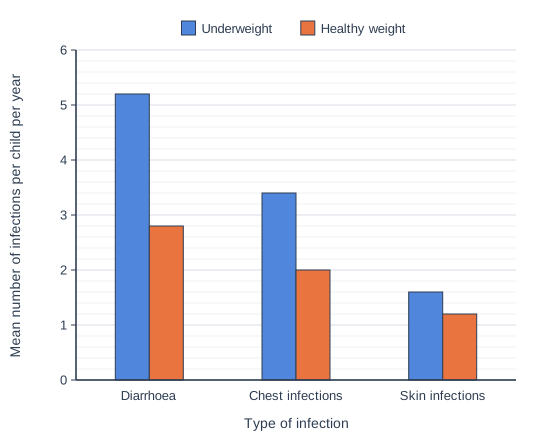
A scientist studied 400 children aged 1 to 5 years in one region for one year. She grouped the children as underweight (because they did not get enough food) or healthy weight.

The bar chart shows the mean number of times a child in each group had each type of infection during the year.

Compare the numbers of infections in the two groups of children.

Suggest an explanation for the difference.

Dual bar chart of mean number of infections per child per year for each type of infection, comparing Underweight and Healthy weight (a key above the chart shows which bar is which). Diarrhoea: Underweight 5.2, Healthy weight 2.8; Chest infections: Underweight 3.4, Healthy weight 2; Skin infections: Underweight 1.6, Healthy weight 1.2.

Model answer

Underweight children had more of every type of infection than healthy-weight children. The biggest difference was for diarrhoea: 5.2 infections per child per year compared with 2.8, which is nearly twice as many. The smallest difference was for skin infections (1.6 compared with 1.2).

Children who do not get enough food may not have enough nutrients to make white blood cells and antibodies, so their immune system is weaker. Pathogens are not destroyed as quickly, so these children are more likely to get infections.

Explanation

A good comparison states the overall pattern and then uses figures from the chart, such as a difference or the biggest and smallest differences. The explanation applies specification point 5.3: undernutrition weakens the immune system, so the children are more susceptible to communicable diseases. Credit is also given for the idea that repeated infections such as diarrhoea can themselves cause weight loss.

Mark scheme
  1. 1 mark

    underweight children had more of each type of infection / more infections in total (1)

    Accept ORA (healthy-weight children had fewer infections). Ignore a list of values with no comparison.

  2. 1 mark

    a correct comparison using the data, e.g. the biggest difference is for diarrhoea (5.2 compared with 2.8 / 2.4 more per year / nearly twice as many) (1)

    Accept any correct comparative manipulation of the data, e.g. chest infections 1.4 more (3.4 compared with 2.0); skin infections show the smallest difference (0.4); total 10.2 compared with 6.0 per year (4.2 more). Values quoted must be read correctly from the chart.

  3. 1 mark

    undernutrition weakens the immune system / fewer white blood cells or antibodies are made (1)

    Accept 'not enough nutrients / protein to make white blood cells or antibodies'. Accept 'one condition (undernutrition) makes the children more susceptible to other diseases'.

  4. 1 mark

    so pathogens are not destroyed as quickly / the children are more likely to get infections (1)

    Accept 'pathogens can multiply more before they are destroyed'. Accept the reverse argument for one of marking points 3 and 4 (max 1): frequent infections, such as diarrhoea, could cause the children to lose weight / become underweight.

Ready to try the rest? Every answer you write is marked against the mark scheme, so you can see exactly where the marks are.

Study Helper Hints first, answers after you try

Stuck on this one? Ask for a hint and I’ll point you in the right direction, without giving the answer away. Once you’ve checked your answer, I’ll show you how the marks are awarded.