
Level:
Correct: 0
Incorrect: 0
Marks: 0/0
Exam Practice
Course:
Topics:
Avg
score:
–
Topics
done:
0/27

Core practical: osmosis in potatoes

Practise 13 exam-style questions on Core practical: osmosis in potatoes for Edexcel GCSE Combined Science (Biology Paper 1). Write your answer as you would in the exam and get it marked in seconds against the mark scheme, point by point, with the Study Helper on hand if you get stuck.

  • 13 questions
  • 1–6 marks each
  • Instant marking
  • No sign-up needed
13 questions, marked as you go

Sample questions with model answers

Here are 4 of the questions in this topic, each with a model answer, an explanation of why it earns the marks and the mark scheme an examiner would use.

Question 1

1 mark

Hannah took each potato cylinder out of its sucrose solution and rolled it gently on a paper towel to blot it before she weighed it again.

What is the reason for blotting the cylinders?

Choose your answer.

  • A to stop water leaving the cells
  • B to remove sucrose from the cells
  • C to remove solution from the surface
  • D to dry out the cells inside it

Model answer

C - to remove solution from the surface

Explanation

Liquid clinging to the outside of a cylinder adds to its mass but has not moved into the cells by osmosis, so it must be removed before weighing. Each cylinder should be blotted gently and in the same way, because squeezing it removes water from the cells and gives a mass that is too low.

Mark scheme
  1. 1 mark

    C / to remove solution from the surface (1)

    The only correct answer is C: solution left on the outside of a cylinder adds to its mass but has not entered the cells by osmosis, so each cylinder is blotted in the same way before it is weighed. A is not correct because blotting only touches the outside of the cylinder, and the water has already moved by osmosis while the cylinder was in the solution; B is not correct because blotting cannot remove anything from inside the cells; D is not correct because only the liquid on the surface should be removed - pressing hard enough to squeeze water out of the cells would make the final mass too low. Accept the letter or the option. If more than one option is given, do not award the mark.
Question 2

2 marks

A potato cylinder had a starting mass of 1.60 g. After 24 hours in distilled water, its mass was 1.82 g.

Calculate the percentage change in mass of the potato cylinder.

Model answer

Change in mass = 1.82 − 1.60 = 0.22 g
Percentage change = 0.22 ÷ 1.60 × 100 = 13.75
Percentage change = +13.75 %

Explanation

Subtract the starting mass from the final mass, then divide by the starting mass and multiply by 100. The answer is positive because the cylinder gained water by osmosis from the distilled water. Dividing by the final mass (giving 12.1 %) is the most common error.

Mark scheme
  1. 1 mark

    (percentage change =) (1.82 − 1.60) ÷ 1.60 × 100 (1)

    award full marks for the correct answer with no working; accept 0.22 ÷ 1.60 × 100; an answer of 12.1 (%) (dividing by 1.82) scores 0

  2. 1 mark

    13.75 (%) (1)

    accept 13.8 / 14 / +13.75; accept the answer with or without a plus sign

Question 3

3 marks

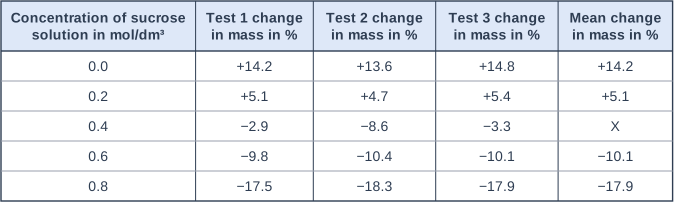
A student did the potato osmosis core practical three times at each concentration of sucrose solution.

The table shows the results. One result at 0.4 mol/dm³ is anomalous.

Calculate the mean percentage change in mass, X, at 0.4 mol/dm³, leaving out the anomalous result.

Suggest one reason for the anomalous result.

Table with columns "Concentration of sucrose solution in mol/dm³", "Test 1 change in mass in %", "Test 2 change in mass in %", "Test 3 change in mass in %", "Mean change in mass in %". Concentration of sucrose solution in mol/dm³: 0.0; Test 1 change in mass in %: +14.2; Test 2 change in mass in %: +13.6; Test 3 change in mass in %: +14.8; Mean change in mass in %: +14.2 | Concentration of sucrose solution in mol/dm³: 0.2; Test 1 change in mass in %: +5.1; Test 2 change in mass in %: +4.7; Test 3 change in mass in %: +5.4; Mean change in mass in %: +5.1 | Concentration of sucrose solution in mol/dm³: 0.4; Test 1 change in mass in %: −2.9; Test 2 change in mass in %: −8.6; Test 3 change in mass in %: −3.3; Mean change in mass in %: X | Concentration of sucrose solution in mol/dm³: 0.6; Test 1 change in mass in %: −9.8; Test 2 change in mass in %: −10.4; Test 3 change in mass in %: −10.1; Mean change in mass in %: −10.1 | Concentration of sucrose solution in mol/dm³: 0.8; Test 1 change in mass in %: −17.5; Test 2 change in mass in %: −18.3; Test 3 change in mass in %: −17.9; Mean change in mass in %: −17.9.

Model answer

The anomalous result is −8.6 %.
Mean = (−2.9 + −3.3) ÷ 2 = −6.2 ÷ 2 = −3.1 %
X = −3.1 %
The anomalous cylinder may have been blotted too hard when it was dried, so extra water was squeezed out of it and it lost more mass than the others.

Explanation

Leave out the anomalous result (−8.6 % is much larger than the other two losses) and take the mean of the remaining values. A reason for an anomaly must fit its direction: this cylinder lost more mass than expected, so a reason such as over-blotting or a longer time in the solution fits, but not leaving it wet before the final weighing. 'Human error' is too vague to gain the mark.

Mark scheme
  1. 1 mark

    (mean =) (−2.9 + −3.3) ÷ 2 (1)

    An answer of −3.1 % or a 3.1 % decrease with no working scores marking points 1 and 2; the anomalous result is −8.6; −4.9 (the anomalous result included) is wrong and scores 0 for points 1 and 2

  2. 1 mark

    −3.1 (%) (1)

    accept 3.1 (%) decrease; accept −3.10

  3. 1 mark

    a valid reason for a larger loss of mass, e.g. the cylinder was blotted / squeezed too hard / the cylinder was left in the solution for longer / the solution was made up too concentrated / the mass was misread or recorded wrongly (1)

    the reason must explain a larger loss of mass or a measurement error; ignore 'human error' / 'mistake' on its own; accept the cylinder was not blotted dry before its starting mass was measured (so the starting mass was too high); accept the cylinder was thinner / smaller / had a larger surface area, so it lost water faster; do not accept the cylinder was not dried before its final mass was measured (this would give a smaller loss, not a larger one)

Question 4

4 marks

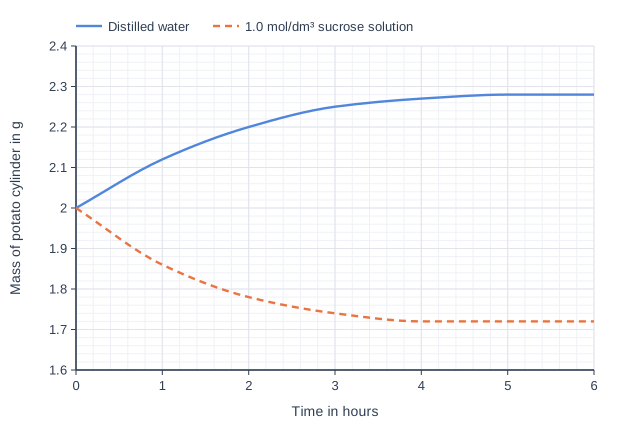
A student placed one potato cylinder in distilled water and another in 1.0 mol/dm³ sucrose solution. The student measured the mass of each cylinder every hour for 6 hours.

The graph shows the results.

Explain why the mass of each cylinder stopped changing after about 4 hours.

Line graph of mass of potato cylinder in g (y-axis, 1.6 to 2.4) against time in hours (x-axis, 0 to 6). "Distilled water" is a smooth curve through (0, 2), (1, 2.12), (2, 2.2), (3, 2.25), (4, 2.27), (5, 2.28), (6, 2.28). "1.0 mol/dm³ sucrose solution" (dashed) is a smooth curve through (0, 2), (1, 1.86), (2, 1.78), (3, 1.74), (4, 1.72), (5, 1.72), (6, 1.72).

Model answer

In distilled water, water entered the potato cells by osmosis until the cells were turgid. The cell walls are strong and stop the cells expanding any further, so no more water could enter and the mass stayed at 2.28 g. In the 1.0 mol/dm³ sucrose solution, water left the cells by osmosis, so the cell contents became more concentrated. After about 4 hours the water concentration inside the cells was equal to the water concentration of the solution, so there was no further net movement of water and the mass stayed at 1.72 g.

Explanation

Osmosis continues only while there is a difference in water concentration and the cells can change volume. In pure water, the cell wall limits how much water a turgid cell can take in; in the concentrated solution, water leaves until the concentrations are balanced. Water molecules still move in both directions, so the correct idea is 'no net movement', not 'no movement'.

Mark scheme
  1. 1 mark

    (in distilled water) the cells became turgid / full of water (1)

    An explanation linking the four points. accept the vacuoles were full of water

  2. 1 mark

    the cell wall stopped the cells expanding / resisted more water entering (1)

    accept the cell wall is rigid / strong so the cells cannot take in more water; do not accept the cell membrane stopped water entering

  3. 1 mark

    (in sucrose solution) the water concentration inside the cells became equal to that of the solution (1)

    accept the solute concentrations inside and outside became the same / equilibrium was reached; ignore 'the cells ran out of water'

  4. 1 mark

    so there was no (further) net movement of water out of the cells (by osmosis) (1)

    accept water moved in and out at the same rate; do not accept no water moved

Ready to try the rest? Every answer you write is marked against the mark scheme, so you can see exactly where the marks are.

Study Helper Hints first, answers after you try

Stuck on this one? Ask for a hint and I’ll point you in the right direction, without giving the answer away. Once you’ve checked your answer, I’ll show you how the marks are awarded.