
Level:
Correct: 0
Incorrect: 0
Marks: 0/0
Exam Practice
Course:
Topics:
Avg
score:
–
Topics
done:
0/27

Treatments for cardiovascular disease

Practise 14 exam-style questions on Treatments for cardiovascular disease for Edexcel GCSE Combined Science (Biology Paper 1). Write your answer as you would in the exam and get it marked in seconds against the mark scheme, point by point, with the Study Helper on hand if you get stuck.

  • 14 questions
  • 1–6 marks each
  • Instant marking
  • No sign-up needed
14 questions, marked as you go

Sample questions with model answers

Here are 4 of the questions in this topic, each with a model answer, an explanation of why it earns the marks and the mark scheme an examiner would use.

Question 1

1 mark

Statins are medicines that many people take every day for the rest of their lives.

What do statins do?

Choose your answer.

  • A lower blood cholesterol
  • B dissolve blood clots
  • C widen narrowed arteries
  • D lower blood pressure

Model answer

A - lower blood cholesterol.

Explanation

Statins reduce the amount of cholesterol the body makes, so blood cholesterol falls and fatty deposits build up in the arteries more slowly, lowering the risk of heart attacks and strokes. They are usually taken long term. Students often mix up the jobs of statins, anticoagulants and blood pressure medicines.

Mark scheme
  1. 1 mark

    A / lower blood cholesterol (1)

    The only correct answer is A. B is not correct because statins do not dissolve blood clots - anticoagulants are used to reduce the risk of clots forming; C is not correct because narrowed arteries are widened by surgery, e.g. fitting a stent; D is not correct because lowering blood pressure is the job of blood pressure medicines (antihypertensives). Accept the letter or the option. If more than one option is given, do not award the mark.
Question 2

2 marks

Ade has had a stent fitted in one of his coronary arteries. His doctor tells him that he also needs to stop smoking, eat less saturated fat and take more exercise.

Explain why Ade still needs to make these lifestyle changes.

Model answer

The stent only widens the one narrowed section of artery; it does not cure coronary heart disease. If Ade keeps smoking and eating a lot of saturated fat, fatty deposits will keep building up in his other coronary arteries (and in the stented artery), so he could still have a heart attack. Stopping smoking, eating less saturated fat and exercising lower his cholesterol and blood pressure and reduce damage to his arteries.

Explanation

Surgical treatments such as stents relieve one narrowed section but do not remove the causes of cardiovascular disease. Lifestyle changes reduce those causes (smoking, high cholesterol, high blood pressure, obesity), so they are recommended alongside surgery and medication. Saying only 'to be healthier' is too vague to score.

Mark scheme
  1. 1 mark

    the stent only treats one narrowed section / does not cure coronary heart disease (1)

    An explanation including two from the three points; max 2. Accept 'the stent does not remove the cause'.

  2. 1 mark

    fatty deposits could still build up in other (coronary) arteries / in the stented artery if he does not change his lifestyle (1)

    Accept 'the artery could narrow again'. Accept 'other arteries could become blocked'.

  3. 1 mark

    the changes reduce risk factors, e.g. lower blood cholesterol / lower blood pressure / less damage to arteries from smoking, so the risk of a heart attack is lower (1)

    Accept any one correctly explained effect of the named changes. Ignore 'to be healthy' unqualified.

Question 3

3 marks

A heart valve that does not work properly can be replaced by a mechanical valve or by a tissue valve made from animal tissue.

The NHS gives this information.
Mechanical valves last a long time and do not usually need to be replaced. They increase the risk of blood clots, so patients must take anticoagulant medicines for the rest of their life.
Tissue valves usually last 15 to 20 years. They do not increase the risk of blood clots.

Suggest why a mechanical valve is usually recommended for a 35-year-old patient, but a tissue valve for an 80-year-old patient.

Model answer

A 35-year-old is likely to live for another 40 years or more, so a tissue valve lasting 15 to 20 years would wear out and need replacing in another major operation; a mechanical valve should last the rest of their life, even though they must take anticoagulants. An 80-year-old is unlikely to outlive a tissue valve, and a tissue valve means they avoid taking anticoagulants for the rest of their life, which would make them bleed more easily.

Explanation

Evaluating a treatment means weighing its benefits against its risks for a particular patient. A mechanical valve lasts but needs life-long anticoagulants (with a bleeding risk), while a tissue valve avoids anticoagulants but wears out in 15 to 20 years, so the patient's age decides which is better. Answers that only describe the valves without linking them to the two ages score fewer marks.

Mark scheme
  1. 1 mark

    a 35-year-old is likely to live much longer than 15 to 20 years, so a tissue valve would need to be replaced (in another operation) (1)

    Any three from the four points; max 3. Max 2 if only one of the two patients is discussed.

  2. 1 mark

    a mechanical valve should last for the rest of the 35-year-old's life (1)

    Accept 'a mechanical valve avoids repeat surgery for the younger patient'.

  3. 1 mark

    a tissue valve is likely to last for the rest of the 80-year-old's life (1)

    Accept 'the 80-year-old is unlikely to outlive the tissue valve'.

  4. 1 mark

    the 80-year-old avoids taking anticoagulants for life, which can cause bleeding (1)

    Accept 'anticoagulants make the patient bleed more easily'. Accept 'avoids the risk of blood clots forming on a mechanical valve'.

Question 4

4 marks

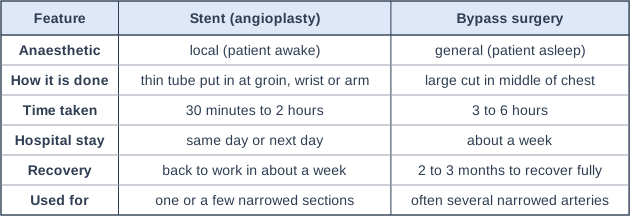
The table shows information from the NHS about two surgical treatments for coronary heart disease.

A patient has one narrowed coronary artery.

Compare fitting a stent with bypass surgery as treatments for this patient. Use the information in the table.

Table with columns "Feature", "Stent (angioplasty)", "Bypass surgery". Feature: Anaesthetic; Stent (angioplasty): local (patient awake); Bypass surgery: general (patient asleep) | Feature: How it is done; Stent (angioplasty): thin tube put in at groin, wrist or arm; Bypass surgery: large cut in middle of chest | Feature: Time taken; Stent (angioplasty): 30 minutes to 2 hours; Bypass surgery: 3 to 6 hours | Feature: Hospital stay; Stent (angioplasty): same day or next day; Bypass surgery: about a week | Feature: Recovery; Stent (angioplasty): back to work in about a week; Bypass surgery: 2 to 3 months to recover fully | Feature: Used for; Stent (angioplasty): one or a few narrowed sections; Bypass surgery: often several narrowed arteries.

Model answer

Fitting a stent needs only a local anaesthetic, while bypass surgery needs a general anaesthetic and a large cut in the middle of the chest, so a stent is much less invasive. Fitting a stent is quicker (30 minutes to 2 hours compared with 3 to 6 hours), the patient usually goes home the same day or the next day instead of staying about a week, and they can return to work after about a week instead of taking 2 to 3 months to recover fully. Bypass surgery is often used when several arteries are narrowed, but this patient has only one narrowed artery, so a stent is suitable.

Explanation

A 'Compare' answer needs linked statements about both treatments, such as 'a stent is quicker than bypass surgery', supported by values from the table. Stents are less invasive, quicker and have a much shorter recovery, while bypass surgery is a major operation more often used when several arteries are narrowed. Answers that describe each treatment separately without comparing them score fewer marks.

Mark scheme
  1. 1 mark

    a stent needs only a local anaesthetic but bypass surgery needs a general anaesthetic (1)

    An answer including four from the six points; max 4. Each point must compare the two treatments (accept the reverse argument for any point). A statement about one treatment only, with no comparison, does not score. Accept 'a general anaesthetic carries more risk' as part of this point.

  2. 1 mark

    fitting a stent is less invasive / does not need a large cut in the chest (open-heart surgery) (1)

    Accept 'the stent is put in through a small tube in the groin, wrist or arm, but bypass surgery needs the chest to be opened'.

  3. 1 mark

    fitting a stent is quicker (30 minutes to 2 hours compared with 3 to 6 hours) (1)

    Accept 'bypass surgery takes longer'.

  4. 1 mark

    a shorter stay in hospital with a stent (same day or next day compared with about a week) (1)

    Accept ORA.

  5. 1 mark

    faster recovery with a stent (back to work after about a week compared with 2 to 3 months to fully recover) (1)

    Accept ORA.

  6. 1 mark

    bypass surgery is more suited to several narrowed arteries, but this patient has only one, so a stent is suitable (1)

    Accept 'a stent is used for one or a few narrowed sections, which matches this patient'.

Ready to try the rest? Every answer you write is marked against the mark scheme, so you can see exactly where the marks are.

Study Helper Hints first, answers after you try

Stuck on this one? Ask for a hint and I’ll point you in the right direction, without giving the answer away. Once you’ve checked your answer, I’ll show you how the marks are awarded.