
Level:
Correct: 0
Incorrect: 0
Marks: 0/0
Exam Practice
Course:
Topics:
Avg
score:
–
Topics
done:
0/27

Antibiotics and developing new medicines

Practise 16 exam-style questions on Antibiotics and developing new medicines for Edexcel GCSE Combined Science (Biology Paper 1). Write your answer as you would in the exam and get it marked in seconds against the mark scheme, point by point, with the Study Helper on hand if you get stuck.

  • 16 questions
  • 1–6 marks each
  • Instant marking
  • No sign-up needed
16 questions, marked as you go

Sample questions with model answers

Here are 4 of the questions in this topic, each with a model answer, an explanation of why it earns the marks and the mark scheme an examiner would use.

Question 1

1 mark

A company carries out a double-blind trial of a new antibiotic. Half the patients are given the new antibiotic and half are given an existing antibiotic.

During the trial, who knows which patients are given the new antibiotic?

Choose your answer.

  • A the patients only
  • B the doctors only
  • C the patients and the doctors
  • D neither patients nor doctors

Model answer

D - neither the patients nor the doctors.

Explanation

In a double-blind trial neither the patients nor the doctors treating and assessing them know who has the new medicine; the groups are coded and only revealed at the end. This stops patients' expectations and doctors' judgements from biasing the results. In a single-blind trial only the patients do not know.

Mark scheme
  1. 1 mark

    D / neither patients nor doctors (1)

    The only correct answer is D. A is not correct because in a double-blind trial the patients do not know which treatment they receive; B is not correct because if only the doctors know, the trial is single-blind, not double-blind; C is not correct because if both know, the trial is not blind at all and the results could be biased. Accept the letter or the option. If more than one option is given, do not award the mark.
Question 2

2 marks

In the final stage of clinical testing, a new medicine is usually tested on several thousand patients in many hospitals, often in different countries.

Explain why so many patients are used.

Model answer

Using thousands of patients makes the results more reliable, because differences between individual patients and any anomalous results have less effect on the overall results. It also means that rare side effects, which might only affect one person in several hundred, are more likely to be found before the medicine is licensed.

Explanation

Large trials reduce the effect of chance and of individual variation, so a real difference between the medicine and the control can be seen. Thousands of patients from many places also give a wide range of ages and backgrounds and are needed to detect side effects that are rare. 'To make it a fair test' is not enough on its own.

Mark scheme
  1. 1 mark

    the results are more reliable / repeatable / anomalies (or individual differences) have less effect on the results (1)

    An explanation including two from the three points; max 2. Accept 'gives a more accurate mean / a more representative sample'. Ignore 'fair test'.

  2. 1 mark

    rare side effects are more likely to be found (1)

    Accept 'side effects that only affect a few people will show up'.

  3. 1 mark

    the medicine is tested on a wide range of people (e.g. ages, sexes, ethnic groups) so the results apply to the whole population (1)

    Accept 'people with different genetic backgrounds / lifestyles / other medical conditions'. Ignore 'more people can be cured'.

Question 3

3 marks

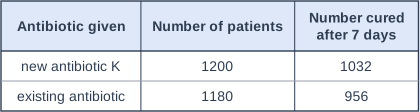
A double-blind trial compared a new antibiotic, K, with an existing antibiotic for treating throat infections caused by bacteria.

The table shows the results.

Calculate the difference between the percentage of patients cured by antibiotic K and the percentage of patients cured by the existing antibiotic.

Table with columns "Antibiotic given", "Number of patients", "Number cured after 7 days". Antibiotic given: new antibiotic K; Number of patients: 1200; Number cured after 7 days: 1032 | Antibiotic given: existing antibiotic; Number of patients: 1180; Number cured after 7 days: 956.

Model answer

Antibiotic K: 1032 ÷ 1200 × 100 = 86.0%
Existing antibiotic: 956 ÷ 1180 × 100 = 81.0%
Difference = 86.0 - 81.0 = 5.0 percentage points (antibiotic K cured 5.0% more of its patients).

Explanation

Because the two groups are different sizes, the numbers cured cannot be compared directly: each must be turned into a percentage of its own group first. 1032 out of 1200 is 86.0% and 956 out of 1180 is 81.0%, a difference of 5.0. A common error is to subtract the numbers cured (1032 - 956 = 76) instead.

Mark scheme
  1. 1 mark

    (antibiotic K =) 1032 ÷ 1200 × 100 = 86(.0) (%) (1)

    An answer of 5(.0) (percentage points) with no working scores 3 marks.

  2. 1 mark

    (existing antibiotic =) 956 ÷ 1180 × 100 = 81(.0) (%) (1)

    Accept 81, 81.0, 81.02 or values that round to 81.0.

  3. 1 mark

    (difference =) 5(.0) (percentage points) (1)

    Accept 4.98 or values from 4.98 to 5.0. Allow ecf from incorrect percentages in the first two steps (subtraction of the student's two percentages). Do not accept 76 (the difference in the numbers of patients cured) - this scores 0, because the groups are different sizes.

Question 4

4 marks

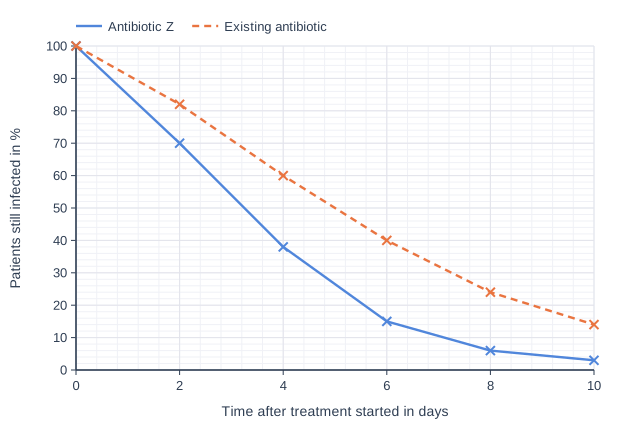
A doctor carried out a double-blind trial of a new antibiotic, Z, on 300 patients with a bacterial chest infection. Half the patients were given antibiotic Z and half were given an existing antibiotic.

The graph shows the percentage of patients in each group who still had the infection.

The doctor concluded that antibiotic Z should replace the existing antibiotic.

Evaluate this conclusion.

Line graph of patients still infected in % (y-axis, 0 to 100) against time after treatment started in days (x-axis, 0 to 10). "Antibiotic Z" joins the points (0, 100), (2, 70), (4, 38), (6, 15), (8, 6), (10, 3). "Existing antibiotic" (dashed) joins the points (0, 100), (2, 82), (4, 60), (6, 40), (8, 24), (10, 14).

Model answer

The graph supports the conclusion: at every time fewer patients taking Z were still infected. For example, at day 6 only 15% of the Z group were still infected compared with 40% of the existing-antibiotic group, and by day 10 it was 3% compared with 14%. The trial was double-blind, which reduces bias. However, there is no information about the side effects of Z, which might be worse than those of the existing antibiotic, and this was only one trial with 150 patients in each group, so it should be repeated with more patients. The existing antibiotic also cured 86% of patients, so more evidence is needed before Z replaces it.

Explanation

An evaluation weighs the evidence for the conclusion against its weaknesses. The graph clearly shows Z clearing the infection faster (quote paired values from the same day), and the double-blind design adds confidence, but the trial gives no data on side effects or cost and is a single, quite small trial. Answers that only describe the graph, or quote values without comparing the two groups on the same day, score fewer marks.

Mark scheme
  1. 1 mark

    a smaller percentage of patients are still infected with antibiotic Z at every time / antibiotic Z clears the infection faster (1)

    An answer including four from the eight points; max 4. Max 3 if the answer gives only points that support the conclusion or only points against it. Accept 'Z is more effective'.

  2. 1 mark

    correct comparative data quoted from the graph, e.g. day 6: 15% (Z) and 40% (existing) still infected / day 10: 3% and 14% (1)

    Accept correctly calculated differences, e.g. 25 percentage points fewer at day 6, 11 fewer at day 10. Accept data given as percentage cured, e.g. 97% and 86% by day 10.

  3. 1 mark

    the trial was double-blind so bias was reduced (1)

    Accept 'the results are more valid because neither patients nor doctors knew who had Z'.

  4. 1 mark

    there is no information about the side effects of Z (1)

    Accept 'Z may have more / worse side effects than the existing antibiotic'.

  5. 1 mark

    only one trial / only 150 patients in each group / the trial needs repeating (by other scientists) (1)

    Accept 'a small sample for a final-stage trial'. Ignore 'not enough people' unqualified.

  6. 1 mark

    the existing antibiotic also works well / cured most of its patients (86% by day 10) (1)

    Accept 'both antibiotics clear most infections, so the difference may not justify a change'.

  7. 1 mark

    the cost of Z is not known / Z may be more expensive (1)

    Accept 'it may not be worth the extra cost to the NHS'.

  8. 1 mark

    the long-term effects of Z are not known (1)

    Accept 'patients were only followed for 10 days'. Ignore 'it may not work' unqualified.

Ready to try the rest? Every answer you write is marked against the mark scheme, so you can see exactly where the marks are.

Study Helper Hints first, answers after you try

Stuck on this one? Ask for a hint and I’ll point you in the right direction, without giving the answer away. Once you’ve checked your answer, I’ll show you how the marks are awarded.