
Level:
Correct: 0
Incorrect: 0
Marks: 0/0
Exam Practice
Course:
Topics:
Avg
score:
–
Topics
done:
0/27

Enzyme action and factors affecting enzymes

Practise 15 exam-style questions on Enzyme action and factors affecting enzymes for Edexcel GCSE Combined Science (Biology Paper 1). Write your answer as you would in the exam and get it marked in seconds against the mark scheme, point by point, with the Study Helper on hand if you get stuck.

  • 15 questions
  • 1–6 marks each
  • Instant marking
  • No sign-up needed
15 questions, marked as you go

Sample questions with model answers

Here are 4 of the questions in this topic, each with a model answer, an explanation of why it earns the marks and the mark scheme an examiner would use.

Question 1

1 mark

Enzymes are proteins. Each enzyme molecule has a region called its active site.

State the role of the active site in a reaction catalysed by an enzyme.

Model answer

The active site is the part of the enzyme molecule where the substrate binds, forming an enzyme-substrate complex, so that the reaction can take place.

Explanation

The active site is a region of the enzyme with a particular shape that is complementary to its substrate; the substrate binds there to form an enzyme-substrate complex. A common error is to describe the active site as part of the substrate, or to repeat the question with 'where the enzyme is active'.

Mark scheme
  1. 1 mark

    (it is the part of the enzyme) where the substrate binds (1)

    accept the substrate fits into / attaches to / joins the active site; accept it forms an enzyme-substrate complex with the substrate; accept the part of the enzyme where the reaction is catalysed / takes place; do not accept the part of the substrate where the enzyme binds; ignore 'the part of the enzyme that is active' / 'where the enzyme works' (repeats the question)
Question 2

2 marks

A student wrote this sentence in a report.

'When an enzyme is heated to 80 °C it is killed, so it stops working.'

Explain why the student's sentence is not correct and give a better explanation of why the enzyme stops working.

Model answer

Enzymes are protein molecules, not living things, so they cannot be killed. At 80 °C the enzyme is denatured: the shape of its active site changes, so the substrate can no longer bind to it and no enzyme-substrate complexes form.

Explanation

An enzyme is a protein molecule made by living cells, so 'killed' is the wrong word; high temperature denatures it. Denaturation means the active site changes shape so the substrate no longer fits. Answers that say the enzyme is 'killed' or 'destroyed' instead of denatured do not gain credit.

Mark scheme
  1. 1 mark

    enzymes are (protein) molecules / are not living, so they cannot be killed (1)

    An explanation linking two points. accept enzymes are chemicals / proteins, not organisms

  2. 1 mark

    the enzyme is denatured / the shape of its active site changes so the substrate can no longer bind (1)

    accept the active site is denatured; accept the substrate no longer fits the active site / no enzyme-substrate complexes form; ignore 'the enzyme is destroyed' / 'the enzyme melts'

Question 3

3 marks

Enzyme X comes from a mould that grows on citrus fruits. Enzyme Y comes from a bacterium that lives in a lake where the water is strongly alkaline.

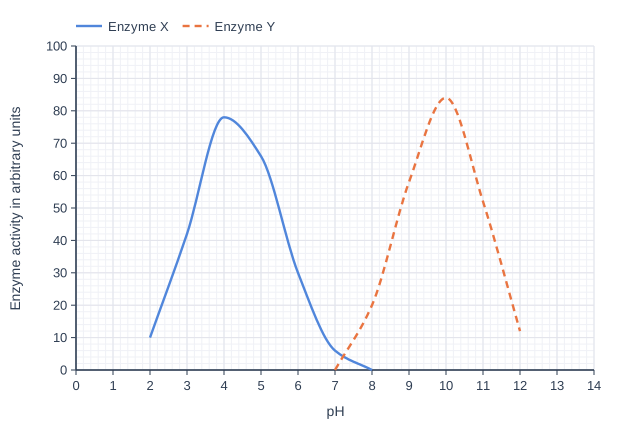
The graph shows the activity of each enzyme at different pH values.

Compare the effect of pH on the activity of enzyme X and enzyme Y.

Line graph of enzyme activity in arbitrary units (y-axis, 0 to 100) against pH (x-axis, 0 to 14). "Enzyme X" is a smooth curve through (2, 10), (3, 42), (4, 78), (5, 66), (6, 30), (7, 6), (8, 0). "Enzyme Y" (dashed) is a smooth curve through (7, 0), (8, 20), (9, 58), (10, 84), (11, 52), (12, 12).

Model answer

Both enzymes have an optimum pH: their activity increases up to the optimum and then decreases. Enzyme X has an optimum of pH 4 (acidic), but enzyme Y has a much higher optimum of pH 10 (alkaline). Enzyme X is active from about pH 2 to pH 7, while enzyme Y is only active from about pH 8 to pH 12. Enzyme Y has a slightly higher maximum activity than X (84 compared with 78 arbitrary units).

Explanation

A comparison must say how the two enzymes are similar or different, not just describe each one separately. Each enzyme's optimum pH matches where its organism lives: acidic fruit for X, an alkaline lake for Y. On either side of its optimum, each enzyme's active site changes shape and its activity falls.

Mark scheme
  1. 1 mark

    both enzymes have an optimum pH / for both, activity increases to a maximum then decreases (1)

    A comparison including three from the five points; max 3. Each point must refer to both enzymes (a comparison)

  2. 1 mark

    the optimum pH of X is (pH) 4 and the optimum pH of Y is (pH) 10 (1)

    accept X has a lower optimum pH than Y / X works best in acidic conditions and Y works best in alkaline conditions; accept optimum values in the range 3.5 to 4.5 for X and 9.5 to 10.5 for Y

  3. 1 mark

    X is active from (about) pH 2 to pH 7 but Y is only active from (about) pH 8 to pH 12 (1)

    accept X has no activity above pH 8 and Y has no activity at pH 7 or below; accept the ranges of the two enzymes do not overlap (much)

  4. 1 mark

    Y has a (slightly) higher maximum activity than X (1)

    accept 84 compared with 78 (arbitrary units)

  5. 1 mark

    at pH 7 X has low activity and Y has no activity (1)

    accept neither enzyme works well at pH 7 / at neutral pH

Question 4

4 marks

Invertase is an enzyme made by yeast. It breaks down sucrose into glucose and fructose.

A student measured the rate of glucose production using the same volume and concentration of invertase solution with different concentrations of sucrose solution. The temperature and pH were kept the same.

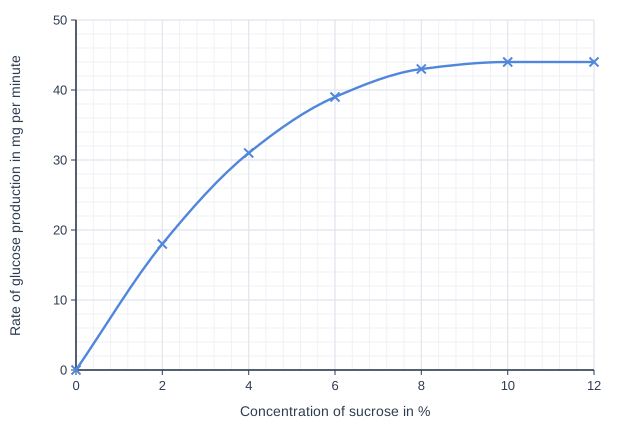
The graph shows the results.

Explain the effect of sucrose concentration on the rate of glucose production shown in the graph.

Line graph of rate of glucose production in mg per minute (y-axis, 0 to 50) against concentration of sucrose in % (x-axis, 0 to 12). The line is a smooth curve through (0, 0), (2, 18), (4, 31), (6, 39), (8, 43), (10, 44), (12, 44).

Model answer

As the sucrose concentration increases from 0 to about 8 %, the rate of glucose production increases. This is because there are more sucrose molecules, so they collide with the active sites of the invertase more often and more enzyme-substrate complexes form each minute. Above about 10 % the rate stays constant at 44 mg per minute. This is because all the active sites are occupied, so the concentration of invertase is now the limiting factor and adding more sucrose cannot increase the rate.

Explanation

At low substrate concentrations the rate is limited by how often substrate molecules meet active sites, so more substrate gives a faster rate. Once every active site is occupied (saturated), the enzyme concentration limits the rate and the graph levels off. A common error is to say the enzyme is denatured or the substrate runs out at high concentrations.

Mark scheme
  1. 1 mark

    as the sucrose concentration increases (from 0 to about 8 %), the rate (of glucose production) increases (1)

    An explanation linking the four points. accept any upper value from 6 % to 10 %

  2. 1 mark

    because there are more sucrose / substrate molecules, so more collisions with active sites / more enzyme-substrate complexes form (per minute) (1)

    ignore 'more sucrose to break down' on its own; ignore references to kinetic energy

  3. 1 mark

    at high concentrations / above about 10 % the rate levels off / stays constant (at 44 mg per minute) (1)

    accept plateaus; accept any value from 8 % to 10 %

  4. 1 mark

    because all the active sites are occupied / the enzyme concentration is the limiting factor (1)

    accept the enzyme is saturated / there are not enough enzyme molecules; do not accept the enzyme is denatured / the sucrose is used up

Ready to try the rest? Every answer you write is marked against the mark scheme, so you can see exactly where the marks are.

Study Helper Hints first, answers after you try

Stuck on this one? Ask for a hint and I’ll point you in the right direction, without giving the answer away. Once you’ve checked your answer, I’ll show you how the marks are awarded.