
Level:
Correct: 0
Incorrect: 0
Marks: 0/0
Exam Practice
Course:
Topics:
Avg
score:
–
Topics
done:
0/26

Ionic bonding

Practise 14 exam-style questions on Ionic bonding for Edexcel GCSE Combined Science (Chemistry Paper 2). Write your answer as you would in the exam and get it marked in seconds against the mark scheme, point by point, with the Study Helper on hand if you get stuck.

  • 14 questions
  • 1–6 marks each
  • Instant marking
  • No sign-up needed
14 questions, marked as you go

Sample questions with model answers

Here are 4 of the questions in this topic, each with a model answer, an explanation of why it earns the marks and the mark scheme an examiner would use.

Question 1

1 mark

Potassium oxide, K₂O, is an ionic compound. It forms when potassium atoms (2.8.8.1) transfer electrons to oxygen atoms (2.6).

How many electrons are transferred from potassium atoms to make one oxide ion?

Choose your answer.

  • A 1
  • B 2
  • C 6
  • D 8

Model answer

B (2)

Explanation

Each potassium atom (2.8.8.1) loses its one outer electron, and the oxygen atom (2.6) needs two more electrons to fill its outer shell, so two potassium atoms each transfer one electron to one oxygen atom. This is why the formula is K₂O: two K⁺ ions for each O²⁻ ion.

Mark scheme
  1. 1 mark

    B / 2 (1)

    The only correct answer is B. An oxygen atom has 6 outer electrons and gains 2 to fill its outer shell, forming O²⁻ (2.8); each of two potassium atoms gives it one electron. A is not correct because one electron is what each potassium atom loses, but the oxide ion needs two, one from each of two potassium atoms. C is not correct because 6 is the number of outer electrons the oxygen atom already has. D is not correct because 8 is the number of electrons in the full outer shell of the oxide ion, not the number transferred. Accept the letter or the option. If more than one option is given, do not award the mark.
Question 2

2 marks

Sodium and potassium are both metals in group 1. When the two metals are melted together, they mix, but they do not form an ionic compound.

Explain why sodium and potassium cannot form an ionic compound with each other.

Model answer

Sodium (2.8.1) and potassium (2.8.8.1) atoms each have one outer electron, which they lose to form positive ions. Neither atom would gain an electron, so no negative ions can form. Ionic bonding needs electrons to be transferred from one atom to another to make oppositely charged ions, so sodium and potassium cannot form an ionic compound.

Explanation

Ionic compounds form between a metal and a non-metal because the metal atoms lose electrons and the non-metal atoms gain them, making cations and anions that attract. Two metals both lose electrons, so there is nothing to accept them. A common error is to say that one of the metals gains an electron.

Mark scheme
  1. 1 mark

    atoms of both elements have one outer electron, which they lose (to get a full outer shell) / both form positive ions (1)

    An explanation linking two points. Allow 'both are metals, so both lose electrons'. Reject 'sodium gains an electron from potassium'.

  2. 1 mark

    neither atom gains electrons, so no negative ions / anions can form, and ionic bonding needs oppositely charged ions formed by electron transfer (1)

    Allow 'there is no atom to accept the electrons, so electrons cannot be transferred to make oppositely charged ions'. Ignore 'they are in the same group' on its own.

Question 3

3 marks

Sodium nitrate is used in some fertilisers, and sodium sulfate is used in some washing powders. Both are ionic compounds.

sodium ion: Na⁺
nitrate ion: NO₃⁻
sulfate ion: SO₄²⁻

A student wrote these formulae:
sodium nitrate NaNO₃
sodium sulfate NaSO₄

One of the student's formulae is wrong.

Identify the wrong formula, explain why it is wrong and give the correct formula.

Model answer

The formula of sodium sulfate, NaSO₄, is wrong. Sodium nitrate, NaNO₃, is correct, because one Na⁺ ion (1+) balances one NO₃⁻ ion (1-). But a sulfate ion has a charge of 2-, so one Na⁺ ion and one SO₄²⁻ ion would leave an overall charge of 1-. An ionic compound has no overall charge, so two Na⁺ ions (total 2+) are needed for each SO₄²⁻ ion (2-). The correct formula is Na₂SO₄.

Explanation

In the formula of an ionic compound the total positive charge must equal the total negative charge, so compare the charges of the ions before writing the numbers. A nitrate ion (1-) needs one 1+ ion, but a sulfate ion (2-) needs two, and as there is only one sulfate ion no bracket is needed: Na₂SO₄. Common errors are writing one of each ion whatever the charges, or putting the 2 on the sulfate ion instead, as in Na(SO₄)₂.

Mark scheme
  1. 1 mark

    (the formula of) sodium sulfate / NaSO₄ is wrong (1)

    Do not award this mark if NaNO₃ is said to be wrong, or if both formulae are said to be wrong.

  2. 1 mark

    the charges do not balance: one Na⁺ ion (1+) and one SO₄²⁻ ion (2-) would give an overall charge of 1- / two Na⁺ ions are needed to balance the charge on one SO₄²⁻ ion (1)

    Dependent on MP1. Allow 'the total positive charge (1+) does not equal the total negative charge (2-)'; allow 'sulfate has a 2- charge but nitrate has a 1- charge, so sodium sulfate needs twice as many sodium ions'. Do not accept 'it needs brackets', 'there should be two sulfate ions' or 'sodium ions have a 2+ charge'.

  3. 1 mark

    Na₂SO₄ (1)

    Accept Na2SO4. Ignore a bracket round the single sulfate ion, e.g. Na₂(SO₄). Do not accept NaSO₄₂ / Na(SO₄)₂ / Na₂(SO₄)₂ / Na²SO₄ / Na₂SO₄² or incorrect capital letters such as NA2SO4 / Na2So4. Ignore correct charges shown in the formula. The correct formula scores this mark even if MP1 or MP2 is not awarded.

Question 4

4 marks

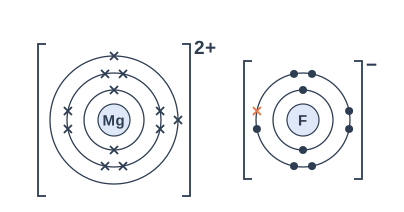
A student made the dot-and-cross diagram in Figure 1 to show the ions in magnesium fluoride, MgF₂. Electrons from magnesium are shown as crosses, and electrons from fluorine are shown as dots.

The student's diagram has two errors.

Identify each error and describe how it should be corrected.

Electron shell diagram: ion with Mg in the centre and electrons 2,8,2 drawn on 3 shells, in square brackets with charge 2+; ion with F in the centre and electrons 2,8 drawn on 2 shells, in square brackets with charge - (1 outer electron drawn as crosses to show it came from another atom).

Model answer

Error 1: the magnesium ion is shown with two crosses still in its third shell (2.8.2). A magnesium atom loses both of its outer electrons when it forms Mg²⁺, so the ion should be shown with only two shells, 2.8, and an empty third shell is not drawn.
Error 2: only one fluoride ion is shown. Each fluorine atom gains only one electron, so the magnesium atom gives one electron to each of two fluorine atoms. Two fluoride ions are needed, each 2.8 with one cross in its outer shell and a 1- charge, so that the charges balance (2+ and 2 × 1-).

Explanation

In a dot-and-cross diagram of an ionic compound, the metal ion has lost its outer electrons and the non-metal ions show the gained electrons in the other symbol. The number of each ion must match the formula: MgF₂ needs two F⁻ ions for each Mg²⁺. Students often leave the outer electrons on the metal ion or draw only one of each ion.

Mark scheme
  1. 1 mark

    (error 1) the magnesium ion still has 2 electrons in its outer (third) shell / is shown as 2.8.2 (1)

    Allow 'the magnesium ion is drawn like a magnesium atom'. The errors may be given in either order.

  2. 1 mark

    (correction) the magnesium ion should have no third shell / should be 2.8, because the atom loses both outer electrons (1)

    Allow 'remove the two crosses in the outer shell / show two shells with 2 and 8 crosses'. Do not accept 'the charge should be 0'.

  3. 1 mark

    (error 2) only one fluoride ion is shown / the charges shown do not balance (2+ and only one 1-) (1)

    Allow 'there is only one F⁻ for the Mg²⁺ ion'.

  4. 1 mark

    (correction) add a second fluoride ion, with one cross in its outer shell, so that there are two F⁻ ions for each Mg²⁺ ion (1)

    Allow 'there should be two F⁻ ions (2.8 with 7 dots and 1 cross)' / 'show 2[F]⁻'. A reason is not needed for this point, but allow 'because the magnesium atom gives one electron to each of two fluorine atoms / to balance the 2+ charge'. Do not accept 'the fluoride ion should have a 2- charge' or 'the fluoride ion should have two crosses'.

Ready to try the rest? Every answer you write is marked against the mark scheme, so you can see exactly where the marks are.

Study Helper Hints first, answers after you try

Stuck on this one? Ask for a hint and I’ll point you in the right direction, without giving the answer away. Once you’ve checked your answer, I’ll show you how the marks are awarded.