
Level:
Correct: 0
Incorrect: 0
Marks: 0/0
Exam Practice
Course:
Topics:
Avg
score:
–
Topics
done:
0/26

Exothermic and endothermic changes

Practise 16 exam-style questions on Exothermic and endothermic changes for Edexcel GCSE Combined Science (Chemistry Paper 2). Write your answer as you would in the exam and get it marked in seconds against the mark scheme, point by point, with the Study Helper on hand if you get stuck.

  • 16 questions
  • 1–6 marks each
  • Instant marking
  • No sign-up needed
16 questions, marked as you go

Sample questions with model answers

Here are 4 of the questions in this topic, each with a model answer, an explanation of why it earns the marks and the mark scheme an examiner would use.

Question 1

1 mark

Precipitation reactions can be exothermic. A student wants to measure the temperature change in a precipitation reaction.

Which pair of solutions should the student mix?

Choose your answer.

  • A HCl(aq) and NaOH(aq)
  • B AgNO₃(aq) and NaCl(aq)
  • C HNO₃(aq) and KOH(aq)
  • D KCl(aq) and NaNO₃(aq)

Model answer

B - AgNO₃(aq) and NaCl(aq).

Explanation

A precipitation reaction happens when two solutions are mixed and an insoluble product forms. Using the solubility rules, nitrates and most chlorides are soluble, but silver chloride is insoluble, so only B gives a precipitate. A and C are neutralisation reactions, which are also exothermic but are a different type of change.

Mark scheme
  1. 1 mark

    B / AgNO₃(aq) and NaCl(aq) (1)

    The only correct answer is B: silver nitrate and sodium chloride solutions react to form silver chloride, an insoluble salt, which forms as a precipitate. A is not correct because hydrochloric acid and sodium hydroxide react in a neutralisation, and the salt formed (sodium chloride) is soluble; C is not correct because nitric acid and potassium hydroxide also react in a neutralisation, and potassium nitrate is soluble; D is not correct because all the possible products (potassium nitrate and sodium chloride) are soluble, so no precipitate forms. Accept the letter or the option. If more than one option is given, do not award the mark.
Question 2

2 marks

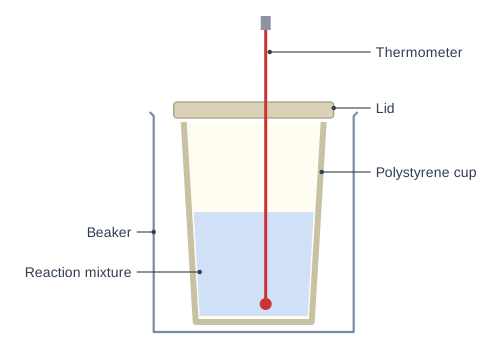
The diagram shows the apparatus a student uses to measure the temperature change when an acid is neutralised by an alkali.

Explain why the student uses a polystyrene cup with a lid, rather than an open glass beaker.

Diagram of a polystyrene cup calorimeter. Labelled parts: Thermometer, Lid, Polystyrene cup, Beaker, Reaction mixture.

Model answer

Polystyrene is a good thermal insulator and the lid covers the surface of the mixture. This reduces the heat energy transferred to the surroundings, so the temperature rise measured is closer to the true value.

Explanation

Heat energy given out by the reaction warms the mixture, but some is always transferred to the surroundings. Polystyrene is a thermal insulator and the lid stops heat escaping from the surface, so the loss is small and the measured temperature change is closer to the true value. An answer that only says 'it keeps the heat in' needs the reason (the insulating cup or the lid) or the effect on the measurement to score.

Mark scheme
  1. 1 mark

    polystyrene is a (good thermal) insulator / a poor conductor of heat (1)

    Any two from the three points; max 2. Allow 'polystyrene reduces heat transfer through the sides of the cup'. Do not accept 'polystyrene is not a conductor of electricity'.

  2. 1 mark

    the lid reduces heat loss from the surface (of the mixture) / reduces heat loss by evaporation / convection (1)

    Allow 'the lid stops heat escaping from the top'. Do not accept 'the lid stops the mixture spilling' or 'the lid keeps the mixture clean'.

  3. 1 mark

    the measured temperature change is more accurate / closer to the true value (because less heat is lost to the surroundings) (1)

    Allow 'less heat is lost, so the temperature rise measured is not lower than it should be'. 'It keeps the heat in' on its own does not score this point without the effect on the measurement. Ignore 'to make it a fair test'. Ignore 'safer'.

Question 3

3 marks

A student wrote this statement about a chemical reaction.

'Breaking bonds releases energy. So a reaction in which a lot of bonds are broken will always be exothermic.'

Explain what is wrong with the student's statement.

Model answer

Breaking bonds does not release energy: it takes in energy, so it is endothermic. Energy is released when new bonds are made in the products, which is exothermic. Whether the whole reaction is exothermic depends on the balance: it is exothermic only if more energy is released making the bonds in the products than is needed to break the bonds in the reactants, not on how many bonds are broken.

Explanation

The overall energy change depends on two opposite steps: bond breaking (energy in) and bond making (energy out). A reaction that breaks many bonds will often make many new bonds too, so only comparing the two energy totals tells you the overall change. Examiners often see 'it takes more energy to make bonds', which contradicts bond making being exothermic.

Mark scheme
  1. 1 mark

    breaking bonds takes in / requires energy / is endothermic (1)

    An explanation linking three points. Allow 'energy is needed to break bonds, it is not released'. Do not accept 'breaking bonds releases a small amount of energy'.

  2. 1 mark

    making bonds gives out / releases energy / is exothermic (1)

    Allow 'energy is released when new bonds form in the products'.

  3. 1 mark

    a reaction is exothermic only if more energy is released making the bonds (in the products) than is needed to break the bonds (in the reactants) / it depends on the balance between the two (1)

    Allow the reverse: 'if more energy is needed to break bonds than is released making bonds, the reaction is endothermic'. Allow 'the number of bonds broken does not decide it - it is the difference in energy'. Do not accept 'it takes more energy to make bonds than to break them' (making bonds releases energy).

Question 4

4 marks

A student added different masses of zinc powder to 25.0 cm³ portions of copper(II) sulfate solution in a polystyrene cup. A displacement reaction takes place.

zinc + copper(II) sulfate → zinc sulfate + copper

She stirred each mixture and measured the temperature rise.

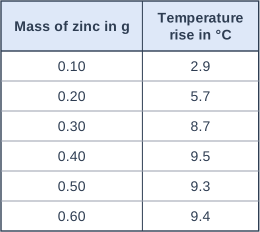
The table shows her results.

Explain the pattern in the results.

Table with columns "Mass of zinc in g", "Temperature rise in °C". Mass of zinc in g: 0.10; Temperature rise in °C: 2.9 | Mass of zinc in g: 0.20; Temperature rise in °C: 5.7 | Mass of zinc in g: 0.30; Temperature rise in °C: 8.7 | Mass of zinc in g: 0.40; Temperature rise in °C: 9.5 | Mass of zinc in g: 0.50; Temperature rise in °C: 9.3 | Mass of zinc in g: 0.60; Temperature rise in °C: 9.4.

Model answer

The displacement reaction is exothermic. From 0.10 g to 0.30 g of zinc, the temperature rise increases because more zinc reacts with the copper(II) sulfate, so more heat energy is given out. From 0.40 g onwards the temperature rise stays at about 9.4 °C. This is because all the copper(II) sulfate in the 25.0 cm³ has reacted, so the zinc is in excess: the extra zinc has nothing to react with and gives out no extra heat.

Explanation

While zinc is the limiting reactant, adding more zinc means more reaction and more heat energy. Once there is enough zinc to react with all the copper(II) sulfate (between 0.30 g and 0.40 g), the copper(II) sulfate becomes limiting and the temperature rise cannot increase any more. A common mistake is to say the zinc has 'run out' at the higher masses - it is the copper(II) sulfate that is used up.

Mark scheme
  1. 1 mark

    the (displacement) reaction is exothermic / gives out heat energy (1)

    An explanation linking four points. Allow 'heat is released when zinc displaces copper'. Do not accept 'endothermic'.

  2. 1 mark

    up to 0.30 g, the greater the mass of zinc, the more zinc reacts, so more heat energy is given out and the temperature rise increases (1)

    Allow 'from 0.10 g to 0.30 g the temperature rise increases (roughly in proportion to the mass) because more zinc reacts'. A description of the increase with no reason in terms of more reaction / more heat does not score.

  3. 1 mark

    from 0.40 g (onwards) the temperature rise stays (about) the same / levels off at about 9.4 °C (1)

    Allow any value from 9.3 to 9.5 °C, or 'the rise stops increasing'. Do not accept 'the temperature rise decreases'.

  4. 1 mark

    because all the copper(II) sulfate has reacted / the zinc is in excess (so the extra zinc does not react and no extra heat is given out) (1)

    Allow 'the copper sulfate is the limiting reactant / is used up'. Do not accept 'all the zinc has reacted' or 'the reaction has reached its maximum temperature'.

Ready to try the rest? Every answer you write is marked against the mark scheme, so you can see exactly where the marks are.

Study Helper Hints first, answers after you try

Stuck on this one? Ask for a hint and I’ll point you in the right direction, without giving the answer away. Once you’ve checked your answer, I’ll show you how the marks are awarded.