
Level:
Correct: 0
Incorrect: 0
Marks: 0/0
Exam Practice
Course:
Topics:
Avg
score:
–
Topics
done:
0/26

Ionic and simple molecular substances

Practise 12 exam-style questions on Ionic and simple molecular substances for Edexcel GCSE Combined Science (Chemistry Paper 2). Write your answer as you would in the exam and get it marked in seconds against the mark scheme, point by point, with the Study Helper on hand if you get stuck.

  • 12 questions
  • 1–6 marks each
  • Instant marking
  • No sign-up needed
12 questions, marked as you go

Sample questions with model answers

Here are 4 of the questions in this topic, each with a model answer, an explanation of why it earns the marks and the mark scheme an examiner would use.

Question 1

1 mark

Substances can be classified as ionic, simple molecular, giant covalent or metallic.

Which of these types of substance can never be an element?

Choose your answer.

  • A metallic
  • B simple molecular
  • C ionic
  • D giant covalent

Model answer

C ionic

Explanation

Elements can be metallic (sodium), simple molecular (chlorine) or giant covalent (diamond), but not ionic: ionic bonding needs electrons to be transferred from a metal atom to a non-metal atom, so an ionic substance always contains at least two elements. A common error is to think that 'simple molecular' and 'giant covalent' describe only compounds.

Mark scheme
  1. 1 mark

    C / ionic (1)

    The only correct answer is C: an ionic substance is made of oppositely charged ions, formed when electrons are transferred from atoms of a metal to atoms of a non-metal, so it always contains at least two different elements - it is always a compound. A is not correct because metals such as sodium and iron are elements with a metallic structure; B is not correct because elements such as hydrogen, oxygen and chlorine are simple molecular; D is not correct because diamond and graphite (forms of the element carbon) and silicon are elements with giant covalent structures. Accept the letter or the option. If more than one option is given, do not award the mark.
Question 2

2 marks

Calcium chloride and calcium carbonate are both ionic compounds that contain Ca²⁺ ions.

A student added 2 g of each compound to separate beakers, each containing 50 cm³ of deionised water, and stirred. She then dipped two electrodes, connected to a power supply and a bulb, into each beaker.

The bulb lit with the calcium chloride, but it did not light with the calcium carbonate.

Explain these results.

Model answer

Calcium chloride is soluble in water. When it dissolves, its Ca²⁺ and Cl⁻ ions separate and are free to move through the water, so they can carry the charge between the electrodes and the bulb lights. Calcium carbonate is insoluble, so it does not dissolve: its Ca²⁺ and CO₃²⁻ ions stay held in fixed positions in the solid lattice and cannot move. There are no ions free to carry the charge, so the bulb does not light.

Explanation

An ionic compound conducts only when its ions are free to move - when it is molten or dissolved. Testing a mixture with water therefore works only for a soluble ionic compound; an insoluble one, such as calcium carbonate, releases almost no ions into the water. A common error is to conclude that calcium carbonate is not ionic, or to say that electrons carry the charge through the solution.

Mark scheme
  1. 1 mark

    calcium chloride dissolves (in water), so its ions separate and are free to move (and carry the charge) (1)

    An explanation linking. accept calcium chloride is soluble, so Ca²⁺ and Cl⁻ ions can move through the solution / to the electrodes. 'calcium chloride contains ions' without dissolving or movement does not score. reject electrons move through the solution.

  2. 1 mark

    calcium carbonate is insoluble / does not dissolve, so its ions stay held in the solid (lattice) and cannot move (1)

    accept calcium carbonate releases (almost) no ions into the water / there are (almost) no ions free to move in the water. Both the insolubility and the idea that its ions are not free to move are needed. reject calcium carbonate is not ionic / has no ions / is made of molecules / is covalent (these contradict the question).

Question 3

3 marks

Liquid hydrogen is used as a fuel in some rockets. Hydrogen boils at -253 °C.

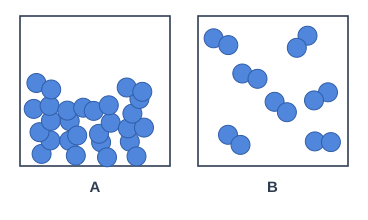
Figure 1 shows a model of the particles in liquid hydrogen (A) and in hydrogen gas (B).

Use Figure 1 and ideas about forces to explain why hydrogen has such a low boiling point.

Particle diagram: box A shows molecules made of two identical atoms joined together close together but randomly arranged; box B shows molecules made of two identical atoms joined together far apart and randomly arranged.

Model answer

Figure 1 shows that the particles in the gas are still pairs of hydrogen atoms, so the covalent bonds between the atoms in each H₂ molecule are not broken when hydrogen boils. Only the forces between the molecules (the intermolecular forces) are overcome as the molecules move apart. These intermolecular forces are very weak, so only a little energy is needed to overcome them, and hydrogen boils at a very low temperature.

Explanation

Boiling a simple molecular substance separates whole molecules from one another; the strong covalent bonds inside the molecules are not broken, as the model shows. The boiling point depends on the weak intermolecular forces, which need little energy to overcome. Writing that the covalent bonds break, or that intermolecular forces act between atoms, loses marks.

Mark scheme
  1. 1 mark

    (Figure 1 shows that) the hydrogen molecules / pairs of joined atoms are the same in the gas, so the covalent bonds (between the hydrogen atoms) are not broken when hydrogen boils (1)

    An explanation linking. accept the H₂ molecules stay intact / the molecules do not split into atoms. allow hydrogen is (simple) molecular / is made of small H₂ molecules. reject the covalent bonds break / hydrogen atoms separate when it boils.

  2. 1 mark

    only the (weak) forces between the molecules / intermolecular forces are overcome (1)

    allow weak intermolecular bonds / weak bonds between molecules. reject weak covalent bonds / forces between atoms / forces between bonds.

  3. 1 mark

    these forces are (very) weak, so only a little energy is needed to overcome them (1)

    accept only a small amount of (heat) energy is needed. ignore 'less energy' without a comparison; ignore 'easy to break' or 'low temperature' without reference to energy.

Question 4

4 marks

Ionic liquids are ionic compounds that are liquids at room temperature. They are made of large positive and negative ions, and some are being tested as electrolytes in batteries.

One ionic liquid melts at -12 °C. Hexane, C₆H₁₄, is a simple molecular compound that melts at -95 °C. Both are liquids at 20 °C.

Potassium iodide is an ionic compound that is a solid at 20 °C.

Explain why, at 20 °C, the ionic liquid conducts electricity but solid potassium iodide and liquid hexane do not.

Model answer

The ionic liquid is made of positive and negative ions. Because it is a liquid, the ions are free to move, so they can carry the charge and the ionic liquid conducts. Potassium iodide also contains ions, but at 20 °C it is a solid, so its ions are held in fixed positions in the lattice by strong electrostatic forces and cannot move; solid potassium iodide does not conduct. Hexane is a liquid, but it is made of molecules with no overall charge. It contains no ions, and all its outer electrons are in covalent bonds, so there are no delocalised electrons. With no charged particles that can move, hexane does not conduct.

Explanation

Two conditions are needed for conduction: charged particles must be present and they must be able to move. The ionic liquid has both; solid potassium iodide has ions that cannot move; liquid hexane can flow but has no charged particles. This shows that being a liquid is not enough - the type of particle matters.

Mark scheme
  1. 1 mark

    the ionic liquid contains (positive and negative) ions (1)

    An explanation linking any four from the five points; max 4. To score 4 marks, the answer must refer to all three substances.

  2. 1 mark

    the ions in the (ionic) liquid are free to move and carry the charge (1)

    accept the ions can move to the electrodes. reject electrons move in the ionic liquid.

  3. 1 mark

    in solid potassium iodide the ions are held in fixed positions (in a lattice) / can only vibrate, so they cannot carry the charge (1)

    accept the ions are held by strong electrostatic forces, so they cannot move. reject potassium iodide has no ions / is made of molecules.

  4. 1 mark

    hexane is made of (covalent) molecules with no overall charge / contains no ions (1)

    accept hexane is simple molecular, so it has no ions. reject hexane is ionic.

  5. 1 mark

    hexane has no delocalised electrons (all its outer electrons are in covalent bonds), so it has no charged particles that can move (1)

    accept no free / mobile charged particles in hexane. ignore 'no free electrons' on its own.

Ready to try the rest? Every answer you write is marked against the mark scheme, so you can see exactly where the marks are.

Study Helper Hints first, answers after you try

Stuck on this one? Ask for a hint and I’ll point you in the right direction, without giving the answer away. Once you’ve checked your answer, I’ll show you how the marks are awarded.