Level:
Correct: 0
Incorrect: 0
Marks: 0/0
Exam Practice
Course:
Topics:
Avg
score:
–
Topics
done:
0/26

Core practical: rates of reaction

Practise 17 exam-style questions on Core practical: rates of reaction for Edexcel GCSE Combined Science (Chemistry Paper 2). Write your answer as you would in the exam and get it marked in seconds against the mark scheme, point by point, with the Study Helper on hand if you get stuck.

  • 17 questions
  • 1–6 marks each
  • Instant marking
  • No sign-up needed
17 questions, marked as you go

Sample questions with model answers

Here are 4 of the questions in this topic, each with a model answer, an explanation of why it earns the marks and the mark scheme an examiner would use.

Question 1

1 mark

Iodine solution is yellow-brown. In the presence of an acid, iodine reacts with propanone to form colourless products. No gas and no precipitate are formed.

Which method could be used to measure the rate of this reaction?

Choose your answer.

  • A collect gas in a gas syringe
  • B record the loss in mass
  • C time until the mixture is colourless
  • D time until a cross is hidden

Model answer

C - time until the mixture is colourless.

Explanation

To choose a method, look for something that changes and can be measured over time: a gas (volume or mass loss), a precipitate (a disappearing cross) or a colour. Here only the colour changes, so the time for the colour to disappear measures the rate.

Mark scheme
  1. 1 mark

    C / time until the mixture is colourless (1)

    The only correct answer is C: the colour fades as the iodine is used up, so the time taken for the yellow-brown colour to disappear can be measured (rate = 1/time). A is not correct because no gas is produced, so there is nothing to collect; B is not correct because no gas leaves the flask, so the mass does not change; D is not correct because no precipitate forms, so the mixture never becomes cloudy - a cross under the flask becomes easier to see as the colour fades. Accept the letter or the option. If more than one option is given, do not award the mark.
Question 2

2 marks

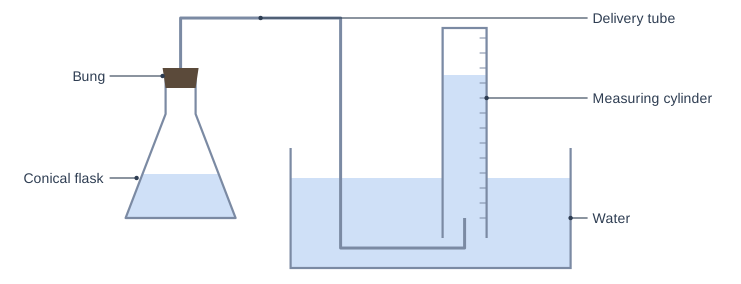
Kofi reacted marble chips with dilute hydrochloric acid and collected the carbon dioxide in an upside-down measuring cylinder full of water, standing in a trough of water, as shown in the diagram.

Ellie used a gas syringe instead, with the same amounts of the same reactants. Kofi's final volume of gas was lower than Ellie's.

Explain why Ellie's gas syringe gave the more accurate final volume.

Diagram of collecting a gas over water in an upside-down measuring cylinder. Labelled parts: Delivery tube, Measuring cylinder, Water, Bung, Conical flask.

Model answer

Carbon dioxide is slightly soluble in water. When it is collected over water, some of the gas dissolves in the water in the trough and measuring cylinder, so it is not measured and the volume is too low. In a gas syringe the gas does not pass through water, so all of it is measured.

Explanation

Collecting a gas over water only works well for gases that are almost insoluble, such as hydrogen. Carbon dioxide dissolves a little, so some is lost into the water and the measured volume is too low. A gas syringe avoids this.

Mark scheme
  1. 1 mark

    carbon dioxide is (slightly) soluble in water (1)

    An explanation linking. accept 'carbon dioxide dissolves in water'.

  2. 1 mark

    so some of the gas dissolves in the water (in the trough / measuring cylinder) and is not measured / in the gas syringe the gas does not bubble through water, so it is all measured (1)

    Mark independently. Ignore references to the resolution of the apparatus or to gas escaping while the bung is put in (this happens with both methods). Do not accept 'the gas escapes from the water' or 'the water reacts with the gas'.

Question 3

3 marks

Leo added 8.0 g of marble chips (an excess) to 40 cm³ of dilute hydrochloric acid in a conical flask on a balance. He recorded the mass of the flask and its contents every 30 s.

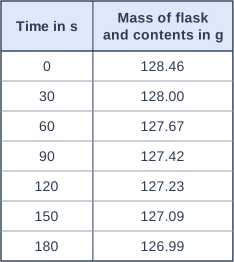
The table shows his results for the first 3 minutes.

Calculate the mean rate of reaction over the first 60 s, in g/s.

Give your answer to 2 significant figures.

Table with columns "Time in s", "Mass of flask and contents in g". Time in s: 0; Mass of flask and contents in g: 128.46 | Time in s: 30; Mass of flask and contents in g: 128.00 | Time in s: 60; Mass of flask and contents in g: 127.67 | Time in s: 90; Mass of flask and contents in g: 127.42 | Time in s: 120; Mass of flask and contents in g: 127.23 | Time in s: 150; Mass of flask and contents in g: 127.09 | Time in s: 180; Mass of flask and contents in g: 126.99.

Model answer

Mass lost in the first 60 s = 128.46 - 127.67 = 0.79 g
Mean rate = 0.79 ÷ 60 = 0.01317 g/s
Mean rate = 0.013 g/s (2 significant figures)

Explanation

The mass falls because carbon dioxide escapes from the flask, so the mass lost in a time is the mass of carbon dioxide made in that time, and mean rate = mass lost ÷ time. A common error is to divide the balance reading itself by the time. Note that 0.01 is only 1 significant figure; 0.013 has 2.

Mark scheme
  1. 1 mark

    (mass lost =) 128.46 - 127.67 = 0.79 (g) (1)

    0.013 g/s with or without working scores 3.

  2. 1 mark

    (mean rate =) 0.79 ÷ 60 = 0.01316... (g/s) (1)

    allow ecf from an incorrect mass lost divided by 60. Dividing a balance reading by the time (e.g. 127.67 ÷ 60 = 2.13) is a wrong method and scores 0. Inverting the fraction (60 ÷ 0.79 = 76) scores MP1 only.

  3. 1 mark

    0.013 (g/s) (1)

    The answer must be given to 2 significant figures for this mark: 0.0132 or 0.01317 scores 2; 0.01 (1 significant figure) scores 2 only if the working is seen. allow 1.3 × 10⁻² g/s. allow ecf for a correct 2 significant figure rounding of their own value.

Question 4

4 marks

Excess marble chips were added to dilute hydrochloric acid. The volume of carbon dioxide was measured every 20 s.

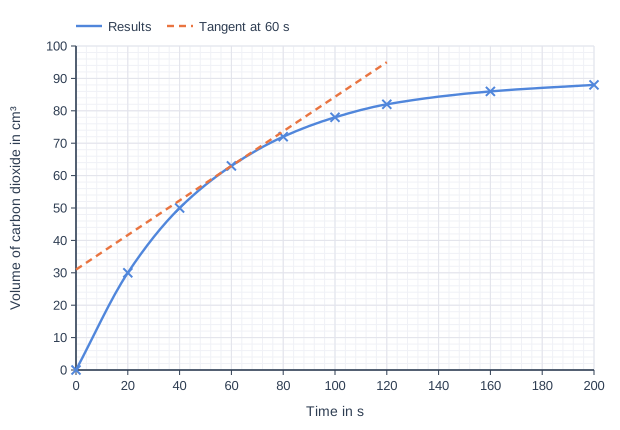
The graph shows the results. A tangent has been drawn to the curve at 60 s.

Calculate:
- the rate of reaction at 60 s, using the tangent
- the mean rate of reaction over the first 60 s.

Explain why the two values are different.

Line graph of volume of carbon dioxide in cm³ (y-axis, 0 to 100) against time in s (x-axis, 0 to 200). "Results" is a smooth curve through (0, 0), (20, 30), (40, 50), (60, 63), (80, 72), (100, 78), (120, 82), (160, 86), (200, 88). "Tangent at 60 s" (dashed) joins the points (0, 31), (120, 95).

Model answer

Gradient of tangent = (95 - 31) ÷ (120 - 0) = 64 ÷ 120 = 0.53 cm³/s, so the rate at 60 s is 0.53 cm³/s.
Mean rate over the first 60 s = 63 ÷ 60 = 1.05 cm³/s.
The rate is fastest at the start, when the acid is most concentrated, and decreases as the acid is used up. The mean rate over the first 60 s includes the fast early part of the reaction, so it is higher than the rate at 60 s.

Explanation

The rate at an instant is the gradient of the tangent at that time; the mean rate over an interval is the total change in volume divided by the time. Because the curve gets less steep as the reaction goes on, the rate at 60 s (0.53 cm³/s) is only about half the mean rate for the first 60 s (1.05 cm³/s). A common error is to divide time by volume.

Mark scheme
  1. 1 mark

    (from the tangent) change in volume = 95 - 31 = 64 (cm³) and change in time = 120 - 0 = 120 (s) (1)

    0.53 cm³/s with or without working scores MP1 and MP2. allow the change in volume and the change in time between any two points read from the tangent.

  2. 1 mark

    (rate at 60 s =) 64 ÷ 120 = 0.53 (cm³/s) (1)

    accept 0.533. accept values from 0.51 to 0.55 from points read off the tangent. Inverting the gradient (120 ÷ 64 = 1.9) scores MP1 only. Using 95 ÷ 120 (not a change in volume) scores 0 for MP1 and MP2.

  3. 1 mark

    (mean rate =) 63 ÷ 60 = 1.05 / 1.1 (cm³/s) (1)

    1.05 or 1.1 with or without working scores this mark.

  4. 1 mark

    the rate is fastest at the start and decreases (as the acid is used up), so the mean over the first 60 s includes the faster early part (1)

    accept 'the curve gets less steep with time, so the gradient at 60 s is less than the average gradient over the first 60 s'. Do not accept 'the rate at 60 s is lower than the mean' or 'the mean rate is an average' without saying how the rate changes.

Ready to try the rest? Every answer you write is marked against the mark scheme, so you can see exactly where the marks are.

Study Helper Hints first, answers after you try

Stuck on this one? Ask for a hint and I’ll point you in the right direction, without giving the answer away. Once you’ve checked your answer, I’ll show you how the marks are awarded.