
Level:
Correct: 0
Incorrect: 0
Marks: 0/0
Exam Practice
Course:
Topics:
Avg
score:
–
Topics
done:
0/26

Group 7: the halogens

Practise 15 exam-style questions on Group 7: the halogens for Edexcel GCSE Combined Science (Chemistry Paper 2). Write your answer as you would in the exam and get it marked in seconds against the mark scheme, point by point, with the Study Helper on hand if you get stuck.

  • 15 questions
  • 1–6 marks each
  • Instant marking
  • No sign-up needed
15 questions, marked as you go

Sample questions with model answers

Here are 4 of the questions in this topic, each with a model answer, an explanation of why it earns the marks and the mark scheme an examiner would use.

Question 1

1 mark

The melting points of three halogens are:
chlorine -101.5 °C   bromine -7.2 °C   iodine 113.7 °C

Astatine (At) lies directly beneath iodine in the halogen group.

Which is the most likely melting point of astatine?

Choose your answer.

  • A -150 °C
  • B 0 °C
  • C 100 °C
  • D 300 °C

Model answer

D - 300 °C.

Explanation

Down group 7 the melting point rises and each step is larger than the one before, so astatine, below iodine, must melt well above 113.7 °C. The Royal Society of Chemistry gives a melting point of about 300 °C for astatine. Only one option is above iodine's value, so the trend alone gives the answer.

Mark scheme
  1. 1 mark

    D / 300 °C (1)

    The only correct answer is D: melting points increase down group 7 (by about 94 °C from chlorine to bromine and 121 °C from bromine to iodine), so astatine's melting point should be well above iodine's 113.7 °C. A is not correct because it is below chlorine's melting point, which reverses the trend. B is not correct because it is between bromine and iodine, not above iodine. C is not correct because it is below iodine's melting point. Accept the letter or the option. If more than one option is given, do not award the mark.
Question 2

2 marks

When hot iron wool is placed in chlorine gas, the iron glows and brown iron(III) chloride, FeCl₃, is formed.

Write a balanced equation for the reaction of iron with chlorine.

Model answer

2Fe + 3Cl₂ → 2FeCl₃

Explanation

Chlorine is made of diatomic molecules, Cl₂, so each molecule provides two chlorine atoms; two FeCl₃ units need six chlorine atoms, which is three Cl₂ molecules. Examiners' reports note that many students write halogens as single atoms (Cl instead of Cl₂), which makes the equation wrong.

Mark scheme
  1. 1 mark

    correct formulae: Fe + Cl₂ → FeCl₃ (1)

    All three formulae must be correct and on the correct sides, with no other substances. Accept formulae typed as plain text (Cl2, FeCl3) and -> or = for the arrow. Do not accept Cl or Cl₃ for chlorine, or Fe₃ for iron. Ignore state symbols.

  2. 1 mark

    balancing: 2Fe + 3Cl₂ → 2FeCl₃ (1)

    Dependent on the correct formulae (MP1): balancing of correct formulae only. Allow multiples, and allow Fe + 1½Cl₂ → FeCl₃.

Question 3

3 marks

A teacher heats iron wool in chlorine gas, bromine vapour and iodine vapour in three separate tubes in a fume cupboard.

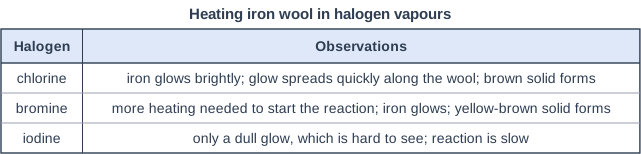
The table shows the teacher's observations.

Describe the pattern in reactivity shown by the observations.

Predict how fluorine would react with iron wool, and name the product.

Heating iron wool in halogen vapours. Table with columns "Halogen", "Observations". Halogen: chlorine; Observations: iron glows brightly; glow spreads quickly along the wool; brown solid forms | Halogen: bromine; Observations: more heating needed to start the reaction; iron glows; yellow-brown solid forms | Halogen: iodine; Observations: only a dull glow, which is hard to see; reaction is slow.

Model answer

The reactions get less vigorous from chlorine to bromine to iodine, so the reactivity of the halogens decreases down the group. Fluorine is above chlorine, so I predict that it reacts even more vigorously than chlorine, probably without needing to heat the iron. The product would be iron fluoride (iron(III) fluoride, FeF₃).

Explanation

The brightness of the glow and the heating needed show how vigorously each halogen reacts: chlorine reacts most vigorously and iodine least. Every halogen reacts with metals to form a metal halide, so fluorine forms iron fluoride. The pattern places fluorine at the top of the order, so its reaction is predicted to be the most vigorous.

Mark scheme
  1. 1 mark

    reactivity decreases down the group / chlorine is the most reactive and iodine the least reactive (1)

    Accept 'chlorine > bromine > iodine' or 'the reaction gets less vigorous from chlorine to iodine'. Do not accept 'reactivity increases down the group'.

  2. 1 mark

    fluorine would react (even) more vigorously than chlorine (1)

    Accept 'fluorine would react with the iron wool without heating / the iron would burst into flame'. Do not accept 'fluorine would not react' or 'less vigorously than iodine'.

  3. 1 mark

    iron fluoride (1)

    Accept iron(III) fluoride or FeF₃. Do not accept iron fluorine, fluoride on its own or iron chloride.

Question 4

4 marks

The melting points and boiling points of two halogens are shown.

chlorine: melting point -101.5 °C, boiling point -34.0 °C
bromine: melting point -7.2 °C, boiling point 58.8 °C

Samples of chlorine and bromine are cooled to -50 °C.

Predict the physical state of chlorine and the physical state of bromine at -50 °C. Explain your answers.

Model answer

Chlorine is a liquid at -50 °C, because -50 °C is above its melting point (-101.5 °C) but below its boiling point (-34.0 °C). Bromine is a solid at -50 °C, because -50 °C is below its melting point (-7.2 °C).

Explanation

A substance is a solid below its melting point, a liquid between its melting point and boiling point, and a gas above its boiling point. Careful comparison of negative numbers is needed: -50 °C is lower than -34.0 °C, so chlorine has condensed, but higher than -101.5 °C, so it has not frozen. A common error is to assume that chlorine is always a gas because it is a gas at room temperature.

Mark scheme
  1. 1 mark

    chlorine is a liquid (1)

    Do not accept gas or solid.

  2. 1 mark

    (because) -50 °C is between the melting point (-101.5 °C) and the boiling point (-34.0 °C) of chlorine (1)

    Dependent on 'liquid' (MP1). Accept 'it is below the boiling point but above the melting point' or 'it has condensed but not frozen'. Do not accept a reason that only mentions one of the two values, e.g. 'it is below its boiling point'.

  3. 1 mark

    bromine is a solid (1)

    Do not accept liquid or gas.

  4. 1 mark

    (because) -50 °C is below the melting point of bromine (-7.2 °C) (1)

    Dependent on 'solid' (MP3). Accept 'bromine freezes at -7.2 °C, so at -50 °C it has frozen'.

Ready to try the rest? Every answer you write is marked against the mark scheme, so you can see exactly where the marks are.

Study Helper Hints first, answers after you try

Stuck on this one? Ask for a hint and I’ll point you in the right direction, without giving the answer away. Once you’ve checked your answer, I’ll show you how the marks are awarded.