Level:
Correct: 0
Incorrect: 0
Marks: 0/0
Exam Practice
Subject:
Topics:
AQA GCSE History (Restoration England) Smart practice A mixed round aimed at your weak spots
Unit 1
Part one: Crown, Parliament, plots and court life
Unit 2
Part two: Life in Restoration England
Life in Restoration England
Crisis
0%
Restoration culture
0%
Unit 3
Part three: Land, trade and war
Unit 4
Part four: The historic environment of Restoration England
Avg
score:
–
Topics
done:
0/10

Trade

Practise 41 exam-style questions on Trade for AQA GCSE History (Restoration England). Write your answer as you would in the exam and get it marked in seconds against the mark scheme, point by point, with an AI tutor on hand if you get stuck.

  • 41 questions
  • 1–16 marks each
  • Instant marking
  • No sign-up needed
20 questions, marked as you go

Sample questions with model answers

Here are 4 of the questions in this topic, each with a model answer, an explanation of why it earns the marks and the mark scheme an examiner would use.

Question 1

2 marks

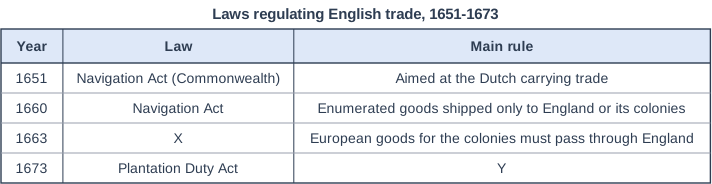
Figure 1 is a table of laws regulating English trade between 1651 and 1673.

What should replace X and Y in the table?

Laws regulating English trade, 1651-1673. Table with columns "Year", "Law", "Main rule". Year: 1651; Law: Navigation Act (Commonwealth); Main rule: Aimed at the Dutch carrying trade | Year: 1660; Law: Navigation Act; Main rule: Enumerated goods shipped only to England or its colonies | Year: 1663; Law: X; Main rule: European goods for the colonies must pass through England | Year: 1673; Law: Plantation Duty Act; Main rule: Y.

Model answer

X is the Staple Act of 1663. Y is that duties had to be paid on enumerated goods such as tobacco and sugar shipped from one English colony to another, collected by customs officers in the colonies.

Explanation

The Staple Act (1663) made the colonies buy European goods through England, so English merchants and the customs gained. The Plantation Duty Act (1673) closed a loophole: colonists had shipped tobacco to another colony and then on to Europe, so a duty was charged on goods traded between colonies and collectors were sent out to enforce it.

Mark scheme
  1. 1 mark

    X: the Staple Act (1663).

    Accept the Act for the Encouragement of Trade (1663) / the second Navigation Act / the 1663 Navigation Act. Do not accept the Plantation Duty Act or the Navigation Act of 1660.

  2. 1 mark

    Y: it put duties (taxes) on enumerated goods shipped from one English colony to another (unless they were taken on to England), collected by customs officers appointed in the colonies.

    Accept any clear version of the main rule, e.g. 'colonists had to pay a duty if they sent sugar or tobacco to another colony' / 'to stop colonists avoiding the rules by trading between colonies'. Do not accept a rule from another Act.

Question 2

8 marks

Explain what was important about the growth of the re-export trade for England in the years 1660-1685.

Model answer

The re-export trade was important first because it made London one of Europe's great trading centres. Under the Navigation Act of 1660, enumerated colonial goods such as sugar and tobacco had to be shipped to England, so English merchants, not the Dutch, sold them on to the rest of Europe. The East India Company also brought calico and pepper to London for re-sale. Re-exports grew so fast that by about 1700 they made up nearly a third of all English exports. London's merchants, warehouses and shipping prospered, and after the Fire the Royal Exchange was rebuilt and reopened in 1669 as the centre of this business.

Secondly, the re-export trade strengthened the Crown's finances. Goods had to pass through English ports, so customs duties were paid on them, and from 1671 customs commissioners collected these duties directly for the king. In the trade boom of the 1680s customs revenue rose sharply, which helped Charles II to rule without Parliament from 1681.

Thirdly, it boosted shipping and industry. More cargoes meant more voyages for English ships, contributing to the growth of the merchant fleet to an estimated 340,000 tons by 1686, and it encouraged new industries such as sugar refining and tobacco processing. England began to take over part of the Dutch role as the warehouse of Europe, especially when the Dutch and French were at war between 1674 and 1678 while England stayed neutral.

The most important result was the boost to royal revenue, because it gave Charles independence from Parliament in his last years. But this wealth also depended on sugar and tobacco grown by enslaved Africans on colonial plantations.

Explanation

Because the Navigation Acts forced colonial goods through England, London became a centre for re-exporting sugar, tobacco and Asian goods, enriching merchants, expanding shipping and raising customs revenue that helped Charles rule without Parliament after 1681. Level 4 explains several consequences and links them or judges which mattered most.

Mark scheme
  1. 8 marks

    Levels of response (8 marks).
    Level 4 (7-8 marks): Complex explanation of the importance of the re-export trade, e.g. explains how the Navigation Acts channelled colonial and Asian goods through England, and how re-exports enriched London merchants, increased shipping and customs revenue and strengthened the Crown's finances, linking these or judging which mattered most, supported by precise knowledge.
    Level 3 (5-6 marks): Developed explanation of two or more ways the re-export trade was important, supported by specific knowledge.
    Level 2 (3-4 marks): Simple explanation of one way, e.g. that merchants made money selling sugar and tobacco to Europe.
    Level 1 (1-2 marks): Basic explanation: general statements about trade, with little specific knowledge.
    0 marks: nothing worthy of credit.

    Indicative content (not a checklist; credit other valid points): What it was - goods imported into England and sold on to Europe: sugar and tobacco from the colonies (enumerated goods had to come to England under the 1660 Act), calico, pepper and other goods brought by the East India Company, furs from Hudson's Bay; it grew from small beginnings to nearly a third of English exports by about 1700. Importance for London - merchants, warehouses and shipping on the Thames; London's growth as a commercial centre; the Royal Exchange rebuilt after the Fire (reopened 1669); coffee houses used for business and shipping news. Shipping - more voyages for English ships; the merchant fleet about 340,000 tons by 1686. Crown finances - customs duties on imports (part refunded on re-export) raised revenue; customs collected directly by commissioners from 1671; rising customs in the trade boom of the 1680s helped Charles rule without Parliament from 1681. Economy - processing industries (sugar refining, tobacco curing and cutting); capital for banking (goldsmith bankers) and later investment; a 'commercial revolution'. Rivalry - England took over some of the Dutch role as Europe's warehouse; profits during English neutrality while the Dutch and French fought (1674-78). Wider - depended on the slave-worked sugar and tobacco plantations.

Question 3

8 marks

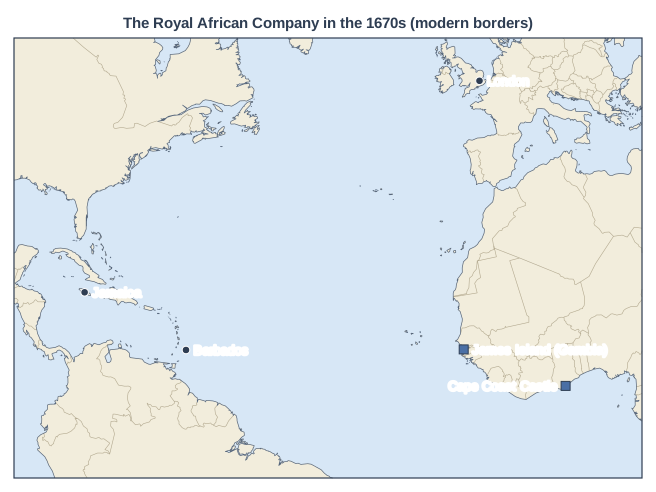
Figure 1 is a map showing some places connected with the Royal African Company in the 1670s.

Explain what was important about the Royal African Company for the English slave trade.

Map of the area from 85°W to 10°E and from 5°S to 56°N, titled "The Royal African Company in the 1670s (modern borders)". Points: a dot labelled "London" in the United Kingdom; a blue square labelled "James Island (Gambia)" on the coast of the Gambia; a blue square labelled "Cape Coast Castle" in Ghana; a dot labelled "Barbados" in Barbados; a dot labelled "Jamaica" in Jamaica.

Model answer

The Royal African Company was important first because it organised the English slave trade on a large scale. Chartered in 1672, it replaced the Company of Royal Adventurers, which had been ruined by losses in the Second Dutch War. The new company had a monopoly of English trade with West Africa. As Figure 1 shows, it held forts and trading posts such as Cape Coast Castle on the Gold Coast, its headquarters, and James Island in the Gambia, where its agents exchanged English cloth, metal goods and guns for enslaved Africans, gold and ivory. These permanent bases allowed it to trade far more than individual merchants could.

Secondly, it supplied the plantation colonies. By the 1680s the Company was carrying about 5,000 enslaved Africans a year across the Atlantic, mainly to Barbados and Jamaica, where they were forced to work on sugar plantations. Many died on the Middle Passage. This supply of enslaved labour allowed the sugar colonies to grow rapidly, which in turn increased trade and customs revenue in England.

Thirdly, the Company tied the Crown closely to the slave trade. James, Duke of York, was its governor and leading shareholder, and many courtiers and merchants invested. Enslaved people bought by the Company were often branded with the letters DY or RAC. Gold from its trade was used to make the guinea coin.

However, the Company never fully controlled the trade. Independent 'interlopers', including Bristol merchants, broke its monopoly, and planters complained that it charged too much. Even so, it was the largest single English slave-trading organisation of the period and made London the centre of the trade, so it played a central part in making England one of the leading slave-trading nations.

Explanation

The Royal African Company (1672) organised the trade through a royal monopoly, forts such as Cape Coast Castle and James Island, and regular shipments (about 5,000 enslaved Africans a year by the 1680s) to the sugar colonies, with the Duke of York as governor; interlopers limited its monopoly. Level 4 explains several consequences and links them or weighs its importance.

Mark scheme
  1. 8 marks

    Levels of response (8 marks).
    Level 4 (7-8 marks): Complex explanation of the importance of the Royal African Company, e.g. explains how its royal charter and monopoly organised and expanded the trade, how its forts and ships made large-scale trading possible, how it supplied the sugar colonies, and how it tied the Crown to the slave trade, linking these or judging its importance against the role of interlopers, supported by precise knowledge.
    Level 3 (5-6 marks): Developed explanation of two or more ways the Company was important, supported by specific knowledge.
    Level 2 (3-4 marks): Simple explanation of one way, e.g. that it had a monopoly of the trade.
    Level 1 (1-2 marks): Basic explanation: general statements about the slave trade, with little specific knowledge.
    0 marks: nothing worthy of credit.

    Indicative content (not a checklist; credit other valid points): Origins - replaced the Company of Royal Adventurers into Africa (1660, rechartered 1663), ruined by the Second Dutch War; chartered in 1672 with a monopoly of English trade with West Africa. Royal links - James, Duke of York, was its governor and leading shareholder; other investors included courtiers and merchants (and the philosopher John Locke); enslaved people bought by the Company were often branded with the letters DY or RAC; the Crown gained from the gold (used for guineas) and from customs on plantation goods. Organisation - forts and trading posts: Cape Coast Castle on the Gold Coast (its headquarters), James Island in the Gambia, and others; ships, agents, trade goods (cloth, metal goods, guns, alcohol) exchanged for enslaved Africans, gold, ivory and dyewood. Scale - by the 1680s it was carrying about 5,000 enslaved Africans a year across the Atlantic, mainly to Barbados and Jamaica; a high proportion died on the Middle Passage. Effects - supplied labour for sugar and tobacco plantations, fuelling the growth of the Caribbean colonies; made London the centre of the English slave trade. Limits - interlopers (independent traders, including Bristol merchants) broke the monopoly; planters complained of high prices and too few people supplied; Dutch competition; the monopoly lost support after 1688 and ended in 1698.

Question 4

16 marks

'The Navigation Acts brought England more benefits than problems in the years 1660-1685.'

How far do you agree with this statement? Explain your answer.

Model answer

The Navigation Acts brought England serious problems, especially war with the Dutch and resentment in the colonies, but I agree with the statement because their benefits for English shipping, trade and royal revenue were greater and longer lasting.

The first major benefit was the growth of English shipping. The Act of 1660 required colonial trade to be carried in English ships with mainly English crews and barred foreigners from the coastal trade. Historians estimate that the merchant fleet grew from about 115,000 tons in 1629 to about 340,000 tons by 1686. This meant more work for shipbuilders and sailors, and a larger pool of seamen who could be pressed into the navy in wartime.

A second benefit was the growth of trade and revenue. Because enumerated goods such as sugar and tobacco had to come to England, London became a centre for re-exporting them to Europe, and by about 1700 re-exports made up nearly a third of English exports. Every cargo paid customs duties, which were collected directly by royal commissioners from 1671. In the trade boom of the 1680s customs revenue rose so much that, together with French subsidies, it allowed Charles II to rule without Parliament after 1681.

However, the Acts also caused problems. They sharpened rivalry with the Dutch and helped cause two wars. The Second Dutch War was very expensive: Parliament voted about 2.5 million pounds in 1664, and the war ended in humiliation when the Dutch raided the Medway in 1667 and towed away the Royal Charles. At the Treaty of Breda England even had to relax the Navigation Act. The cost of the wars added to the Crown's debts, which led to the Stop of the Exchequer in 1672.

The Acts also caused trouble in the colonies. Tobacco planters in Virginia suffered low prices, and New England merchants evaded the rules so openly that the government passed the Plantation Duty Act of 1673 and sent Edward Randolph to Massachusetts in 1676; its charter was revoked in 1684. Scots, excluded from English colonial trade, also resented the Acts.

Overall, the benefits outweighed the problems. The wars had several causes besides the Acts, such as rivalry in Africa and Charles's alliance with France, and many of the colonial problems fell on colonists rather than on England. By contrast, the growth of shipping, the re-export trade and customs revenue lasted and laid the foundation for England's later commercial and naval power. The Acts benefited English merchants and the Crown far more than they harmed England, even if colonists and taxpayers paid part of the price.

Explanation

Benefits: shipping (about 340,000 tons by 1686), seamen for the navy, re-exports, customs revenue that helped Charles rule alone after 1681. Problems: the costly Dutch Wars, the Medway humiliation and Breda concession, debts, colonial resentment and evasion. Level 4 weighs these, considers who gained and lost, and reaches a sustained judgement.

Mark scheme
  1. 16 marks

    Levels of response (16 marks).
    Level 4 (13-16 marks): Complex explanation of the benefits and the problems the Navigation Acts brought England, with a sustained judgement about whether the benefits outweighed the problems, supported by precise knowledge of shipping, revenue, re-exports, colonial relations and war with the Dutch.
    Level 3 (9-12 marks): Developed explanation of benefits and at least one problem (or vice versa), supported by specific knowledge.
    Level 2 (5-8 marks): Simple explanation of one or more benefits or problems.
    Level 1 (1-4 marks): Basic explanation: general statements about the Navigation Acts, with limited knowledge.
    0 marks: nothing worthy of credit.

    Indicative content (not a checklist; credit other valid points): Benefits - growth of English merchant shipping (about 115,000 tons in 1629, about 340,000 tons by 1686, historians' estimates) and shipbuilding; more seamen for the navy; London's re-export trade (nearly a third of exports by about 1700); customs revenue rose, especially in the 1680s (collected directly from 1671), helping Charles rule without Parliament after 1681; English merchants profited from colonial trade instead of the Dutch; colonies supplied raw materials and bought English manufactures; capture of New Amsterdam (1664) strengthened the system; long-term foundation of English commercial and naval power. Problems - they helped cause the Second and Third Dutch Wars, which were costly (about 2.5 million pounds voted in 1664) and brought defeats (Four Days' Battle 1666, the Medway raid 1667) and concessions at Breda (1667); the wars added to the Crown's debts and the Stop of the Exchequer (1672); colonial resentment and evasion - Virginia's tobacco planters, New England smuggling, Edward Randolph's reports, Massachusetts' charter revoked (1684); costs of enforcement; Scots excluded from colonial trade, Irish restricted, causing resentment; consumers paid more for some goods. Judgement - benefits for shipping, merchants and royal revenue were large and lasting; problems were serious but mostly short-term or outside England; or the wars' costs and humiliation in 1667 were so great that the balance is closer; credit discussion of 'for whom' (merchants and Crown vs colonists and taxpayers).

Ready to try the rest? Every answer you write is marked against the mark scheme, so you can see exactly where the marks are.

AI Tutor Hints first, answers after you try

Hi! Stuck? Ask me for a hint and I’ll help you work it out. Once you’ve checked your answer I can explain exactly where the marks are.