'Henry Morgan did more harm than good to England's position in the Caribbean.'
How far do you agree with this statement? Explain your answer.
Model answer
Henry Morgan did both good and harm to England's position in the Caribbean. In the 1660s his raids helped to protect and enrich a weak Jamaica and put pressure on Spain, but after the peace of 1670 his attack on Panama threatened England's interests. Overall, I think he did more good than harm, partly because he later served the new policy of peace.
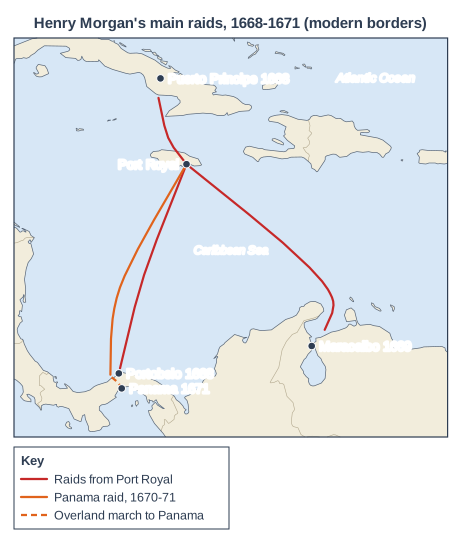
Morgan did a great deal of good for Jamaica's defence. England captured the island from Spain in 1655, but in the 1660s it had few royal warships or troops, and Spain wanted it back. Governor Sir Thomas Modyford used privateers to keep the Spanish on the defensive, and Morgan was the most successful. His raids on Puerto Principe and Portobelo in 1668 and Maracaibo in 1669 showed that Spain's towns were vulnerable and kept Spanish forces busy defending them rather than attacking Jamaica.
His raids also brought wealth. The haul from Portobelo was enormous, and much of the plunder was spent in Port Royal, which became one of the richest towns in the Americas. Some was invested in land and sugar plantations, helping the colony to grow and attract settlers.
The pressure of the privateers also had diplomatic results. In the Treaty of Madrid in July 1670, Spain for the first time recognised English possession of Jamaica and the other English islands. This was a major gain for England's position in the Caribbean, and the privateers' raids helped to persuade Spain to make it.
However, Morgan also did harm. His raid on Panama in January 1671 came after the Treaty of Madrid had been signed, and it endangered the new peace. England valued peace and trade with Spain, both in Europe and through legal and illegal trade with Spanish America, and Charles II had to recall Modyford, send him to the Tower and arrest Morgan. The raids also encouraged a culture of piracy at Port Royal: when commissions stopped, many buccaneers simply became pirates, which damaged trade, including English trade. The reported cruelty of Morgan's men, publicised by Exquemelin, gave England a reputation for brutality and gave Spain reasons for revenge against English ships and logwood cutters.
Yet Morgan's later career reduced the harm. Knighted and made Lieutenant-Governor in 1674, he acted against the pirates he had once led and supported the move from plunder to planting, becoming a sugar planter himself. Although he quarrelled with governors and was removed from the council in 1683, he had helped Jamaica make the transition to a settled colony.
Overall, I disagree with the statement. The Panama raid did real harm to relations with Spain and encouraged piracy, but in the 1660s Morgan helped to secure Jamaica when it had no other defence, brought it wealth and helped push Spain into recognising English possession in 1670. Since Jamaica became one of England's most valuable colonies, and Morgan later supported the policy of peace, I think the good he did outweighed the harm.