Level:
Correct: 0
Incorrect: 0
Marks: 0/0
Exam Practice
Subject:
Topics:
AQA GCSE History (Restoration England) Smart practice A mixed round aimed at your weak spots
Unit 1
Part one: Crown, Parliament, plots and court life
Unit 2
Part two: Life in Restoration England
Life in Restoration England
Crisis
0%
Restoration culture
0%
Unit 3
Part three: Land, trade and war
Unit 4
Part four: The historic environment of Restoration England
Avg
score:
–
Topics
done:
0/10

Crown and Parliament

Practise 41 exam-style questions on Crown and Parliament for AQA GCSE History (Restoration England). Write your answer as you would in the exam and get it marked in seconds against the mark scheme, point by point, with an AI tutor on hand if you get stuck.

  • 41 questions
  • 1–16 marks each
  • Instant marking
  • No sign-up needed
20 questions, marked as you go

Sample questions with model answers

Here are 4 of the questions in this topic, each with a model answer, an explanation of why it earns the marks and the mark scheme an examiner would use.

Question 1

2 marks

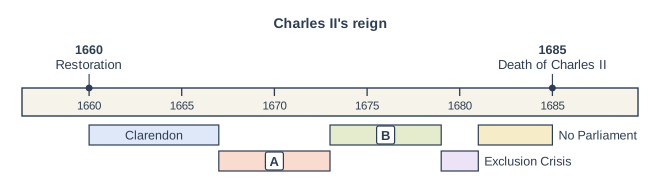
Figure 1 is a timeline of Charles II's reign. Give the name of the group of ministers who led the government in the period labelled A, and the name of the chief minister in the period labelled B.

Horizontal timeline titled "Charles II's reign", running from 1658 on the left to 1688 on the right, with the years marked every 5 years (1660 to 1685). Events marked by dots on the line, in date order: 1660: Restoration; 1685: Death of Charles II. Periods shown as bars below the line, each bar as long as the period: Clarendon (1660 to 1667); bar A, from c. 1667 to c. 1673; bar B, from 1673 to 1679; Exclusion Crisis (1679 to 1681); No Parliament (1681 to 1685).

Model answer

A is the Cabal and B is the Earl of Danby.

Explanation

After Clarendon's fall in 1667 Charles relied on five ministers - Clifford, Arlington, Buckingham, Ashley and Lauderdale - whose initials spelt 'Cabal'. When the Test Act broke them up in 1673, Thomas Osborne, Earl of Danby, became Lord Treasurer and led the government until he was impeached in 1678-79.

Mark scheme
  1. 1 mark

    A: the Cabal.

    Accept the Cabal ministry, or the names of its members (Clifford, Arlington, Buckingham, Ashley/Shaftesbury, Lauderdale) if at least three are given. Do not accept the Privy Council.

  2. 1 mark

    B: Thomas Osborne, Earl of Danby.

    Accept Danby / Thomas Osborne / Lord Treasurer Danby. Do not accept Clarendon or Shaftesbury.

Question 2

8 marks

Interpretation A: from a textbook on Stuart England written by a university historian in 1990. (Written for practice.)
The Restoration settlement was remarkably merciful. After twenty years of war and revolution, Charles II might have taken a terrible revenge on the men who had killed his father and driven him into exile. Instead the Act of Indemnity and Oblivion pardoned almost everyone. Only a handful of regicides went to the scaffold, and thousands of former Parliamentarians kept their lands, their jobs and even their places in government. Charles, who wanted above all to avoid going on his travels again, chose to forgive and forget.

How convincing is Interpretation A about the way Charles II's former enemies were treated after the Restoration? Explain your answer based on your contextual knowledge and what it says in Interpretation A.

Model answer

Interpretation A is largely convincing about the scale of the pardon. The Act of Indemnity and Oblivion of August 1660 pardoned almost everyone for what they had done during the wars and the Interregnum, as Charles had promised in the Declaration of Breda, and Charles urged Parliament to keep the list of exceptions short. Thirteen regicides were executed - ten in October 1660 and three more in 1662 - which really was a small number after twenty years of conflict. A is also right that former Parliamentarians kept their places: Monck became Duke of Albemarle, Anthony Ashley Cooper became Chancellor of the Exchequer, and Edward Montagu, who had commanded the fleet for the republic, became Earl of Sandwich. Royalists even complained that the settlement gave 'indemnity for the King's enemies and oblivion for his friends'.

However, A plays down the revenge that was taken. The regicides who were caught were hanged, drawn and quartered in public - Pepys watched Thomas Harrison die at Charing Cross on 13 October 1660 - and others were imprisoned for life. On 30 January 1661, the anniversary of Charles I's execution, the bodies of Cromwell, Ireton and Bradshaw were dug up, hanged at Tyburn and their heads stuck on poles at Westminster Hall. Sir Henry Vane, who was not a regicide, was executed in 1662, and Lambert stayed a prisoner until he died in 1684. The settlement was not merciful to everyone in religion either: the Clarendon Code drove about 2,000 ministers from their livings and punished dissenters for years.

Overall Interpretation A is convincing that the settlement was more lenient than might have been expected, and that Charles wanted to avoid provoking his former enemies. But 'forgive and forget' is too generous: the regicides were punished savagely and symbolically, and Puritans and dissenters were not forgiven at all.

Explanation

The Act of Indemnity and Oblivion pardoned most former opponents and many served Charles, but the regicides were executed or imprisoned, Cromwell's body was exhumed and the Clarendon Code persecuted dissenters. Level 4 weighs both sides with specific detail and sustains a judgement on how far 'merciful' and 'forgive and forget' are accurate.

Mark scheme
  1. 8 marks

    Levels of response (8 marks).
    Level 4 (7-8 marks): Complex evaluation of Interpretation A with a sustained judgement based on contextual knowledge, e.g. accepts that the Act of Indemnity and Oblivion pardoned most people and that former Parliamentarians served Charles, but weighs this against the executions of the regicides, the exhumation of Cromwell, the treatment of Vane and Lambert and the later persecution of dissenters, and considers whether 'forgive and forget' reflects Charles or Parliament; the judgement is sustained throughout.
    Level 3 (5-6 marks): Developed evaluation of Interpretation A based on contextual knowledge: explains, with specific knowledge, what supports and/or challenges its view.
    Level 2 (3-4 marks): Simple evaluation of Interpretation A based on contextual knowledge, e.g. agrees that most people were pardoned, with one supporting fact.
    Level 1 (1-2 marks): Basic analysis of Interpretation A: paraphrases it with little or no contextual knowledge.
    0 marks: nothing worthy of credit.

    Indicative content (not a checklist; credit other valid points): Convincing: the Declaration of Breda promised a general pardon and the Act of Indemnity and Oblivion (August 1660) pardoned almost everyone for actions during the wars and Interregnum; Charles urged Parliament to keep the exceptions few; thirteen regicides were executed - ten in October 1660 (Thomas Harrison first, at Charing Cross on 13 October; also John Cook and Hugh Peters) and three in 1662 - a small number after twenty years of conflict; former Parliamentarians held high office - Monck (Duke of Albemarle), Anthony Ashley Cooper (Chancellor of the Exchequer), Edward Montagu (Earl of Sandwich), the Earl of Manchester (Lord Chamberlain); buyers of confiscated private land often kept it or made deals. Less convincing: revenge on the regicides was savage - hanged, drawn and quartered in public; others imprisoned for life; the bodies of Cromwell, Ireton and Bradshaw were dug up and hanged at Tyburn on 30 January 1661 and their heads displayed at Westminster Hall; Sir Henry Vane, not a regicide, was executed in 1662 and Lambert imprisoned until his death in 1684; Crown and Church lands were taken back; the Clarendon Code (1661-65) punished Puritans and dissenters - about 2,000 ministers ejected; 'forgive and forget' is more Parliament's and Charles's political calculation than generosity, and royalists complained of 'indemnity for the King's enemies and oblivion for his friends'. Possible judgement: largely convincing about the scale of the pardon, but it underplays the vengeance taken on the regicides and the religious persecution that followed.

Question 3

8 marks

Write an account of the ways in which the Cabal ministry broke up in the years 1672-1674.

Model answer

The break-up of the Cabal began with the policies of 1672. In January Charles stopped repaying the goldsmith-bankers in the Stop of the Exchequer, so that money could go to the fleet. In March he issued the Declaration of Indulgence, suspending the penal laws against dissenters and Catholics, and declared war on the Dutch in alliance with Louis XIV. These policies were linked: Charles wanted to fight the war without asking Parliament for money and to help Catholics as he had secretly promised in the Treaty of Dover. But they stored up trouble, because the war went badly and Louis XIV's invasion of the Dutch Republic made Catholic France look a greater danger than the Dutch. Pamphlets such as 'England's Appeal from the Private Cabal at Whitehall' (1673) accused the ministers of serving popery and France.

When Charles had to recall Parliament in February 1673 to pay for the war, MPs struck back. The Commons resolved that penal laws could be suspended only by Act of Parliament and held back money until the Declaration was withdrawn. In March Charles gave way. Parliament then passed the Test Act, which required all office-holders to take Anglican communion and deny transubstantiation. This was the turning point, because in June Clifford resigned as Lord Treasurer and James resigned as Lord High Admiral, showing that both were Catholics. Thomas Osborne, the future Earl of Danby, replaced Clifford.

The remaining ministers were divided. Shaftesbury, now Lord Chancellor, opposed James's marriage to the Catholic Mary of Modena and was dismissed in November 1673; he then became the leading opponent of the court. In January 1674 the Commons attacked Buckingham, who was dismissed, and Arlington, who moved to the less powerful post of Lord Chamberlain, and asked for Lauderdale's removal. Parliament forced Charles to make peace with the Dutch in the Treaty of Westminster in February 1674. By then the Cabal had fallen apart and Danby led the government. The ministry broke up because its policies of 1672 united Parliament against it, and the Test Act turned that anger into resignations.

Explanation

The Stop of the Exchequer, the Declaration of Indulgence and the unpopular French alliance of 1672 provoked Parliament, which forced the Declaration's withdrawal and passed the Test Act in 1673; Clifford and James resigned, Shaftesbury was dismissed and joined the opposition, and Buckingham and Arlington were attacked in 1674. Level 4 shows how each stage caused the next, not just what happened.

Mark scheme
  1. 8 marks

    Levels of response (8 marks).
    Level 4 (7-8 marks): A coherent account with complex analysis of causation: shows how the policies of 1672 (the Stop of the Exchequer, the Declaration of Indulgence, the Third Anglo-Dutch War) led to Parliament's counter-attack in 1673 (withdrawal of the Declaration, the Test Act) and how this caused the resignations, dismissals and attacks that ended the Cabal by 1674, supported by accurate, detailed knowledge.
    Level 3 (5-6 marks): A developed account with developed analysis of two or more stages or causes of the break-up.
    Level 2 (3-4 marks): A simple account with simple analysis of one cause or stage.
    Level 1 (1-2 marks): A basic or general narrative with little specific knowledge.
    0 marks: nothing worthy of credit.

    Indicative content (not a checklist; credit other valid points): January 1672 Stop of the Exchequer - repayments to goldsmith-bankers suspended to pay for the coming war; March 1672 Declaration of Indulgence and declaration of war on the Dutch in alliance with France; the war went badly (Solebay, 1672, indecisive) while Louis XIV's invasion of the Dutch Republic made France look the greater danger; Dutch propaganda such as 'England's Appeal from the Private Cabal at Whitehall' (1673) accused the ministers of serving popery and France; Parliament met in February 1673: the Commons declared penal laws could be suspended only by Act of Parliament and held back war money; Charles withdrew the Declaration (March 1673); the Test Act (1673) required office-holders to take Anglican communion and deny transubstantiation; June 1673 - Clifford resigned as Lord Treasurer (replaced by Thomas Osborne, later Earl of Danby) and James resigned as Lord High Admiral, showing both were Catholics; the Cabal's members were divided over toleration, France and the succession; Shaftesbury (Lord Chancellor) opposed James's marriage to the Catholic Mary of Modena (1673) and was dismissed in November 1673, then led the opposition; January 1674 the Commons attacked Buckingham (dismissed) and Arlington (moved to the less powerful post of Lord Chamberlain) and asked for Lauderdale's removal; Parliament forced peace with the Dutch - Treaty of Westminster (February 1674); Danby took over.

Question 4

16 marks

'The Earl of Clarendon was the most successful of Charles II's chief ministers.'

How far do you agree with this statement? Explain your answer.

Model answer

Clarendon has a strong claim to be Charles II's most successful chief minister because he guided the Restoration settlement, which lasted for the rest of the reign. However, Danby was more successful in managing Parliament and the king's finances, so overall I only partly agree with the statement.

Clarendon's greatest success was the settlement of 1660-62. As Edward Hyde he had helped Charles draft the Declaration of Breda, and as Lord Chancellor he steered its promises through Parliament: the Act of Indemnity and Oblivion pardoned almost everyone except the regicides, the New Model Army was paid off and disbanded without trouble, a permanent revenue of customs and excise was granted, and the Church of England was restored. After twenty years of upheaval this brought stability, and he kept power for seven years.

But Clarendon also had serious failures. The revenue fell short of the £1.2 million Parliament had estimated, so the king remained in debt. The Clarendon Code, though harsher than he wanted, created a permanent body of dissenters. He became unpopular for the sale of Dunkirk in 1662 and was blamed for the Queen's childlessness. Above all, the Second Anglo-Dutch War ended in the humiliation of the Medway raid in June 1667. Clarendon had lost the support of the court, the Commons and the king, and he was dismissed, impeached and forced to flee to France.

The Cabal was much less successful. The Triple Alliance of 1668 was popular, and the secret Treaty of Dover of 1670 brought Charles French money, but the ministry's main policies collapsed. The Stop of the Exchequer of 1672 ruined the government's credit, the Declaration of Indulgence had to be withdrawn in 1673, the Third Anglo-Dutch War achieved nothing, and the Test Act broke the ministry up. It left Parliament more suspicious of the court than ever and drove Shaftesbury into opposition.

Danby was the most skilful manager of Parliament. As Lord Treasurer from 1673 he brought order to the finances, helped by rising customs revenue, and built a 'Court party' of MPs rewarded with offices and pensions, which is why the Cavalier Parliament was nicknamed the 'Pensionary Parliament'. His Anglican and anti-French policies suited MPs: he arranged the marriage of James's daughter Mary to the Protestant William of Orange in 1677, and Parliament voted money for thirty new warships. However, Danby's fall was even more dramatic than Clarendon's. In December 1678 Ralph Montagu revealed a letter in which Danby, on Charles's orders, had asked Louis XIV for 6 million livres. He was impeached, the Cavalier Parliament was dissolved to save him, and he spent five years in the Tower.

Overall, I partly agree. Danby was the most effective at the day-to-day task of managing Parliament and money, and the Cabal was the least successful. But Clarendon's achievement was the greater, because the settlement he guided - indemnity, the restored Church and the financial and military arrangements - shaped the whole reign, whereas Danby's system collapsed with him in 1679. On that measure Clarendon was the most successful, even though all three ministries ended in failure.

Explanation

Clarendon guided the lasting Restoration settlement but fell after Dunkirk, the Queen's childlessness and the Medway raid; the Cabal's policies collapsed by 1673; Danby managed Parliament and the finances well but fell over his secret French letter in 1678. Level 4 compares the ministers against clear criteria with specific evidence and sustains a judgement; describing Clarendon alone is Level 2.

Mark scheme
  1. 16 marks

    Levels of response (16 marks).
    Level 4 (13-16 marks): Complex explanation of Clarendon's successes and failures compared with other ministers (the Cabal, Danby), using clear criteria such as establishing the settlement, managing Parliament, finance, foreign policy and keeping power, with a sustained judgement about whether Clarendon was the most successful, supported throughout by specific, accurate knowledge.
    Level 3 (9-12 marks): Developed explanation of Clarendon and at least one other minister or ministry, with specific knowledge; a judgement is reached but not fully sustained.
    Level 2 (5-8 marks): Simple explanation of Clarendon or of other minister(s).
    Level 1 (1-4 marks): Basic explanation, with little specific knowledge.
    0 marks: nothing worthy of credit.

    Indicative content (not a checklist; credit other valid points): Clarendon (1660-67) successes: drafted the Declaration of Breda with Charles; guided the Restoration settlement - Act of Indemnity and Oblivion (1660), payment and disbanding of the army, financial settlement (customs, excise; Hearth Tax 1662), restoration of the Church of England; a stable government for seven years. Clarendon failures: the Clarendon Code went further than he wanted and created lasting division; revenue fell short of £1.2 million; the sale of Dunkirk (1662) and the marriage to Catherine of Braganza brought unpopularity; the Second Anglo-Dutch War (1665-67) ended in the Medway humiliation; he lost Charles's favour, was impeached and fled (1667). The Cabal (c. 1667-73): Triple Alliance (1668) popular; secret Treaty of Dover (1670) and French subsidies; Declaration of Indulgence (1672) withdrawn in 1673; Stop of the Exchequer (1672) damaged credit; Third Anglo-Dutch War achieved little; Test Act (1673) and break-up; Shaftesbury driven into opposition. Danby (1673-79): restored order to the finances and benefited from rising customs revenue; built a 'Court party' in the Commons with offices and pensions ('Pensionary Parliament'); Anglican and anti-French policies popular - Mary's marriage to William of Orange (1677); Parliament voted money for thirty warships (1677); but the Non-Resisting Test failed (1675), and his secret letter asking Louis XIV for 6 million livres, revealed by Ralph Montagu in December 1678, led to impeachment, the dissolution of the Cavalier Parliament (January 1679) and five years in the Tower. Possible judgements: Clarendon most successful because the settlement he guided lasted; or Danby, the most effective manager of Parliament and finance; or none succeeded in the long run because all fell.

Ready to try the rest? Every answer you write is marked against the mark scheme, so you can see exactly where the marks are.

AI Tutor Hints first, answers after you try

Hi! Stuck? Ask me for a hint and I’ll help you work it out. Once you’ve checked your answer I can explain exactly where the marks are.