Level:
Correct: 0
Incorrect: 0
Marks: 0/0
Exam Practice
Subject:
Topics:
AQA GCSE History (Restoration England) Smart practice A mixed round aimed at your weak spots
Unit 1
Part one: Crown, Parliament, plots and court life
Unit 2
Part two: Life in Restoration England
Life in Restoration England
Crisis
0%
Restoration culture
0%
Unit 3
Part three: Land, trade and war
Unit 4
Part four: The historic environment of Restoration England
Avg
score:
–
Topics
done:
0/10

The Catholic question

Practise 41 exam-style questions on The Catholic question for AQA GCSE History (Restoration England). Write your answer as you would in the exam and get it marked in seconds against the mark scheme, point by point, with an AI tutor on hand if you get stuck.

  • 41 questions
  • 1–16 marks each
  • Instant marking
  • No sign-up needed
20 questions, marked as you go

Sample questions with model answers

Here are 4 of the questions in this topic, each with a model answer, an explanation of why it earns the marks and the mark scheme an examiner would use.

Question 1

2 marks

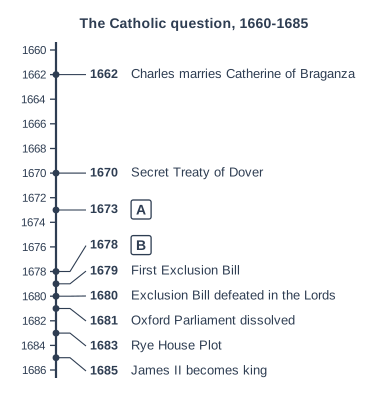
Figure 1 is a timeline of the Catholic question in Charles II's reign. Name the events labelled A and B.

Vertical timeline titled "The Catholic question, 1660-1685", running from 1660 at the top to 1686 at the bottom, with the years marked every 2 years (1660 to 1686). Events marked by dots on the line, in date order: 1662: Charles marries Catherine of Braganza; 1670: Secret Treaty of Dover; 1673: label A; 1678: label B; 1679: First Exclusion Bill; 1680: Exclusion Bill defeated in the Lords; 1681: Oxford Parliament dissolved; 1683: Rye House Plot; 1685: James II becomes king.

Model answer

A is the Test Act of 1673, which revealed that James was a Catholic. B is the Popish Plot of 1678.

Explanation

The Test Act (1673) required office-holders to take Anglican communion, so James's resignation as Lord High Admiral revealed that the heir was a Catholic. In 1678 Titus Oates's invented Popish Plot created a panic that led to the Exclusion Bills of 1679-81.

Mark scheme
  1. 1 mark

    A (1673): the Test Act, which forced James, Duke of York, to resign as Lord High Admiral.

    Accept the Test Act / James resigns as Lord High Admiral / James's Catholicism revealed / James marries Mary of Modena / the Declaration of Indulgence withdrawn (all 1673).

  2. 1 mark

    B (1678): the Popish Plot (Titus Oates's allegations).

    Accept Titus Oates's plot / the murder of Sir Edmund Berry Godfrey / the second Test Act (all 1678). Do not accept the Rye House Plot (1683).

Question 2

8 marks

Explain what was important about the letters of Edward Coleman for the Popish Plot.

Model answer

Coleman's letters were important because they seemed to confirm that Oates was telling the truth. Edward Coleman, a Catholic convert who was secretary to Mary of Modena, the Duchess of York, was named by Oates and arrested at the end of September 1678. Among his papers were letters he had written in the mid-1670s to Louis XIV's confessor, Père La Chaise. They spoke of 'a mighty work' - 'the conversion of three kingdoms' and 'the utter subduing of a pestilent heresy'. The letters did not mention any plan to kill the king, but to most Protestants they proved that a real Catholic conspiracy existed, so Oates's wilder claims seemed believable.

Secondly, the letters drew suspicion onto the heir to the throne. Coleman had worked for James and now served his wife, so his schemes seemed to come from the heart of James's household. Many people concluded that a Catholic succession would bring the plans in the letters to fruition, which strengthened the case for keeping James off the throne.

Thirdly, the letters linked Catholicism with France and with destroying Parliament. Coleman had asked for French money to help Charles rule without Parliament. This seemed to confirm the long-standing fear of 'popery and arbitrary government', turning the plot from a religious scare into a political crisis about the future of Parliament and English liberties.

Finally, the letters had direct consequences. Coleman was tried, convicted of treason and executed on 3 December 1678, the first victim of the plot. Together with Godfrey's murder, the letters helped persuade Parliament to declare a 'hellish plot', pass the second Test Act excluding Catholics from Parliament and begin attacking James, which led to the Exclusion campaign. Historians now see the letters as genuine but foolish intrigue rather than proof of Oates's plot, but in 1678 they were taken as evidence that Oates was right.

Explanation

Coleman's letters about 'the conversion of three kingdoms' and French money seemed to confirm Oates's story, linked the plot to James's household and to French absolutism, and led to Coleman's execution and the campaign against James. Level 4 explains several such consequences with detail and links them.

Mark scheme
  1. 8 marks

    Levels of response (8 marks).
    Level 4 (7-8 marks): Complex explanation of the importance of Coleman's letters, e.g. explains how their contents seemed to confirm Oates's allegations, how their link to James's household drew suspicion onto the heir, how they turned the plot into a political issue about French money and Parliament, and what they led to (Coleman's trial and execution, the exclusion campaign), with links or a judgement about the most important.
    Level 3 (5-6 marks): Developed explanation of two or more ways the letters were important, with specific knowledge.
    Level 2 (3-4 marks): Simple explanation of one way.
    Level 1 (1-2 marks): Basic explanation: general statements with little specific knowledge.
    0 marks: nothing worthy of credit.

    Indicative content (not a checklist; credit other valid points): Edward Coleman, a Catholic convert, secretary to Mary of Modena (Duchess of York) and earlier in James's service, was named by Oates and arrested at the end of September 1678; his papers included letters written in the mid-1670s to Père La Chaise, Louis XIV's confessor, and others; they spoke of 'a mighty work' - 'the conversion of three kingdoms' and 'the utter subduing of a pestilent heresy'; they asked for French money to help Charles rule without Parliament / dissolve Parliament; importance: seemed to confirm that a real Catholic conspiracy existed, even though they did not mention a plan to kill the king - so Oates seemed credible; linked the plot to the household of the heir, James, increasing fear of a Catholic succession; linked Catholicism with France and with destroying Parliament - 'popery and arbitrary government'; Coleman was tried, convicted of treason and executed on 3 December 1678, the first victim of the plot; helped persuade Parliament to pass the second Test Act and the Commons to turn against James, leading to the Exclusion campaign; historians see the letters as real but foolish intrigue, not proof of Oates's plot.

Question 3

8 marks

Write an account of the ways in which the Whigs tried to exclude James, Duke of York, from the succession in the years 1679-1681.

Model answer

The Whigs' main method was to use Parliament. In May 1679 they introduced the first Exclusion Bill, which passed its second reading in the Commons by 207 votes to 128. Charles stopped it by proroguing Parliament on 27 May and dissolving it in July. This showed the Whigs' central problem: however large their majority in the Commons, the king could send Parliament home.

The Whigs therefore turned to elections and public pressure. They won majorities in the elections of 1679, but Charles delayed the meeting of the new Parliament by repeated prorogations for a year. In response the Whigs organised a national petitioning campaign in 1679-80, demanding that Parliament be allowed to meet; their opponents sent addresses 'abhorring' the petitions, so the two sides became known as Petitioners and Abhorrers. The Green Ribbon Club organised huge pope-burning processions through London on 17 November 1679 and 1680, and after the Licensing Act lapsed in 1679 Whig pamphlets and prints poured out, keeping fear of the Popish Plot alive. Some Whigs also promoted the Duke of Monmouth as an alternative heir, and his progress through the West Country in 1680 drew large crowds.

When Parliament finally met in October 1680, the second Exclusion Bill passed the Commons in November. But on 15 November the House of Lords rejected it by 63 votes to 30, after the Earl of Halifax spoke repeatedly against it. The angry Commons attacked Halifax and refused money, and Charles dissolved Parliament in January 1681.

The Whigs won the election again and made a final attempt at the Oxford Parliament in March 1681, where Whig MPs arrived with armed followers. Charles offered a compromise - James would be king in name while a Protestant regent ruled - but the Whigs insisted on a third Exclusion Bill. Secure with a secret French subsidy, Charles dissolved Parliament after a week. Each Whig method failed for the same reason: the king's power to prorogue and dissolve, supported by the Lords and by growing Tory fears of a return to 1641, was stronger than a Commons majority.

Explanation

The Whigs used three Exclusion Bills (1679, 1680, 1681), elections, petitions, processions, pamphlets and the claims of Monmouth, but each attempt was defeated by Charles's prorogations and dissolutions, the Lords' vote of 63 to 30 and his dissolution of the Oxford Parliament. Level 4 explains why each method failed rather than simply describing them.

Mark scheme
  1. 8 marks

    Levels of response (8 marks).
    Level 4 (7-8 marks): A coherent account with complex analysis of causation: shows how the Whigs used Parliament (three Exclusion Bills), elections, petitions, propaganda and processions, and the claims of Monmouth, and how Charles's responses (limitations, prorogations, dissolutions, the Lords' vote, the Oxford Parliament) led each attempt to fail, supported by accurate, detailed knowledge.
    Level 3 (5-6 marks): A developed account with developed analysis of two or more Whig methods or attempts.
    Level 2 (3-4 marks): A simple account with simple analysis of one method or attempt.
    Level 1 (1-2 marks): A basic or general narrative with little specific knowledge.
    0 marks: nothing worthy of credit.

    Indicative content (not a checklist; credit other valid points): Parliament: first Exclusion Bill, May 1679 - passed second reading 207 to 128; Charles prorogued (27 May) and dissolved (July 1679) Parliament; second bill, November 1680 - passed the Commons, rejected by the Lords 63 to 30 (15 November) after Halifax's speeches; Parliament dissolved January 1681; third bill at the Oxford Parliament, March 1681 - Charles had offered a regency compromise, then dissolved Parliament after a week (28 March). Elections: Whig majorities in February 1679, autumn 1679 and February 1681. Petitions: when Charles delayed the second Parliament by repeated prorogations (1679-80), the Whigs organised a national campaign of petitions demanding that it meet (Petitioners), answered by Tory 'Abhorrers'. Propaganda: the Green Ribbon Club organised pope-burning processions on 17 November 1679 and 1680; pamphlets, newspapers and prints poured out after the Licensing Act lapsed (1679); the Popish Plot was kept alive. Monmouth: some Whigs promoted the Duke of Monmouth, rumoured to be legitimate (the 'black box'); his progress through the West Country (1680). Pressure on Charles: Shaftesbury, briefly Lord President of the Council (1679), was dismissed; the Commons attacked the king's advisers (Halifax) and refused money; Whig MPs went to Oxford with armed followers. All failed because Charles, the Lords and, increasingly, Tory opinion held firm.

Question 4

16 marks

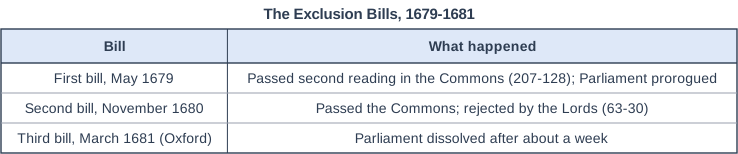
Figure 1 is a table showing what happened to the three Exclusion Bills.

'The Exclusion Bills failed mainly because of Charles II's determination to protect his brother's right to the throne.'

How far do you agree with this statement? Explain your answer.

The Exclusion Bills, 1679-1681. Table with columns "Bill", "What happened". Bill: First bill, May 1679; What happened: Passed second reading in the Commons (207-128); Parliament prorogued | Bill: Second bill, November 1680; What happened: Passed the Commons; rejected by the Lords (63-30) | Bill: Third bill, March 1681 (Oxford); What happened: Parliament dissolved after about a week.

Model answer

Charles II's determination to protect his brother's right to the throne was the most important reason why the Exclusion Bills failed, because only the king could prorogue and dissolve Parliament, and he used that power whenever exclusion came close. However, his determination succeeded only because the House of Lords, Tory opinion and his growing financial independence were on his side.

Charles's determination is clear throughout the crisis. He believed the succession was a matter of God-given hereditary right and would not abandon his brother. He refused to legitimise Monmouth and publicly denied that he had ever married Lucy Walter. He tried to appear reasonable by offering 'limitations' on a Catholic successor in 1679 and a regency compromise at Oxford in 1681, but he would never accept exclusion itself. As Figure 1 shows, he stopped the first bill by proroguing Parliament in May 1679 and dissolving it in July. He then delayed the next Parliament by repeated prorogations, dissolved it in January 1681 and dissolved the Oxford Parliament after only a week when the Whigs introduced the third bill. A weaker king might have given way, as Charles I had given way to Parliament in 1641.

However, the second bill was defeated not by Charles but by the House of Lords, which rejected it by 63 votes to 30 in November 1680 after the Earl of Halifax spoke repeatedly against it and the bishops voted against it. This was vital, because it meant exclusion was stopped by the normal working of the constitution and Charles did not need to use his veto, which would have looked like tyranny.

The Whigs' own weaknesses also mattered. They were divided over who should replace James: some backed Monmouth, others James's Protestant daughter Mary and her husband William of Orange. Their campaign depended on the Popish Plot, but after a jury acquitted the Queen's physician, Sir George Wakeman, in July 1679, Oates's credibility began to collapse. Their methods - petitions, pope-burning processions and armed followers at Oxford - allowed the Tories to claim that 1641 was coming again, and many moderates decided that a Catholic king was less dangerous than another civil war, especially as James's heirs were Protestant. The Scottish Parliament's Succession Act of 1681 showed that Scotland would support James, making that danger real.

Finally, money freed Charles from dependence on Parliament. Just before the Oxford Parliament he secured a secret subsidy from Louis XIV, and his customs revenue was rising with trade. This meant he could dissolve Parliament without fear of bankruptcy, and after March 1681 he never called another.

Overall I largely agree. Charles's determination was the main reason because, without it, the Commons' huge majorities would eventually have forced exclusion through. But his determination only succeeded because the Lords blocked the second bill, the Whigs discredited themselves and moderates feared civil war, and French money and trade revenue meant he could manage without Parliament. Charles provided the will; these other factors gave him the means.

Explanation

Charles's refusal to compromise on the succession and his use of prorogation and dissolution stopped the first and third bills, but the Lords (63 to 30, after Halifax) stopped the second, the Whigs were divided and discredited by Oates's collapse and fear of civil war, and French money and trade revenue freed Charles from Parliament. Level 4 weighs Charles's role against these factors and sustains a judgement, using knowledge beyond the table.

Mark scheme
  1. 16 marks

    Levels of response (16 marks).
    Level 4 (13-16 marks): Complex explanation of the stated factor (Charles's determination and his use of the prerogative) and other factors, e.g. the House of Lords and Halifax, divisions among the Whigs, the discrediting of the Popish Plot, Tory propaganda and fear of civil war, Charles's financial independence and French money, and the support for James in Scotland, with a sustained judgement about whether Charles's determination was the main reason, supported throughout by specific, accurate knowledge that goes beyond the table.
    Level 3 (9-12 marks): Developed explanation of Charles's determination and at least one other factor, with specific knowledge; a judgement is reached but not fully sustained.
    Level 2 (5-8 marks): Simple explanation of Charles's determination or of other factor(s), which may rely on the table.
    Level 1 (1-4 marks): Basic explanation of one or more factors, with little specific knowledge.
    0 marks: nothing worthy of credit.

    Indicative content (not a checklist; credit other valid points): Charles's determination: he refused to accept any change to the succession, believing in hereditary right and loyalty to his brother; he publicly denied marrying Lucy Walter and refused to legitimise Monmouth; he offered 'limitations' (1679) and a regency compromise (Oxford, 1681) to appear reasonable; he prorogued (May 1679) and dissolved (July 1679) the first Exclusion Parliament, delayed the second by repeated prorogations, attended the Lords' debate in November 1680, dissolved the second Parliament (January 1681) and the Oxford Parliament after a week (March 1681); he sent James abroad (1679) to lower tension. Other factors: the House of Lords rejected the second bill by 63 votes to 30 (15 November 1680) after Halifax's speeches, with the bishops against it; divisions among the Whigs - Monmouth or William and Mary as the alternative; the Popish Plot was discredited (Wakeman acquitted, July 1679) and Oates's credibility collapsed; Tory propaganda and memories of the 1640s - fear that 'forty-one' was coming again - turned opinion against the Whigs, especially after armed Whig followers went to Oxford; financial independence - a secret French subsidy (1681) and rising customs revenue meant Charles did not need Parliament's money; James's Protestant daughters were next in line, so exclusion seemed less necessary to moderates; the Scottish Parliament's Succession Act (1681) showed that Scotland would back James, raising the risk of civil war; the Whigs' extreme methods alienated moderates; Charles's Declaration (April 1681) won the propaganda war. Possible judgements: Charles's determination was decisive because only he could dissolve Parliament; or it worked only because the Lords, money and Tory opinion were on his side.

Ready to try the rest? Every answer you write is marked against the mark scheme, so you can see exactly where the marks are.

AI Tutor Hints first, answers after you try

Hi! Stuck? Ask me for a hint and I’ll help you work it out. Once you’ve checked your answer I can explain exactly where the marks are.