
Level:
Correct: 0
Incorrect: 0
Marks: 0/0
Exam Practice
Subject:
Topics:
Avg
score:
–
Topics
done:
0/9

The resolution of 'the Indian problem' after 1865

Practise 44 exam-style questions on The resolution of 'the Indian problem' after 1865 for AQA GCSE History (America 1840-1895). Write your answer as you would in the exam and get it marked in seconds against the mark scheme, point by point, with an AI tutor on hand if you get stuck.

  • 44 questions
  • 1–12 marks each
  • Instant marking
  • No sign-up needed
20 questions, marked as you go

Sample questions with model answers

Here are 4 of the questions in this topic, each with a model answer, an explanation of why it earns the marks and the mark scheme an examiner would use.

Question 1

2 marks

Figure 1 shows the approximate amount of land owned by Native Americans between 1887 and 1934.

Using Figure 1, about how much land did Native Americans lose between 1887 and 1934? Give one reason from your own knowledge for this loss.
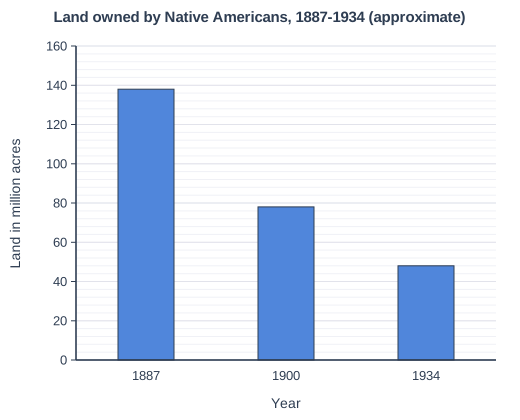
Land owned by Native Americans, 1887-1934 (approximate). Bar chart of land in million acres for each year: 1887 138, 1900 78, 1934 48.

Model answer

Native Americans lost about 90 million acres, falling from about 138 million acres in 1887 to about 48 million in 1934. One reason was the Dawes Act of 1887, which divided reservation land into family allotments and sold the 'surplus' land to white settlers.

Explanation

The fall was steepest between 1887 and 1900, when 'surplus' reservation land was sold off. Further land was lost after the 25-year trust period ended and allottees sold or leased their plots.

Mark scheme
  1. 1 mark

    About 90 million acres (from about 138 million to about 48 million acres).

    Accept any answer from 85 to 95 million acres, or 'about two-thirds of their land'.

  2. 1 mark

    One valid reason, e.g. the Dawes Act (1887) divided reservations into allotments and sold the 'surplus' land to white settlers; allotted land was later sold or leased, sometimes after fraud; reservations were opened to settlers (e.g. in Indian Territory, or the break-up of the Great Sioux Reservation in 1889).

    Max 1 for the reason.

Question 2

4 marks

Interpretation A: from a book about government policy towards Native Americans written by a supporter of the reformers in 1900. (Written for practice.)
The Dawes Act was the most hopeful law ever passed for the Indian. The reservation system had kept him idle, dependent on rations and at the mercy of corrupt agents. Now each family would own its own farm, protected from sale for twenty-five years, and every Indian who took his land would become a citizen of the United States. The Act opened the way to schools, farming and self-respect. In a generation, its friends believed, the Indian would stand beside his white neighbour as an equal.

Interpretation B: from a history of Native American land written by a Native American historian in 1992. (Written for practice.)
The Dawes Act was presented as a gift, but it was a way of taking land. Our peoples had held land in common for generations; now it was cut into plots, and whatever was left over was sold to white settlers. Much of the land given to families was too dry to farm, and few had the tools, seed or training to farm it. Between 1887 and 1934 Native Americans lost about two-thirds of their land. The Act also struck at our tribes, our leaders and our way of life.

How does Interpretation B differ from Interpretation A about the Dawes Act?

Explain your answer based on what it says in Interpretations A and B.

Model answer

Interpretation A presents the Dawes Act as a generous reform that would make Native Americans independent and equal, while Interpretation B presents it as a way of taking their land and destroying their tribes. A calls it 'the most hopeful law ever passed for the Indian': it says the reservation system had made Native Americans dependent on rations and corrupt agents, and that owning a family farm, protected for twenty-five years, together with citizenship, would bring farming, schooling and self-respect. B says the Act was 'presented as a gift' but was really 'a way of taking land': land held in common was cut into plots, the 'left over' land was sold to settlers, much of the land given out was too dry to farm, and families lacked tools and training. While A expects equality with white neighbours, B says Native Americans lost about two-thirds of their land and that the Act attacked their tribes, leaders and way of life.

Explanation

Level 2 needs a developed difference supported by detail from both - hope, ownership and citizenship in A against land loss, poor allotments and damage to tribes in B. Saying only that A supports the Act and B opposes it is Level 1.

Mark scheme
  1. 4 marks

    Levels of response (4 marks).
    Level 2 (3-4 marks): Developed analysis of both interpretations: explains how they differ about the Dawes Act (e.g. A sees it as a hopeful reform that would make Native Americans independent, equal citizens; B sees it as a way of taking their land and destroying their tribes), supported by detail from each.
    Level 1 (1-2 marks): Simple analysis: identifies a difference (e.g. A is for the Act, B against it) with little or no support from the interpretations.
    0 marks: nothing worthy of credit.

    Indicative content (not a checklist; credit other valid points): A calls the Act 'the most hopeful law ever passed for the Indian', while B says it was 'a way of taking land'; A says each family would own its own farm, protected for 25 years, whereas B says common land was cut into plots and the 'left over' land was sold to white settlers; A expects the Act to lead to farming and self-respect, while B says much of the land was too dry and families lacked tools, seed and training; A says Native Americans would become citizens and equals, while B says they lost about two-thirds of their land between 1887 and 1934; A sees the reservation system as the problem, B sees the Act as an attack on tribes, leaders and their way of life.

Question 3

8 marks

In what ways were the lives of Native American children affected by US government policy in the 1870s and 1880s?

Explain your answer.

Model answer

Government policy affected Native American children's lives in several ways. Most dramatically, many were separated from their families. In 1879 Richard Henry Pratt opened the Carlisle Indian Industrial School in Pennsylvania, and many more boarding schools followed. Children were taken hundreds of miles from the reservations, often for years at a time, which broke the close family bonds through which they would normally have learned their people's ways.

Second, the schools tried to destroy their culture. On arrival, children's hair was cut, they were put into uniforms and given English names. They were forbidden to speak their own languages and were punished if they did, and they were taught Christianity while their own religion was treated as superstition. Boys were trained to farm or learn trades and girls to do housework, and under the 'outing' system some were sent to live with white families. Pratt summed up the aim as 'kill the Indian in him, and save the man'.

Third, children's health suffered. Crowded schools spread diseases such as tuberculosis, and many children died far from home. Even those on the reservations grew up hungry, dependent on rations, and without the traditions of earlier generations, because the buffalo had gone and ceremonies such as the Sun Dance were banned from 1883.

These changes were linked: by separating children from their families, the government hoped to raise a generation that would no longer be 'Indian'. Many returning pupils found themselves caught between two worlds, although some later used their education to defend their people's rights.

Explanation

Government policy took many children to boarding schools such as Carlisle (1879), where they lost their names, languages and religion and often their health. Level 4 needs several effects explained with specific detail and linked to the government's aim of assimilation.

Mark scheme
  1. 8 marks

    Levels of response (8 marks).
    Level 4 (7-8 marks): Complex explanation of the effects: several ways children's lives were affected (e.g. separation from families, loss of language and culture, religion and work training, health, long-term effects) are explained with specific, accurate knowledge of government policy, and the explanations are linked.
    Level 3 (5-6 marks): Developed explanation of two or more ways, supported by relevant knowledge.
    Level 2 (3-4 marks): Simple explanation of one way, with some supporting knowledge.
    Level 1 (1-2 marks): Basic explanation: general statements with little specific knowledge.
    0 marks: nothing worthy of credit.

    Indicative content (not a checklist; credit other valid points): boarding schools - Richard Henry Pratt opened the Carlisle Indian Industrial School in Pennsylvania in 1879, and many more followed; children were taken far from their families, often for years; on arrival their hair was cut, they were given uniforms and English names; they were forbidden to speak their own languages and punished if they did; they were taught Christianity and American customs, and their own religion was dismissed; boys were trained in farming and trades and girls in housework; the 'outing' system placed pupils with white families; crowded conditions spread diseases such as tuberculosis, and many children died; on the reservations, day schools and mission schools taught the same aims; children grew up without the hunting, warrior and religious traditions of earlier generations, because of the loss of the buffalo and the ban on ceremonies such as the Sun Dance (1883); returning pupils were often caught between two worlds; some used their education (English, literacy) later to defend their people's rights.

Question 4

12 marks

Which of the following was the more important reason for the passing of the Dawes Act in 1887:
- the desire to 'civilise' Native Americans
- the demand for Native American land?

Explain your answer with reference to both bullet points.

Model answer

The desire to 'civilise' Native Americans was an important reason for the Dawes Act. By the 1880s many Eastern reformers, in groups such as the Women's National Indian Association (1879) and the Indian Rights Association (1882), and at the yearly Lake Mohonk conferences from 1883, believed that Native Americans could only survive by giving up tribal life and becoming like other Americans. They saw the reservation system as a failure, because it kept people dependent on rations and at the mercy of corrupt agents. They believed that owning private property and farming would turn Native Americans into independent, Christian citizens. Senator Henry Dawes presented the Act as a reform to help them: allotments were protected from sale for twenty-five years, and those who accepted them became US citizens. The Act fitted alongside other 'civilising' policies, such as the Carlisle boarding school (1879) and the ban on ceremonies such as the Sun Dance (1883).

However, the demand for Native American land was also very important. By the 1880s the frontier was filling up, and settlers, railroads, ranchers and speculators wanted the large areas still held by tribes. Under the Act, once each family had its allotment, the 'surplus' land could be sold to white settlers. 'Boomers' were already pressing for Indian Territory to be opened, and in 1889 the Unassigned Lands were opened in the Oklahoma Land Rush, while the Great Sioux Reservation was broken up and about 9 million acres were opened to settlers. Critics in Congress warned at the time that the real aim was to get at Native American land, and the results support them: Native land fell from about 138 million acres in 1887 to about 78 million by 1900.

Overall, the demand for land was the more important reason. The reformers' belief in 'civilising' Native Americans gave the Act its moral justification and led the campaign for it, but the Act passed so easily because it also gave settlers and western politicians what they wanted. The way it was designed - with 'surplus' land sold off - and the speed with which land was transferred show that, whatever the reformers intended, getting land for white Americans was what the Act actually achieved and why it won such wide support.

Explanation

Reformers wanted to 'civilise' Native Americans through private farms and citizenship, while settlers and others wanted the 'surplus' land the Act made available. Level 4 needs both explained with specific detail and a sustained judgement, for example weighing supporters' stated aims against how the Act worked.

Mark scheme
  1. 12 marks

    Levels of response (12 marks).
    Level 4 (10-12 marks): Complex explanation of both bullet points: explains the reformers' aim of assimilation and the pressure for Native American land, supported by specific, accurate knowledge of the Act and its background, leading to a sustained judgement about which was more important (e.g. by weighing the stated aims of its supporters against how the Act worked in practice).
    Level 3 (7-9 marks): Developed explanation of both bullet points, supported by relevant knowledge.
    Level 2 (4-6 marks): Simple explanation of one or both bullet points.
    Level 1 (1-3 marks): Basic explanation of one or both bullet points: general statements with little specific knowledge.
    0 marks: nothing worthy of credit.

    Indicative content (not a checklist; credit other valid points): Desire to 'civilise': Eastern reformers - the Women's National Indian Association (1879), the Indian Rights Association (1882) and the Lake Mohonk conferences (from 1883) - believed Native Americans could only survive by assimilating; they saw private property and farming as the key to 'civilisation' and tribal life as a barrier; the reservation system was seen as a failure (dependence on rations, corrupt agents); allotments were held in trust for 25 years to protect them; allottees became US citizens; Senator Henry Dawes and his supporters presented the Act as a reform to help Native Americans; it fitted alongside boarding schools (Carlisle 1879) and the bans on ceremonies (1883). Demand for land: settlers, railroads, ranchers and speculators wanted reservation land as the frontier filled up; the 'surplus' land left after allotment was sold to settlers; Native American land fell from about 138 million acres (1887) to about 78 million (1900); 'Boomers' were pressing to open Indian Territory, and the Unassigned Lands were opened in 1889; the Great Sioux Reservation was broken up in 1889, opening about 9 million acres; critics in Congress warned at the time that the real aim was to open Native land to settlement. Judgements: the desire to civilise was more important in getting the Act passed, because reformers led the campaign and genuinely believed in it; or the demand for land was more important because it explains why Congress and the West supported it and how it worked in practice; the Act succeeded politically because it satisfied both groups.

Ready to try the rest? Every answer you write is marked against the mark scheme, so you can see exactly where the marks are.

AI Tutor Hints first, answers after you try

Hi! Stuck? Ask me for a hint and I’ll help you work it out. Once you’ve checked your answer I can explain exactly where the marks are.