
Level:
Correct: 0
Incorrect: 0
Marks: 0/0
Exam Practice
Subject:
Topics:
Avg
score:
–
Topics
done:
0/9

Dealing with a different culture

Practise 44 exam-style questions on Dealing with a different culture for AQA GCSE History (America 1840-1895). Write your answer as you would in the exam and get it marked in seconds against the mark scheme, point by point, with an AI tutor on hand if you get stuck.

  • 44 questions
  • 1–12 marks each
  • Instant marking
  • No sign-up needed
20 questions, marked as you go

Sample questions with model answers

Here are 4 of the questions in this topic, each with a model answer, an explanation of why it earns the marks and the mark scheme an examiner would use.

Question 1

2 marks

Give two features of the tipi that made it well suited to the Plains Indians' way of life.

Model answer

It could be taken down and put up quickly by the women and carried on a horse travois, which suited a nomadic people following the buffalo. Its cone shape was strong enough to stand up to the powerful winds that blew across the Plains.

Explanation

The tipi was an excellent adaptation to the Plains: portable for a nomadic life, made from buffalo hides and poles, strong in the wind, cool in summer and warm in winter. Credit any two developed features.

Mark scheme
  1. 1 mark

    One valid feature, e.g. it could be taken down and put up quickly and carried by horse, which suited a nomadic life following the buffalo

    Accept any of: quick to put up and take down (by the women) and easily carried on a horse travois - suited to a nomadic life; its cone shape stood up to the strong Plains winds; smoke flaps at the top could be adjusted to let smoke out of the fire inside; the sides could be rolled up in summer to let air through; an inner lining kept it warm in winter; made from materials they had - buffalo hides and wooden poles; the door faced east, away from the prevailing west winds and towards the rising sun. One mark per feature, max 2.

  2. 1 mark

    A second, different valid feature from the list

    Must be different from the first.
Question 2

4 marks

Read Interpretations A and B.

Interpretation A: from the memoirs of a Christian missionary who worked among the Plains Indians in the 1850s and 1860s, written in 1885. (Written for practice.)
The Indians have no true religion, only a mass of superstitions. They pray to the sun, to animals and to spirits in the rocks and rivers, and they torture themselves in their Sun Dance in the belief that it will bring back the buffalo. They have no idea of owning land, and so they make no use of it: a country that could feed thousands of farmers lies idle so that a few hundred hunters may chase the buffalo. Until they learn to work the land and worship the true God, they will remain savages.

Interpretation B: from a book about Plains Indian religion written by an anthropologist in 2004. (Written for practice.)
For the Lakota, religion was not separate from daily life. Wakan Tanka, the Great Mystery, was present in all things - the sun, the earth, the buffalo, the people themselves. Because the land was sacred and shared by all living things, it could no more be owned than the air. The Sun Dance, the vision quest and the buffalo ceremonies kept the people in balance with the powers on which they depended. These beliefs fitted their way of life exactly: a people who lived by following the buffalo had every reason to see themselves as part of the natural world.

Why might the authors of Interpretations A and B have a different interpretation about the beliefs of the Plains Indians? Explain your answer using Interpretations A and B and your contextual knowledge.

Model answer

The authors may differ because of their purposes and the times when they wrote. The author of A was a Christian missionary whose aim was to convert the Plains Indians. He believed Christianity was the only true religion, so he dismisses their beliefs as 'superstitions' and sees the Sun Dance as torture. Like most white Americans of his time, he believed land should be owned and farmed, so he thought the Plains were 'idle'. He wrote in 1885, when the Plains Indians had been forced onto reservations and the government and missionaries were trying to turn them into Christian farmers, so his memoirs support that policy. The author of B is an anthropologist writing in 2004, whose job is to understand a culture on its own terms rather than to judge it. By then attitudes to Native American cultures had changed, and scholars could use the accounts of Lakota people themselves, so B explains how the beliefs about Wakan Tanka and sacred land fitted a life following the buffalo.

Explanation

Use provenance: the missionary's purpose (conversion), Christian values and the reservation-era context of 1885, against the anthropologist's aim of understanding a culture and the changed attitudes of 2004. Level 2 develops reasons and links them to what each interpretation says.

Mark scheme
  1. 4 marks

    Levels of response (4 marks).
    Level 2 (3-4 marks): Developed explanation of why the interpretations differ, based on their provenance and supported by contextual knowledge, e.g. A's author was a Christian missionary whose purpose was to convert the Plains Indians and who believed Christianity was the only true religion, writing in 1885 when the government was trying to make Native Americans farm on reservations, so he dismisses their beliefs as superstition; B's author is an anthropologist writing in 2004, whose job is to understand a culture on its own terms and who could draw on Lakota accounts, so explains how the beliefs fitted their way of life.
    Level 1 (1-2 marks): Simple explanation identifying a reason from the provenance, e.g. 'A was a missionary so he thought his religion was right.'
    0 marks: nothing worthy of credit.

    Indicative content (not a checklist; credit other valid points): Purpose and values of A: a Christian missionary whose aim was to convert the Plains Indians; he believed Christianity was the only true religion, so other beliefs were 'superstitions'; like many 19th-century Americans he believed land should be owned and farmed, and that Native peoples should be 'civilised'. Time of A: written in 1885, when the Plains Indians had been defeated and confined to reservations, and government policy (supported by many missionaries) was to make them farmers and Christians and to ban ceremonies such as the Sun Dance; his memoirs justify that policy. B's author and purpose: an anthropologist, trained to study a culture on its own terms and explain how beliefs fit a way of life, rather than to judge them. Time of B: written in 2004, when attitudes to Native American cultures had changed greatly, Native American religious freedom was respected, and scholars could use the accounts of Lakota people themselves. Access to evidence: A had first-hand contact but saw through his missionary aims; B has a century of research and Native testimony.

Question 3

8 marks

Read Interpretations A and B.

Interpretation A: from the memoirs of a newspaper editor who lived on the Kansas frontier, written in 1890. (Written for practice.)
War was the chief business of the Plains Indian. The tribes were forever raiding one another for horses and scalps, and no traveller or settler was safe. A young brave won his place in the tribe by killing and stealing, and the more enemies he slew the greater his honour. Their warfare knew no rules: women and children were not spared, and prisoners were tortured. Only the firm hand of the army could put an end to it.

Interpretation B: from a book about the Plains wars written by a historian in 2008. (Written for practice.)
Warfare between the Plains peoples was common, but it was very different from war as the US Army understood it. Raids were usually small and aimed at capturing horses or taking revenge. The highest honour was not to kill but to count coup - to touch a living enemy and escape - and a war leader who lost many men lost his followers. Battles to destroy an enemy completely were rare. Fighting could be cruel, but it was bound by rules of honour that most white observers never understood.

Which interpretation gives the more convincing opinion about Plains Indian warfare? Explain your answer based on your contextual knowledge and what it says in Interpretations A and B.

Model answer

Interpretation B is more convincing. My knowledge supports its claim that most warfare between Plains peoples took the form of small raids to capture horses, which were the main form of wealth, or to take revenge for relatives who had been killed. The highest honour was counting coup, touching a living enemy and escaping, and brave deeds were recognised with eagle feathers. Warriors joined raids by choice, so a leader who lost many men would lose his followers, which meant Plains Indians tried to avoid heavy casualties. This was very different from the US Army, which aimed to defeat and destroy its enemies and control territory.

Interpretation A is convincing in some ways. Warfare was frequent and central to a young man's status, horse raids were common, scalps were taken as trophies, and in some raids women and children were killed or captured. Peoples did fight over hunting grounds: the Lakota pushed the Kiowa and the Crow from lands they wanted. However, A's claim that warfare 'knew no rules' and that honour came only from killing ignores counting coup and the limits on Plains warfare. Its claim that no traveller or settler was safe is also exaggerated for the 1840s and 1850s, when attacks on emigrants were rare. The author was a Kansas frontier editor writing in 1890, after the Plains wars, who wanted to justify the army's conquest.

Overall, B is more convincing because it explains the purpose of Plains warfare and the rules of honour that shaped it, which fit what we know about horse raids and counting coup. A is right that warfare was common and could be cruel, but it misunderstands why and how the Plains Indians fought.

Explanation

Test A's claims of rule-less, constant killing and B's claims of limited, honour-based raiding against knowledge of horse raids, counting coup, leaders avoiding losses, scalping and captive-taking. Level 4 sustains a judgement rather than simply calling A biased.

Mark scheme
  1. 8 marks

    Levels of response (8 marks).
    Level 4 (7-8 marks): Complex evaluation of both interpretations, using accurate contextual knowledge to test the claims of each, leading to a sustained judgement about which is more convincing about Plains Indian warfare (e.g. testing A's claims of constant, rule-less killing against knowledge of horse raids, counting coup and leaders' concern to avoid losses; and testing B against evidence of frequent raids, scalping and the taking of captives).
    Level 3 (5-6 marks): Developed evaluation of both interpretations, using relevant contextual knowledge to support or challenge each, but without a sustained judgement.
    Level 2 (3-4 marks): Simple evaluation of one interpretation using some relevant contextual knowledge.
    Level 1 (1-2 marks): Basic analysis of one or both interpretations, with assertion and little or no contextual knowledge.
    0 marks: nothing worthy of credit.

    Indicative content (not a checklist; credit other valid points): Support for B: most inter-tribal warfare consisted of small raids to capture horses (the main form of wealth) or to avenge relatives; counting coup - touching a living enemy - was the highest honour, and deeds were recognised with eagle feathers and told at gatherings; warriors joined raids voluntarily and a leader who lost men lost his followers, so warriors avoided heavy casualties; full-scale battles to wipe out an enemy were rare; Plains warfare was very different from the US Army's aim of defeating the enemy and controlling territory. Support for A: warfare was frequent and central to a young man's status; horse raids were constant and scalps were taken as trophies; women and children were sometimes killed or carried off as captives in raids; peoples fought over hunting grounds (the Lakota pushed the Kiowa and Crow from lands they wanted); in the 1860s and 1870s there were attacks on settlers and travellers. Challenge to A: claims of 'no rules' and honour from killing ignore counting coup and the limits on warfare; 'no traveller or settler was safe' is exaggerated for the 1840s-50s, when attacks on emigrants were rare; the author, a Kansas frontier editor writing in 1890 after the Plains wars, was hostile and justifies the army's conquest. Challenge to B: it may underplay the brutality and frequency of raiding. Possible judgement: B is more convincing because it explains the purposes and limits of Plains warfare, which A misunderstands, although A is right that warfare was common and could be cruel.

Question 4

12 marks

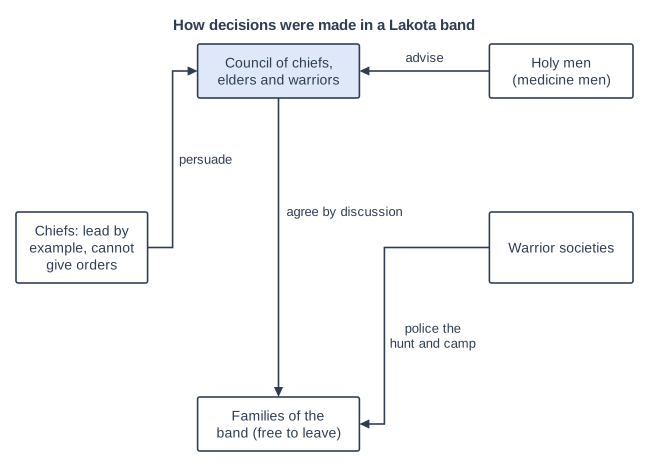
Study Figure 1, which shows how decisions were made in a Lakota band.

Which of the following was the more important cause of misunderstanding between white Americans and the Plains Indians in the mid-19th century:
• different beliefs about the ownership of land
• different ways of making decisions and agreements?

Explain your answer with reference to both bullet points.

How decisions were made in a Lakota band. Block diagram with five parts in five rows. Top row, left to right: a box "Council of chiefs, elders and warriors" (shaded) and a box "Holy men (medicine men)". Third row, left to right: a box "Chiefs: lead by example, cannot give orders" and a box "Warrior societies". Bottom row: a box "Families of the band (free to leave)". Connections: an arrow from "Holy men (medicine men)" to "Council of chiefs, elders and warriors", labelled "advise"; an arrow from "Chiefs: lead by example, cannot give orders" to "Council of chiefs, elders and warriors", labelled "persuade"; an arrow from "Council of chiefs, elders and warriors" to "Families of the band (free to leave)", labelled "agree by discussion"; an arrow from "Warrior societies" to "Families of the band (free to leave)", labelled "police the hunt and camp".

Model answer

Different beliefs about the ownership of land caused serious misunderstanding. The Plains Indians believed the land was sacred, 'Mother Earth', and shared by all living things, so it could not be owned, bought or sold, and hunting grounds were used in common. White Americans believed that land should be owned, fenced and farmed, and that land which was not farmed was being wasted. Many therefore saw the Plains Indians as savages who did not deserve the land. When Plains peoples agreed to treaties, they may have believed they were allowing others to use or cross their land, not giving it up for ever. The Fort Laramie Treaty of 1851 drew boundaries for each people's territory, an idea that made little sense to nomadic hunters who followed the buffalo.

Different ways of making decisions also caused misunderstanding. As Figure 1 shows, Lakota chiefs led by example and could not give orders; councils of chiefs, elders and warriors decided by discussion until all agreed, and families who disagreed could leave. Warrior societies and young men could act on their own. White Americans assumed that chiefs were rulers who could sign an agreement for a whole people. In 1851 the government chose Conquering Bear as 'head chief' of the Lakota, a position that did not exist. When young men who had not agreed to a treaty carried out raids, white Americans saw this as treaty-breaking. In 1854 Conquering Bear could not simply hand over a Lakota man the army wanted, which led to the Grattan incident and his death.

Overall, different beliefs about land were the more important cause. Land was what white Americans wanted and what the Plains Indians needed to survive, so it lay behind every treaty and every conflict. Differences in decision-making made the misunderstanding worse, because agreements about land signed by a few chiefs were not accepted by everyone, but those agreements only mattered because the two sides had such different ideas about what land was and who could own it.

Explanation

Land (sacred and shared against private property and farming) and decision-making (chiefs who persuaded, consensus, independent warriors against the white belief that chiefs could sign for everyone, e.g. Conquering Bear in 1851) both caused misunderstanding. Level 4 explains both and sustains a judgement, often by showing how they combined in treaties.

Mark scheme
  1. 12 marks

    Levels of response (12 marks).
    Level 4 (10-12 marks): Complex explanation of both bullet points, each supported by specific and accurate knowledge (e.g. sacred, shared land against private property and farming, and what each side thought a treaty about land meant; chiefs who could not command, decisions by agreement and independent warrior societies against the white assumption that chiefs could sign for a whole people, such as the government's choice of a 'head chief' for the Lakota in 1851), leading to a sustained judgement about which was more important.
    Level 3 (7-9 marks): Developed explanation of both bullet points, with relevant knowledge; any judgement is not sustained.
    Level 2 (4-6 marks): Simple explanation of one or both bullet points (an answer that explains only one bullet point cannot go above Level 2).
    Level 1 (1-3 marks): Basic explanation of one or both bullet points, with general or descriptive knowledge.
    0 marks: nothing worthy of credit.

    Indicative content (not a checklist; credit other valid points): Land: the Plains Indians believed land was sacred ('Mother Earth') and shared by all living things, so it could not be owned, bought or sold; hunting grounds were used in common; white Americans believed land should be owned, fenced and farmed, and that unfarmed land was wasted; many saw the Plains Indians as 'savages' for not using the land; when Plains peoples agreed to treaties they may have thought they were allowing others to use or pass through land, not giving it up for ever; the Fort Laramie Treaty of 1851 drew boundaries for each people's territory, an idea foreign to nomadic hunters; later land disputes (e.g. over the Black Hills) grew from this. Decisions and agreements: chiefs led by persuasion and could not give orders; councils decided by agreement; families and bands that disagreed could leave; warrior societies and young men could act independently; white Americans assumed chiefs were rulers who could sign treaties binding a whole nation - in 1851 the government chose Conquering Bear as 'head chief' of the Lakota, a position that did not exist in Lakota society; when young men raided after a treaty, whites saw treaty-breaking; treaties were written in English and translated, often poorly. Links: misunderstandings over decision-making meant land agreements were not accepted by all; both shaped conflicts such as the Grattan incident of 1854, in which Conquering Bear could not simply hand over the man the army wanted. Possible judgements: land was more important because it was the fundamental issue behind expansion and every treaty; or decision-making was more important because it made it impossible for agreements about land to work.

Ready to try the rest? Every answer you write is marked against the mark scheme, so you can see exactly where the marks are.

AI Tutor Hints first, answers after you try

Hi! Stuck? Ask me for a hint and I’ll help you work it out. Once you’ve checked your answer I can explain exactly where the marks are.